All posts by John Hughes

Reason for Transmigrating the Six Realms

The reason why those who had received the seed of Buddhahood in the eternal past have been transmigrating the six realms (lower states of existence) ever since for as long as “500 dust-particle kalpa” without attaining Buddhahood, and those who had heard the Lotus Sūtra at the time of the Great Universal Wisdom Buddha have been undergoing transmigration in the six realms ever since for the “3,000 dust-particle kalpa” was because they abandoned the great teaching of the Lotus, seeking refuge instead in expedient and Hinayāna sūtras preached forty years or so before the Lotus Sūtra. Later they gave up faith in those expedient sūtras, too, and thus have continued to transmigrate through the six realms.

Shugo Kokka-ron, Treatise on Protecting the Nation, Writings of Nichiren Shōnin, Doctrine 1, Page 42

Daily Dharma – Jan. 31, 2020

Bhikṣus! It is a very long time since that Buddha passed away. Suppose someone smashed all the earth-particles of one thousand million Sumeru-worlds into ink-powder. Then he went to the east[, carrying the ink-powder with him]. He inked a dot as large as a particle of dust [with that ink-powder] on the world at a distance of one thousand worlds from his world. Then he went again and repeated the inking of a dot on the world at every distance of one thousand worlds until the ink-powder was exhausted. What do you think of this? Do you think that any mathematician or any disciple of a mathematician could count the number of the worlds [he went through]?

The Buddha gives this explanation in Chapter Seven of the Lotus Sūtra. Our concept of time can be limited to what happens in the brief existence we enjoy in this world. We often feel we have no time for what is necessary, much less what we enjoy. With this limited viewpoint, we can find it hard to believe that we have enough time to become enlightened. The Buddha reminds us that there is no shortage of time, and that in all of our existence, we will have opportunities to increase our capacity to benefit others.

The Daily Dharma is produced by the Lexington Nichiren Buddhist Community. To subscribe to the daily emails, visit zenzaizenzai.com

Day 20

Day 20 completes Chapter 15, The Appearance of Bodhisattvas from Underground, and concludes the Fifth Volume of the Sutra of the Lotus Flower of the Wonderful Dharma.

Having last month heard Śākyamuni tell Maitreya that he is the one who taught these Bodhisattvas, we hear
the World-Honored One repeat to Maitreya in gāthās:

Thereupon the World-Honored One, wishing to repeat what he had said, sang in gāthās:

Ajita, know this, these great Bodhisattvas
Have studied and practiced
The wisdom of the Buddha
For the past innumerable kalpas.

They are my sons because I taught them
And caused them to aspire for great enlightenment.
They have been living in this world
[For the past innumerable kalpas].

They always practiced the dhuta.
They wished to live in a quiet place.
They kept away from bustling crowds.
They did not wish to talk much.

These sons of mine studied my teachings
Strenuously day and night
In order to attain
The enlightenment of the Buddha.
They lived in the sky
Below this Sahā-World.

Resolute in mind,
They always sought wisdom,
And expounded
Various wonderful teachings without fear.

I once sat under the Bodhi-tree
In the City of Gaya,
Attained perfect enlightenment,
And turned the wheel of the unsurpassed Dharma.

Then I taught them,
And caused them to aspire £or enlightenment.
Now they do not falter [in seeking enlightenment].
They will be able to become Buddhas.

My words are true.
Believe me with all your hearts!
I have been teaching them
Since the remotest past.

See The Divine Power to Save the People in the Sahā World

The Divine Power to Save the People in the Sahā World

That these bodhisattvas [from Underground] did not originally dwell in the earth but that they, who were in the infinite space below the sahā-world, came out of the earth and rose into the sky has a deep meaning. These bodhisattvas were people who had been freed from illusion in their previous lives by means of the Buddha’s teachings. For this reason, they had been dwelling in infinite space. But hearing the Buddha declare that he would entrust the instruction of the sahā-world to them, they entered into the earth, namely, this sahā-world, experiencing suffering there, and practiced religious disciplines so zealously as to attain the mental state of bodhisattvas. Therefore, they rose into the sky again after coming out of the earth. Though the bodhisattvas had been free from illusion in their previous lives, they voluntarily passed through various sufferings and worries in sahā-world for the purpose of saving the people here, endeavored earnestly to become enlightened, and preached the teaching to others. As mentioned before, this is a very important process; without completing such an endeavor, they could not truly acquire the divine power to save the people in the sahā-world.

Buddhism for Today, p179

The Great Instruction

With the audience having been enumerated [in Chapter 1, Introductory], the Buddha then teaches a Mahāyāna sūtra identified in Sanskrit as Mahānirdeśa. However, nothing of the content of that teaching is provided, and mahānirdeśa is a generic term that simply means “great instruction.” Kumārajīva’s Chinese translation, however, renders this as “a Mahāyāna sūtra named Immeasurable Meanings,” and by the fifth century, a text purporting to be this very sutra was circulating in China, also with the name Sūtra of Immeasurable Meanings (Ch. Wuliang yi jing), said to have been translated by a monk named Dharmāgatayaśas. No Sanskrit original, or reference to the Sanskrit original, has been located, nor are any other translations attributed to Dharmāgatayaśas, leading scholars to consider the text to be a Chinese apocryphon, a work composed in China that purports to be not only of Indian origin but spoken by the Buddha himself. It achieved canonical status in China, where it is regarded as the first of three sūtras comprising the so-called threefold Lotus Sūtra. The text itself is short, not quite thirty pages in English translation, and has only three chapters. The first describes the bodhisattvas present in the assembly and reports their lengthy praise of the Buddha. In the second, the Buddha praises the importance of the Sūtra of Immeasurable Meanings and then gives the actual teaching, which is that, although buddhas teach immeasurable meanings, they all originate from a single dharma, which is without form. Also in the chapter the Buddha says, “For more than forty years I have expounded the dharma in all manner of ways through adeptness in skillful means, but the core truth has still not been revealed.” East Asian commentators would find great meaning in this statement, for it serves to position the Lotus Sūtra as the Buddha’s final teaching. The third and longest chapter is devoted to ten benefits accruing to those who hear one verse of this sūtra or keep, read, recite, and copy the sūtra.

Two Buddhas, p39-40

Holding on to Unwavering Faith

Not only I, Nichiren, but also my disciples will reach the land of Buddha unfailingly so long as we all hold on to unwavering faith no matter what difficulty confronts us. I have always told my disciples not to have a doubt about the lack of heavenly protection and not to lament the lack of tranquility in this world. I am afraid, however, that they might all have doubts about these and no longer listen to me. It seems only natural that ordinary people, in face of reality, will forget what they promised. Having pity on their families, my lay followers must lament being separated from wives and children in this world. However, had they ever been truly separated from their beloved families throughout many lives in the past? Had they ever been separated for the sake of Buddhism? Theirs must have been the same sad separation. I, Nichiren, should continue upholding the Lotus Sūtra and go to the Pure Land of Mt. Sacred Eagle, so that I will be able to return to this world to guide the people.

Kaimoku-shō, Open Your Eyes to the Lotus Teaching, Writings of Nichiren Shōnin, Doctrine 2, Page 109

Daily Dharma – Jan. 30, 2020

World-Honored One! The bhikṣus, bhikṣunīs, upāsakās or upāsikās who seek, keep, read, recite and copy this Sūtra of the Lotus Flower of the Wonderful Dharma in the defiled world in the later five hundred years after [your extinction], if they wish to study and practice this sūtra, should concentrate their minds [on study and practice] strenuously for three weeks. When they complete [the study and practice of] three weeks, I will mount a white elephant with six tusks, and appear before them with my body which all living beings wish to see, together with innumerable Bodhisattvas surrounding me.

Universal-Sage Bodhisattva (Fugen, Samantabhadra) makes this declaration to the Buddha in Chapter Twenty-Eight of the Lotus Sūtra. Nichiren interprets “the later five hundred years” as the time in which we live today. Universal sage describes the ways in which we can practice this Sūtra. To seek it is to find it in all aspects of our lives. To keep it is to rely on its teachings and have confidence in its ability to lead us to the Buddha’s wisdom. To read and recite it is to continue to remind ourselves and others of the details of the teachings. To copy it is to make it available to others. The merits we gain through these practices allow us to see the world for what it is and be part of making it better for everyone.

The Daily Dharma is produced by the Lexington Nichiren Buddhist Community. To subscribe to the daily emails, visit zenzaizenzai.com

Day 19

Day 19 concludes Chapter 14, Peaceful Practices, and begins Chapter 15, The Appearance of Bodhisattvas from Underground.

Having last month concluded today’s portion of Chapter 14, Peaceful Practices, we consider the question poised by the Bodhisattva-mahāsattvas, more than eight times the number of the sands of the River Ganges, who had come from the other worlds.

Thereupon the Bodhisattva-mahāsattvas, more than eight times the number of the sands of the River Ganges, who had come from the other worlds, rose from among the great multitude, joined their hands together towards the Buddha, bowed to him, and said:

“World-Honored One! If you permit us to protect, keep, read, recite and copy this sūtra, and make offerings to it strenuously in this Sahā-World after your-extinction, we will [do so, and] expound it in this world.”

Thereupon the Buddha said to those Bodhisattva-mahāsattvas:

“No, good men! I do not want you to protect or keep this sūtra because there are Bodhisattva-mahāsattvas sixty thousand times as many as the sands of the River Ganges in this Sahā-World. They are each accompanied by attendants also numbering sixty thousand times as many as the sands of the River Ganges. They will protect, keep, read, recite and expound this sūtra after my extinction.”

See Through Our Own Efforts

Through Our Own Efforts

The bodhisattvas who sprang up out of the earth signify people who have had much suffering and worry during their lives, have accumulated virtues in such an unfavorable environment, and have attained enlightenment while leading ordinary lives. Such people, who have themselves experienced and weathered much suffering and worry, possess real power. They indeed have the power to instruct other people.

That the Buddha entrusted the sahā-world to the bodhisattvas who emerged from the earth teaches us that the world in which we live should be purified and made peaceful through our own efforts as dwellers in the world, and that we should realize happiness in our lives through our own efforts. We are responsible for creating the Pure Land where we live. We should bring about our happiness through our own efforts. What a reassuring and positive teaching this is!

Buddhism for Today, p177

An Introduction to Open Your Eyes

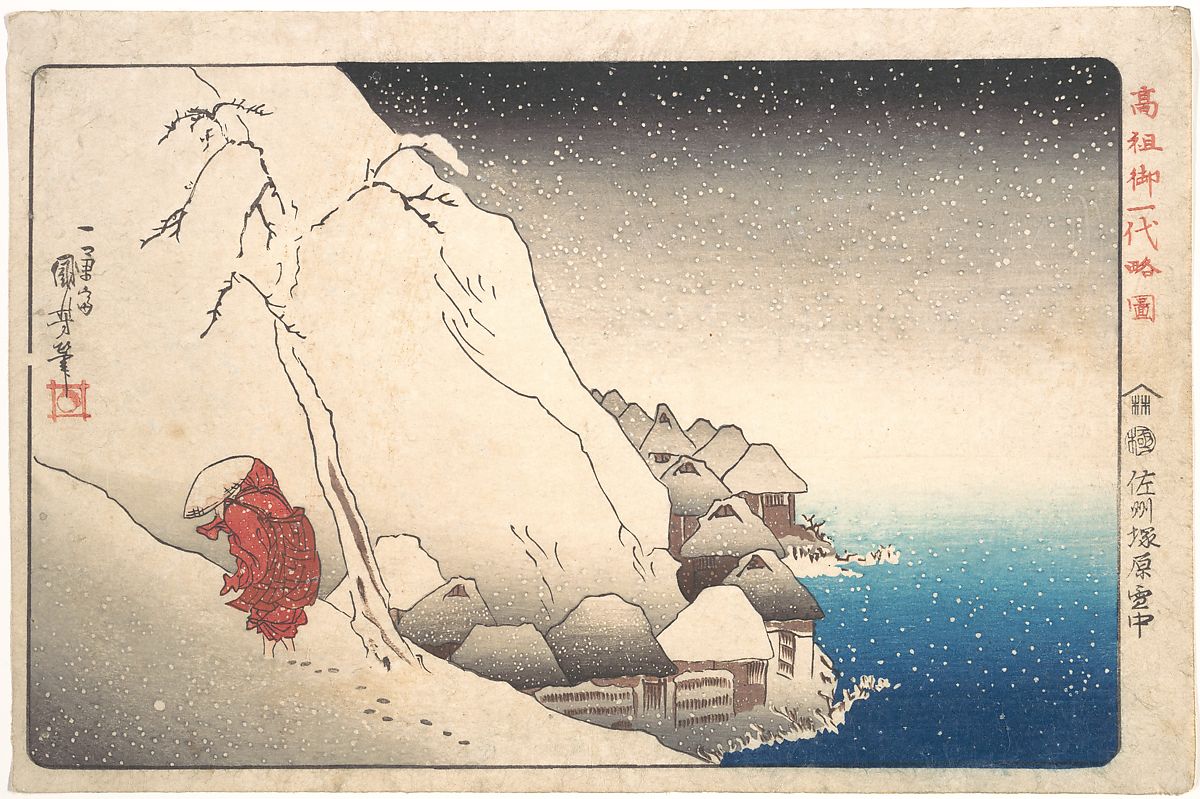
Nichiren arriving at Sado exile.

Introduction from Open Your Eyes: A Nichiren Buddhist View of Awakening.


On September 12, 1271, Nichiren Shōnin was arrested and taken to the execution grounds on Tatsunokuchi beach. He was saved from death when a mysterious ball of light that flew through the sky frightened the executioner and the other samurai. A messenger from the regent arrived soon after with orders that Nichiren Shōnin was not to be executed in any case but exiled instead. On October 10, 1271, Nichiren Shōnin was sent into exile on Sado Island. At first, he lived in a small broken-down shrine in a graveyard called Tsukuhara. It was the hope of his enemies that Nichiren Shōnin would die in the harsh winter of Sado Island without any adequate shelter or provisions.

Many of Nichiren Shōnin’s followers, like Nisshin and Nichirō had also been arrested and imprisoned. They wondered why they had not been protected from such persecution, so in order to resolve these doubts Nichiren Shōnin wrote the Open Your Eyes to the Lotus Teaching (Kaimoku-shō) in February 1272 and addressed it to Shijō Kingo, a samurai in Kamakura who was a staunch follower of Nichiren. Shockingly, Nichiren Shōnin wrote that he had been beheaded at Tatsunokuchi and it was his spirit that had come to Sado Island. This reflects Nichiren Shōnin’s feelings that in a sense he had given up his life at the execution ground and had now begun a new life. At the same time, he was aware that he could still literally die in the harsh conditions of winter on Sado Island or that he might once again face execution. So he stated that the Kaimoku-shō was intended to be a memento and an expression of his true will if it should come to that. Throughout the work, Nichiren Shōnin states that the most important question is whether or not he really has been acting as the practitioner of the Lotus Sūtra; and, if so, why he and his followers have not received the blessings and protections of the buddhas, bodhisattvas and other divine protectors of the Dharma.

In the course of the Kaimoku-shō Nichiren Shōnin shows through a series of comparisons that only the teaching of the Lotus Sūtra can enable all people to attain buddhahood. He also shows that the Lotus Sūtra itself predicted that anyone propagating it in the Latter Age of the Dharma would be bound to encounter the kinds of hardships that Nichiren Shōnin and his disciples had already faced and would continue to face. Nichiren also discerned that of all the teachers in Japan at that time, he was the only one who was directing people to the Lotus Sūtra instead of away from it. Having reflected upon these things, Nichiren Shōnin states his determination in the form of a threefold vow to continue upholding the Lotus Sūtra for the sake of Japan, no matter what hardships he might have to face:

“…no matter how many great difficulties fall upon me, I will not submit to them until a man of wisdom defeats me by reason. Other difficulties are like dust in the wind. I will never break my vow to become the pillar of Japan, to become the eyes of Japan, and become a great vessel for Japan.” (Hori 2002, p. 106; see also Murano 2000, p. 114; Gosho Translation Committee 1999, pp. 280-281)

The Kaimoku-shō is one of the five major writings of Nichiren Shōnin. In it, Nichiren Shōnin reflects upon the course of his life and the nature of the hardships and persecutions that had beset him. In this work, Nichiren Shōnin clarifies his mission and renews his determination to work selflessly, even at the cost of his life, for the sake of Japan and by extension all sentient beings whose only salvation is in the universal promise of Buddhahood conveyed by the Lotus Sūtra.

Open Your Eyes, p8-9