
All posts by John Hughes

Open Your Eyes

A Nichiren Buddhist View of Awakening
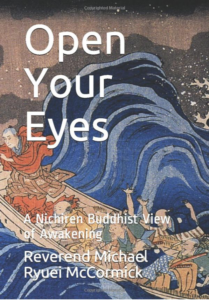
Finally completed Rev. Ryuei McCormick’s Open Your Eyes: A Nichiren Buddhist View of Awakening. This is a compilation of a series of blog posts McCormick originally posted on his Fraught With Peril website.

I heartily endorse Mark Herrick’s assessment of this work:

This book is a thoroughly researched and well sourced reference combining a historical look at the spread of Buddhism and illuminating Nichiren’s thinking within its context of medieval Japanese culture. It carefully explains why Nichiren expressed criticism of other Buddhist schools and his overarching motivation to ease the suffering of people in this world by returning emphasis to Śākyamuni Buddha’s message that everyone regardless of gender, status, or circumstance can become a buddha in this very lifetime.

Open Your Eyes, p6

The physical book is huge. Literally. It measures 7 inches by 10 inches and 600 pages. (By comparison, Murano’s Lotus Sutra is 5 7/8 by 8 1/4 and 427 pages.) But it is not difficult to read. The text is broken up into 46 chapters, with an average length of 12 or so pages per chapter. I recommend a chapter-a-night regimen.

At the conclusion of the book, McCormick offers an excellent explanation of why you should bother reading his book. Given the length of the book, moving this message up front may encourage more people to pick it up and consider what it has to say:

Many people today, I think, are very casual about being either nominally religious, or vaguely spiritual, or openly disdainful of religious teachings and spiritual practice. Those who do investigate and take up Buddhism and Buddhist practice all too often are satisfied with the small rewards of worldly benefits like peace of mind gained through silent sitting practices, or perhaps good fortune in their relationships or careers because they believe Buddhism can give them some kind of metaphysical control over their lives through ritual practices. I would not deny that sitting meditation or chanting can bring about peace of mind or help people gain the insight to refrain from bad and instead make good causes to help them make the most of life in a worldly sense. Even Śākyamuni Buddha gave discourses to lay followers to help them live wisely and thereby enjoy relatively happy lives in a worldly sense. However, what Nichiren is inviting us to do in Kaimoku-shō is to reflect more deeply about religious teachings including Buddhism and what they mean in terms of how we view life and our own role. Are we content to simply accept that this is the only life and that after death there is nothing at all? Or do we believe there may be some heavenly realm to hope for and that a virtuous life can lead us to it? Or do we wish to seek buddhahood — a life of selfless compassion that transcends small-minded concerns about personal happiness in this or some other lifetime? If we are really willing to engage the deepest teachings of Buddhism and try to realize and actualize them, what are we willing to put on the line? How much of ourselves are we willing to give? Are we only looking for protection and benefits? Or do we have the compassion and courage to give more and more of ourselves for the sake of all beings according to whatever the situation may demand? I cannot imagine that everyone will come to the same conclusions as Nichiren did, but I do think that if the Kaimoku-shō can inspire us to at least reflect on these questions, then it will have been well worth taking the time to read and ponder its message.

Open Your Eyes, p586-587

I’m also publishing the Introduction and I will be setting aside additional quotes in the future.

Earlier I published a lengthy excerpt in a blog post Understanding the 12-Linked Chain of Causation.


Book List

The Nature of Buddha Nature

The Hossō school represents an intriguing case, in that its doctrinal position offered a steadfast minority opposition, not only to the Tiantai/Tendai schema of the five periods, but also to the entire notion of buddhahood as a universal possibility. Hossō thought distinguishes two kinds of buddha nature: buddha nature as suchness or principle (J. ri busshō), which is universal, and active buddha nature (gyō busshō), which is not. Buddha nature as principle is quiescent and does not manifest itself in the phenomenal world; thus its universality does not mean that all beings can become buddhas. Achieving buddhahood depends on the presence of “untainted seeds” originally inherent in the ālaya or storehouse consciousness, the root consciousness underlying samsaric existence in which all deeds and impressions are stored as “seeds” or latent potentials, later fructifying in the form of experience. According to Hossō doctrine, individuals can be divided into “five natures” according to what sort of seeds they possess. Some have “active buddha nature,” that is, seeds that enable them to practice the bodhisattva way and become buddhas. Others have seeds that allow them to practice the path of the śrāvaka or the pratyekabuddha. These individuals can reach the nirvāṇa of the arhat, but they cannot become buddhas. Another group has a mixture of two or more of these three kinds of seeds: bodhisattva, śrāvaka, pratyekabuddha. Which kind of seed will develop is not predetermined; such persons are therefore said to be of “indeterminate nature.” Last, there are those who possess no untainted seeds and thus can never escape saṃsāra. They can, however, better their condition by accumulating merit through Buddhist practice.

Against the Lotus Sūtra’s claim that the three vehicles are the Buddha’s skillful means while the one vehicle is true, Hossō thinkers put forth this division of human capacity into five natures; they argued that the three vehicles of the śrāvaka, pratyekabuddha, and bodhisattva are true, while the one vehicle is a skillful method, designed by the Buddha to lead persons of the indeterminate group to follow the bodhisattva path and become buddhas, rather than taking the lesser path of the two vehicles. To support this argument, they invoked the Lotus Sūtra’s theme of “resuscitating” śrāvakas and restoring them to the bodhisattva path — as when the Buddha, in Chapter Three, reminds Śāriputra of his long-forgotten bodhisattva vow. Saichō, the Japanese Tendai founder, countered in part by drawing on Huayan (J. Kegon) thinkers to argue that suchness has not only a quiescent aspect as universal principle (fuhen shinnyo), but also a dynamic aspect that manifests itself as the concrete forms of the phenomenal world (zuien shinnyo). He also maintained that suchness has the nature of realizing and knowing. Thus, there was no need to postulate seeds in the store consciousness of only certain individuals as the cause of buddhahood. Saichō equated suchness in its dynamic aspect with active buddha nature, and because suchness is universal, everyone has the potential to realize buddhahood.

Two Buddhas, p94-95

The Kalpa of Decrease

The Kalpa of Decrease is a period of cosmic change in which the individual life span decreases from 80,000 years to ten and human beings degenerate. The cause of this decrease in life span and degeneration of human life lies in the mind of human beings. Namely, as the three evil passions of human beings — greed, anger, and ignorance — grow rampant, the life span of human beings gradually decreases, and their height is diminished.

Before the transmission of Buddhism to China and Japan, non-Buddhist teachings of the Three Emperors, Five Rulers, and Three Sages were used to educate the people and govern the country. As a result, human hearts hardened and virtue declined while evil flourished.

Chie Bōkoku Gosho, Evil Wisdom Destroying the Country, Volume 7, Followers II, Pages 84

Daily Dharma – Jan. 29, 2020

Anyone who keeps this sūtra in the evil world
In the age of the decline of my teachings
Should be considered
To have already made these offerings
.

The Buddha sings these verses to Maitreya Bodhisattva in Chapter Seventeen of the Lotus Sūtra. Given the trauma we have suffered in our previous existences, especially the calamity of death, it should be no surprise that our memories of those lives is dim at best. It can be enough to know that beneficial actions bring benefit and harmful actions bring harm, even if we do not know the specific causes of our condition. Our finding and practicing the Wonderful Dharma in this life is an indication of our great generosity in previous lives, and our capacity to continue practicing that same generosity.

The Daily Dharma is produced by the Lexington Nichiren Buddhist Community. To subscribe to the daily emails, visit zenzaizenzai.com

Day 18

Day 18 concludes Chapter 13, Encouragement for Keeping this Sutra, and begins Chapter 14, Peaceful Practices.

Having last month considered Mañjuśrī’s question, we consider the proper practices a Bodhisattva-mahāsattva should perform and the proper things a Bodhisattva-mahāsattva should approach.

“Mañjuśrī! What are the proper practices the Bodhisattva-mahāsattvas should perform? He should be patient, mild and meek. He should not be rash, timorous, or attached t anything. He should see things as they are. He should not be attached to his nonattachment to anything. Nor should he be attached to his seeing thing as they are. These are the proper practices the Bodhisattva-mahāsattvas should perform.

“What are the proper things the Bodhisattva-mahāsattvas should approach? He should not approach kings, princes, ministers or other government directors. He should not approach heretics, aspirants for the teaching of Brahman, Nirgraṇṭhas, writer of worldly literature, writers of non-Buddhist songs of praise, Lokāyatas or Anti-Lokāyatas. He should not approach players of dangerous sports such as boxers or wrestlers. He should not approach naṭas or other various amusement-makers. He should not approach caṇḍālas, boar-keepers, shepherds, poulterers, dog-keepers, hunters, fishermen, or other people who do evils for their livelihood. When they come to him, he should expound the Dharma to them, but should not wish [to receive anything from them]. He should not approach those who seek Śrāvakahood, be they bhikṣus, bhikṣunīs, upāsakās or upāsikās. He should not exchange greeting with them. He should not stay with them in the same monastery, promenade or lecture-hall. When they come to him, he should expound the Dharma to them according to their capacities, but should not wish [to receive anything from them]. Mañjuśrī! The Bodhisattva-mahāsattvas should not expound the Dharma to a woman with a desire for her. He should not wish to look at her. When he enters the house of others, he should not talk with a little girl, an unmarried woman or a widow. He should not approach or make friend with anyone of the five kinds of eunuchs. He should not enter the house of others alone. lf he must enter it alone for some rea on, he should think of the Buddha with all his heart. When he expounds the Dharma to a woman, he should not laugh with his teeth visible to her. He should not expose his breast to her. He should not be friendly with her even for the purpose of expounding the Dharma to her. Needless to say, he should not be so for other purposes. He should not wish to keep young disciples, śramaṇeras or children. He should not wish to have the same teacher with them.

See A Happy Life

A Happy Life

“A Happy Life” [the title of the Peaceful Practices chapter in the 1975 edition of the Threefold Lotus Sutra] means always to maintain a peaceful and happy mind and willingly to practice religious disciplines. So long as a person faces religious persecution with resentment, his mental attitude does not embody the ideal way of a true believer of the Lotus Sutra; whatever misfortune may befall him, he must maintain a peaceful and calm mind for the sake of the Law and must voluntarily practice religious discipline and preach the Law.

Buddhism for Today, p169

Five Periods of the Buddha’s Teaching

The “five periods” and other schemas of this kind represent remarkable achievements as efforts to systematize the Buddhist teachings into a coherent whole. However, text-critical scholarship has now made clear that they cannot be accepted as historically accurate. The Buddhist sūtras were compiled over a long period, and the Mahāyāna sūtras in particular were produced over several centuries, well after Śākyamuni’s passing. Nonetheless, it is vital to understand that for Nichiren and his Tendai forebears and contemporaries, the division of the teachings into “five periods” was, in fact, historical reality, a faithful account of how Śākyamuni Buddha had taught, and indeed, of how all buddhas proceed.

Two Buddhas, p93

Daily Dharma – Jan. 28, 2020

To enter the room of the Tathāgata means to have great compassion.
To wear his robe means to be gentle and patient.
To sit on his seat means to see the voidness of all things.
Expound the Dharma only after you do these [three] things!

The Buddha sings these verses in Chapter Ten of the Lotus Sūtra. Our compassion leads us to engage with the world and benefit others. Cultivating our gentle and patient nature lets us live the peace everyone wants and show them how to obtain it. To see the voidness of things does not mean acting as if they don’t exist. We presume that things that do not exist forever do not exist at all. A wisp of smoke. A fleeting smile. The Buddha teaches that there is nothing permanent and self-existing. Only what is interdependent and changing truly exists.Only that which is connected with everything else truly exists.Nothing hinders us. Nothing opposes us. When we see the harmony in our changing existence, then we see the Buddha Dharma.

The Daily Dharma is produced by the Lexington Nichiren Buddhist Community. To subscribe to the daily emails, visit zenzaizenzai.com

Day 17

Day 17 covers all of Chapter 12, Devadatta, and opens Chapter 13, Encouragement for Keeping this Sutra.

Having last month heard Accumulated-Wisdom Bodhisattva greet Mañjuśrī and Mañjuśrī tell of the skills of the dragon king’s daughter, we hear Accumulated-Wisdom Bodhisattva’s doubts and meet the dragon king’s daughter.

Accumulated-Wisdom Bodhisattva said:

“As far as I know, [when he was a Bodhisattva,] Śākyamuni Buddha sought Bodhi, that is, enlightenment incessantly for innumerable kalpas. He accumulated merits by practicing austerities. Even the smallest part, even the part as large as a poppy-seed of this world-this world being composed of one thousand million Sumeru-worlds-is not outside the places where the Bodhisattva made efforts to save all living beings at the cost of his life. It was after doing all this that he attained Bodhi, that is, enlightenment. I do not believe that this girl will be able to attain perfect enlightenment[, that is, to become a Buddha] in a moment.”

No sooner had he said this than the daughter of the dragon king came to [Śākyamuni] Buddha. She worshipped [his feet] with her head, retired, stood to one side, and praised him with gāthās:

You know the sins and merits
Of all living beings.
You illumine the worlds of the ten quarters.
Your wonderful, pure and sacred body
Is adorned with the thirty-two major marks
And with the eighty minor marks.

Gods and men are looking up at you.
Dragons also respect you.
None of the living beings
Sees you without adoration.

Only you know that I [am qualified to] attain Bodhi
Because I heard [the Dharma].
I will expound the teachings of the Great Vehicle
And save all living beings from suffering.

See The Modern Perspective on the Dragon King’s Daughter

The Modern Perspective on the Dragon King’s Daughter

Women of today may feel dissatisfied that the dragon’s daughter was suddenly transformed into a male and then became a buddha. Such an expression was used merely because of the idea of women in ancient India. The sudden transformation of a woman into a male means nothing but the transcendence of the difference between male and female. Sakyamuni Buddha asserted that animals, birds, worms, plants, and trees, as well as human beings, possess the buddha-nature. How could he then discriminate between men and women? It is impossible. Observed with the Buddha’s eyes, all living beings are equal. We must never misunderstand this.

Buddhism for Today, p159