
There are obviously many ways of reading the Lotus Sutra, including, I suppose, several legitimate ways, by which I mean ways reasonably consistent with or based upon the text itself. Without trying to argue for such an interpretation here, I will simply share with you that I see the text as being primarily soteriological. That is, I think its main purpose is not to teach Buddhist doctrines or refute other interpretations or forms of Buddhism, but to incline the reader’s heart, and especially behavior, in a certain way. There are, for example, numberless claims in the sutra to the effect that everyone, be they poor, not very bright, female, even evil, absolutely everyone without exception is destined to become a buddha. I take it that this is not just a proto-buddha-nature doctrine, though it is that, and not just a metaphysical assumption, though it does express an underlying metaphysics. What is intended primarily, I think, is that you and I understand that we can become Buddha-like because we have that capacity already within us simply by virtue of being alive. This capacity or potential is in everyone. It does not have to be earned and it cannot be taken away. But it does need to be developed.
A Buddhist Kaleidoscope; Gene Reeves, Appropriate Means as the Ethics of the Lotus Sutra, Page 384
All posts by John Hughes
Taking Opportunity of Illness to Become Devotee of Lotus Sūtra
Although your husband did not exhibit a strong faith in the Lotus Sūtra in this life, perhaps due to meritorious acts in his previous life, he is taking this opportunity of a long illness to become a devotee of the Lotus Sūtra and is trying to practice its teaching. I believe that the minor crimes committed by him may have already dissipated. Even the major evil of his slandering the True Dharma must have been eradicated due to his devotion to the Lotus Sūtra. Even if he should leave this world to go to the Pure Land of the Sacred Mountain right now, he would be as happy as if he were basking in the sunshine, and finally able to see clearly in all directions due to its light. He would rejoice over an early death.
Myōshin-ama Gozen Gohenji, A Response to My Lady, the Nun Myōshin Writings of Nichiren Shōnin, Volume 7, Followers II, Pages 103
Daily Dharma – Jan. 5, 2020
Needless to say, so will be the merits of the person
Who keeps this sūtra, gives alms, observes the precepts,
Practices patience, prefers dhyāna-concentrations,
And does not get angry or speak ill of others.
The Buddha sings these verses in Chapter Seventeen of the Lotus Sūtra. In this chapter, he explains that anyone who understands his ever-present existence, even for a moment, will gain the merit of ridding themselves of innumerable delusions. In his previous teachings on the perfections of a Bodhisattva, he showed that our practices of generosity, discipline, patience, enthusiastic perseverance, concentration and wisdom, all these will help us to see the world as it is. Realizing that the Buddha is always here teaching us helps us to look for him. But this realization does not obscure the necessity of putting his teachings into practice so that we may benefit all beings.
The Daily Dharma is produced by the Lexington Nichiren Buddhist Community. To subscribe to the daily emails, visit zenzaizenzai.com
Day 28
Day 28 covers all of Chapter 24, Wonderful-Voice Bodhisattva, and concludes the Seventh Volume of the Sutra of the Lotus Flower of the Wonderful Dharma.

Having last month learned of Wonderful-Voice Bodhisattva’s samadhi and the benefits of this chapter, we witness Wonderful-Voice Bodhisattva’s return trip to All-Pure-Light-Adornment world and conclude Chapter 24,
Thereupon Wonderful-Voice Bodhisattva-mahāsattva made offerings to Śākyamuni Buddha and to the stupa of Many-Treasures Buddha, [benefited the living beings of the Sahā World,] and left for his home world[, accompanied by the eighty-four thousand Bodhisattvas]. As they passed through the [one hundred and eight billion nayuta] worlds, the ground of those worlds quaked in the six ways; lotus-flowers of treasures rained down; and hundreds of thousands of billions of kinds of music were made. Having reached his home world, accompanied by the eighty-four thousand Bodhisattvas who surrounded him, he came to Pure-Flower-Star-King-Wisdom Buddha. He said to the Buddha:
“World-Honored One! I went to the Sahā-World and benefited the living beings there. I saw Śākyamuni Buddha and the stupa of Many-Treasures Buddha. I bowed and made offerings to them. I also saw Mañjuśrī Bodhisattva, the Son of the King of the Dharma. [I also saw] Medicine-King Bodhisattva, Endeavor-Power-Obtainer Bodhisattva, Brave-In-Giving Bodhisattva, and others. I also caused these eighty-four thousand Bodhisattvas to obtain the ability to practice the samadhi by which they could transform themselves
into any other living being.”When [Śākyamuni Buddha] expounded this chapter of the Coming and Going of Wonderful-Voice Bodhisattva, forty-two thousand gods obtained the truth of birthlessness, and Flower-Virtue Bodhisattva obtained the ability to practice the samadhi for the Lotus Flower of the Wonderful Dharma.
[Here ends] the Seventh Volume of the Sūtra of the Lotus Flower of the Wonderful Dharma.
See A Bodhisattva Who Watches Over the Lotus Sūtra’s Female Devotees
A Bodhisattva Who Watches Over the Lotus Sūtra’s Female Devotees
Two Buddhas, p239-240Gadgadasvara [Wonderful-Voice Bodhisattva] finds brief mention in a personal letter Nichiren wrote to a woman who had made offerings to each of the Lotus Sūtra’s twenty-eight chapters. “The ‘Gadgadasvara’ chapter,” he wrote to her, “tells of a bodhisattva called Gadgadasvara (“Fine Sound”) who dwells in the land of the buddha Kamaladalavimalanakṣastrarā jasaṃkusumitābhijn͂a (“Knowledge [Conferred by] the King of Constellations [Named] Pure Flower”) in the east. In the past, in the age of the buddha Jaladharagarjitaghoṣasusvaranakṣatrarājasamkusumitābhijn͂a (“Flowering Wisdom of the King of Constellations [Named] Thunder-Sound of Clouds”), he was Lady Vimaladattā (Pure Virtue), the consort of King Śubhavyūha (Fine Adornment). At that time, Lady Vimaladattā made offerings to the Lotus Sūtra and was reborn as the present bodhisattva Gadgadasvara. When the tathagata Śākyamuni expounded the Lotus Sūtra in the Sahā world, this bodhisattva arrived and promised to protect those women who would embrace the Lotus Sūtra in a latter age.”
Here Nichiren draws on the interpretive tradition that Gadgadasvara had in a past life been the consort of King Subhavyūha, who appears in Chapter 27 of the Lotus, to assert that this bodhisattva will watch over the sūtra’s female devotees.
Promoting Overall Spiritual Health
[M]ost people who feel no particular spiritual suffering assume they are in a sound state of psychological health. Many remain unaware of their true condition because they do not recognize the difference between spiritual health and spiritual illness. Without a reliable criterion, they consider the unhealthy to be sound and believe themselves free of mental suffering and in no need of help from religion. Even those who are relatively sound of spirit, like those in good physical shape, need to maintain and improve their health. They need to deepen their religious faith and discipline and cultivate themselves in order to preserve and improve the psychological health they enjoy. The teachings of the Four Noble Truths and the Eightfold Path are the foundation of a highly rational system that not only corrects spiritual disturbances but also promotes overall spiritual health and encourages its improvement.
Basic Buddhist Concepts
Lessons from the Story of Devadatta
The story of Devadatta is very instructive [in the discussion of Hōben]. Its message is that even our enemies, regardless of their intentions, can be bodhisattvas for us if we regard them as such. In this sutra, Devadatta, the embodiment of evil in so much Buddhist literature outside of the Lotus Sutra, is thanked by the Buddha for being helpful. “Thanks to my good friend Devadatta, I was able to develop fully the six pāramitās, with pity, compassion, joy, equanimity,” etc. The Buddha learned from his experiences with Devadatta, making Devadatta a bodhisattva, but we are not told that this was in any way a function of what Devadatta himself intended. Good intentions may be good in their own right, but they are not what is all important or even most important in a bodhisattva. What is more important is effectiveness, effectiveness in leading others to the Buddha-way, and thus to their salvation.
It is their “only” salvation because outside of the Buddha-way there is, and can be, no other way. If an act is salvific it is good, and if it is good it is bodhisattva practice, and if it is bodhisattva practice it is included in the Buddha-way. Whatever else it is, the Buddha-way is good and includes everything good, that is, everything that leads to salvation.
A Buddhist Kaleidoscope; Gene Reeves, Appropriate Means as the Ethics of the Lotus Sutra, Page 383
Understanding the 12-Linked Chain of Causation
In Nikkyō Niwano’s Buddhism for Today, he offers this explanation for the 12-linked chain of causation, one of the basic teachings of Sakyamuni Buddha.
Buddhism for Today, p101-102The Buddha preached the Law of the Twelve Causes in detail to Ānanda in the Dirghagānta-sūtra (Jō-agon-gyō). This law rules the growth of the human body as well as the changes in man’s mind. The former is called the “outer causation” (gai-engi) and the latter the “inner causation” (nai-engi). It explains the process through which a human being is born, grows, ages, and dies in light of the three temporal states of existence, the past, present, and future. And in connection with this, it shows how man’s mind changes and the fundamental method of purifying it and of removing illusions from it.
The twelve links or stages are (1) ignorance (mumyō), (2) actions (gyō), (3) consciousness (shiki), (4) name and form (mental functions and matter; myō-shiki), (5) the six entrances (the five sense organs and the mind; rokunyū), (6) contact (soku), (7) sensation (ju), (8) desire (ai), (9) clinging (shu), (10) existence (u), (11) birth (shō), and (12) old age and death (rō-shi).
First we will explain the growth and changes of the human body, the outer causation.
The first link of the Twelve Causes is ignorance. Prior to our conception by our parents, nothing is known or sensed. When the ignorant spirit is conceived in the mother’s womb through the action of sexual intercourse, consciousness is produced. Consciousness means “something living.” Here something like a human being – a fetus – is produced, although it is still incomplete. As the incomplete consciousness is gradually taking shape, it grows into name and form (mental functions and matter). “Name” means an immaterial being, spirit or soul, and “form” indicates a material being, that is, the human body. “Name and form” mean the human body with a soul.
As name and form (mind and body) grow, they develop the five sense organs (eyes, ears, nose, tongue, body) and the mind, by which we perceive the existence of things. At this time, we are still in the mother’s womb and incomplete. This stage is called the six entrances because the functions of our minds and bodies are on the point of dividing into six different senses.
We are born into this world at the stage of the six entrances. When we grow to the age of two or three, the six entrances are completed and sensibility is developed. That is, we become able to discern shapes, colors, sounds, smells, tastes, physical sensations, and so on. This stage is called contact.
When this sensibility is further developed, feelings of like and dislike naturally develop. This state is called sensation. These feelings become distinct at six or seven years of age. As this state develops, desire is produced. “Desire” implies many things, but here we limit its meaning to the human body and take it only as meaning affection for the opposite sex. As affection for the other sex becomes stronger, we come to have the desire of possessing the other. This is clinging. Later we enter into married life; this stage is existence. In the course of time children are born as a natural consequence of our marriage. This is birth. When we reach this stage, we are attacked in various ways by sufferings in their true sense. This stage continues through life, and finally we come to old age and death.
Clinical studies by modern doctors prove that during the nine months from the moment of conception to the birth of a human baby, the body, which was at first like an amoeba, passes through all the major evolutionary stages that occurred before reaching the form of man as he is today. In other words, even today’s evolved man is in a state like the amoeba of two billion years ago when he is conceived in his mother’s womb. When this fact is compared with the Law of the Twelve Causes taught by the Buddha, we cannot help admiring the fact that the Buddha preached exactly what the studies of twentieth-century scientists tell us.

This seemed really odd to me and I contacted Rev. Ryuei McCormick. I sent him a copy of the above graphic and asked him what he thought. He replied, “It is pretty much in line with the interpretation found in the Treasury of Abhidharma Treatise (Abhidharmakośa), which summarizes the baseline of Buddhist teachings in both East Asian and Tibetan Buddhism. By ‘baseline’ I mean what are assumed to be the basic teachings that everyone agrees on.”
For me, Niwano’s dualistic view of our existence as a “human body with a soul” is problematic. I am much more comfortable with the emptiness of dependent origination, the provisional existence we experience and the middle way that encompasses this non-dualistic reality. There is no soul that exists beyond the process of dependent origination.
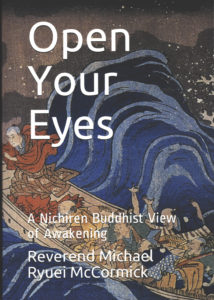 After completing Buddhism for Today I took up McCormick’s Open Your Eyes: A Nichiren Buddhist View of Awakening and read his explanation. Reading McCormick’s book is a lot like trying to slake your thirst with a firehose. There is just so much information and, in my case, most of it is probably wasted. Still, I feel there is a lode of information here that I will want to mine further.
Dependent origination, then, is the teaching that things do have a provisional (though not intrinsic) existence based on causes and conditions. Therefore, one who is following the Middle Way will think in terms of causes and conditions, and not existence or non-existence. For the follower of the Middle Way there are no immutable categories or boundaries, nor is there any question of absolute identity or absolute difference between entities. Dependent origination is the awareness of cause and effect and the interdependence of all things that gives rise to an authentic sense of responsibility, genuine love and compassion.
Dependent origination applies to all phenomena, but the Buddha was specifically concerned with applying it to the human predicament. He wished to show the specific causes and conditions that bind people to an existence of suffering, and through understanding those causes, how to change them. To this end, the Buddha expounded the twelve-fold chain of dependent origination.
“With ignorance as condition, volitional formations [come to be]; with volitional formations as condition, consciousness; with consciousness as condition, name-and-form; with name-and-form as condition, the six sense bases; with the six sense bases as condition, contact; with contact as condition, feeling; with feeling as condition, craving; with craving as condition, clinging; with clinging as condition, becoming; with becoming as condition, birth; with birth as condition, aging-and-death, sorrow, lamentation, pain, displeasure, and despair come to be. Such is the origin of this whole mass of suffering. This, monks, is called dependent origination. ” (Bodhi, Bhikkhu, trans. The Connected Discourses of the Buddha: A New Translation of the Samyutta Nikaya. Boston: Wisdom Publications, 2000, p. 353)
Admittedly, this formula may seem a little obscure. Nevertheless, it is the foundation upon which the Buddha’s teachings rest and so deserves careful study. Through the ages Buddhists have understood and taught the twelvefold chain in a variety of ways depending upon the social and historical context. The following explanation is based upon the Buddha’s expanded analysis of this formula from another discourse, and also the traditional understanding derived from the abhidharma, the phenomenological treatises written by the early Buddhist monks in India as a systematic explanation of the sūtras.
In the traditional understanding, ignorance and volitional formations refer to past causes inherited from one’s past life or lives. The cycle begins with ignorance of the true nature of reality. Specifically, the Buddha states that this link in the twelve-fold chain refers to ignorance of the four noble truths.
“And what, monks, is ignorance? Not knowing suffering, not knowing the origin of suffering, not knowing the cessation of suffering, not knowing the way leading to the cessation of suffering. This is called ignorance.” (Bodhi 2000, p. 535)
Due to ignorance, one is disposed to perform acts of thought, word and deed based upon the most selfish and short sighted of motives. These are the volitional formations.
“And what, monks, are the volitional formations? There are these three kinds of volitional formations: the bodily volitional formation, the verbal volitional formation, the mental volitional formation. These are called the volitional formations.” (Ibid, p. 535)
These actions are also called “karma” which is not destiny or fate, but intentional activity motivated by ignorance, and to the consequences of those actions upon the future life or lives of the one who performs them. Volitional formations are also a subset of the mental formations that are the fourth of the five aggregates that constitute human life. They are habit-patterns that condition both ourselves and our environment in accordance with the nature of our motivations.
The next five links of the chain spell out the consequences of past karma in terms of one’s present life. They are the present effects of past causes. The first link is consciousness, which is the same as the fifth of the five aggregates.
“And what, monks, is consciousness? There are these six classes of consciousness: eye-consciousness, ear-consciousness, nose-consciousness, tongue-consciousness, body-consciousness, mind-consciousness. This is called consciousness.” (Ibid, p. 535)
According to Buddhism, the kind of person we are in this life is not simply the result of heredity and environment but is the outcome of karma. In other words, the kind of person that we are now has been determined by our own choices and the habits or dispositions that we have built up over many previous lives. These predispositions give rise to and condition conscious experience of various kinds (consciousness of the external world and the internal awareness of thoughts and feelings). According to the abhidharma, the perpetuation of consciousness carries over from the expiration of one sentient being to the conception of a new sentient being. At some point, whether instantaneously or after an “intermediate existence” (depending on which version of abhidharma one gives credence to), consciousness finds itself drawn to the most appropriate womb and environment wherein it’s karmic inheritance can unfold. This transmigration of consciousness as a gandharva or “being to be reborn” is explained by the Buddha as follows:
“Monks, the conception of an embryo in a womb takes place through the union of three things. Here, there is the union of the mother and father, but it is not the mother’s season, and the being to be reborn is not present — in this case there is no conception of an embryo in a womb. Here, there is the union of the mother and father, and it is the mother’s season, but the being to be reborn is not present — in this case too there is no conception of an embryo in a womb. But when there is the union of the mother and father, and it is the mother’s season, and the being to be reborn is present, through the union of these three things the conception of an embryo in a womb takes place.” (Nanamoli, Bhikkhu and Bodhi, Bhikkhu, trans. The Middle Length Discourses of the Buddha: A New Translation of the Majjhima Nikaya. Boston: Wisdom Publications, 1995, p. 358)
Some might be misled into thinking that consciousness is a kind of self that transmigrates from one lifetime to another. This was the mistaken view of a monk named Sati, who believed that the same consciousness “runs and wanders through the round of rebirths.” (Ibid, p. 349) The Buddha admonished Sati and in no uncertain terms stated that consciousness is not a fixed entity that transmigrates but is itself something that arises in accordance with conditions. Consciousness is more of a recurring pattern, like a wave, than a thing. In another discourse, the Buddha even says that the mutability and impermanence of consciousness is even more drastic than that of the body, and therefore one would be better off identifying the body as a self.
“It would be better, monks, for the uninstructed worldling to take as self this body composed of the four great elements rather than the mind. For what reason? Because this body composed of the four great elements is seen standing for one year, for two years, for three, four, five, or ten years, for twenty, thirty, forty, or fifty years, for a hundred years, or even longer. But that which is called ‘mind’ or ‘mentality’ and ‘consciousness’ arises as one thing and ceases as another by day and by night. Just as a monkey roaming through the forest grabs hold of one branch, lets that go and grabs another, then lets that go and grabs still another, so too that which is called ‘mind’ and ‘mentality’ and ‘consciousness’ arises as one thing and ceases as another by day and by night.” (Bodhi 2000, p. 595)
Consciousness, then, is constantly changing to reflect the conditions that brought it about. As the Buddha explains to Sati, sometimes it is consciousness of something visual, or something auditory, or something tangible, or of some other sense. From moment to moment consciousness changes its focus and composition as often as a monkey jumping from branch to branch. Each moment of consciousness is therefore unique, dependent on conditions, impermanent, and not a candidate for any kind of permanent unchanging self.
Consciousness in turn gives rise to and is supported by the aggregates that make up name-and-form, the psychophysical personality.
“And what, monks, is name-and-form? Feeling, perception, volition, contact, attention: this is called name. The four great elements and the form derived from the four great elements: this is called form. Thus this name and this form are together called name-and-form.” (Ibid, p. 535)
Name-and-form in this case, encompasses four of the five aggregates — form, feeling, perception, and mental formations. “Name” is applied to feeling, perception, and mental formations as well as to contact and attention. These five always accompany consciousness as supportive functions that are involved in the recognition, or “naming,” of experience. “Form” is constituted by the four primary elements that are elsewhere listed as earth, air, fire, and water. These four elements do not simply refer to earth, air, fire, and water as we commonly relate to them. Rather, the four primary elements are emblematic of our experience of the physical world — solidity, movement, temperature, and cohesion respectively.
When dependent origination is explained within the boundaries of a single lifetime, then the links of name-and-form and consciousness are shown to be mutually conditioning. Instead of consciousness arising due to the ignorance and volitional formations attributed to a previous lifetime, consciousness is said to arise depending on name-and-form and to in turn give rise to name-and-form. In another discourse, Śāriputra explains this through the simile of two sheaves of reeds that are able to stand up by leaning up against one another, thus providing mutual support (Ibid, pp. 608-609).
Upon birth, the psychophysical personality begins to utilize the six sense bases consisting of sight, sound, touch, taste, smell and cognition.
“And what, monks, are the six sense bases? The eye base, the ear base, the nose base, the tongue base, the body base, the mind base. These are called the six sense bases.” (Ibid, p. 535)
These six senses bring one into contact with the world. They are sometimes called the six sense entrances because through them the world enters into our awareness. They are also referred to as the six roots because through them we are rooted in the world.
“And what, monks, is contact? These are the six classes of contact: eye-contact, ear-contact, nose-contact, tongue-contact, body-contact, mind-contact. This is called contact.” (Ibid, p. 535)
Contact naturally results in feelings based on that contact.
“And what, monks, is feeling? There are these six classes of feeling: feeling born of eye-contact, feeling born of ear-contact, feeling born of nose-contact, feeling born of tongue-contact, feeling born of body contact, feeling born of mind-contact. This is called feeling.” (Ibid, p. 535)
These feelings constitute the second of the five aggregates. Again, these last five links describe what one experiences in the present life; they are all givens that are the fruits of one’s own actions.
The next three links describe one’s present actions in relation to the circumstances that one experiences. They are the present causes that will have future effects. The first is the craving that arises based upon feeling.
“And what, monks, is craving? There are these six classes of craving: craving for forms, craving for sounds, craving for odors, craving for tastes, craving for tangibles, craving for mental objects. This is called craving.” (Ibid, p. 535)
One wishes to experience only pleasant feelings while avoiding the unpleasant at all costs. This craving leads to clinging to particular things, people, ideas and circumstances.
“And what, monks, is clinging? There are these four kinds of clinging: clinging to sensual pleasures, clinging to views, clinging to rules and vows, clinging to a doctrine of self. This is called clinging. ” (Ibid, p. 535)
This results in “becoming,” which is a way of summarizing the way in which we “become” hell-dwellers, hungry ghosts, animals, fighting demons, humans, and heavenly beings in the three realms. The three realms consist of the realms of desire (which takes in all existence from the hells up to the lower six heavens), form (the more refined heavens), and the formless (the most refined heavens). “Becoming’ refers to the constant struggle for identity and happiness that characterizes the day-to-day life of most people.
“And what, monks, is becoming? There are these three kinds of becoming: sense-realm becoming, form-realm becoming, formless-realm becoming. This is called becoming. (Ibid, p. 535)
The last two links of the chain explain the future effects of the present causes. In the Buddhist view, this constant struggle for a happy existence or even for a peaceful annihilation can never be achieved because life is characterized by the three marks of impermanence, suffering and non-self. One’s desperate strivings and unrequited desires can only lead to a future birth.
“And what, monks, is birth? The birth of the various beings into the various orders of beings, their being born, descent [into the womb], production, the manifestation of the aggregates, the obtaining of the sense bases. This is called birth.” (Ibid, p. 534)
Birth will then lead to another round of old age and death, grief, lamentation, suffering, dejection and despair.
“And what, monks, is aging-and-death? The aging of the various beings in the various orders of beings, their growing old, brokenness of teeth, grayness of hair, wrinkling of the skin, decline of vitality, degeneration of the faculties: this is called aging. The passing away of the various beings from the various orders of beings, their perishing, breakup, disappearance, mortality, death, completion of time, the breakup of the aggregates, the laying down of the carcass: this is called death. Thus this aging and this death are together called aging-and-death. ” (Ibid, p. 534)
In short, the twelve-fold chain of dependent origination shows that human life is the outcome of a vicious circle of desire, karma and suffering. The only escape is to abolish ignorance and recognize the vicious circle for what it is. Once the chain is broken, liberation is at hand.
“But with the remainderless fading away and cessation of ignorance comes cessation of volitional formations; with the cessation of volitional formations, cessation of consciousness; with the cessation of consciousness, cessation of name-and-form; with the cessation of name-and-form, cessation of the six sense bases; with the cessation of the six sense bases, cessation of contact; with the cessation of contact, cessation of feeling; with the cessation of feeling, cessation of craving; with the cessation of craving, cessation of clinging; with the cessation of clinging, cessation of becoming; with the cessation of becoming, cessation of birth; with the cessation of birth, cessation of aging-and-death, sorrow, lamentation, pain, displeasure, and despair cease. Such is the cessation of this whole mass of suffering.” (Ibid, p. 534)
Who has achieved liberation? As discussed earlier, the twelve-fold chain is not concerned with the preservation or eradication of an individual person or entity. It is concerned with the way in which suffering is perpetuated and the way in which the conditions that give rise to suffering can be unraveled. The important thing is that suffering has ended and liberation has been achieved.
There is another way of understanding the twelve-fold chain of dependent origination, however, that does not need to assume the literal existence of many lifetimes. It can be said that from moment-to-moment we are renewing ourselves and enacting the cycle of birth and death, with all the suffering that it entails. From this point of view, ignorance and volitional formations refer to our inability to accept the life process on its own terms. We desperately search for some form of stability and lasting happiness and refuse to acknowledge the dynamic flow and interrelations that is the true reality of our lives.
Due to this misguided activity, we fall out of sync with the true rhythm of life and end up feeling self-conscious and threatened. We never see reality itself because it is clouded over with our expectations, regrets, frustration and all other manner of projection. At this point, the psychophysical personality, name-and-form, is consolidated and immediately begins interpreting the world encountered through the senses in terms of self and other. The contact between this self and the world outside it from moment-to-moment gives rise to the feelings that constitute our self-referential experience of the world.
At this point we begin craving for what is pleasant and constantly strive to be in the situations we do want. In this way, every moment becomes a new experience of transitory pleasure and pain.
Birth, then, refers not to an actual rebirth, but to the birth of a new self-concept or identity based on what we are experiencing in that single moment. Thus, from moment-to-moment we have a new idea about who we are in relation to our environment. We see ourselves variously as competent, kind, gentle, harsh, admirable, pitiable, uncertain, loving, loved, hateful, hated, indifferent, fascinated and so on as each moment arises. However, no matter how comfortable we are with these ideas of ourselves, they will all fade away as the next moment comes and the cycle renews itself. This is the momentary meaning of aging and death.
Looked at in this way, the abolishing of ignorance means that we cease living life in terms of self-reference. By not projecting our desires and expectations onto reality or bifurcating it into self and other, the actions and self-consciousness that lead to so much suffering ceases. Free of the chain, life can take on entirely new qualities that are no longer characterized by ignorance, craving, grasping or the myriad forms of suffering. The moment-to-moment unfolding of the life process continues, but now it is free of our erroneous and fearful interpretations, such as the idea of birth and death. Dependent origination teaches that since all entities are actually phases and configurations of the continuous unfolding of causes and conditions, there are no clear-cut lines that can be drawn between self and other, birth and death. Without such self-oriented projections, dependent origination can be seen just as it is — a dynamically relational unfolding of reality wherein every part contains the whole and is embraced by the whole.
The Lotus Sūtra states that the Buddha taught the twelve-fold chain of dependent origination for the sake of the pratyekabuddhas. “To those who were seeking Pratyekabuddhahood, he expounded the teaching of the twelve causes, a teaching suitable for them.” (Murano 2012, p. 14) As with the four noble truths this would indicate that the twelve-fold chain of dependent origination is a Hinayāna teaching, but once again Zhiyi, taught that the twelve-fold chain of dependent origination could be understood on increasingly profounder levels up to and including the perspective of the Lotus Sūtra. Just as the voice-hearers and privately awakened ones enter into the One Vehicle that takes them to buddhahood, so do the teachings associated with them blossom into the teaching of the One Vehicle.
Open Your Eyes: A Nichiren Buddhist View of Awakening, Page 179-188
Saving the Ignorant, Evil, Women, and Icchantika
According to the three great works of T’ien-t’ai (Profound Meaning of the Lotus Sūtra, Words and Phrases of the Lotus Sūtra, and Great Concentration and Insight ) and Miao-lê’s annotations on them, the Lotus Sūtra is to save the ignorant, evil, and women, whom other sūtras are unable to save, as well as icchantika, who are eternally drowned in the sea of life and death. Yet, teachers of other sects, who do not know this aim of the Buddha, consider the Lotus Sūtra either equal to other sūtras, good only for much-practiced bodhisattvas above the ranks of shoji and shojū, or promising Buddhahood to the ignorant merely as a means of encouragement.
T’ien-t’ai and Miao-lê refuted these erroneous doctrines, declaring that those wandering in the six realms of illusions are exactly whom the Lotus Sūtra aims to address. They preached the two doctrines of shurui seed and sōtai seed, recognizing both merits and demerits of the past as the seed of Buddhahood. They also declared that those born into the realms of heavenly beings or human beings must have accumulated in the past the merit of keeping the five precepts or the ten virtuous acts enabling them to become Buddhas.
Shugo Kokka-ron, Treatise on Protecting the Nation, Writings of Nichiren Shōnin, Doctrine 1, Page 41
Daily Dharma – Jan. 4, 2020
I am saving all living beings from suffering.
I say that I pass away even though I shall not.
If they always see me,
They will become arrogant and licentious,
And cling to the five desires
So much that they will fall into the evil regions.
The Buddha sings these verses in Chapter Sixteen of the Lotus Sūtra. Sometimes we wonder why the Buddha’s presence in this world is not more obvious. We think if only we could find a living example of an enlightened being living among us then we would be happy and the world would be a better place to live. We forget that even during the Buddha’s lifetime, not everyone sought him out for his teaching, and some actively opposed him. In this explanation, the Buddha points out that our not seeing him is due to our limitations rather than his, and by not taking our lives and this world for granted, we open ourselves to his presence
The Daily Dharma is produced by the Lexington Nichiren Buddhist Community. To subscribe to the daily emails, visit zenzaizenzai.com