All posts by John Hughes

Daily Dharma – Jan. 2, 2020

Universal-Sage! Anyone who keeps, reads and recites this Sūtra of the Lotus Flower of the Wonderful Dharma, memorizes it correctly, studies it, practices it, and copies it, should be considered to see me, and hear this sūtra from my mouth. He should be considered to be making offerings to me. He should be considered to be praised by me with the word ‘Excellent!’

The Buddha makes this declaration to Universal-Sage Bodhisattva (Fugen, Samantabhadra) in Chapter Twenty-Eight of the Lotus Sutra. He reminds us that when we study and practice the Lotus Sūtra, we see not only the Buddha, but all beings who have vowed to protect and encourage us in our practice. It is often difficult to see these beings and appreciate what they are doing for us, much more so to hear the encouragement they offer us in this world of conflict. This is why we must continue to dedicate our lives to offer benefit and encouragement to all beings, so that we can embody the spirit of these protective deities.

The Daily Dharma is produced by the Lexington Nichiren Buddhist Community. To subscribe to the daily emails, visit zenzaizenzai.com

Day 25

Day 25 covers all of Chapter 20, Never-Despising Bodhisattva, and opens Chapter 21, The Supernatural Powers of the Tathāgatas.

Having last month learned who was Never-Despising Bodhisattva in the past, we repeat in gāthās and conclude Chapter 20, Never-Despising Bodhisattva.

Thereupon the World-Honored One, wishing to repeat what he had said, sang in gāthās:

There was once a Buddha,
Called Powerful-Voice-King.
His supernatural powers and wisdom
Were immeasurable.
Leading all living beings, he is honored
By gods, men and dragons with offerings.

Some time after the extinction of that Buddha,
His teachings had almost died out.
At that time there lived a Bodhisattva
Called Never-Despising.
The four kinds of devotees at that time
Were attached to views.

Never-Despising Bodhisattva
Went to them,
And said,
“I do not despise you
Because you will practice the Way
And become Buddhas.”

When they heard this,
They spoke ill of him and abused him.
But Never-Despising Bodhisattva
Endured all this.

Thus he expiated his sin.
When he was about to pass away,
He heard this sūtra,
And had his six sense-organs purified.
He prolonged his life
By his supernatural powers,
And expounded this sūtra
To many people.

Those who were attached to views
Were led into the Way
To the enlightenment of the Buddha
By this Bodhisattva.

Never-Despising [Bodhisattva] met
Innumerable Buddhas after the end of his life.
He expounded this sūtra,
And obtained innumerable merits,
He quickly attained the enlightenment of the Buddha
By these accumulated merits.

Never-Despising [Bodhisattva] at that time
Was myself.
The four kinds of devotees,
Who were attached to views at that time,
Were able to meet innumerable Buddhas
After they heard
The words of Never-Despising [Bodhisattva]:
“You will become Buddhas.”
They are now present here
In this congregation.

They are the five hundred Bodhisattvas
And the four kinds of devotees
Including men and women of pure faith,
Who are now hearing the Dharma from me.

In my previous existence
I encouraged them
To hear this sūtra,
That is, the most excellent Dharma.
In all my previous existences
I taught them the Way to Nirvana.
But really this is the sūtra
I taught them to keep.

This Sūtra of the Lotus Flower of the Wonderful Dharma
Can be heard only once
In hundreds of millions of billions of kalpas,
That is, in an inconceivable number of kalpas.

The Buddhas, the World-Honored Ones,
Expound this sūtra only once
In hundreds of millions of billions of kalpas,
That is, in an inconceivable number of kalpas.

Therefore, anyone who hears this sūtra
And practices the Way
After my extinction,
Should have no doubts about [this sūtra].

He should expound this sūtra with all his heart;
Then he will be able to meet Buddhas
Throughout all his existences,
And quickly attain the enlightenment of the Buddha.

See The Practice of Bowing to Others

The Practice of Bowing to Others

Chinese commentators … stressed the bodhisattva Sadāparibhūta’s attitude as a model for practice. Huisi, Zhiyi’s teacher, commented on this sūtra chapter as follows: “Looking upon each and every being as though it were a buddha, you should join your palms and venerate it as though paying reverence to the Lord [Buddha himself]. You should also regard each and every being as a great bodhisattva and good spiritual friend.” Fragmentary evidence suggests that East Asian Buddhists sometimes literally attempted to imitate the bodhisattva Sadāparibhūta’s practice of bowing to all. One example can be found in the “Three Stages” movement, founded by the Chinese master Xinxing (540-594) as a form of Buddhism suited to the degenerate Final Dharma age. Xinxing incorporated Sadāparibhūta’s practice of bowing into a set of interrelated practices combining the attitudes of universally venerating others and recognizing one’s own shortcomings. The practice of bowing to others was also sometimes conducted in Japan. The monk Shōnyo (781-867), to repay his debt to his parents, is said to have carried out Sadāparibhūta’s practice by bowing at the homes of more than 167,600 people. In aristocratic circles, this practice was carried out on the fourteenth day of the seventh month. Entries for that date in the diary of the poet and courtier Fujiwara no Teika (1162-1241) record that he himself performed this practice in the streets or had others do it on his behalf.

Two Buddhas, p208

A New Year

My wife has a theory that whatever you do on New Year’s Day will be your focus for the coming year. For example, she studiously avoids housework on this day. Instead, today she is making cookies. I spent way too much time configuring my new Pixel 4 phone, so to avoid technical dilemmas as my New Year focus I’ve fired up the laptop and I’m working on my blog as I listen to a Spotify channel called “Coffee Table Jazz.”

As can be surmised from the video above, I attended the New Year services at the Sacramento Nichiren Buddhist Church. Those are illegal fireworks being launched by residents of the nextdoor apartments. Don’t particularly care for driving at night and especially not after midnight on New Year’s Day, but I enjoy the year end and New Year services. We even had a stranger show up who lives in Tokyo but is visiting family in Sacramento. He heard about the service on our website. He said he routinely attends the midnight service in Tokyo.

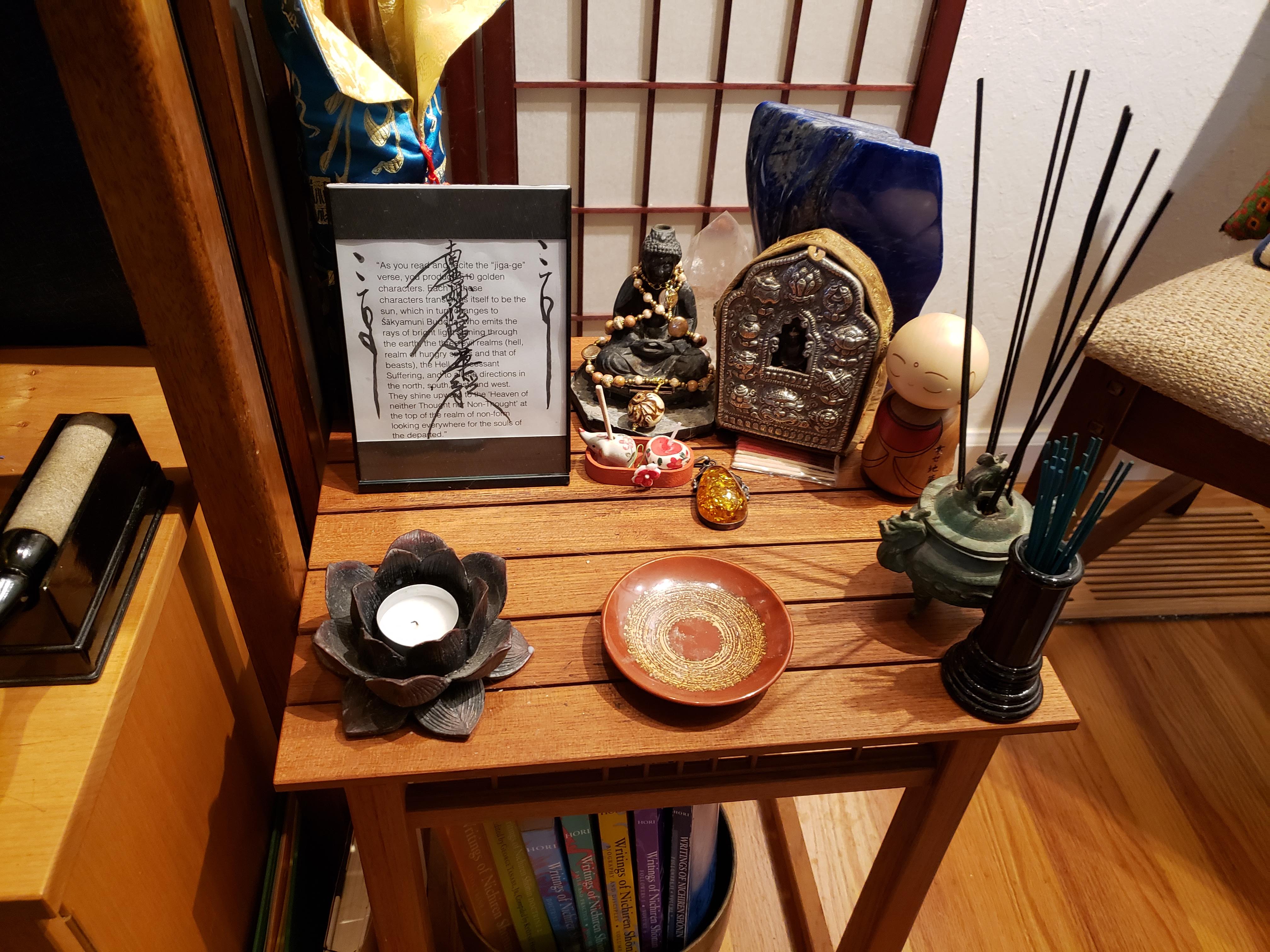
2020 New Year altar

Today I offered some mochi and a tangerine on my altar. I’ve done some reconfiguring since the last time I posted a photo. I now have water cups for Kishimojin (left) and Daikokuten (right) that I purchased from Gasshodo. (Didn’t realize they were different sizes when I ordered them.)

Gone is my side altar, which looked like this:

My Decorations
My Decorations

Instead I’ve moved all of those “decorations” to some new glass shelves that I installed in corner next to the altar.

corner arrangement

Back in July I explained my gods on the altar and my decorations. In addition to Jizo (who I misspelled Jizu in my original post), I have added a collection of Hotei Bodhisattva statues that my son collected as a child. The larger Hotei is a contribution from my wife. The gold plated pagoda next to the Ryusho Jeffus’ painting belonged to my wife’s parents. It is from Japan but I have no idea which Japanese pagoda it represents. And, as illustrated, I’ve made an altar for Ryusho Jeffus’ gohonzon that he and Rev. Kanjin Cederman created for Jeffus’ book designed for prison inmates. The cup is another Gasshodo purchase.

I should point out that the slab of lapis lazuli and the crystal represent the purified Buddha lands described in the Lotus Sutra.

Happy New Year!

The Definition of Hōben

What is wrong with “expedient”? Briefly, it is deeply rooted in an ethical frame of reference which is about as diametrically opposed to the ethical perspective of the Lotus Sutra as one can get. The Random House Unabridged Dictionary has as its second definition of “expedient. conducive to advantage or interest, as opposed to right.” Moreover, “expediency” is defined as “a regard for what is polite or advantageous rather than what is right or just; a sense of self-interest.” Though one could argue that this term does not have to carry such freight, the fact of the matter is that it is deeply embedded in a biblical ethics which is essentially deontological because it is rooted in notions of divine commandment and human obedience. In John 11:49-50, for example, we find:

And one of them, named Caiaphas, being the high priest that year, said to them, “You know nothing at all. Nor do you consider that it is expedient for us, that one man should die for the people, and not that the whole nation perish.

And in several places, in the King James version at least, Saint Paul uses the term “expedient” to mean “profitable” to oneself. The Bible, of course, had a major impact on what terms mean in English.

Thus, a very basic meaning of “expedient” is an act which is done in spite of principle in order to benefit oneself. It is rooted in an ethics and in a vision of reality in which there is a radical, unbridgeable gap between principles and self-interest. Though they may be internalized, principles are given, by God or Nature, or the metaphysical structure of reality. Principles are lawlike, and thus their disobedience requires just punishment. To do the expedient thing is to ignore or go against what is right in order to gain some selfish benefit.

But this is exactly what, according to the Lotus Sutra, hōben cannot be. It is part of the very definition of hōben in the Lotus Sutra that it is always for the benefit of someone else. Not in this sutra, or in any other that I know of, is there even a single example of hōben in which the doer forsakes some principle for his or her own benefit.
A Buddhist Kaleidoscope; Gene Reeves, Appropriate Means as the Ethics of the Lotus Sutra, Page 380

The Sin of Slandering a Practicer of the Lotus Sūtra

Suppose a man as evil as Devadatta slandered, physically beat and envied Śākyamuni Buddha, committing all three kinds of acts—physical, verbal, and mental—against the Buddha for as long as one medium kalpa (20 times the length of a kalpa). How serious is the sin committed by this man? This earth is 168,000 yojana in depth, and it supports all the water of the four great oceans, earth, and rocks of nine mountains, numerous trees and plants, and all creatures on top without dropping, tilting or breaking them. On the contrary, Devadatta’s body being five feet tall or so fell into hell breaking through the earth because he committed the Three Rebellious Sins. The hole he fell through still exists today in India. Tripiṭaka Master Hsüan-chuang writes in his Record of the Western Regions that he saw the hole of Devadatta in India while making a pilgrimage from China to India.

However, it is preached in the “Teacher of the Dharma” chapter of the Lotus Sūtra that the sin of slandering a practicer of the Lotus Sūtra in the Latter Age of Degeneration on a mere whim, without any trace of animosity or envy, is more serious than the sin of Devadatta committing the three kinds of acts—verbal, physical, and mental—against the Buddha for as long as a medium kalpa. How much more so then is the sin of people today who, like Devadatta commit the three kinds of evil acts (verbal, physical, and mental) against a practicer of the Lotus Sūtra, by speaking ill of him, censuring him, envying and physically beating him, and trying to kill him for many years!

Hōren-shō, Letter to Hōren, Writings of Nichiren Shōnin, Volume 6, Followers I, Page 44-45

Daily Dharma – Jan. 1, 2020

Tears keep falling when I think of the current unbearable hardships, but I cannot stop tears of joy when I think of obtaining Buddhahood in the future. Birds and insects chirp without shedding tears. I, Nichiren, do not cry, but tears keep falling. These tears are shed not for worldly matters, but solely for the sake of the Lotus Sutra. Therefore they should be called tears of nectar.

Nichiren wrote this as part of his letter to monk Sairen-bō in his Treatise on All Phenomena as Ultimate Reality (Shohō-Jissō Shō). For the sake of the Lotus Sūtra, Nichiren endured two harsh exiles, his house being burnt down, ambushes by soldiers with swords, being placed on the execution mat himself, and the persecution of his followers. Despite all these obstacles, he held true to the Buddha’s teaching in the face of all opposition. Most of us who practice the Lotus Sūtra today have lives of relative comfort. It is wonderful that we have Nichiren’s example. He was a human being just like us, and we too are capable of his faith and determination.

The Daily Dharma is produced by the Lexington Nichiren Buddhist Community. To subscribe to the daily emails, visit zenzaizenzai.com

Day 24

Day 24 concludes Chapter 19, The Merits of the Teacher of the Dharma, and closes the Sixth Volume of the Sutra of the Lotus Flower of the Wonderful Dharma.

Having last month considered the eight hundred merits of the nose in prose, we consider the eight hundred merits of the nose in gāthās.

Thereupon the World-Honored One, wishing to repeat what he had said, sang in gāthās:

Their nose will be purified.
They will be able to know
The smells of all things,
Be they good or bad.

They will be able to recognize by smell
The sumanas-flowers and jātika-flowers;
Tamala[pattra] and candana;
Aloes and sappanwood;
Various flowers and fruits;
And all Jiving beings including men and women.

Anyone who expounds the Dharma will be able to locate
All living beings from afar by smell.
He will be able to locate by smell
The wheel-turning-kings of great [countries],
The wheel-turning-kings of small [countries],
And their sons, ministers and attendants.

He will be able to locate by smell
The wonderful treasures of personal ornaments,
The underground stores of treasures,
And the ladies of the wheel-turning-kings.

He will be able to recognize persons
By smelling their ornaments or garments
Or by smelling their necklaces
Or by smelling the incense applied to their skin.

Anyone who keeps
This Sūtra of the Lotus Flower of the Wonderful Dharma
Will be able to know by smell
Whether the gods are walking, sitting, playing or performing wonders.

Anyone who keeps this sūtra
Will be able to locate by smell, without moving about,
The flowers and fruits of trees,
And the oil taken from sumanas-flowers.

He will be able to recognize by smell
The flowers of the candana-trees
Blooming in steep mountains,
And the living beings in those mountains.

Anyone who keeps this sūtra
Will be able to locate by smell
The living beings in the Surrounding Iron Mountains,
In the oceans, and underground.

He will be able to know by smell
Whether asuras and their daughters
And their attendants are fighting
Or playing with each other.

He will be able to locate by smell
Lions, elephants, tigers,
Wolves, wild oxen and buffalos
In the wilderness and in steep places.

He will be able to know by smell
Whether an unborn child is a boy or a girl,
Or a child of ambiguous sex,
Or the embryo of a nonhuman being.

He will be able to know by smell
Whether a woman is an expectant mother,
Or whether she will give an easy birth
To a happy child or not.

He will be able to know by smell
What a man or a woman is thinking of,
Or whether he or she is greedy, ignorant or angry,
Or whether he or she is doing good.

He will be able to recognize by smell
The gold, silver, and other treasures
Deposited underground,
And the things enclosed in a copper box.

He will be able to know by smell
The values of various necklaces,
And the deposits of their materials,
And also to locate the necklaces [when they are lost].

He will be able to recognize by smell
The mandārava-flowers,
And the mañjūṣaka-flowers,
And the pārijātaka-trees in heaven.

He will be able to know by smell
Whether a heavenly palace
Adorned with jeweled flowers
Is superior, mean or inferior.

He will be able to recognize by smell
Gardens, forests, excellent palaces,
And the wonderful hall of the Dharma in heaven,
And other stately buildings where [the gods] enjoy themselves.

He will be able to know by smell
Whether the gods are hearing the Dharma
Or satisfying their five desires,
Or coming, going, walking, sitting or reclining.

He will be able to know by smell
Whether the goddesses, clad in the garments
Adorned with fragrant flowers,
Are playing as they are moving about.

He will be able to know by smell
Who has reached the Heaven of Brahman,
Who has entered into dhyāna,
And who has come out of it.

He will be able to know by smell
The person who has appeared for the first time in the Light-Sound Heaven
Or in the Universal-Pure Heaven or in the Highest Heaven,
And who has disappeared from there.

Anyone who keeps this sūtra
Will be able to locate by smell
The bhikṣus who are sitting or walking about
In seeking the Dharma strenuously,
And the bhikṣus who are reading or reciting [this] sūtra
Or devoting themselves
To sitting in dhyāna
Under the trees of forests.

He will be able to know by smell
The Bodhisattvas who are resolute in mind,
And who are sitting in dhyāna or reading [this] sūtra
Or reciting it or expounding it to others.

He will be able to locate by smell
The World-Honored One who is expounding the Dharma
Out of his compassion
Towards all living beings who respect him.

He will be able to know by smell
Those who rejoice at hearing [this] sūtra
From the Buddha,
And act according to the Dharma.

Anyone who keeps this sūtra
Will be able to have these merits of the nose
Although he has not yet obtained the nose
Of the Bodhisattva [who attained] the
Dharma without āsravas.

See Realizing Buddhahood ‘Quickly’

Realizing Buddhahood ‘Quickly’

As we have seen, Zhiyi and other Chinese Tiantai thinkers drew on the Lotus Sūtra to integrate the disparate Buddhist teachings into a coherent whole and to explain how all phenomena, being empty of independent substance, interpenetrate and “contain” one another in an interrelated holistic cosmos. Saichō and later Japanese Tendai thinkers took these ideas in new directions. One was the claim that practicing the Lotus Sūtra enables one to realize buddhahood “quickly.” We find some basis for this in the Lotus itself, and the idea had already been proposed in the Chinese Tiantai tradition. Zhiyi’s teacher Huisi (515-577), for example, had written that Lotus practitioners awaken spontaneously and without proceeding through sequential stages of practice, and Zhiyi, as we have seen, saw the possibility of sudden and full awakening to the threefold truth in its entirety as what distinguished the “perfect teaching” from the “distinct teaching”: where bodhisattvas of the provisional Mahāyāna must practice for three incalculable eons to achieve full awakening, practitioners of the sudden and perfect teaching, exemplified by Lotus Sūtra, can do so directly. Saichō also understood the Lotus as the “great direct path” that enabled the realization of buddhahood in only two or three lifetimes, or in some cases, in this very lifetime.

Two Buddhas, p20

The Union of Suffering and Salvation

The maximum commitment to serving others, united to awareness of the limits of every action, represents the dynamic realization of the Middle Path. Each limited and concrete action can certainly redeem just a fragment of the world, but through the prayer/meditation also a fragment becomes totality (ichinen sanzen). In this way, liberation is not put off to a utopian future, and suffering is not related to an inevitable karma or to the logic of economics or power. To the eyes of the Buddha and in the hand and heart of the Sangha, we are bound together by warm links of solidarity and loving kindness.

In other words, Buddhist liberation consists of the union of suffering and salvation. Redemption is not obtained through a sacrifice offered to a divinity which, with its intervention, “mends” the world, destroying what we qualify as negative and as a source of suffering. Redemption is found in overcoming conflict and opposition, and in the creation of a more subtle harmony between order and disorder. This is a path that doesn’t involve nonsuffering, but the nonsuffering-of-suffering; a path which, we could say according to French writer Marguerite Yourcenar, if it doesn’t make us mad with joy, at least it makes us wise with pain.

That is why we can affirm that this world, full of misery and conflict, is, nonetheless, the tranquil realm of the Buddha.
A Buddhist Kaleidoscope; Riccardo Venturini, A Buddha Teaches Only Bodhisattvas, Page 336