All posts by John Hughes

Praying the Repose of Parents After Death

Your having deep faith is not for the sake of [pleasing] others, but for the sake of your late father. Other people will not pray for your deceased parents. You are their child, so you must pray for their repose after death.

Ueno-dono Gohenji, A Reply to Lord Ueno, Writings of Nichiren Shōnin, Faith and Practice, Volume 4, Page 113

Daily Dharma – Dec. 31, 2019

Ajita, look! The merits of the person who causes even a single man to go and hear the Dharma are so many. It is needless to speak of the merits of the person who hears [this sūtra] with all his heart, reads it, recites it, expounds it to the great multitude, and acts according to its teachings.

The Buddha gives this explanation to Maitreya, whom he calls Ajita (Invincible) in Chapter Eighteen of the Lotus Sutra. While earlier parts of the Sūtra describe the possible reactions those who teach the Buddha Dharma may find, the Buddha here reminds us that we do not need to wait until we are strong enough, wise enough, or even practiced enough to use it to benefit others. This sūtra contains the Buddha’s enlightenment itself. When we hear it, we hear the Buddha. When we expound it, it is the Buddha speaking through us.

The Daily Dharma is produced by the Lexington Nichiren Buddhist Community. To subscribe to the daily emails, visit zenzaizenzai.com

Day 23

Day 23 covers all of Chapter 18, The Merits of a Person Who Rejoices at Hearing This Sutra, and opens Chapter 19, The Merits of the Teacher of the Dharma.

Having last month considered the eight hundred merits of the eye, we consider the twelve hundred merits of the ear.

“Furthermore, Constant-Endeavor! The good men or women who keep, read, recite, expound or copy this sūtra, will be able to obtain twelve hundred merits of the ear. With their pure ears, they will be able to recognize all the various sounds and voices inside and outside the one thousand million Sumeru-worlds, [each of which is composed of the six regions] down to the Avici Hell and up to the Highest Heaven. They will be able to recognize the voices of elephants, horses and cows; the sounds of carts; cryings and sighings; the sounds of conch-shell horns, drums, gongs and bells; laughter and speech; the voices of men, women, boy and girls; meaningful voices, meaningless voices; painful voices, delightful voices; the voices of the unenlightened ones, the voices of the enlightened ones; joyful voices, joyless voices; the voices of gods, dragons, yakṣas, gandharvas, asuras, garuḍas, kiṃnaras and mahoragas; the sounds of fire, water and wind; the voices of hellish denizens, animals and hungry spirits; and the voices of bhikṣus, bhikṣunīs, Śrāvakas, Pratyekabuddhas, Bodhisattvas and Buddhas. In a word, with their pure and natural ears given by their parents, they will be able to recognize all the sounds and voices inside and outside the one thousand million Sumeru-worlds, although they have not yet obtained heavenly ears. Even when they recognize all these various sounds and voices, their organ of hearing will not be destroyed.”

See Chih-i’s Three-Fold Doctrine

Chih-i’s Three-Fold Doctrine

Zhiyi [Chih-i] drew on the Lotus Sūtra’s claim that the Buddha’s various teachings were all his “skillful means,” or teaching devices, preached in accordance with the capacity of different individuals but all ultimately united in the fundamental principle of the one vehicle.

What was that fundamental principle? Zhiyi described it as the “threefold truth,” or “threefold discernment,” of emptiness, conventional existence, and the middle. Discerning all phenomena as “empty,” lacking self-essence or independent existence, frees the practitioner from attachment to desires and intellectual constructs. It collapses all categories, hierarchies, and boundaries to reveal an absolute equality and nondifferentiation. This insight corresponds to the wisdom of persons of the two vehicles of the “Hinayāna,” those who seek the goal of nirvāṇa, stopping the wheel of birth and death, as well as the wisdom of novice bodhisattvas. However, from a Mahāyāna perspective, it is one-sided. Though empty of fixed substance, all things nonetheless exist conventionally in dependence upon causes and conditions. The discernment of “conventional existence” reestablishes discrete entities and conceptual distinctions as features of commonsense experience but without false essentializing or clinging; it frees the practitioner to act in the world without bondage to it. This corresponds to the wisdom of more advanced bodhisattvas. Finally, phenomena are neither one-sidedly empty nor conventionally existing but exhibit both aspects simultaneously: at each moment, every existent, without losing its individual character, permeates and contains all others. This insight, termed “the middle,” encompasses both poles of understanding – emptiness and conventional existence – without dissolving the tension between them. The bodhisattva path culminates in the simultaneous discernment of all three truths as integrated in one. Page 16-17

Taking Others’ Suffering on Oneself

Taking others’ suffering on oneself and purifying it without allowing oneself to be contaminated is the mission of the bodhisattva, who clears a world polluted by ignorance and selfishness. As Saichō, the founder of Japan’s Tendai sect, said, “To take evil upon oneself and to give good to others, and to forget about oneself and to work for the benefit of all, is the ultimate in compassion.”

Not discriminating between friends and enemies, tending not to have “personal” needs, appreciating all beings and all situations, bodhisattvas never pause in their constant, merciful practice (nondualism in action), always treat others as they would like to be treated, and are always ready to help others to overcome their misery.
A Buddhist Kaleidoscope; Riccardo Venturini, A Buddha Teaches Only Bodhisattvas, Page 335

A True Friend

[T]he reason why I, Nichiren, insist on the supremacy of the Lotus Sūtra is as follows: while preaching the Lotus Sūtra the Buddha twice exhorted the listeners to actively spread the teaching. In addition, the Buddha expounded the Nirvana Sūtra for the purpose of amplifying the Lotus teaching. It is preached in the Nirvana Sūtra, “Suppose a good priest who upholds the True Dharma sees a man destroying the Buddha’s Dharma and ignores him without rebuking him, chasing him away, or chastising him. You should know that such a priest is a loathsome enemy of Buddhism.” …

Therefore if I, Nichiren, am afraid of the people in the world and do not rectify the false teachings of these tripitaka masters and grand masters, I will end up in being a loathsome enemy of the Buddha. Moreover, Grand Master Chang-an warns the scholars in the Latter Age of Degeneration in his Annotations on the Nirvana Sūtra: “He who destroys and confuses Buddhism is an enemy of Buddhism. He who pretends to be friendly while having no compassion to someone is someone’s enemy. He who rectifies someone’s mistakes is someone’s true friend.”

Ōta-dono-gari Gosho, A Letter to Lord Ōta, Writings of Nichiren Shōnin, Doctrine 3, Pages 199.

Daily Dharma – Dec. 30, 2019

The Buddhas, the World-Honored Ones,
Say only expediently [that some are not Bodhisattvas]
To tell the truth,
All living beings taught by them are Bodhisattvas.

This verse comes from Chapter Three of the Lotus Sūtra. In Chapter Two, the Buddha declared that he only teaches Bodhisattvas. If we believe that we are not Bodhisattvas, we could conclude that the Buddha does not teach us. Part of what the Buddha is explaining here is that we are all Bodhisattvas. The way to reach the Buddha’s enlightenment is by living as Bodhisattvas: beings whose every breath is intended to improve our world.

The Daily Dharma is produced by the Lexington Nichiren Buddhist Community. To subscribe to the daily emails, visit zenzaizenzai.com

Day 22

Day 22 covers all of Chapter 17, The Variety of Merits.

Having last month heard Maitreya Bodhisattva repeat the merits received in gāthās, we hear Maitreya explain the reaction of the gods and the bodhisattvas to these merits.

[The gods] rained down mandārava-flower ,
And mahā-mandārava-flowers of heaven.
Sakras and Brahmans came from the [other] Buddha-worlds
As many as there are sands in the River Ganges.

[The gods] rained down candana and aloes [powder],
And offered it to the Buddhas.
The powder came down fluttering
Just as birds fly down from the sky.

Heavenly drums automatically sounded
Wonderful in the sky.
Thousands of billions of heavenly garments
Whirled down.

[The gods] burned priceless incense which was put
In wonderful incense-burners of many treasures.
The incense-burners automatically went around,
And the odor was offered to the World-Honored Ones.

The great Bodhisattvas lined up vertically one upon another
To the Heaven of Brahman, holding
Billions of lofty and wonderful canopies and streamers
Made of the seven treasures.

[The great Bodhisattvas] hoisted before the Buddha
Jeweled banner adorned with excellent streamers.
They also praised the Tathāgatas
With tens of millions of gāthās.

I have never seen these things before.
All living beings
Rejoice at hearing
That the duration of your life is immeasurable.

Your fame is extended over the worlds of the ten quarters.
You benefit all living beings.
The root of good which they have planted
Will help them aspire for unsurpassed [enlightenment].

See Faith Is the Cause for Wisdom

Faith Is the Cause for Wisdom

In its claims for the salvific powers of the Lotus Sūtra, the “Description of Merits” chapter says that the merit accruing to those who generate even a single thought of willing acceptance — that is, faith — in the Lotus Sūtra immeasurably surpasses that gained by men and women who cultivate the first five perfections of a bodhisattva for eighty myriads of kotis of nayutas of eons. The sixth perfection, wisdom, is not included. But Nichiren held that wisdom, too, is inherent in, and emerges from, faith in the Lotus Sūtra. Scholars of his day, he notes, all agree that those who would practice the Lotus Sūtra must devote themselves to the three disciplines of moral conduct, meditative concentration, and wisdom; lacking any of these, one cannot attain the way. Nichiren adds, “I too once thought the same.” But over time, he became convinced that this was not the case. Citing the “Description of Merits” chapter to support his argument, Nichiren asserts that the Buddha had restrained persons at the first, second, and third of the five stages of practice from focusing on the cultivation of moral conduct and meditative concentration and directed them solely to cultivate some degree of wisdom.” And because our wisdom is inadequate, he teaches us to substitute faith, making this single word ‘faith’ the basis. … Faith is the cause for wisdom and corresponds to the stage of verbal identity.”

Two Buddhas, p196

Year-end Cleanup

2019 cleaning

The last Sunday of the year is the traditional day for cleaning the temple at the Sacramento Nichiren Buddhist Church. This was my fourth time cleaning. Ven. Kenjo Igarashi cleans the altar and the statues, including dusting the inside of the Butsudan. My chore is to polish all of the brass. Rev. Igarashi’s son and wife and one other parishioner help out dusting and mopping the temple floor.

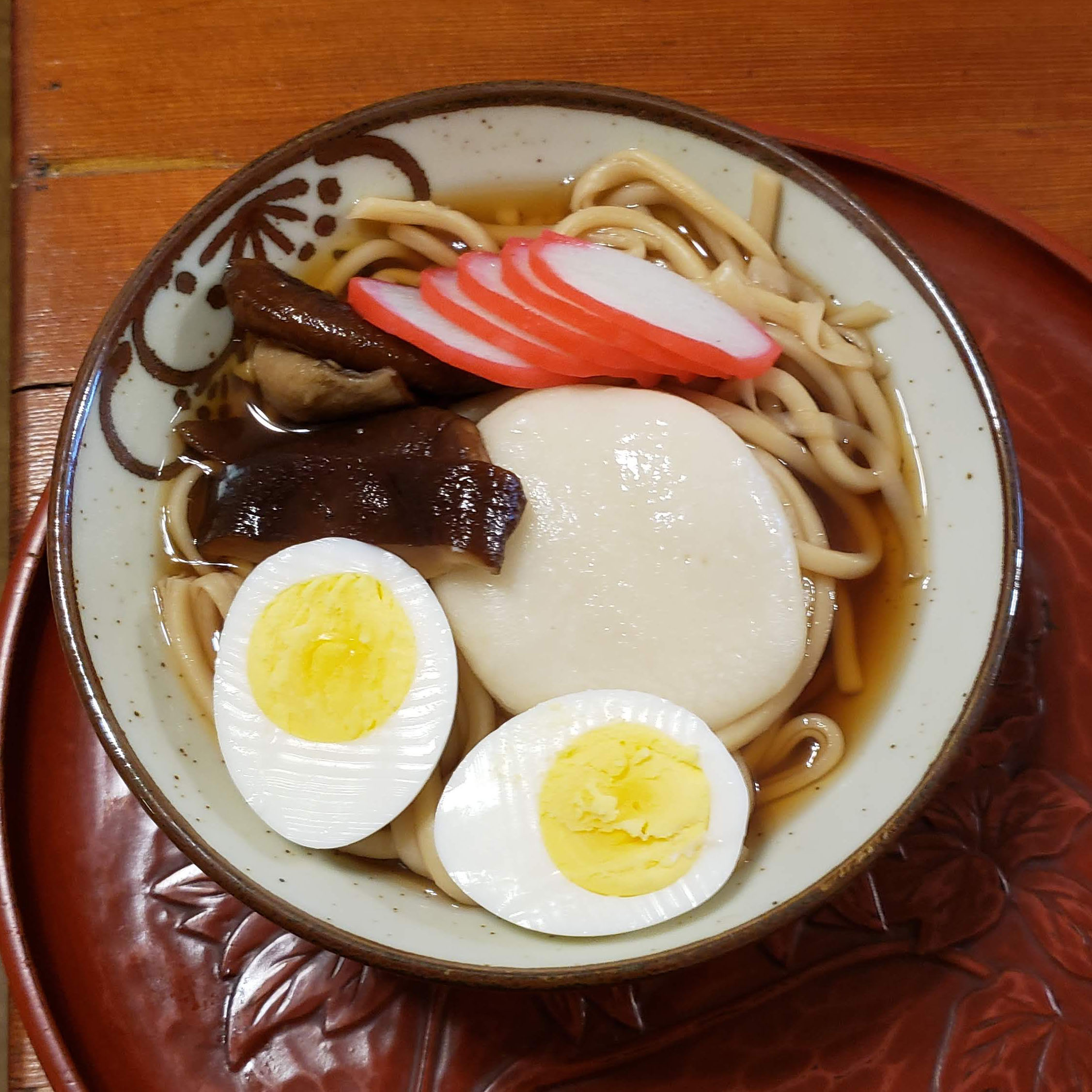
Following the cleanup, Mrs. Igarashi prepared noodles with mochi, mushrooms and hard-boiled eggs. I seriously don’t understand why more people don’t participate. The lunch alone is more than reward enough for me to come back next year.

2019 lunch