All posts by John Hughes

Rissho Peace Movement

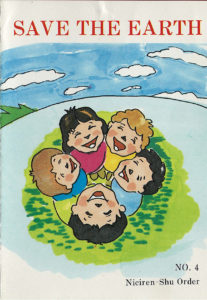
SaveTheEarth-cover
Children’s anti-war brochure published by Nichiren Shu headquarters

Today I completed my recent project of adding old brochures found in the Sacramento Nichiren Buddhist Church classroom to the church website’s collection of brochures. This final brochure is entitled Save the Earth. The roughly 4-inch by 6-inch pamphlet unfolds into a seven panel brochure with comic-book-like illustrations on one side and a text-only article on the other.

Japanese postwar pacifism is one of the things I find very foreign, especially as it relates to Nichiren Buddhism. After all, my father fought in Europe in World War II, earning a bronze star for valor for holding his position during the Battle of the Bulge. My wife’s father served in counterintelligence in Tokyo during Gen. McCathur’s post-war occupation of Japan. That’s where he met my wife’s mother, a translator who had been a teenager in Tokyo during the war. I served in the US Navy in the Vietnam War, although that was mostly because I was going to be drafted into the Army. Being a self-proclaimed anti-war Christian at the time, I toyed with flight to Canada or principled jail time, but ended up joining the Navy. While I thought that would keep me out of the war, I ended up spending 11 months in and out of the Gulf of Tonkin on the aircraft carrier USS Midway. I worked in squadron maintenance administration, shuffling papers related to the maintenance of F4 Phantom jets.

Anyway, the thought of teaching children that war is bad, especially in our current age of endless war in Afghanistan, seems both inspiring and naive.

The Save the Earth brochure concludes:

To realize peace we must abandon greed and make the “principle of thankfulness” the basis of civilization. Buddhism teaches that “all phenomena are produced by causation.” This means that nothing—be it living or non-living things, natural or artificial phenomena—can exist by itself. The existence of anything is dependent on the existence of others. When we become thankful for others, we learn to be contented. Here arises dialogue, mutual understanding, the spirit of tolerance and friendship.

In his writings Nichiren repeatedly stresses the importance of peace. He says,

“You must be awakened promptly to the true teaching of Buddha Sakyamuni. Then the world will become the land of the Buddha. How can the Land of Buddha decline or be destroyed? If the nation does not decline and the land is not destroyed, we can be safe and calm:”
Uphold Righteousness and Bring Peace to the Country

We are promoting the “Rissho Peace Movement” in accordance with Nichiren’s teachings. Peace will never be realized while we are standing idly by. Let’s join hands and speak out worldwide for the realization of peace.

My Google search for background on “Rissho Peace Movement” failed to turn up any references to Nichiren Shu activities. However, it did point me to Millennialism, Persecution, and Violence: Historial Cases, a collection of essays published by Syracuse University Press in January 2000. In this book, Jacqueline Stone writes in an article entitled Japanese Lotus Millennialism: From Militant Nationalism to Contemporary Peace Movements:

During Japan’s modern imperial period, intense nationalism, militarism, and war were assimilated to new millennial visions of a world harmoniously united under Japanese rule. Certain elements in the teachings of the medieval Buddhist teacher Nichiren were appropriated to these visions. His discourse about Japan as the place where a new Dharma would arise to illuminate the world was given an imperialist reading; his advocacy of assertive proselytizing or shakubuku—which for Nichiren had meant preaching and debate—was adopted as a metaphor for armed force; and his emphasis on giving one’s life for the Lotus became a celebration of violent death in the imperial cause. Such millennialist appropriations inspired not only extremists committed to political assassination or coups but also broadly legitimated the violence that pitted Japan as a whole against other Asian countries and the West.

A World Without War

It is little exaggeration to say that ultranationalistic Lotus millennialism died in August 1945 in the flames of Hiroshima and Nagasaki. But even before these ruined cities had been rebuilt, a new Lotus millennialism had risen to take its place. Postwar Lotus millennialism envisions a time when, by awakening to the universal Buddha nature, people everywhere will live in harmony and with mutual respect. Different Nichiren-and Lotus-related religious groups offer variations on this basic theme, but on one point they all agree: in that future time, there will be no war. Nuclear weapons, in particular, will be abolished.

Download full article

I suppose the use of Nichiren’s writings to take both sides of the question of war shows the universality of his message. Or, perhaps more to the point, it shows how the one True Dharma is subverted by innumerable meanings.

The Function of Faith

The three (or four) seals of the Law, the law of dependent origination, and the Four Noble Truths express basic Buddhist views, all of which are closely related. From the theoretical viewpoint, the law of dependent origination, which describes life and society as they actually exist, is central. The focal point of religious practice, on the other hand, is the Four Noble Truths, which embody not only the logical truth of dependent origination but also moral values and the path of action whereby the Buddhist ideal can be attained.

The insight gained through an understanding of the law of dependent origination makes it possible to see the true condition of the world. Once the vast gap separating the actual world and humanity from the ideal is realized, the individual begins to yearn to abandon the flawed and sullied and to seek perfection. Realistic observation of life inspires the pursuit of the ideal once a person has come to see that actuality and the ideal, though apparently different, are not two totally separate things after all. To inspire this realization is the function of faith.
Basic Buddhist Concepts

Petitions Concerning Intermediate Students

During the week after Saichō submitted the Rokujōshiki, he wrote two more memorials, adding details about the training program for those who aspired to be yearly ordinands. He proposed a rigorous training course for candidates (called intermediate students or tokugō gakushō) for the examinations which would qualify them to become government-sponsored yearly ordinands. Saichō was thus both providing his school with able candidates for ordination and responding to the court’s attempts to improve the quality of yearly ordinands.

Regulations For Intermediate Students
Of The Tendai-Lotus Hall On Mount Hiei

(Heizan Tendai Hokkein tokugō gakushōshiki)

How difficult it is to reside in conditioned existence, in the cycles of life and death. Without wisdom, how can we wake from the slumber that is ignorance? (I hear) the faint sound of spring thunder; it is time to be resolute. (I see) the glimmer of summer lightning; time is short. The roots of great compassion may begin to grow this morning. The aspiration to attain enlightenment may arise this very day.

Thus we must permanently establish regulations for our halls which are in this dream-like world. By forever establishing these regulations, we shall open the sources of the Dharma. Above, we shall serve all the generations of emperors. In the middle, we shall protect all the people of the world. Below, we shall save all sentient beings. Thus we would like to install nine intermediate shikangō (Meditation Course) students who will lecture and turn the Lotus Sūtra, Chin kuang ming Ching, Jen wang Ching and other sūtras daily. They will not miss even one day. We would also like to install nine intermediate Esoteric Course students who will turn and meditate on the (Ta p’i lu) che na(ching), (Fo mu ta) k’ung ch’iao (ming wang Ching), Shou hu (kuo chieh chu t’o lo ni ching) and other sūtras everyday.

Youths who are fifteen years or older, and believers who are twenty-five years or younger should take their identification documents to be verified. Next they should have their names added to the register, be assigned positions, and thus become intermediate students. Those who are able to read three works will form the highest rank. Those who are able to read two will form the middle rank. And those who are able to read only one will form the lowest rank. The top rank shall consist of those with minds of the Middle Way. Among the students, they are the resolute ones, excelling in both ability and achievements.

The students will be tested after nine years and all those who fail the test will be expelled (from the monastery). Those who pass shall reside on Mount Hiei continuously in both body and mind for twelve years. They shall follow the monastery’s rules and advance in their studies. (By becoming a) treasure of the nation, a teacher of the nation, or an asset of the nation, they will benefit both themselves and others. They will rapidly advance through the six stages (roku soku) and long reside in the three virtues.

From now on, those who reside in my halls shall purge themselves forever of the three poisons. They shall follow the rules of the Lotus Sūtra and not rely on the sheep or elephant vehicles; rather, they shall board the latter three vehicles.

The fifteenth day of the fifth month of the ninth year of the Konin era (818).

Written by Saichō, Head of the Tendai School.

Saichō: The Establishment of the Japanese Tendai School, p126-127

The Merit of Making Offerings to a Practicer of the Lotus Sūtra

The “Teacher of the Dharma” chapter in the 4th fascicle of the Lotus Sūtra states: “If there is one who, in the quest for the Buddha Way, honors me in countless verses with palms pressed together in my presence throughout one kalpa (aeon), such a person will gain immeasurable benefits because of this praise. But one who extols the upholders of this sūtra will accrue blessings that surpass even those.” This means that the merits received for making offerings to a practicer of the Lotus Sūtra in the Latter Age of Degeneration surpass the benefits received for serving with sincerity a Buddha as noble as Śākyamuni with one’s body; mouth, and mind for an entire medium kalpa (aeon). Although this may seem implausible, there should be no doubt about it because such are the Buddha’s golden words.

Grand Master Miao-lê further clarifies this passage from the sūtra by saying: “Those who slander them (practicers of the Lotus Sūtra), will have their heads split into seven pieces. However, those who make offerings to them (practicers of the Lotus Sūtra) will find that their merits exceed those of a Buddha endowed with the ten honorable titles.” This means that the merit of making offerings to a practicer of the Lotus Sūtra in the Latter Age of Degeneration exceeds that of making offerings to a Buddha with ten honorable titles. It also means that those who persecute a practicer of the Lotus Sūtra in the impure age will have their heads split into seven pieces.

Kō no Ama Gozen Gosho, A Letter to My lady, the Nun Kō, the Nun Myōichi, Writings of Nichiren Shōnin, Volume 7, Followers II, Pages 165-166

Daily Dharma – Sept. 16, 2019

I know who is practicing the Way and who is not.
Therefore I expound various teachings
To all living beings
According to their capacities.

The Buddha sings these verses in Chapter Sixteen of the Lotus Sūtra. Even though the Buddha knows when we have strayed from the way of compassion and wisdom that he has opened for us, he knows that the innate capacity we have for enlightenment remains unchanged. Therefore, he does not judge us, or give up in his efforts to lead us away from our delusions. When we maintain our determination to save all beings despite their delusions, we maintain this mind of the Buddha and nourish the seeds of our own enlightenment.

The Daily Dharma is produced by the Lexington Nichiren Buddhist Community. To subscribe to the daily emails, visit zenzaizenzai.com

Day 19

Day 19 concludes Chapter 14, Peaceful Practices, and begins Chapter 15, The Appearance of Bodhisattvas from Underground.

Having last month considered how Śākyamuni is like the king who rewards his soldiers’ efforts, we consider why Śākyamuni teaches this sūtra lastly.

“Mañjuśrī! This Sutra of the Lotus Flower of the Wonderful Dharma is the most excellent and profound teaching of all the Tathāgatas. Therefore, I expound it lastly just as the powerful king gave the brilliant gem lastly, the one which he had kept [in his topknot) for a long time.

“Mañjuśrī! This Sutra of the Lotus Flower of the Wonderful Dharma is the treasury of the hidden core of the Buddhas, of the Tathāgatas. It is superior to all the other sūtras. I kept it [in secret] and refrained from expounding it for the long night. Now I expound it to you today for the first time.”

Nichiren comments on this in Selecting the Right Time:

It is said in the Lotus Sūtra, fascicle 5 (chapter 14): “This Lotus Sūtra is the secret treasure of all Buddhas. It is supreme of all sūtras.” Please note that “it is supreme of all sūtras.” According to this sūtra, therefore, he who insists that the Lotus Sūtra is supreme of all sūtras is a true practicer of the Lotus Sūtra, isn’t he? Nevertheless, many who are revered in the land insist that there are sūtras superior to the Lotus. Standing against these monks, who are revered by the king and his subjects, the practicer of the Lotus Sūtra is poor and powerless, with all the people in the land despising him. Under such circumstances, if he points out their sin of slandering the True Dharma as stubbornly as Never Despising Bodhisattva or as decisively as Commentator Bhadraruci defeated Brahman, the Boaster, his life will be in jeopardy. This seems of prime importance. This fits me, Nichiren.

Senji-shō, Selecting the Right Time: A Tract by Nichiren, the Buddha’s Disciple, Writings of Nichiren Shōnin, Doctrine 1,
Page 250-251

Retirement News from Myoshoji

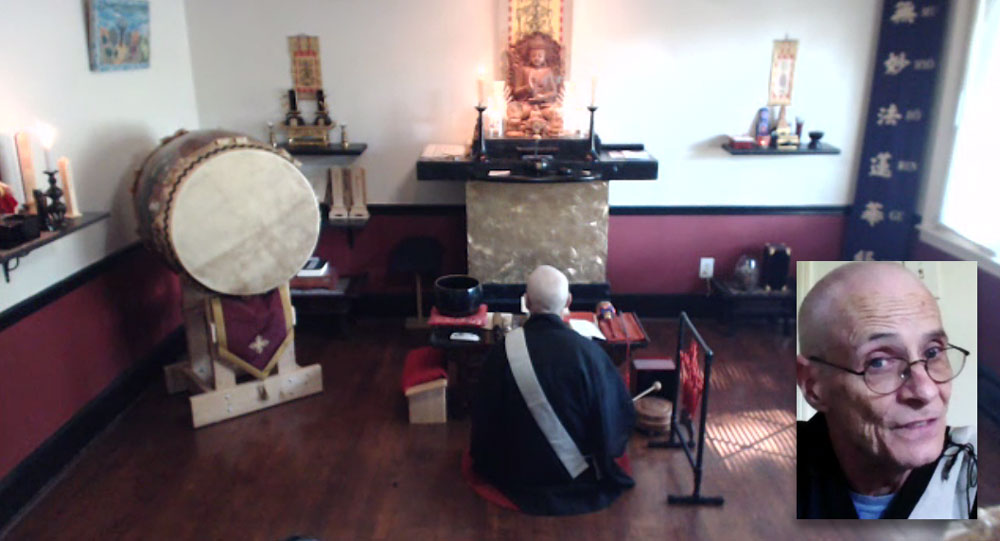
2019-09-15_ryusho_retiring

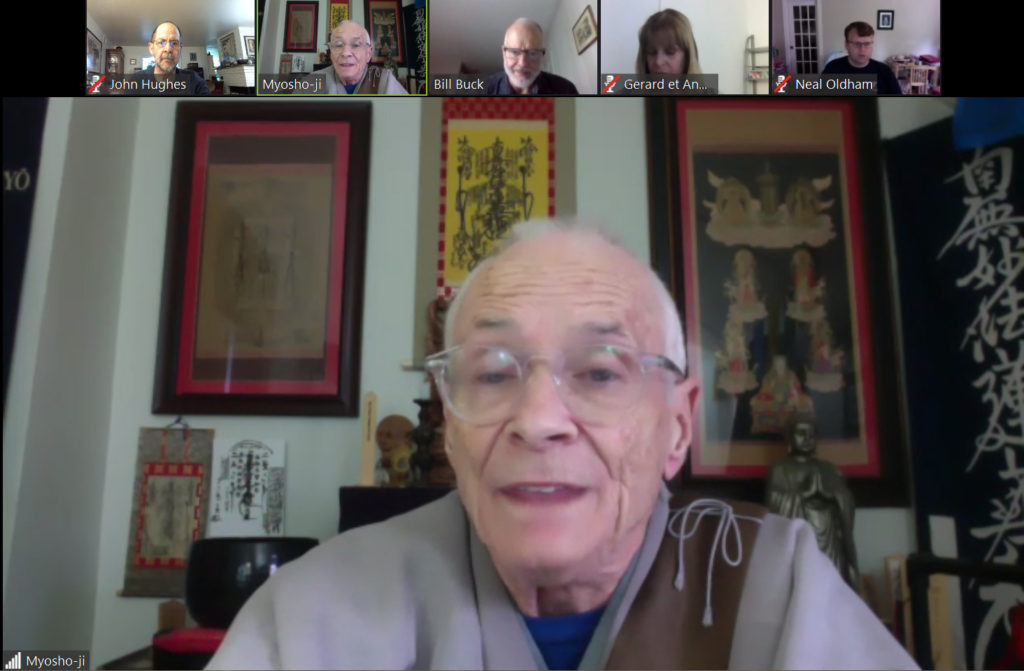
Attended the online service with Rev. Ryusho Jeffus and three other members of the Myoshoji sangha today. I haven’t been attending as often as I once did. And now, apparently, I will soon have even fewer chances to attend.

Today, Rev. Ryusho Jeffus announced that he will be retiring on Oct. 13, 2019. He plans a formal announcement later, so I’ll leave the details of his plans for that time.

I became a Nichiren Shu follower at the start of 2015 and, as you can tell from the story about why I started this blog – see the About page – Ryusho has been an important influence.

Ryusho plans to continue services after his retirement but other activities he plans to pursue will make those services less frequent. That will be a real loss.

Sept. 6, 2015, Service at Myoshoji with Ryusho Jeffus Shonin
This is the first photo I posted of an online service – Sept. 6, 2015. At the time, Myoshoji was in Charlotte, North Carolina.

The Ten Good Precepts

The ten good precepts (jūzenkai) were one of the earliest formulations of bodhisattva precepts; they were granted to both laymen and monks. They originated from a list of ten actions which produced good karma.

  1. Abstention from killing living things
  2. Abstention from stealing
  3. Abstention from unchastity
  4. Abstention from lying
  5. Abstention from malicious speech
  6. Abstention from harsh speech
  7. Abstention from indistinct prattling
  8. Abstention from covetousness
  9. Abstention from anger
  10. Abstention from wrong views
Saichō: The Establishment of the Japanese Tendai School, p119

The Buddha’s True Intention

Please be aware of the Buddha’s true intention. Understand the basics of what the Odaimoku is, what the Lotus Sūtra is, and what teachings Nichiren Shōnin left for us at the risk of his own life. Endeavor to strengthen your practice, chant and transmit the Odaimoku to other people. We sometimes tend to be self-righteous about our own faith. At that time we should try to correct our way of faith and life by checking ourselves against the true intention of the Buddha and Nichiren Shōnin and the Lotus Sūtra.

Buddha Seed: Understanding the Odaimoku

Difficulty in Meeting a Practicer of the Lotus Sūtra

Putting aside the preciousness of the Lotus Sūtra for now, it is all the more difficult for us to meet a practicer of the Lotus Sūtra who preaches the sūtra as expounded in it than for a one-eyed turtle to find a piece of sandalwood tree floating on the sea or for anyone to lift Mt. Sumeru with a lotus root into the air.

Kyōdai-shō, A Letter to the Ikegami Brothers, Writings of Nichiren Shōnin, Volume 6, Followers I, Page 74