The written words of the Lotus Sutra express in a visible and tangible form the Brahma’s voice of the Buddha, which is invisible and intangible, so that we can see and read them with our eyes. The Buddha’s pure and immaculate voice, which had disappeared, is resuscitated in the form of written characters for the benefit of humankind.
Nichiren wrote this passage in his Treatise on Opening the Eyes of Buddhist Images, Wooden Statues or Portraits (Mokue Nizō Kaigen no Koto). Living in this world, 2500 years after the Buddha Śākyamuni walked the Earth, it is difficult to hear his voice leading us to enlightenment and encouraging us to let go of our attachments. In the Lotus S̄ūtra we have an instrument for creating the Buddha’s voice in our own time. This is his highest teaching. It brings all beings to liberation, whether they are clever or dull, stupid or wise, focused or distracted. It reminds us of our true nature as Bodhisattvas who chose this life out of our determination to benefit all beings. It shows us how to transform the poison of suffering into the medicine of compassion, and the poison of ignorance into the medicine of wisdom.
The Daily Dharma is produced by the Lexington Nichiren Buddhist Community. To subscribe to the daily emails, visit zenzaizenzai.com
Day 16 concludes Chapter 11, Beholding the Stūpa of Treasures, and completes the Fourth Volume of the Sūtra of the Lotus Flower of the Wonderful Dharma.
Having last month witnessed Śākyamuni opening the door to the Stupa of Treasures, we witness him taking a seat in the stupa and then raising the congregation into the air so they can see better.
Having seen that the Buddha, who had passed away many thousands of billions of kalpas before, had said this, the four kinds of devotees praised him, saying, “We have never seen [such a Buddha as] you before.” They strewed heaps of jeweled flowers of heaven to Many-Treasures Buddha and also to Śākyamuni Buddha.
Thereupon Many-Treasures Buddha in the stūpa of treasures offered a half of his seat to Śākyamuni Buddha, saying, “Śākyamuni Buddha, sit here!”
Śākyamuni Buddha entered the stūpa and sat on the half-seat with his legs crossed. The great multitude, having seen the two Tathāgatas sitting cross-legged on the lion-like seat in the stūpa of the seven treasures, thought, “The seat of the Buddhas is too high. Tathāgata! Raise us up by your supernatural powers so that we may be able to be with you in the sky!”
Thereupon Śākyamuni Buddha raised them up to the sky by his supernatural powers, and said to the four kinds of devotees with in a loud voice:
“Who will expound the Sūtra of the Lotus Flower of the Wonderful Dharma in this Saha-World? Now is the time to do this. I shall enter into Nirvana before long. I wish to transmit this Sūtra of the Lotus Flower of the Wonderful Dharma to someone so that this sūtra may be preserved.”
The Daily Dharma from Dec. 20, 2018, offers this:
“Who will expound the Sūtra of the Lotus Flower of the Wonderful Dharma in this Sahā-World? Now is the time to do this. I shall enter into Nirvāṇa before long. I wish to transmit this Sūtra of the Lotus Flower of the Wonderful Dharma to someone so that this sūtra may be preserved.”
The Buddha asks this of those gathered to hear him teach in Chapter Eleven of the Lotus Sūtra. If there had been no one among those listening who was able to expound the Sūtra, he would not have asked this question. Our ability to benefit others with the Buddha Dharma is not based on our eloquence, our intelligence or our position in life. It is based only on our faith in the Buddha’s teachings and our determination to benefit others. When we read, recite, and copy the Lotus Sūtra, the Buddha is transmitting it to us. We preserve the Sūtra through our practice.
The Daily Dharma is produced by the Lexington Nichiren Buddhist Community. To subscribe to the daily emails, visit zenzaizenzai.com
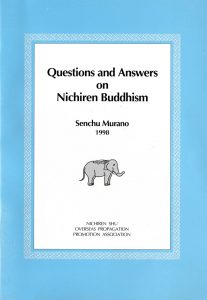
This is the second booklet by Senchu Murano from the late 1990s that I’ve uploaded to the church website. It was curious to see that both include “fantasy” text inserted by Murano into discussion of the Lotus Sutra. I commented earlier about his Gohonzon booklet in which he has an entire section entitled The Fantasy of the Lotus Sutra.
In this booklet, Murano goes to great lengths to expand the story of the Buddha Many Treasures (Prabhutaratna, Taho) in a discussion prompted by a request to “Please explain the Dai Mandala Gohonzon.”
Murano replies:
Sakyamuni Buddha did what he had never done before at the beginning of Chapter XI of the Lotus Sutra. He produced innumerable Replica Buddhas of his own from himself, told them to expound what he was going to expound from that moment, and dispatched them to the worlds of the ten quarters: the four quarters, the four intermediate quarters, zenith, and nadir. After he saw them having reached their assigned worlds, Sakyamuni Buddha expounded the teaching of the One Vehicle, that is the Lotus Flower of the Wonderful Dharma. Obedient to their Original Buddha, his Replica-Buddhas expounded the same teaching throughout the universe and as a result the universal validity of the Wonderful Dharma was revealed.
Prabhutaratna (Taho), a past Buddha of a world located far to the east, rejoiced at seeing all this. You should bear in mind that a past Buddha, who had already entered Parinirvana, can see, hear, speak, and let his Stupa move at his will. When Prabhutaratna entered Parinirvana, his disciples enshrined him in his stupa, and shut the door of the stupa. Since then Prabhutaratna had been sitting in meditation in his Stupa with no disciple attendants. He had wished to expound the Wonderful Dharma by himself during his lifetime, but refrained from it because he thought that the Wonderful Dharma should be expounded by a Buddha whose emanations be the Buddhas of the worlds of the ten quarters to show the universal validity of the Dharma. Prabhutaratna himself had not such Replica Buddhas, so he had waited for the advent of such a Buddha for so long a time.
Overjoyed with Sakyamuni’s expounding the Wonderful Dharma, Prabhutaratna caused his Stupa to travel westwards through the skies of innumerable worlds. The Stupa reached the sky below the Saha-world, passed the world from underneath, and stayed in the sky just above Mt. Sacred Eagle, where Sakyamuni Buddha was expounding the Wonderful Dharma.
He continues with the Buddha emitting a light and calling home all of his emanations and opening the stupa and taking a seat offered by Many Treasures Buddha. Murano adds that Many Treasures Buddha gave Sakyamuni the lesser seat, believing that he was older than Sakyamuni.
Murano continues his version of events after the congregation is raised level with the two Buddhas in the stupa:
Thereupon Sakyamuni addressed the congregation that his Parinirvana day was drawing near, and that he was going to transmit the Wonderful Dharma to someone. Hearing this, many Bodhisattvas appealed to him for the transmission. Sakyamuni refused their appeal, however, saying that there were proper persons for that. And he issued rays of light from himself as a sign of call-up.
All of a sudden the earth quaked and cracked, and innumerable Bodhisattvas came from underground. To the astonishment of the congregation, those Bodhisattvas exchanged greetings with Sakyamuni Buddha. How strange! The congregation had never heard of them.
Sakyamuni addressed the congregation, “I am older than any other Buddhas. All the Buddhas of the past, present and future are my emanations. Those Bodhisattvas who have arrived from underground are my disciples.” Here it is revealed that the One Vehicle, that is the Wonderful Dharma, is universally valid not only spatially but also temporally.
Seeing all this, Prabhutaratna was shocked. He felt ashamed of his ignorance of the fact that the Buddha sitting next to him was his Original Buddha. He tried to change the seats, but Sakyamuni checked him, saying, “You are now the State Guest of the World-State of the Eternal Sakyamuni. You are now representing all the Buddhas of the past, present and future.” Prabhutaratna understood Sakyamuni, and remained at his seat, motionless.
I am sincerely puzzled as to why Murano insists on inserting his “fantasy” into these booklets. How does this advance understanding of the Lotus Sutra, especially in countries outside Japan with very limited contact with the Lotus Sutra?
Scholars disagree about when the dispute over the precepts began. One scholar has suggested that Saichō may have been influenced by some of Dōchū’s disciples who, following Chien-chen’s teachings, called for a more open Buddhist order. Others have suggested that on his trips to Kyushu and Tōgoku, Saichō may have gone to see the kaidan (precepts platforms) in these two areas, and thus may have been considering reforms as early as 814. Neither of these theories has been proven.
The dispute began in earnest with Saichō’s efforts to have the court designate his monastery, Hieizanji, a Mahāyāna temple. On the seventh day of the second month of Konin 9 (late 817) Kōjō reports that Saichö told him that he wanted “to establish a Mahāyāna temple in order to propagate the (Tendai) School.” Kōjō seems to have been surprised by Saichō’s statement. According to Kōjō’s Denjutsu isshinkaimon, the following conversation took place:
The disciple (Kōjō) said, “There are no Mahāyāna temples in Japan. Why must we now suddenly establish a One-vehicle temple (ichijōji)?”
Our late teacher (Saichō) said, “I will bestow on you the title ‘One-vehicle (ichijō)’.”
His disciple (Kōjō) said, “Since there are no Mahāyāna temples in Japan yet, I will not take the One-vehicle title. Please bestow it on me after we establish a Mahāyāna temple.”
Our late teacher said, “In India there are purely Mahāyāna temples, purely Hinayāna temples and mixed (Mahāyāna and Hinayāna) temples.”
His disciple said, “If these three types of temples exist, then I ought to take the title. Temples are, after all, only places where monks reside.”
At this time, no mention was made of precepts. Exactly what the term ‘Mahāyāna temple’ or ‘One-vehicle temple’ designated and how such an institution would differ from the temples in Japan at that time is not specified in the conversation. Probably it was the beginning of an attempt by Saichō to develop a monastic institution which would embody, in a practical way, the issues being debated with Tokuitsu. If the court had recognized Saichō’s claim that Hieizanji was a Mahāyāna temple, it certainly would have enhanced the reputation of the Tendai School at the expense of the Hossō and Sanron schools by implying that they did not have purely Mahāyāna temples.
I, Nichiren, sincerely keep the most profound Lotus Sutra among other sutras which have been preached, are being preached, and will be preached. I also chant Odaimoku, the heart of the sutra, by myself and teach others to chant it. Mugwort grass grows straight amidst the hemp field. Trees do not grow straight, but by cutting them straight, they become useful. If you chant the sutra as it instructs, your mind will be straightened. Be aware that is hard for us the chant even the title of the sutra unless the spirit of the Eternal Buddha enters into our bodies.
Nichiren wrote this passage in his Letter to Myomitsu Shonin (Myomitsu Shonin Gosho). This instruction ties together the practice of reciting devotion to the title of the Lotus Sūtra, Namu Myoho Renge Kyo, and the mind of the ever-present Buddha Shakyamuni. It is through unimaginable deeds of merit that we have met this Sūtra in our lives and have the opportunity to use it to find the Buddha’s wisdom and benefit all beings in this world of conflict and delusion. We are also fortunate to have Nichiren as an example of how to bring this teaching to life. May our gratitude for the merits we have received strengthen our determination to transform the obstacles we face into opportunities we welcome.
The Daily Dharma is produced by the Lexington Nichiren Buddhist Community. To subscribe to the daily emails, visit zenzaizenzai.com
Having last month learned in gāthās how good men or women who live after the Buddha’s extinction should expound this sūtra, we conclude Chapter 10, The Teacher of the Dharma.
If anyone speaks ill of you, or threatens you
With swords, sticks, tile-pieces or stones
While you are expounding this sūtra,
Think of me, and be patient!
My body is pure and indestructible.
I will appear in any of many thousands of billions of worlds
During many hundreds of millions of kalpas,
And expound the Dharma to the living beings.
If a teacher of the Dharma expounds this sūtra
After my extinction,
I will manifest the four kinds of devotees:
Bhikṣus, bhikṣunīs, and men and women of pure faith,
And dispatch them to him
So that they may make offerings to him,
And that they may lead many living beings,
Collecting them to hear the Dharma [from him].
If he is hated and threatened
With swords, sticks, tile-pieces or stones,
I will manifest men and dispatch them to him
In order to protect him.
If an expounder of the Dharma
Reads and recites this sūtra
In a retired and quiet place,
Where no human voice is heard,
I will show my pure and radiant body to him.
If he forgets a sentence or a phrase of this sūtra,
I will tell it to him
For his complete understanding.
Anyone who expounds this sūtra to the four kinds of devotees,
Or reads or recites this sūtra in a retired place,
After doing these [three] virtuous things,
Will be able to see me.
If he lives in a retired place,
I will dispatch gods, dragon-kings, yakṣas,
Demigods, and others to him,
And have them hear the Dharma [from him].
He will expound the Dharma with joy.
He will expound it without hindrance.
He will cause a great multitude to rejoice
Because he is protected by all the Buddhas.
Those who come to this teacher of the Dharma
Will be able to complete the Way of Bodhisattvas quickly.
Those who follow him and study will be able to see
As many Buddhas as there are sands in the River Ganges.
The Daily Dharma from July 28, 2018, offers this:
If anyone speaks ill of you, or threatens you
With swords, sticks, tile-pieces or stones
While you are expounding this sūtra,
Think of me, and be patient!
The Buddha sings these verses to Medicine-King Bodhisattva in Chapter Ten of the Lotus Sūtra. By patience, the Buddha does not mean to toughen ourselves and allow others to harm us. The patience he speaks of allows to increase our capacity to handle the mental suffering that comes when others abuse us. If we keep in mind that nothing anyone does can remove the seed of Buddha nature that is within them, and remember that this seed is within all beings, we can treat even those who mean us harm with respect and compassion, rather than contempt and derision.
The Daily Dharma is produced by the Lexington Nichiren Buddhist Community. To subscribe to the daily emails, visit zenzaizenzai.com
The Buddha-nature was a controversial topic in India, China and Japan. In his classic study of the long history of these disputes, Tokiwa Daijō (1870-1945) argued that the debate between Saichō and Tokuitsu represented the culmination of the disputes over the Buddha nature. The issues were probably more clearly demarcated and discussed by both men than at any other time in East Asian Buddhist history. Many new issues were introduced into the debate and their relation to the subject of the Buddha-nature investigated. Saichō displayed considerable ingenuity and an impressive command of Buddhist literature in drawing upon a variety of sources to formulate and defend his position. At the same time, the debate with Tokuitsu prepared the ground for the controversy over the bodhisattva precepts (bosatsukai) by indicating that the Tendai and Hossō positions were irreconcilable. Saichō’s petitions concerning the bodhisattva precepts … represent his attempt to formulate practices which would reflect the more theoretical statements which he had advanced in his works criticizing Tokuitsu.
Just at the time when I was thinking this must be the place where I would be beheaded, the soldiers began to get excited, gathering around me. Shijō Kingo began to cry saying, “The last moment has come!” Looking at this, I uttered, “How cowardly you all are! I am glad you are laughing at such a wonderful occasion as this when I am now going to present my malodorous head to the Lotus Sūtra. Why do you break the promise you had made?” Just at this moment, something shining like the moon flew like a ball from Enoshima Island from southeast to northwest. It was before daybreak, the night of the twelfth and was still too dark to see the faces of people. However, the night was brightened by the shining object for us to see our faces as clearly as on a moonlit night. The executioner who was ready to kill Nichiren fell down on the ground blinded. The soldiers became frightened. Some ran away as far as one hundred meters, others dismounted from horses and squatted down on the ground, and still others remained stiff on horseback.
I, Nichiren, shouted, “Why do you stay away from a felon like me? Come back here quickly.” None of them, however, came near me in a hurry. “Daybreak is coming very soon; what can you do if it gets light? If you have to kill me, do it right away. It would be unsightly when it gets lighted.” Thus I shouted to them, but there was no response.
Shuju Onfurumai Gosho, Reminiscences: from Tatsunokuchi to Minobu, Writings of Nichiren Shōnin, Biography and Disciples, Volume 5, Pages 28-29
The highest Dharma that I attained
Is profound and difficult to understand.
Now I will expound it.
Listen to me with all your hearts!
The Buddha sings these verses to those gathered to hear him teach in Chapter Fifteen of the Lotus Sūtra. He has already said that we must leave behind the expedient teachings tailored to our minds and take on the highest teaching which is the Buddha’s own mind. He knows how difficult this is for us, that we cannot hear it through our understanding alone, so he asks us to use our whole being to hear him.
The Daily Dharma is produced by the Lexington Nichiren Buddhist Community. To subscribe to the daily emails, visit zenzaizenzai.com
Day 14 covers all of Chapter 9, The Assurance of Future Buddhahood of the Śrāvakas Who Have Something More to Learn and the Śrāvakas Who Have Nothing More to Learn, and opens Chapter 10, The Teacher of the Dharma.
Having last month heard Śākyamuni’s prediction for Ānanda, we consider the complaint of the eight thousand Bodhisattvas who had just resolved to aspire for Anuttara-samyak-saṃbodhi.
There were eight thousand Bodhisattvas who had just resolved to aspire [for Anuttara-samyak-saṃbodhi] in this congregation. They thought, ‘As far as we have heard, even great Bodhisattvas have never been assured of their future Buddhahood. Why have these Śrāvakas been so assured?’
Thereupon the World-Honored One, seeing what the Bodhisattvas had in their minds, said to them:
“Good men! Ānanda and I resolved to aspire for Anuttara-samyak-saṃbodhi under the Void-King Buddha at the same time [in our previous existence]. At that time Ānanda always wished to hear much while I always practiced strenuously. Therefore, I have already attained Anuttara-samyak-saṃbodhi[, but he has not yet]. Now he protects my teachings. He also will protect the store of the teachings of future Buddhas, teach Bodhisattvas, and cause them to attain [Anuttara-samyak-saṃbodhi], according to his original vow. Therefore, now he has been assured of his future Buddhahood.”
The Daily Dharma from Dec. 12, 2018, offers this:
Good men! Ānanda and I resolved to aspire for Anuttara-samyak-saṃbodhi under the Void-King Buddha at the same time [in our previous existence]. At that time Ānanda always wished to hear much while I always practiced strenuously. Therefore, I have already attained Anuttara-samyak-saṃbodhi[, but he has not yet]. Now he protects my teachings.
The Buddha gives this description to those gathered to hear him teach in Chapter Nine of the Lotus Sūtra. In the story, he has just assured his cousin Ānanda that he will become a Buddha. He then explains the difference between hearing what the Buddha teaches and making it a part of our lives. It is when we practice the Buddha Dharma that we truly understand it. But even if we believe we do not have the capacity to practice, it is still important for us to hear and protect what the Buddha left for us. By giving others the opportunity to learn and do what perhaps we cannot, we help to improve their lives, and give them a chance to improve ours.
The Daily Dharma is produced by the Lexington Nichiren Buddhist Community. To subscribe to the daily emails, visit zenzaizenzai.com