All posts by John Hughes

Day 7

Day 7 concludes Chapter 3, A Parable, and begins Chapter 4, Understanding by Faith.

Having last month met the poor son in the Parable of the Rich Man and His Poor Son, we conclude today’s portion of Chapter 4, Understanding by Faith.

The rich man, who was sitting on the lion-like seat, recognized him at first sight as his son. He was delighted. He thought, ‘Now I have found the person to whom I can transfer my treasures and storehouses. I have been thinking of my son all this time, but I have had no way to find him. Now he has come by himself all of a sudden. This is just what I wanted. I am old, but not too old to lose any attachment [to my treasures].’

“He immediately dispatched a man standing beside him to quickly bring back the poor son. The messenger ran up to the poor son and caught him. The poor son was frightened. He cried, ‘You Devil! I have done nothing wrong. Why do you catch me?’

“The messenger pulled him by force. The poor son thought, ‘I am caught though I am not guilty. I shall be killed.’ More and more frightened, the poor son fainted and fell to the ground. Seeing all this in the distance, the father said to the messenger, ‘I do not want him any more. Do not bring him forcibly! Pour cold water on his face and bring him to himself! Do not talk with him any more!’

“The father said this because he had realized that his son was too base and mean to meet a noble man [like his father]. He knew that the man was his son, but expediently refrained from telling to others that that was his son. [The messenger poured water on the son. The son was brought to himself.] The messenger said to him, ‘Now you are released. You can go anywhere you like.’

“The poor son had the greatest joy that he had ever had. He stood up and went to a village of the poor to get food and clothing.

The poor son’s celebration at escaping says a great deal about worldly happiness. He has missed an opportunity to take his place as the heir to his father’s wealth. Fortunately his father, like ours, has a plan to free him from his delusions.

The Life of Buddha

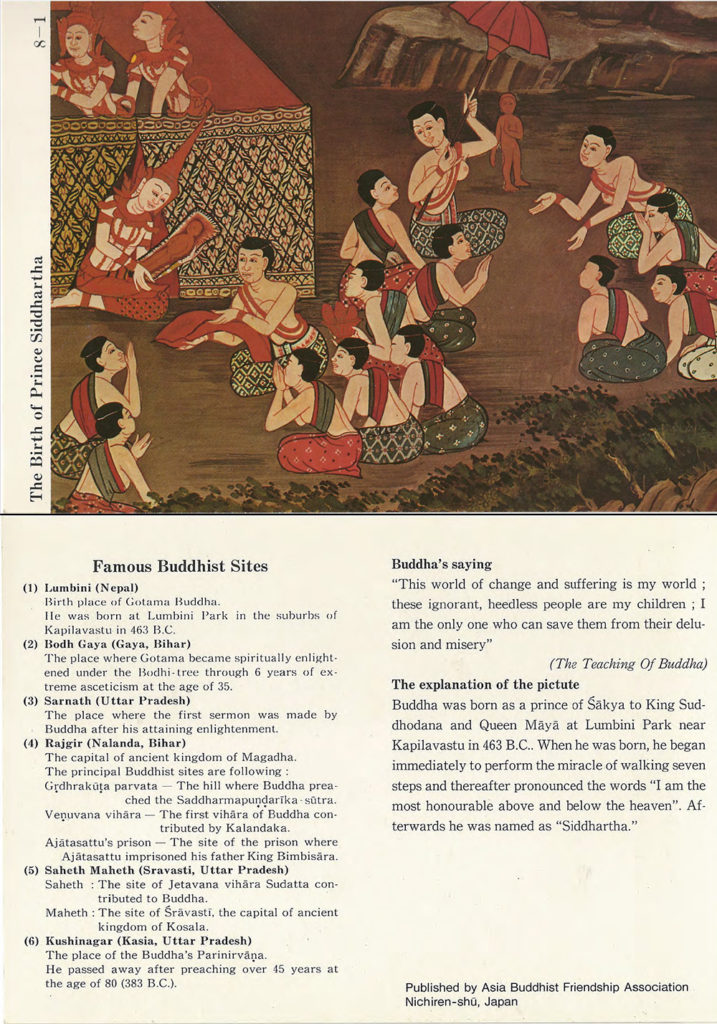
Example card with Thai painting and information on reverse

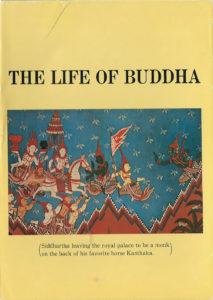
In 1957 the United States Information Service published a book entitled “The Life of Buddha” that used Thai Temple paintings to tell the story. Some time later, the Asia Buddhist Friendship Association, a Nichiren Shu organization, published sets of 5×7 cards with the paintings on one side and information on the back. I found an envelope of cards 8-1 to 8-8 at the Sacramento Nichiren Buddhist Church Sunday school classroom.

Each card contains a Thai Temple painting. On the back of the card is a list of Famous Buddhist Sites. (Same sites on all cards). Each card has a different ‘Buddha’s saying’ quote and information about that card’s Thai painting. The inside cover of the envelope contains a short biography of the Buddha.

I have re-created the package on the Sacramento Nichiren Buddhist Church’s page of Nichiren Shu brochures. A PDF copy of the package is also available.

View re-created package of 5×7 cards

Daily Dharma – Sept. 3, 2019

Mañjuśrī! A Bodhisattva-mahāsattva who performs this third set of peaceful practices in the latter days after [my extinction] when the teachings are about to be destroyed, will be able to expound the Dharma without disturbance. He will be able to have good friends when he reads and recites this sūtra. A great multitude will come to him, hear and receive this sūtra from him, keep it after hearing it, recite it after keeping it, expound it after reciting it, copy it or cause others to copy it after expounding it, make offerings to the copy of this sūtra, honor it, respect it, and praise it.

The Buddha gives this explanation to Mañjuśrī Bodhisattva in Chapter Fourteen of the Lotus Sūtra in which he describes the peaceful practices of a Bodhisattva. The third set of practices involves not despising those who practice the Wonderful Dharma in any way, or hindering their practice by telling them that they are lazy and can never become enlightened. Such treatment goes against the true nature we all share, and can only create conflict.

The Daily Dharma is produced by the Lexington Nichiren Buddhist Community. To subscribe to the daily emails, visit zenzaizenzai.com

The Fantasy of the Lotus Sutra

Cover_Gohonzon_Senchu_Murano-1
Read this booklet
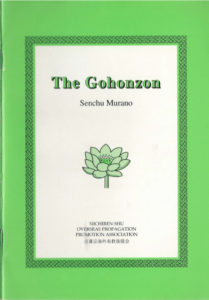
In cleaning out the old Sunday school classroom at the Sacramento Nichiren Buddhist Church I’ve obtained a number of brochures and booklets from the late 1980s and 1990s. I’ve been adding these to the church website since they are no longer in print.

Today I added Senchu Murano’s 36-page booklet entitled The Gohonzon, which was published in 1997 by the Nichiren Shu Overseas Propagation Promotion Association. (Read it here.)

Murano, who is the principal translator for the Nichiren Shu version of the Lotus Sutra harbors some theories that I take issue with. For example, in this booklet he says:

Sakyamuni Buddha became the Buddha in the remotest past. There was no Buddha before him. He was the first Buddha, the Original Buddha. All the other Buddhas in the past, present and future are his emanations.

In The Gohonzon booklet, Murano offers an abbreviated summary of the teaching of the Lotus Sutra that he entitles:

The Fantasy of the Lotus Sutra

The Pure World of the Original and Eternal Sakyamuni Buddha is a fantasy of the Lotus Sutra. A fantasy may not be real, but it sometimes portrays the truth more eloquently than reality. That is why Shakespeare’s A Midsummer Night’s Dream or Miyazawa Kenji’s Milky Way Railroad Train At Night is immortal.

The fantastic narration of the Lotus Sutra begins with the story of Prabhutaratna (Many-Treasures, Taho) Buddha, as follows:

There lived a Buddha called Taho many kalpas ago in a world called Treasure-Pure, which was located far to the east of the Saha World. Taho Buddha knew the Wonderful Dharma, but did not expound it by himself because he thought that the Wonderful Dharma should be expounded by a Buddha who would emanate from himself as many Replica-Buddhas as there are worlds in the universe, dispatch them to those worlds, and then expound the Wonderful Dharma in a sutra called the Lotus Sutra. Taho Buddha decided to wait for the advent of such a Buddha, and to approve the truthfulness of the Lotus Sutra expounded by that Buddha.

Taho Buddha requested his disciples to build a stupa, and to put his body in it after he passes away. His disciples made a stupa as they were instructed. After his Parinirvana, they positioned his body into a sitting posture of meditation, put it in the stupa, and shut the door.

A Buddha can see, hear, speak, and even move after his Parinirvana. The only thing a past Buddha cannot do is to expound the Dharma. Be must be satisfied with hearing the Dharma expounded by a present Buddha.

Taho Buddha had been watching all the corners of the universe for many kalpas until he finally found a Buddha doing what He had wished to see. He saw Sakyamuni Buddha of the Saha World, which was located far to the west of his world, issue many replicas from himself, dispatch them to all the worlds of the universe, and then expound the Lotus Sutra. Having rejoiced at seeing all this, Taho Buddha prepared himself for the journey to the Saha World. He made his stupa move. It flew through the skies over many worlds, and reached the sky below the Saha World. Then the stupa rose, passed the Saha World from underneath, and floated in the sky above Mt. Sacred Eagle. Taho Buddha turned the stupa toward Sakyamuni, and praised him from within the stupa.

The congregation was astonished to see all this. Representing the congregation, Daigyosetsu Bodhisattva asked Sakyamuni, “Who is in the stupa?” Sakyamuni answered, “Taho Buddha is there.” Daigyosetsu begged Sakyamuni to open the door of the stupa so that all the congregation could see the newly arrived Buddha. But Sakyamuni refused his appeal, saying that Taho Buddha would never allow anyone to open the door of his stupa unless an expounder of the Lotus Sutra collects his Replica-Buddhas from the worlds of the ten quarters. Daigyosetsu begged Sakyamuni to collect them.

Sakyamuni Buddha consented to his appeal. He issued a ray of light from his forehead as a sign to call them forth. Acknowledging this light, the Buddhas of the worlds of the ten quarters returned to their home world, and assembled on Mt. Sacred Eagle. With this Sakyamuni Buddha hovered, and opened the door of the stupa. Taho Buddha moved to the left to make some space for Sakyamuni to sit, and asked him to join him. Sakyamuni entered the stupa and sat on the right of Taho Buddha.

Seeing the two Buddhas sitting side by side in the stupa hanging in the sky, the congregation wished to be near the two Buddhas. Reading the minds of the congregation, Sakyamuni raised them up to the sky below the stupa.

Thereupon Sakyamuni Buddha announced that he would transmit the Lotus Sutra to someone. Hearing this, many Bodhisattvas begged Sakyamuni to transmit it to them. But he refused their appeal, saying, “I meant to say that I would transmit this sutra to someone other than you. You are not needed. I have chosen the ones to whom I will transmit this sutra.”

When he said this, innumerable Bodhisattvas sprang up from the four corners of the Saha World. The four army-like divisions of Bodhisattvas were headed by one or another of the Four Bodhisattvas: Visistacaritra (Jogyo), Anantacaritra (Muhengyo ), Visuddhacaritra (Jogyo) and Spratisthitacaritra (Anryugyo). All the Bodhisattvas from underground rose to the sky, and greeted Sakyamuni Buddha with the disciple-to-master courtesy, saying, “We are very glad to see you again. Are you in good health?” Sakyamuni said to them, “I am very glad .to see that you rejoice at seeing me again.”

The congregation was surprised to see the newcomers from underground greeting Sakyamuni as respectfully and as courteously as if they were the disciples of Sakyamuni Buddha.

Representing the congregation, Maitreya Bodhisattva asked Sakyamuni, saying, “Who are they? We have never seen them before. They must have hidden themselves underground a very long time ago. You are younger than they because it is only forty and some years ago that you became the Buddha. But these elders greet you as respectfully and as courteously as if they were your disciples. This is strange. It is difficult to believe that a handsome, black-haired man of twenty-five years can point to men a hundred years old, and say, ‘They are my sons.’ Who are the newcomers?” Sakyamuni Buddha said to Maireya Bodhisattva, “You think that I left the palace of the Sakyas, sat at the place of enlightenment, and became the Buddha forty and some years ago. You are mistaken. I became the Buddha in the remotest past. These Bodhisattvas from underground are my disciples whom I taught in the remotest past.”

After saying this, Sakyamuni Buddha transmitted the Lotus Sutra to the Bodhisattvas headed by Visistacaritra. Then he descended from the stupa to the ground. All the people who were in the sky also descended. Sakyamuni Buddha put his right hand on the heads of the Bodhisattvas, and said, “Now I will transmit the Lotus Sutra to all of you. Propagate it with all your hearts.”

Sakyamuni Buddha turned toward the stupa in the sky, and said, “May the Buddhas be where they wish to be. May the stupa be where it was.”

Here ends the fantasy of the Lotus Sutra.

I prefer the actual book to this fantasy.

Day 6

Day 6 continues Chapter 3, A Parable

Having last month heard Śāriputra saying the father cannot be accused of lying when he gave the larger carts to this children, Śākyamuni explains how the burning house represents this Sahā World.

The Buddha said to Śāriputra:

“So it is, so it is. It is just as you say. Śāriputra! The same can be said of me. [I thought, ‘] I am the father of the world. I eliminated fear, despondency, grief, ignorance and darkness. I obtained immeasurable insight, powers and fearlessness. I have great supernatural powers, the power of wisdom, the paramita of expedients, the paramita of wisdom, great compassion, and great loving-kindness. I am not tired of seeking good things or of benefiting all living beings. I have appeared in the triple world, which can be likened to the rotten and burning house, in order to save all living beings from the fires of birth, old age, disease, death, grief, sorrow, suffering, lamentation, stupidity, darkness, and the three poisons, to teach all living beings, and to cause them to attain Anuttara-samyak-saṃbodhi. I see that all living beings are burned by the fires of birth, old age, disease, death, grief, sorrow, suffering and lamentation. They undergo various sufferings because they have the five desires and the desire for gain. Because they have attachments and pursuits, they have many sufferings in their present existence, and will suffer in hell or in the world of animals or in the world of hungry spirits in their future lives. Even when they are reborn in heaven or in the world of humans, they will still have many sufferings such as poverty or parting from their beloved ones or meeting with those whom they hate. Notwithstanding all this, however, they are playing joyfully. They are not conscious of the sufferings. They are not frightened at the sufferings or afraid of them. They do not dislike them or try to get rid of them. They are running about this burning house of the triple world, and do not mind even when they undergo great sufferings.[‘]

The Daily Dharma from Nov. 3, 2018, offers this:

I see that all living beings are burned by the fires of birth, old age, disease, death, grief, sorrow, suffering and lamentation. They undergo various sufferings because they have the five desires and the desire for gain…Notwithstanding all this, however, they are playing joyfully. They are not conscious of the sufferings. They are not frightened at the sufferings or afraid of them. They do not dislike them or try to get rid of them. They are running about this burning house of the triple world, and do not mind even when they undergo great sufferings.

The Buddha offers this explanation to his disciple Śāriputra in Chapter Three of the Lotus Sūtra. He compares his teaching of suffering and Nirvāṇa to a father luring his children from a dangerous house with a promise of better toys. The children were so preoccupied with their own entertainment that they could not hear their father’s warning. In this triple world of beautiful forms, fascinating ideas and consuming desires, it is easy to stay with our childish games and ignore the Buddha’s teaching. Our maturity as Bodhisattvas comes when we set these aside for the benefit of all beings.

The Daily Dharma is produced by the Lexington Nichiren Buddhist Community. To subscribe to the daily emails, visit zenzaizenzai.com

Daily Dharma – Sept. 2, 2019

If those of high rank reproach you, view them as formidable enemies of the Lotus Sutra. Consider the opportunity as rare as seeing an uḍumbara that blooms only once in 1000 years, or a blind turtle by chance encountering a log floating in the ocean, and respond with confidence. Even a person who possesses a fief as large as 1000 or 10,000 chō may have his land confiscated or lose his life over a small matter. If you must lay down your life for the sake of the Lotus Sutra, have no regrets.

Nichiren wrote this passage in a Reply to Lord Ueno (Ueno-dono Gohenji). Lord Ueno enjoyed a privileged position in society and was concerned about losing his status and belongings as a result of his faith in the Lotus Sūtra. In this letter, Nichiren reminded Lord Ueno of his true purpose in life, that he had come as a Bodhisattva to benefit all beings by leading them to enlightenment with the Buddha Dharma.

The Daily Dharma is produced by the Lexington Nichiren Buddhist Community. To subscribe to the daily emails, visit zenzaizenzai.com

Day 5

Day 5 begins Chapter 3, A Parable

Having last month heard in gāthās the gods praise the Buddha for turning the wheel of the most wonderful, unsurpassed, and greatest Dharma, we hear Śāriputra ask the Buddha to ease the doubts of the others in the congregation.

Thereupon Śāriputra said to the Buddha:

“World-Honored One! Now my doubts are gone. You assured me of my future attainment of Anuttara-samyak-saṃbodhi. These twelve hundred people now have freedom of mind. When they had something more to learn, [that is to say, when they had not yet completed their study for Arhatship,] you taught them, saying, ‘My teaching is for the purpose of causing you to emancipate yourselves from birth, old age, disease, and death, and to attain Nirvāṇa.’ The [two thousand] people, including those who have something more to learn and those who have nothing more to learn, also think that they attained Nirvāṇa because they emancipated themselves from such a view as ‘I exist,’ or ‘I shall exist forever,’ or ‘I shall cease to exist.’ But [both the twelve hundred people and the two thousand people] are now quite perplexed because they have heard from you [the Dharma] which they had never heard before. World-Honored One! In order to cause the four kinds of devotees to remove their doubts, explain why you said all this to them! ”

The Introduction to the Lotus Sutra offers this explanation of the Buddha’s parental methods:

We can compare the Buddha’s method with that of parents who raise their children with tender loving care. Most of the time, the children are not aware of how much is being done for them. They take their parents’ love for granted. Often they fully appreciate all that their parents have done for them only after the parents have died. Then they wish they had displayed more gratitude when they had the chance. The parents, on the other hand, must be careful, and not give their children everything they ask for. Pampered children can quickly become spoiled and helpless. Their parents will not be able to care for them forever.

Introduction to the Lotus Sutra

Daily Dharma – Sept. 1, 2019

Anyone who keeps this sūtra
Will be able to expound
The meanings of the teachings,
And the names and words [of this sūtra].
Their eloquence will be as boundless
And as unhindered as the wind in the sky.

The Buddha sings these verses to Superior-Practice Bodhisattva (Jōgyo, Viśiṣṭacārītra) in Chapter Twenty-One of the Lotus Sūtra. This teaching transforms us from beings who exist for our own comfort and awakens our true nature as Bodhisattvas: beings who exist for the benefit of all beings. This transition requires that we engage with these other beings and break out of the isolation of our own attachments. The first step is simply to listen, to be present and accept whatever the world has to offer. But at some point we need to speak. It can be difficult to know what to say. But with this Wonderful Dharma of the Lotus Sūtra, we find that because it embodies the Buddha’s highest wisdom, so long as we transmit what it has taught us, we will always have ways to use it to benefit other beings and bring this teaching to life in our world.

The Daily Dharma is produced by the Lexington Nichiren Buddhist Community. To subscribe to the daily emails, visit zenzaizenzai.com

Day 4

Day 4 concludes Chapter 2, Expedients, and completes the first volume of the Sūtra of the Lotus flower of the Wonderful Dharma.

Having last month heard the gāthās explaining why the 5,000 listeners left as Śākyamuni was about to talk, we hear Śākyamuni explain the immeasurable power of Buddha’s to employ expedients.

Śāriputra, listen attentively!
The Buddhas, having attained the Dharma,
Expound it to all living beings
By their immeasurable power to employ expedients.

I caused all living beings to rejoice
By telling them stories of previous lives,
Parables, similes and discourses,
That is to say, by employing various expedients
Because I knew their thoughts,
The various teachings they were practicing,
Their desires, their natures,
And the good and evil karmas they have previously done.

The sūtras were composed of prose, gāthās, and geyas.
The contents of them were
Miracles, parables, similes, upadesas,
And stories of the previous lives
Of Buddhas and of their disciples.
The reasons why the sūtras were expounded were also given.

I expounded the teaching of Nirvana to the dull people
Who wished to hear the teachings of the Lesser Vehicle,
Who were attached to birth and death,
And who were troubled by many sufferings
Inflicted on them because they have not practiced
The profound and wonderful teachings under innumerable Buddhas.

I expounded this expedient teaching in order to cause them
To enter the Way to the wisdom of the Buddha.
I never said to them:
“You will be able to attain the enlightenment of the
Buddha.” I never said this
Because time was not yet ripe for it.
Now is the time to say it.
I will expound the Great Vehicle definitely.
I expounded various sūtras of the nine elements
According to the capacities of all living beings.
I expounded various sūtras
Because those sūtras were a basis for the Great Vehicle.

The Introduction to the Lotus Sutra offers this Provisional Imprinted Traces:

Chapter Two, “Expedients,” is one of the most important in the book. It clarifies the fundamental ideas of the “provisional Imprinted Traces,” or first half of the sutra. What are these fundamental ideas?

It is widely known that the Lotus Sutra contains the authentic teaching of the Buddha, or the long-awaited final Dharma—the law which underlies all other laws. Prior to the emergence of the Lotus Sutra, a variety of sutras were preached as means or expedients to lead living beings to enlightenment. This chapter also begins with expedients, suggesting that such expedients and the true teaching cannot be separated from each other. They are closely related, and should be considered as parts of one whole.

Introduction to the Lotus Sutra

Nichiren Shu Brochure from 1991

nichiren-shu-1991-cover

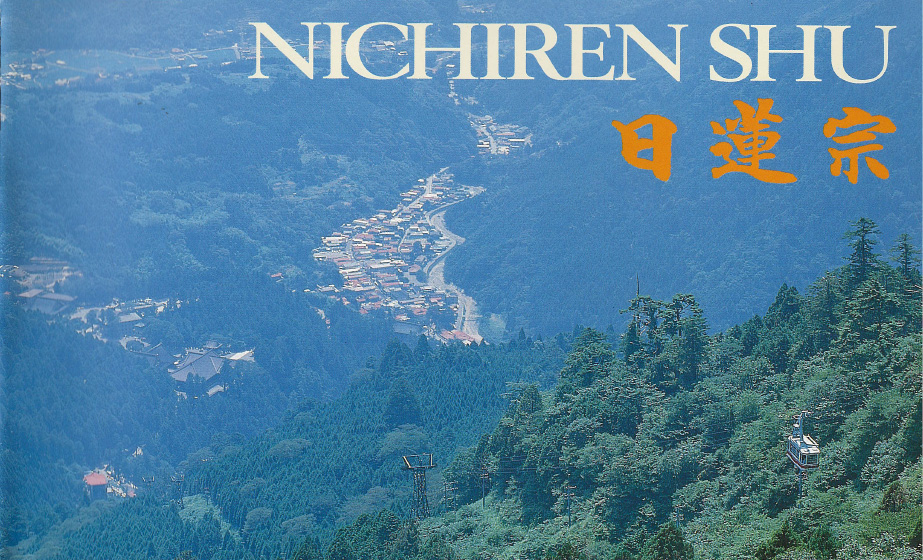
Recently I found a stack of old brochures at the Sacramento Nichiren Buddhist Church. The 28-page 6 inch by 8 inch brochure was produced by Nichiren Order of North America in 1991.

You can read the brochure on the church website here.

I enjoyed this description of the Odaimoku:

According to Nichiren Shonin, the Odaimoku is not a mere representation of Buddha’s Truths. Rather it is the embodiment of Buddha’s Truths when the formula is uttered with a firm belief of the truths contained in the Lotus Sutra and with full acceptance of Buddha as the Saviour.

It also includes this handy list of “Holy Days”:

The Buddha’s Nirvana Day, February 15
After 45 years of preaching, Śākyamuni Buddha entered into Nirvana, perfect tranquility, at the age of 80 in Kusinagara.
Nichiren Shonin’s Birthday, February 16
Nichiren Shon-in was born on February 16, 1222, at Kominato, Chiba.
Sakyamuni Buddha’s Birthday, Apri1 8
Sakyamuni Buddha was born in Lumbini, on April 8, 565 B.C., as a pricce of the Sakya Clan.
Proclamation of the establishment of a new order, April, 28 ·
Nichiren Shonin declared he would establish his faith in the Lotus Sutra at Seichoji Temple in his home town, Kominato on April 28, 1253.
Exile to Izu Peninsula, May 12
In 1260 Nichiren Shōnin presented his work, the “Rissho Ankoku Ron” and admonished the government against believing wrong teachings. On May 12, 1261, he was exiled to Jzu Yeniosula because of his admonition.
Matsubagayatsu ‘ Persecution August 27
The presentation of the “Risshō Ankoku-ron” caused rioters to attack Nichiren Shōnin and they set fire to his hermitage at Matsubagayatsu on Aug. 27, 1260.
Tatsunokuchi Persecution, September J2
In 1271 the government was displeased by Nichiren Shōnin’s propagating acts and he was arrested and exiled to Sado Island. On September 12, on the way to Sado, he was about to be executed at Tatsunokuchi, but his life was saved by a mysterious light from the sky.
Sado Exile, October 10
After Nichiren Shōnin escaped execution at Tatsunokuchi, he was exiled to Sado Island on October 10, 1271. He was there for three years.
Oeshiki, October 13
On the way from Mt. Minobu to Hitachi Spa to cure his illness, Nichiren Shōnin ended his 60 years of eventful life at Ikegami, Tokyo, on October 13, 1282.
Komatsubara Persecution, November 11
Nichiren Shōnin and his disciples were attacked by the lord Kagenobu Tojo, and his conspirators on a path in the forest of Komastubara in Tojo’s territory on November 11, 1264. Nichiren Shōnin was injured on his head and one of his disciples and one follower were killed.

Download PDF copy of this brochure