All posts by John Hughes

Daily Dharma – Aug. 10, 2019

Needless to say, boundless will be the merits
Of the person who hears this sūtra with all his heart,
And expounds its meanings,
And acts according to its teachings.

The Buddha sings these verses to Maitreya (whom he calls Ajita – Invincible) in Chapter Eighteen of the Lotus Sutra. The merits we gain through our study and practice of the Lotus Sūtra do not make us better than any of the other beings with whom we share this world. Merits accumulate when we strip away our delusions and see the world for what it is. We sometimes focus on what we can do to change the world, thinking that merely changing how we look at the world will have little effect. It is only when we see things for what they are that we can act effectively. Otherwise we are merely reinforcing the delusions of ourselves and others.

The Daily Dharma is produced by the Lexington Nichiren Buddhist Community. To subscribe to the daily emails, visit zenzaizenzai.com

Day 16

Day 16 concludes Chapter 11, Beholding the Stūpa of Treasures, and completes the Fourth Volume of the Sūtra of the Lotus Flower of the Wonderful Dharma.

Having last month witnessed Śākyamuni’s effort to purify the Sahā-World in order to accommodate all of his emanations from the worlds of the ten quarters, we witness Śākyamuni opening the door to the Stupa of Treasures.

Thereupon one of the Buddhas on the lion-like seats under the jeweled trees, wishing to inquire after Śākyamuni Buddha, gave a handful of jeweled flowers to his attendant, and said to him, [wishing to] dispatch him:

“Good man! Go to Śākyamuni Buddha who is now living on Mt. Gṛdhrakūṭa! Ask him on my behalf, ‘Are you in good health? Are you peaceful? Are the Bodhisattvas and Śrāvakas peaceful or not?’ Strew these jeweled flowers to him, offer them to him, and say, ‘That Buddha sent me to tell you that he wishes to see the stūpa of treasures opened.”‘

All the other Buddhas also dispatched their attendants in the same way.

Thereupon Śākyamuni Buddha, having seen that all the Buddhas of his replicas had already arrived and sat on the lion-like seats, and also having heard that they had told their attendants of their wish to see the stūpa of treasures opened, rose from his seat, and went up to the sky. All the four kinds of devotees stood up, joined their hands together towards him, and looked up at him with all their hearts. Now he opened the door of the stūpa of the seven treasures with the fingers of his right hand. The opening of the door made a sound as large as that of the removal of the bolt and lock of the gate of a great city. At that instant all the congregation saw Many Treasures Tathāgata sitting with his perfect and undestroyed body on the lion-like seat in the stūpa of treasures as if he had been sitting in dhyāna-concentration. They also heard him say:

“Excellent, excellent! You, Śākyamuni Buddha, have joyfully expounded the Sūtra of the Lotus Flower of the Wonderful Dharma. I have come to hear this sūtra [directly from you].”

The Daily Dharma from April 28, 2019, offers this:

“Good man! Go to Śākyamuni Buddha who is now living on Mt. Gṛdhrakūṭa! Ask him on my behalf, ‘Are you in good health? Are you peaceful? Are the Bodhisattvas and Śrāvakas peaceful or not?’ Strew these jeweled flowers to him, offer them to him, and say, ‘That Buddha sent me to tell you that he wishes to see the stūpa of treasures opened.’”

In Chapter Eleven of the Lotus Sūtra, Buddhas and their devotees from innumerable worlds come to our world of conflict and delusion to see Śākyamuni Buddha open the tower inhabited by Many-Treasures Buddha. As our capability for enlightenment wells up from within us, the tower of treasures sprang up from underground when the Buddha asked who would teach the Wonderful Dharma after the Buddha’s extinction. The treasures in the tower are nothing more than Many-Treasures Buddha declaring the Lotus Sūtra to be the Teaching of Equality, the Great Wisdom, the Dharma for Bodhisattvas and the Dharma upheld by the Buddhas.

The Daily Dharma is produced by the Lexington Nichiren Buddhist Community. To subscribe to the daily emails, visit zenzaizenzai.com

Ichinen Sanzen

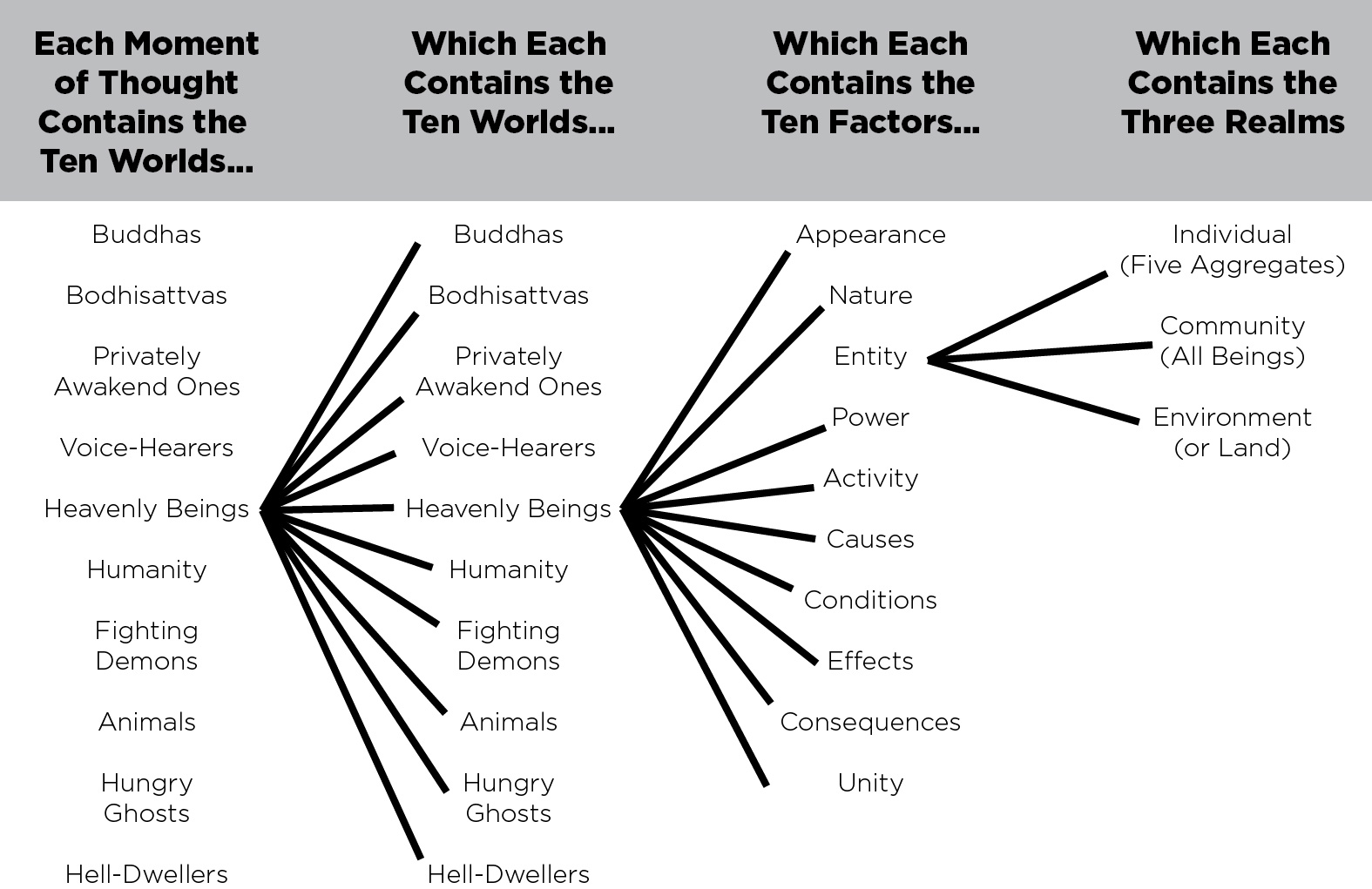
Ichinen Sanzen, the Three Thousand Worlds Contained in One Thought, is the theoretical cornertone of Nichiren Buddhism. It is a universal vision of life as rich, dynamic, and meaningful. Ichinen Sanzen reveals thal all life contains all Ten Worlds, including Buddhahood, and that these worlds operate according to the causes and conditions that we all set in motion. In a praclical sense, this theory means that we are able to make the cause that will allow the world of Buddhahood to emerge in our lives when we chant Namu Myoho Renge Kyo.

3000 worlds

Lotus Seeds

Daily Dharma – Aug. 9, 2019

If anyone keeps, reads, recites, expounds and copies even a gāthā of the Sūtra of the Lotus Flower of the Wonderful Dharma, and respects a copy of this sūtra just as he respects me…or just joins his hands together respectfully towards it, Medicine-King, know this, that person should be considered to have appeared in the world of men out of their compassion towards all living beings.

The Buddha declares these lines to Medicine-King Bodhisattva at the beginning of Chapter Ten of the Lotus Sūtra. We might believe that everything happens by chance, or that we were sent into this life by someone who is testing us. This Sūtra awakens us to our existence as Bodhisattvas who asked to be born in this world of suffering out of our vow to benefit all beings.

The Daily Dharma is produced by the Lexington Nichiren Buddhist Community. To subscribe to the daily emails, visit zenzaizenzai.com

Day 15

Day 15 concludes Chapter 10, The Teacher of the Dharma, and opens Chapter 11, Beholding the Stūpa of Treasures.

Having last month learned how good men or women who live after the Buddha’s extinction should expound this Sūtra of the Lotus Flower of the Wonderful Dharma, we repeat in gāthās how good men or women who live after the Buddha’s extinction should expound this sūtra.

Thereupon the World-Honored One, wishing to repeat what he had said, sang in gāthās:

If you wish to give up all indolence,
Hear this sūtra!
It is difficult to hear this sūtra.
Few receive it by faith.

A man on a plateau, feeling thirsty,
Dug a hole in order to get water.
As long as he saw the dug-out lumps of earth were dry,
He knew that water was still far off.
When he found the earth wet and muddy,
He was convinced that water was near.

In the same manner, Medicine-King, know this!
Those who do not hear
The Sūtra of the Lotus Flower of the Wonderful Dharma
Are far from the wisdom of the Buddha.

In this profound sūtra
The teachings for the Śrāvakas are criticized.
Those who hear
That this sūtra is the king of all the sūtras,
And think over this sūtra clearly after hearing it,
Know this, will approach the wisdom of the Buddha.
If you wish to expound this sūtra,
Enter the room of the Tathāgata,
Wear the robe of the Tathāgata,
Sit on the seat of the Tathāgata,
[And after doing these three things,]
Expound it to people without fear!

To enter the room of the Tathāgata means to have great compassion.
To wear his robe means to be gentle and patient.
To sit on his seat means to see the voidness of all things.
Expound the Dharma only after you do these [three] things!

The Daily Dharma from Dec. 1, 2018, offers this:

In this profound sūtra
The teachings for the Śrāvakas are criticized.
Those who hear
That this sūtra is the king of all the sūtras,
And think over this sūtra clearly after hearing it,
Know this, will approach the wisdom of the Buddha.

The Buddha sings these verses to Medicine-King Bodhisattva in Chapter Ten of the Lotus Sūtra. He has already declared that the sūtra he is teaching is the closest to his own wisdom, that it is different from anything he has taught before, and that it is the teaching for Bodhisattvas. The expedient teachings he gave to Śrāvakas before this sūtra were limited because they did not show the way to enlightenment for all beings. As we keep this sūtra in our minds, and learn to recognize it in our daily lives, we not only approach our own enlightenment, we lead all beings to enjoy the Buddha’s wisdom.

The Daily Dharma is produced by the Lexington Nichiren Buddhist Community. To subscribe to the daily emails, visit zenzaizenzai.com

Daily Dharma – Aug. 8, 2019

The Buddha said to Universal-Sage Bodhisattva: “The good men or women will be able to obtain this Sūtra of the Lotus Flower of the Wonderful Dharma after my extinction if they do the following four things: (1) secure the protection of the Buddhas, (2) plant the roots of virtue, (3) reach the stage of steadiness [in proceeding to enlightenment], and (4) resolve to save all living beings. The good men or women will be able to obtain this sūtra after my extinction if they do these four things.”

For us who aspire to this difficult practice of the Wonderful Dharma, the Buddha gives this guide in Chapter Twenty-Eight of the Lotus Sūtra. For us to have even heard of this sūtra in this life we must have already done these four things. In order to maintain this practice, we need to use the Buddha’s protection for the benefit of all beings, not just for our benefit alone. We need to nourish the virtuous seeds we have already planted, remain steady and confident on the path to enlightenment, and sustain our determination to maintain our respect for everyone.

The Daily Dharma is produced by the Lexington Nichiren Buddhist Community. To subscribe to the daily emails, visit zenzaizenzai.com

Day 14

Day 14 covers all of Chapter 9, The Assurance of Future Buddhahood of the Śrāvakas Who Have Something More to Learn and the Śrāvakas Who Have Nothing More to Learn, and opens Chapter 10, The Teacher of the Dharma.

Having last month heard Śākyamuni’s prediction for Ānanda, we repeat Śākyamuni’s prediction for Ānanda in gāthās.

Thereupon the World-Honored One, wishing to repeat what he had said, sang in gāthās:

Now I announce to the Saṃgha:
Ānanda, the keeper of the Dharma,
Will make offerings to Buddhas,
And then attain perfect enlightenment.

He will be called
Mountain-Sea-Wisdom-Supernatural-Power-King.
His world will be pure, and called
Always-Raising-Banner-Of-Victory.

He will teach as many Bodhisattvas
As there are sands in the River Ganges.
He will be exceedingly powerful and virtuous.
His fame will extend over the worlds of the ten quarters.

The duration of his life will be immeasurable
Because he has compassion towards all living beings.
His right teachings will be preserved for twice as long as his life;
The counterfeit of them, for twice as long as his right teachings.

Under him, as many living beings
As there are sands in the River Ganges
Will obtain the seeds
Of the enlightenment of the Buddha.

Lacking any other comment on this section, I’m going to take this opportunity to reprint the Oxford Dictionary of Buddhism entry on Ānanda:

Ānanda. One of the Buddha’s chief disciples and his first cousin, his father being a brother of Suddhodana, the Buddha’s father. It appears that he entered the Order (Samgha) in the second year of the Buddha’s ministry and was ordained by the Buddha himself. According to the Pāli accounts, after twenty years in which he did not have the same personal attendant all the time, the Buddha made known his wish for a permanent one. All the great disciples offered their services, but Ānanda, not initially seeking the position, was eventually selected by the Buddha. He agreed to serve the teacher, provided a series of conditions were fulfilled. On one hand Ānanda requested not to receive any extra benefits as a result of his position, such as choice clothes or food, separate lodgings, or the inclusion in the invitations accepted by the Buddha. On the other hand, he asked to be allowed to accept invitations on behalf of the Buddha, to bring to the Buddha those who came to see him from afar, to place before the Buddha all his perplexities, while the Buddha was to repeat to him any doctrine taught in his absence.

Ānanda was highly regarded by his colleagues who often consulted him and it is said that sometimes the monks, having heard a sermon from the Buddha, would ask Ānanda to give them a more detailed exposition since he had a reputation of being able to explain the doctrine clearly. Ānanda’s championship of the cause of women is also well known. In particular, he is especially recognized for his role in the establishment of an order of nuns. Ānanda was also revered for his powerful memory. For this reason, when the First Council was called in Rājagṛha, following the Buddha’s death, he was chosen by Mahākāśyapa, president of the Council, to recite all of the sermons preached by the Buddha, thus establishing the canonical record known as the Sūtra Pitaka, or ‘Basket of Discourses’. Ānanda lived to be very old, spending his last years teaching and preaching. The details of his death are not reported in the Pāli Canon.

Buddhist Dependent Origination vs. Indian Philosophies

Two factors distinguish dependent origination, the Buddhist doctrine of causation, from contemporary Indian philosophies. First, it confines itself to the world of actual experience and makes no attempt to deal with universal absolutes, which are beyond the realm of human cognizance and influence. Second, while teaching that given the requisite conditions each cause produces its inevitable effect, it rejects both the idea that human fate is fortuitous and the idea that it is completely governed by any single, fixed cause.
Basic Buddhist Concepts

Daily Dharma – Aug. 7, 2019

The Indian lizard kṛkalāsa eats in the wind; it won’t grow if there is no wind. A fish lives in the water, and a bird makes a nest in the tree. Likewise, Buddhas live in the Lotus Sutra. As the moon’s reflection resides in the water, Buddhas reside in the Lotus Sutra. Therefore, you must remember that where there is no Lotus Sutra, there are no Buddhas.

Nichiren wrote this passage in his Response to My Lady the Nun, Mother of Lord Ueno (Ueno-dono Haha-ama Gozen Gohenji). We may take for granted our opportunity to find and practice the Lotus Sūtra in this lifetime. In Nichiren’s writings, and in the Lotus Sūtra itself, we are reminded of the great benefit we have created and the great hardships we have already endured to allow us to find this Wonderful Dharma and have the opportunity to practice it. When we try to rely on the transitory aspects of our lives, we are surely disappointed. It is only when we keep and practice this Sūtra that we find the Buddha leading us to our true birthright, the enlightenment he knows we and all beings can reach.

The Daily Dharma is produced by the Lexington Nichiren Buddhist Community. To subscribe to the daily emails, visit zenzaizenzai.com

Day 13

Day 13 covers all of Chapter 8, The Assurance of Future Buddhahood of the Five Hundred Disciples.

Having last month heard in gāthās Pūrṇa’s secret Bodhisattva practices, we consider the prediction for Pūrṇa Bhikṣu.

Under hundreds of thousands of millions of past Buddhas,
This Pūrṇa practiced strenuously what he should do.
He expounded and protected
The teachings of those Buddhas.

In order to obtain unsurpassed wisdom,
He became the most excellent disciple
Of those Buddhas.
He was learned and wise.
He expounded the Dharma without fear,
And made his listeners rejoice.
He was never tired
Of helping those Buddhas do their work.

He obtained great supernatural powers
And the four kinds of unhindered eloquence.
Seeing who was clever, and who was dull,
He always expounded the Pure Dharma.

He expounded the dharma of the Great Vehicle
To hundreds of thousands of millions of living beings,
And caused them to dwell in the Dharma
So that the worlds of those Buddhas might be purified.

In the future also he will make offerings
To innumerable Buddhas, protect their right teachings,
Help them propagate their teachings,
And purify their worlds.

He will always fearlessly expound the Dharma
With expedients.
He will save countless living beings
And cause them to have the knowledge of all things.

He will make offerings to many Tathāgatas
And protect the treasure-store of the Dharma.
After that he will be able to become a Buddha
Called Dharma-Brightness.

His world will be called Good-Purity.
It will be made of the seven treasures.
His kalpa will be called Treasure-Brightness.
There will be Bodhisattvas [in his world],
Many hundreds of millions in number.
They will have great supernatural powers.
They will be powerful and virtuous.
They will be seen throughout that world.

Innumerable Śrāvakas will organize the Saṃgha.
They will have the three major supernatural powers,
The eight emancipations,
And the four kinds of unhindered eloquence.

The living beings of that world will have no sexual desire.
They will be born without any medium.
They will be adorned with the marks [of the Buddha].
They will not think
Of any other food [than the two kinds of food]:
The delight in the Dharma, and the delight in dhyāna.
There will be neither women nor evil regions
In that world.

Pūrṇa Bhikṣu will be able to obtain
All these merits,
And have his pure world
Inhabited by many sages and saints.
I have innumerable things to say of him.
I have told you only a few of them.

The Introduction to the Lotus Sutra offers this on Pūrṇa:

“Hearers” of the Lesser Vehicle usually sought as their goal the fulfillment of their own private training. They expected others to imitate the strict practices which they performed, and had little patience with ordinary people caught up in the problems of everyday life.

Purna was an exception. He looked like a sravaka, but he went about preaching the law to common people, and doing so with such eloquence that he was able to cause many of them to aspire to supreme-perfect-enlightenment. Therefore, in reality he was not a sravaka at all, but a Bodhisattva (one who devotes his life to helping others). Any Bodhisattva must also be a preacher (otherwise he cannot help anyone), and that is why a Bodhisattva is called a “teacher of the law.” From Chapter Ten on, the Lotus Sutra will clarify the mission of Bodhisattvas. (Here it is only suggested.)

Introduction to the Lotus Sutra