
All posts by John Hughes

Day 32

Day 32 covers Chapter 28, The Encouragement of Universal-Sage Bodhisattva, closing the Eighth Volume of the Sutra of the Lotus Flower of the Wonderful Dharma.

Having last month received Universal-Sage’s dhārāṇi spells, we hear Universal Sage prediction for anyone who keeps the Sūtra of the Lotus Flower of the Wonderful Dharma.

[He said to the Buddha:]

“World-Honored One! It is by my supernatural powers, know this, that a Bodhisattva can hear these dhārāṇis. Anyone who keeps the Sūtra of the Lotus Flower of the Wonderful Dharma [while it is] propagated in the Jambudvipa, should think, ‘I can keep [this sūtra] only by the supernatural powers of Universal-­Sage.’ Anyone who keeps, reads and recites this sūtra, memorizes it correctly, understands the meanings of it, and acts according to it, know this, does the same practices that I do. He should be considered to have already planted deeply the roots of good under innumerable Buddhas [in his previous existence]. He will be caressed on the head by the hands of the Tathāgatas. Anyone who copies this sūtra will be reborn in the Heaven of the Trāyastriṃs̒a Gods immediately after his present life. On that occasion, eighty-four thousand goddesses will come and receive him, making many kinds of music. A crown of the seven treasures will be put on his head, and he will enjoy himself among the ladies in waiting. Needless to say, [more merits will be given to] the person who [not only copies this sūtra but also] keeps, reads and recites it, memorizes it correctly, understands the meanings of it, and acts according to it. Anyone who keeps, reads and recites this sūtra, and understands the meanings of it, will be given helping hands by one thousand Buddhas immediately after his present life. He will be fearless. He will not fall into any evil region. He will be reborn in the Tusiita Heaven. There he will go to Maitreya Bodhisattva who, adorned with the thirty-two marks, will be surrounded by great Bodhisattvas, and attended on by hundreds of thousands of billions of goddesses. He will be given the benefits of these merits. Therefore, anyone who has wisdom should copy this sūtra with all his heart, cause others to copy it, and also keep, read and recite it, memorize it correctly, and act according to it.

The Daily Dharma from Feb. 9, 2019, offers this:

Therefore, anyone who has wisdom should copy this sūtra with all his heart, cause others to copy it, and also keep, read and recite it, memorize it correctly, and act according to it.

The Buddha declares this to Universal-Sage Bodhisattva in Chapter Twenty-Eight of the Lotus Sūtra. It is important to remember that early in the sūtra, the Buddha explained that he teaches only Bodhisattvas, beings who exist for the benefit of all beings. Our practice of the Lotus Sūtra is not just for ourselves. When we use it to lead others to enlightenment, we create the cause for our own enlightenment.

The Daily Dharma is produced by the Lexington Nichiren Buddhist Community. To subscribe to the daily emails, visit zenzaizenzai.com
21 Days: The Elephant Walk

Programming note: Having completed the 21-day stay-cation retreat encouraged by Universal Sage Bodhisattva, I still have some things I want to say about the Sutra of Innumerable Meanings and The Dharma Practice of Universal Sage Bodhisattva. For the next several days I will add this as an extended 21 Days series.


I can’t imagine any discussion of the The Sutra of Contemplation of the Dharma Practice of Universal Sage Bodhisattva that doesn’t include the Elephant Walk (Reeves, p402-404). Enjoy.

The body of Universal Sage Bodhisattva is unlimited, the range of his voice is unlimited, and the forms of his image are unlimited. When he wants to come to this world he uses his own divine powers to shrink his body to a smaller size. Because the three hindrances of the people in Jambudvipa are heavy, through the power of his wisdom he transforms himself and rides a white elephant.

The elephant has six tusks and is supported by seven legs. Under its seven legs are seven live lotus flowers. The elephant is as white as snow, the most brilliant of whites. Even crystal or the Himalayas cannot be compared with it. The body of the elephant is four hundred and fifty leagues long and four hundred leagues tall.

At the tips of its six tusks are six bathing pools, and in each bathing pool grow fourteen lotus flowers, filling them all equally. The flowers bloom majestically, like the king of heavenly foliage. On each of these flowers sits a jade maiden, with a crimson face surpassing even that of a goddess. In the hands of each of the maidens five harps appear spontaneously, each accompanied by five hundred other musical instruments. Five hundred birds, as colorful as precious gems, including wild ducks, wild geese, and mandarin ducks, are among the leaves and flowers. On the elephant’s trunk there is a flower with a stalk the color of red pearl. The flower itself is gold in color and looks like a bud that has not yet blossomed.

After witnessing this, if anyone continues to repent and contemplates the Great Vehicle sincerely, unceasingly pondering over it with clear vision, they will be able to see the flower bloom and radiate a golden color.

The calyx of the lotus flower is made of kimshuka jewels and wonderful and pure mani jewels. Its stamens are made of diamonds. A transformed buddha can be seen sitting on the calyx of the lotus flower with a host of bodhisattvas sitting on the stamens. From between the eye brows of the transformed buddha comes a golden light, which goes into the elephant’s trunk with the color of a red lotus flower. This light comes out of the elephant’s trunk and enters its eyes. Then it shines from the elephant’s eyes and enters its ears. It then comes out of the elephant’s ears, illuminates the top of its head, and changes into a golden platform.

On the elephant’s head are three transformed attendants. One has a golden wheel in its hands, another holds a mani jewel, and another grasps a diamond pounder. When the attendant raises the pounder and points it at him, the elephant immediately takes a few steps. The elephant does not step on the ground but hovers in the air, seven feet above the earth, yet it leaves its footprints on the ground. The footprints have in them a Dharma wheel with a hub and a thousand spokes, all of them perfect. In each Dharma wheel is a great lotus flower, on which there is a transformed elephant. These elephants also have seven legs and walk behind the great elephant. Every time one of these elephants raises and brings down a foot, seven thousand elephants appear, all following behind the great elephant.

On the elephant’s trunk, the color of a red lotus flower, sits a transformed buddha, who emits light from between his eyebrows. This golden light, as before, enters the elephant’s trunk, which is the color of a red lotus flower. This light comes out of the elephant’s trunk and enters its eyes. Then it shines from the elephant’s eyes and enters its ears. It then comes out of the elephant’s ears and reaches the top of its head.

Gradually going up the elephant’s back, the light is transformed into a golden saddle adorned with the seven precious materials. On all four sides of the saddle are pillars made of the seven precious materials and decorated with sets of jewels, making a jeweled pedestal. On this pedestal there is a lotus flower stamen of the seven precious materials, and that stamen also has on it a hundred jewels. The blossom of that lotus flower is made of a great mani jewel.

The bodhisattva named Universal Sage sits there cross-legged. On his body, pure as a white jewel, are fifty lights of fifty different colors, forming a halo over his head. Golden light radiates from the pores of his body, and innumerable transformed buddhas are at the ends of the golden rays, accompanied by transformed bodhisattvas to serve them.

The elephant walks deliberately and carefully. Going slowly, he pours large jeweled lotus flowers before a follower. When this elephant opens its mouth, the jade maidens in the bathing pools on the elephant’s tusks play fine and wonderful music that praises the one true way of the Great Vehicle. Having seen this, the follower rejoices and shows respect, again reading and reciting the profound sutras, showing respect to the innumerable buddhas in all directions wherever they may be, to the Stupa of Abundant Treasures Buddha, to Shakyamuni Buddha, and to Universal Sage and other great bodhisattvas.

Makes me want to practice.

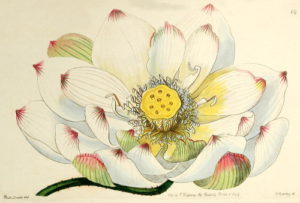
lutus_anatomy_illustration
Lotus flower anatomy illustration circa 1844 showing the central calyx and the surrounding stamens.

The Threefold Lotus translation offers some helpful footnotes.

  • Three hindrances: Arrogance, envy and covetousness.
  • Six tusks: Suggesting the purity of the six sense organs: eye, ear, nose, tongue, body, and mind.
  • Seven legs: Suggesting the absence of the seven evils: killing, stealing, committing adultery, lying, speaking ill of others, improper language, and having a double tongue.
  • Transformed Buddha: The transformed body in which a Buddha manifests himself in order to save sentient beings.

With the Encouragement of Universal-Sage Bodhisattva

“World-Honored One! The bhikṣus, bhikṣunīs, upāsakās or upāsikās who seek, keep, read, recite and copy this Sūtra of the Lotus Flower of the Wonderful Dharma in the defiled world in the later five hundred years after [your extinction], if they wish to study and practice this sūtra, should concentrate their minds [on study and practice] strenuously for three weeks. When they complete [the study and practice of] three weeks, I will mount a white elephant with six tusks, and appear before them with my body which all living beings wish to see, together with innumerable Bodhisattvas surrounding me. I will expound the Dharma to them, show them the Way, teach them, benefit them, and cause them to rejoice.

Chapter 28: The Encouragement of Universal-Sage Bodhisattva

With the encouragement of Universal-Sage Bodhisattva I concentrated my mind on study and practice strenuously for three weeks. It was a very unusual 21 days.

Let me set the stage: On June 29, my wife left for Upstate New York to prepare her parents’ house for sale. Her flight home is schedule July 24. Ostensibly, I was left behind to care for our cats and watch over the house and perhaps harvest a few of those year-round “Honey, Do…” that ripen and demand to be harvested.

In reviewing my wife’s travel plans it occurred to me that I had an excellent opportunity from July 1 to July 21 to take up the encouragement of Universal-Sage Bodhisattva to concentrate my mind on study and practice strenuously for three weeks.

So I declared a 21-day stay-cation retreat, promising to wear my dark blue samue between sunrise and sunset including while preforming a daily one-hour walking meditation.

Before I started I imagined that I would add a half-hour midday service to my existing practice during which I would recite aloud a portion of the Sutra of Innumerable Meanings and, when that was completed, The Sutra of Contemplation of the Dharma Practice of Universal Sage Bodhisattva (Reeves). But by the end of the first day I felt that was not ambitious enough. Beginning with Day 2, I began reciting all of both sutras as separate midday practices. Each takes about one hour to recite.

For the first two weeks I walked an hour, performed my morning service, recited first one sutra and then the other and finished the day with my regular evening service. Between each element I would read and write.

Still, I had this nagging feeling that “I have now made these offerings, yet I do not think that they are enough,” to quote Gladly-Seen-By-All-Beings Bodhisattva.

I wanted to recite the entire threefold Lotus Sutra in a single day. Better still, I wanted to recite it in shindoku on one day and in English the next. Since I don’t have shindoku versions of the Sutra of Innumerable Meanings and The Sutra of Contemplation of the Dharma Practice of Universal Sage Bodhisattva, the English would suffice. I vowed to do this on Saturday and Sunday, the final two days of my 21-day stay-cation retreat.

During the final week, I tested how long it takes to recite one fascicle (there are eight in the Lotus Sutra, plus the other two sutras). And I pushed my entire practice – morning service, Innumerable Meanings, Contemplation of Universal Sage, evening service – into a single session to get a feel for sitting for hours in front of my altar.

On Friday, as a final exercise, I extended my morning service daimoku to one hour and added an hour of daimoku after each of the sutras and concluded by extending my evening service daimoku to one hour. I was chanting in front of my altar from 6:30am to after 5pm, with short breaks between elements.

As I prepared for Saturday and Sunday I had expectations that it would take, maybe, 12 hours to accomplish my morning service and recitation of the complete Lotus Sutra and my evening service. I was wrong.

On Saturday I did my morning walking meditation from 5:07am to 6:17am. I took a short nap and began my morning service just before 7am. The sutra of Innumerable Meanings required just under an hour and the eight fascicles of the Lotus Sutra in shindoku consumed 9 hours and 21 minutes. The Contemplation of Universal Sage took just over an hour. I finished a very abbreviated evening service at 9:50pm, having taken a handful of small breaks during the day. It had been a 14 hour and 54 minute day, not counting the walking meditation.

On Sunday, the final day of my retreat, I decided to skip the walking meditation and instead start with the instructions offered by Universal Sage (Reeves, p420):

If anyone wants to reach supreme awakening rapidly and see the buddhas in the ten directions and Universal Sage Bodhisattva in this life, they should purify themselves by taking a bath, putting on clean clothes, burning rare incense, and living in a secluded place. They should recite and read the Great Vehicle sutras and think about the meaning of the Great Vehicle.

I showered, dressed in a clean samue and began my morning service at 5:50am. The Sutra of Innumerable Meanings required an hour. The English recitation of the eight fascicles of the Lotus Sutra consumed 9 hours and 58 minutes. The Contemplation of Universal Sage took a little more than an hour. And I concluded a full evening service at 7:50pm, exhausted but happy that I had finished that day and the 21 days.

Over the next couple of weeks I expect to publish daily quotes from the two sutras to add to those I posted in the final 14 days of my 21-day stay-cation retreat.

Day 1 of 21

Daily Dharma – July 22, 2019

Suppose parents who had an aversion to alcohol had a son who loved to drink liquor. Because of their love for their son and also to cater to his whim, they made it a point to offer him alcohol, pretending that they were also drinkers of liquor. The hopeless son then assumed that his parents truly loved alcohol. Sutras preached according to others’ minds are the same.

Nichiren wrote this passage in his treatise, The Sutra Preached in Accordance to [the Buddha’s] Own Mind (Zui-jii Gosho). In the Lotus Sūtra, the Buddha sets aside his expedient teachings and leads us to his own way of thinking. He knew the difficulty of changing our habits and beliefs, so he started by catering to our selfish desires to be happy and end our own suffering. For us to realize our full potential for wisdom and compassion, we must stand up to our fears and nourish our true nature as Bodhisattvas: beings who exist to create benefits for the entire universe.

The Daily Dharma is produced by the Lexington Nichiren Buddhist Community. To subscribe to the daily emails, visit zenzaizenzai.com

Day 31

Day 31 covers Chapter 27, King Wonderful-Adornment as the Previous Life of a Bodhisattva.

Having last month considered the effect of wonders displayed by the two sons on their father, we witness the two asking their mother to be allowed to join the Buddha.

“Thereupon the two sons descended from the sky, came to their mother, joined their hands together, and said to her, ‘Our father, the king, has now understood the Dharma by faith. He is now able to aspire for Anuttara-samyak-saṃbodhi. We did the work of the Buddha for the sake of our father. Mother! Allow us to renounce the world and practice the Way under that Buddha!’

“Thereupon the two sons, wishing to repeat what they had said, said to their mother in gāthās:

Mother! Allow us to renounce the world
And become śramaṇas!
It is difficult to see a Buddha.
We will follow that Buddha and study.
To see a Buddha is as difficult
As to see an udumbara[-flower ]
To avert a misfortune is also difficult.
Allow us to renounce the world!

“The mother said, ‘I allow you to renounce the world because it is difficult to see a Buddha.’

Concluding my 21-day retreat encouraged by Universal-Sage Bodhisattva, we consider Day 21 of 21.

Day 21 of 21

And concluding three weeks of reading The Sutra of Innumerable Meanings, I offer this meaning (Reeves, p37-38):

“Good sons, after leaving the king of trees, when I turned the Dharma wheel of the four truths for the five men at Deer Park in Varanasi, Ajnata-Kaundinya and the others, I taught that all things are originally empty and calm, ceaselessly changing, arising and perishing in an instant.

“When I spoke in various places during the middle period, proclaiming the twelve causes and conditions and the six transcendental practices for monks and the group of bodhisattvas, I also taught that all things are originally empty and calm, ceaselessly changing, arising and perishing in an instant.

“Now, preaching the Great Vehicle Sutra of Innumerable Meanings, I also teach that all things are originally empty and calm, ceaselessly changing, arising and perishing in an instant.

“Good sons, this is why the teachings at the beginning, in the middle, and at the end are the same in expression but different in meaning. Since the meaning is different, so too the understandings of living beings differ. And since understandings differ, so too attainments of the Dharma, of its fruits, and of the Way differ.

“Good sons, at the beginning, though I taught the four truths for those who sought to be śrāvakas, eight million heavenly beings came down to hear the Dharma and aspired to become awakened. In the middle, though I preached the profound twelve causes and conditions in various places for those who sought to be pratyekabuddhas, innumerable living beings aspired to become awakened or continue as śrāvakas. Next, though I proclaimed over many eons the practice of bodhisattvas by teaching the equality of the twelve literary forms of the Great Wisdom Sutra, and the vast Flower Garland Sutra, hundreds of thousands of monks, tens of thousands of millions of human and heavenly beings, and innumerable other living beings could remain as stream-enterers, once-returners, non-returners, or arhats in the Dharma of causes and conditions appropriate for pratyekabuddhas.

“Good sons, for this reason, it is known that while the teaching is the same, the meanings differ. Since the meanings differ, so too the understandings of living beings differ. And since understandings differ, so too attainments of the Dharma, of its fruits, and of the Way differ. Thus, good sons, from when I attained the Way and stood to teach the Dharma for the first time until I proclaimed the Great Vehicle Sutra of Innumerable Meanings today, I have never ceased preaching about suffering, emptiness, impermanence, no enduring self, the absence of greatness, the absence of pettiness, original non-arising, present non-extinction, one character, absence of character, Dharma character, Dharma nature, non-corning, non-going, and the four modes by which all the living are driven.

“Good sons, this is why all buddhas everywhere respond to the variety of voices without a forked tongue and with one sound. Though each has only one body, they show bodies as innumerable and numberless as the sands of hundreds of thousands of millions of billions of Ganges. In each body, they display a number of similar types, countless as the sands of hundreds of thousands of millions of billions of Ganges. And in each type, they show forms as countless as the sands of hundreds of thousands of millions of billions of Ganges.

“Good sons, accordingly, this is the inconceivable and profound sphere of all the buddhas. The two vehicles cannot comprehend it, and even bodhisattvas at the tenth stage cannot reach it. Only among buddhas can it be fathomed well.

“Good sons, this is why I teach that the wonderful, profound, and unexcelled Great Vehicle Sutra of Innumerable Meanings is truly correct in logic, unsurpassed in value, and protected by the buddhas of the past, present, and future. No demonic or non-Buddhist ways can damage it, nor can any wrong view of life and death defeat or destroy it.

“Therefore, bodhisattva great ones, if you want to attain unexcelled awakening quickly, you should practice and study the profound, unexcelled Great Vehicle Sutra of Innumerable Meanings.”

Day 20 of 21

Great Bodhisattvas with Powers of the Buddha

The great bodhisattvas who have emerged from the ground go up to the sky and bow before the great stupa with the two Buddhas seated side by side. Then they return to the ground, go around and greet each of the emanation Buddhas one by one, after which the Bodhisattvas return to the sky. This activity takes a great deal of time, fifty kalpas we are told, and yet the time only seemed to be no more than half a day to those who witnessed it due to the great power of the Buddha. Notice here that these Bodhisattvas had complete freedom of movement, they could go up to the sky, they could return to the ground and travel about, and they could then again return to the sky. This is in sharp contrast to the members of the original assembly who had to be raised up by the power of the Buddha.

These Bodhisattvas from beneath the ground not only have the marks and characteristics of the Buddha, they also have the powers of the Buddha.

Lecture on the Lotus Sutra

Daily Dharma – July 21, 2019

Anyone who protects this sūtra
Should be considered
To have already made offerings
To Many-Treasures and to me.

The Buddha makes this declaration to all those assembled to hear him teach the Dharma in Chapter Eleven of the Lotus Sūtra. In the story, Many-Treasures Buddha has just appeared to confirm the truth of the sūtra, and the Buddha has asked who will protect and preserve this sūtra after his extinction. By considering anyone who defends the meaning of the Lotus Sūtra to be one who has been personally present before these Buddhas, the Buddha invites us to consider not just our previous lives, but our current lives. We repay these Buddhas for this wonderful teaching by bringing it to life ourselves. As Nichiren wrote, “even if only a word or phrase, spread it to others.”

The Daily Dharma is produced by the Lexington Nichiren Buddhist Community. To subscribe to the daily emails, visit zenzaizenzai.com

Day 30

Day 30 covers all of Chapter 26, Dhāraṇīs

Having last month considered Medicine-King’s dhārāni spells, we consider Brave-In-Giving Bodhisattva’s offering.

Thereupon Brave-In-Giving Bodhisattva said to the Buddha:

“World-Honored One! I also will utter dhārānis in order to protect the person who reads, recites and keeps the Sūtra of the Lotus Flower of the Wonderful Dharma. If he keeps these dhārānis, this teacher of the Dharma will not have his weak points taken advantage of by any yakṣa, rākṣasa, pūtana, kṛtya, kumbhāṇḍa or hungry spirit.”

Then he uttered spells before the Buddha:

“Zarei (1), makazarei (2), ukki (3), mokki (4), arei (5), arahatei (6), netsureitei (7), netsureitahatei (8), ichini (9), ichini (10), shichini(11), netsureichini (12), netsurichihachi (13).”

[He said to the Buddha:]

“World-Honored One! These dhārānis, these divine spells, have already been uttered by as many Buddhas as there are sands in the River Ganges. Those Buddhas uttered them with joy. Those who attack and abuse this teacher of the Dharma should be considered to have attacked and abused those Buddhas.”

On my 21-day retreat encouraged by Universal-Sage Bodhisattva, we consider Day 20 of 21

Day 20 of 21

As I have recited The Sutra of Contemplation of the Dharma Practice of Universal Sage Bodhisattva over these three weeks, this quote (Reeves, p417) has always stood out as something I will want to refer to in the future. So, for safe keeping, I offer this mark of the great Dharma:

The Buddha then said to Ananda: “After the extinction of the Buddha, if his disciples want to repent of their evil and bad actions, they only have to read and recite the Great Vehicle sutras. These sutras of the Expansive Teaching are the eyes of the buddhas. By means of these sutras the buddhas have been able to attain five kinds of eyes, and from them are born the three kinds of buddha bodies. This is the mark of the great Dharma, marking the ocean of nirvana. From such an ocean the three kinds of pure buddha bodies are born. These three kinds of bodies are a field of blessings for human and heavenly beings, and most worthy of offerings. If anyone recites and reads the sutras of the Great Vehicle, the Expansive Teaching, it should be known that they have the blessings of a buddha and, having extinguished their various evils long ago, are born of buddha-wisdom.”

Day 19 of 21Day 21 of 21