
All posts by John Hughes

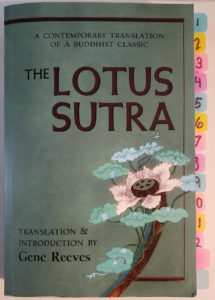
Which Lotus Sutra

20190725_Reeves_LotusSutra
Tabbed and ready to go

Today I began what will be my 44th cycle of 32 Days of the Lotus Sutra posts. At the start of cycle 43 I had intended to make two cycles through The Threefold Lotus Sutra as translated by Bunnō Katō, et al. and revised by W.E. Soothill et al. in 1975. I just couldn’t make it. Today’s post 21 Days: Lost in Translation illustrates part of my disappointment with this translation. But, worse still, this is just not a translation that lends itself to reading aloud and that is a serious failing when you are using it as I am.

As a result I’ve switched a cycle early to Gene Reeves 2008 translation of The Lotus Sutra. Like the Threefold Lotus Sutra, Reeves translation includes The Sutra of Innumerable Meanings and The Sutra of Contemplation of the Dharma Practice of Universal Sage Bodhisattva. It was Reeves’ translation that I have used most often in my 21-Day Retreat posts.

Having read those auxiliary sutras I know what to expect as I cycle through the 28 chapters of the Lotus Sutra. For example, I am not a fan of Reeves’ decision to change “dragons, yakṣas, gandharvas, asuras, garuḍas, kiṃnaras, mahoragas” to “dragons, satyrs, centaurs, asuras, griffins, chimeras, pythons.” I’m also not a fan of using Law in place Dharma.

Still as I start this cycle I know Reeves’ translation at the very least lends itself well to my daily reading aloud.


Update July 27, 2019: I was in error saying Reeves’ translation uses Law instead of Dharma. The Threefold Lotus Sutra translation is the one that uses Law instead of Dharma.

Day 1

Day 1 covers the first half of Chapter 1, Introductory

Having last month met King Ajatasatru and the the four kinds of devotees, we witness the Buddha emit a ray of light from the white curls between his eyebrows illumining all the corners of eighteen thousand worlds in the east.

Thereupon the Buddha emitted a ray of light from the white curls between his eyebrows, and illumined all the corners of eighteen thousand worlds in the east, down to the Avchi Hell of each world, and up to the Akanistha Heaven of each world. The congregation saw from this world the living beings of the six regions of those worlds. They also saw the present Buddhas of those worlds. They also heard the Dharma expounded by those Buddhas. They also saw the bhikṣus, bhikṣunīs, upāsakās and upāsikās of those worlds who had already attained [the various fruits of] enlightenment by their various practices. They also saw the Bodhisattva-mahāsattvas [of those worlds] who were practicing the Way of Bodhisattvas [in various ways] according to the variety of their karmas which they had done in their previous existence, and also according to the variety of their ways of understanding [the Dharma] by faith. They also saw the past Buddhas [of those worlds] who had already entered into Parinirvana. They also saw the stupas of the seven treasures which had been erected to enshrine the śarīras of those Buddhas after their Parinirvana.

Nichiren writes about omens:

Grand Master T’ien-t’ai states in his Profound Meaning of the Lotus Sūtra fascicle 6, “It is said in a secular society that a cobweb is an advance notice of a happy event and chirps of a magpie foretell the arrival of a traveler. Even such trifle matters in the secular world are foreshadowed by an omen, how much more so the advent of the Buddhist Dharma. Based on worldly matters, we can conjecture the profound truth of Buddhism.” Thus, the Buddha showcased the greatest omens that had never been seen during the more than 40 years in His lifetime when He expounded the theoretical section of the Lotus Sūtra.

Zuisō Gosho, Writing on Omens, Writings of Nichiren Shōnin, Volume 6, Followers I, Page 122

21 Days: Lost in Translation

The Sutra of Contemplation of the Dharma Practice of Universal Sage Bodhisattva (Reeves) and The Sutra of Meditation on the Bodhistattva Universal Virtue (Threefold Lotus Sutra) and The Sutra Expounded by the Buddha on Practice of the Way through Contemplation of the Bodhisattva All-embracing Goodness (BDK English Tripitaka) all offer English translations of the ancient Chinese translation of this sutra, which is considered the closing sutra of the Lotus Sutra.

Before this three-week stay-cation retreat I didn’t fully appreciate the difficulty in creating these English versions of a sutra. It is not a simple task of finding the English word for the Chinese word. There’s a lot more required and a good example is this quote from the Reeves translation (Page 416):

“Where can I practice the teaching of repentance?”

The voice in the sky will then say: “Shakyamuni Buddha is called Vairocana, the Omnipresent. His dwelling place is called Always Tranquil Light, a place that is taken up by constant practice, a place that is made stable by self-practice, a place where the characteristics of existence are extinguished by pure practice, a place where body and mind cannot live in comfortable practice, a place where the character of existing or non-existing cannot be seen in anything, and a place of tranquil liberation, which is the practice of wisdom. Because these forms are the ever-present Dharma, you should now meditate on the buddhas in the ten directions.”

I could follow most of this illustration of the Buddha’s teaching of emptiness, but I stumbled over “where body and mind cannot live in comfortable practice.” So I went to the other translations that I have.

Here’s what the Threefold Lotus Sutra (Page 363-363) offers:

“At what place may I practice the law of repentance?”

Thereupon the voice in the sky will speak thus, saying: “Śākyamuni Buddha is called Vairocana Who Pervades All Places, and his dwelling place is called Eternally Tranquil Light, the place which is composed of permanency-pāramitā, and stabilized by self-pāramitā, the place where purity-pāramitā extinguishes the aspect of existence, where bliss-pāramitā does not abide in the aspect of one’s body and mind, and where the aspects of all the laws cannot be seen as either existing or non-existing, the place of tranquil emancipation or prajn͂āpāramitā. Because these forms are based on permanent law, thus you must now meditate on the buddhas in all directions.

For me, this was incomprehensible and another reason why I’ve shunned this translation of the entire threefold sutra.

Which brings us to the BDK translation (Page 69):

At what place may I now practice the way of self-amendment?

The ethereal voice will then immediately reply, saying:

Śākyamuni Buddha is Vairocana – the One Who Is Present in All Places. Where this buddha abides is called Perpetual Tranquil Light – where perpetuity is perfectly achieved, where the perfect truth of self is constituted, where perfect purity casts off the aspects of existence, where perfect happiness is no longer a characteristic that occupies body and mind, where phenomena are no longer perceived as having or not having aspects, where likewise there is serene liberation as well as perfect wisdom. As these are features of the ever-abiding Dharma, you must accordingly contemplate the buddhas of the ten directions!

Already understanding the concept of emptiness of self – there is no fixed, enduring thing that is myself; what we perceive is provisional existence that arises from causes and conditions; and the Middle Way encompasses all of this – the BDK translation left far fewer questions. It also gave me a much better appreciation of the task of translating Buddhist texts into English.

Daily Dharma – July 25, 2019

Mañjuśrī! What are the proper practices the Bodhisattva-mahāsattva should perform? He should be patient, mild and meek. He should not be rash, timorous, or attached to anything. He should see things as they are. He should not be attached to his non-attachment to anything. Nor should he be attached to his seeing things as they are. These are the proper practices the Bodhisattva-mahāsattva should perform.

The Buddha makes this explanation to Mañjuśrī in Chapter Fourteen of the Lotus Sūtra in which he describes the peaceful practices of a Bodhisattva. When we learn to see things differently, we act differently. Conversely, when we act in ways that are not beneficial, either to ourselves or to others, it is an indication that we are not seeing things as they are. At the same time, not being attached to non-attachment helps us realize that becoming enlightened is a process, and that becoming proud of our achievements is another indication of being stuck and not seeing things as they are.

The Daily Dharma is produced by the Lexington Nichiren Buddhist Community. To subscribe to the daily emails, visit zenzaizenzai.com

21 Days: Reading and Reciting the Sutras of the Expansive Teaching

From The Sutra of Contemplation of the Dharma Practice of Universal Sage Bodhisattva (Reeves, p420), something I want to set aside for future reference:

Having recited these verses, the Buddha said to Ananda: “Repent now of the six sense faculties, embrace the teaching of meditation on Universal Sage Bodhisattva, and explain it clearly everywhere for all the heavenly beings and people in all directions. After the extinction of the Buddha, if the disciples receive and embrace, read and recite, and explain the sutras of the Great Vehicle, the Expansive Teaching, in a quiet place, such as a graveyard or under the trees of a monastery, they should read and recite the sutras of the Expansive Teaching and should think about the meaning of the Great Vehicle. As a result of the strong power of reflecting. They will be able to see my body, the Stupa of Abundant Treasures Buddha, the countless buddhas embodied in all directions, Universal Sage Bodhisattva, Manjushri Bodhisattva, Medicine King Bodhisattva, and Medicine Lord Bodhisattva. As a result of revering the Dharma, these buddhas and bodhisattvas, living in the sky with wonderful flowers, will praise and revere those who practice and embrace the Dharma. And as a result just of their reciting the sutras of the Great Vehicle, the Expansive Teaching, the buddhas and bodhisattvas will make offerings day and night to those who embrace the Dharma. …

“After the extinction of the Buddha, if his disciples faithfully follow the Buddha’s words and practice repentance, it should be known that they are doing the work of Universal Sage. Those who do the work of Universal Sage neither see evil characteristics nor experience retribution from evil actions. If there are living beings who show respect to the buddhas in all ten directions six times night and day, recite the Great Vehicle sutras, and think about the profound first principle of the teaching of emptiness, in the time it takes to snap one’s fingers they will rid themselves of the sins of life and death committed during hundreds of myriads of thousands of billions of eons. Anyone doing this work is truly a child of the Buddha, born from the buddhas. The buddhas in all directions and the bodhisattvas will become their teachers. Such people will be said to be perfect in bodhisattva precepts. Without going through a special ceremony, they will become accomplished naturally, and be worthy of receiving offerings from all human and heavenly beings.”

Accomplished naturally without going through a special ceremony.

The Innumerable Day Before Day 1

As mentioned yesterday, I am inserting the Sutra of Innumerable Meanings into my 32 Days of the Lotus Sutra practice as a way to keep this sutra and The Sutra of Contemplation of the Dharma Practice of Universal Sage Bodhisattva in my practice after concluding my 21-Day Retreat Encouraged by Universal Sage Bodhisattva.

Not everything in the Sutra of Innumerable Meanings is easy to digest. For me, I stumble over the many places where negation is used to emphasize the nature of emptiness. This comes early in the sutra when the Bodhisattvas are describing the Buddha (Reeves, p26-27).

His body is neither existing nor non-existing,
Neither caused nor conditioned,
Neither itself nor other,
Neither square nor round,
Neither short nor long.

It does not appear or disappear.
It is not born and does not die.
It is neither constructed nor raised up,
Neither made nor produced.

It is neither sitting nor lying,
Neither walking nor standing still,
Neither moving nor turning over,
Neither at rest nor idle.

It does not advance or retreat,
Knows not safety or danger,
Neither right nor wrong.
It is neither virtuous nor improper.

It is neither this nor that,
Neither going nor coming.

It is neither blue nor yellow,
Neither red nor white;
Neither crimson nor purple,
Nor a variety of colors.

Chih-i, the founder of the T’ien T’ai School upon which much Nichiren Doctrine rests, took such discussions as this and applied  the Threefold Truth – Emptiness, Provisional and Middleway. All things are essentially empty of any enduring, unchanging, self. What we perceive is our provisional existence that flows from causes and conditions of dependent origination. The Middle Way recognizes the non-duality of emptiness and provisional existence.

So what’s left with after all of those negations? The Middle Way.

Or at least that’s my understanding.  For an interesting discussion of how Chih-i applied the Threefold Truth to the Ten Suchnesses of Chapter 2 of the Lotus Sutra, see this quote from the Profound Meaning of the Lotus Sutra.

Daily Dharma – July 24, 2019

If you hear his name, and see him,
And think of him constantly,
You will be able to eliminate all sufferings.

The Buddha gives this description of World-Voice-Perceiver Bodhisattva (Kannon, Kanzeon, Avalokitesvara) to Endless-Intent Bodhisattva in Chapter Twenty-Five of the Lotus Sūtra. World-Voice-Perceiver is the embodiment of compassion. The power of World-Voice-Perceiver is the power of compassion.World-Voice-Perceiver is also known as the one who brings fearlessness. When we can face up to the suffering in the world, both our own and that of others, we can see it for what it is. Then we are no longer afraid of suffering. What else is there to be afraid of?

The Daily Dharma is produced by the Lexington Nichiren Buddhist Community. To subscribe to the daily emails, visit zenzaizenzai.com

21 Days: The Body of the Buddha

Having yesterday provided a detailed look at the white king elephant in The Sutra of Contemplation of the Dharma Practice of Universal Sage Bodhisattva (Reeves, p402-404), I feel a need to offer the description of the Buddha provided by the 80,000 Bodhisattvas in The Sutra of Innumerable Meanings (Reeves, p26-27):

Born of precepts, concentration,
Wisdom, liberation, and insight,
He stems from contemplation,
The six powers, and the elements of the Way.

Springing from kindness and compassion,
The ten powers and courage,
He emerges from
The good actions of living beings.

He shows his body:

Sixteen feet tall,
Shining with purple gold,
Well proportioned,
Brilliant and very bright.

The tuft of curled hair is like the moon.
The light of the sun comes from the nape of his neck.
His curly hair is deep blue
And on the top of his head is a protuberance.

His pure eyes are like mirrors,
And work well in all directions.
His eyebrows are dark blue;
His mouth and cheeks well shaped.

His lips and tongue are a nice red,
Like a bright red flower.
His forty white teeth
Look like snowy jewels.

buddha_swatika_d
See this blog post

His forehead is broad,
His nose long and his face open.
His chest, marked with a swastika,
Is like the chest of a lion.His hands and feet are soft,
Marked with the spokes of a wheel.
Their soles and palms are well rounded,
And the grip is firm.

His arms are long,
His fingers straight and slender.
His skin is delicate and soft
And his hair curls to the right.

His ankles and knees are exposed.
His male organ is concealed,
Like that of a horse.

His muscles are smooth.
His joints are strong.
His legs are tapered,
Like those of a deer.

His back is as resplendent as his front,
Pure and without blemish,
Untainted, like clear water,
Unspotted by any dirt.

His distinguishing thirty-two characteristics
And the eighty different attractive features seem to be visible,
Yet in reality, his form is neither with nor without features.
All visible features are transcended.

Without having features
His body has features.
This is also true of the features
Of the bodies of all living beings.

They incite joy and respect
In living beings,
Eliciting devotion, esteem,
And courtesy toward him.

By cutting off pride and arrogance,
He has acquired such a glorious body.

Now we, the assembly of eighty thousand,
Together make obeisance
To the one who has extinguished
Reflective thought and consciousness.


Buddhism-swastika-seattle
For more about the swastika and Buddhism, see this story quoting Rev. Kanjin Cederman of Seattle Choeizan Enkyoji Nichiren Buddhist Temple

Between Day 32 and Day 1

Daily during my self-styled 21-Day Retreat Encouraged by Universal Sage Bodhisattva I recited The Sutra of Innumerable Meanings and The Sutra of Contemplation of the Dharma Practice of Universal Sage Bodhisattva. Having finished the retreat I was left wanting to fit those sutras into my practice on a regular basis.

I have decided to extend my 32 Days of the Lotus Sutra by two additional days. Today I recited the Contemplation of Universal Sage, splitting it evenly between morning and evening services. (I don’t have romanized shindoku versions of these sutras.) Tomorrow, I will recite Innumerable Meanings, again half in the morning and the remainder in the evening. Both days I will offer a quote that caught my attention from the day’s sutra. After the additional days, I will cycle again through the 32 days of the Lotus Sutra.


Expanding the message of Never-Despising Bodhisattva in the Lotus Sutra, the Contemplation of Universal Sage offers this guidance (Reeves, p405):

Followers should read the Great Vehicle sutras and recite them, think about the meaning of the Great Vehicle, and reflect on its practice. Reverence should be given and offerings made to those who embrace it. All people should be regarded as though they were the Buddha, and all living beings as though they were one’s father and mother.

Daily Dharma – July 23, 2019

A man of shallow faith pretends to have right faith and is contemptuous towards other followers, so as to harm the faith of others. Leave such people alone. By the intention of the King of the Brahma Heaven, Indra and other deities, I believe that such a time will certainly come when all the people of Japan will simultaneously believe in the Lotus Sutra. I am sure that many people will then say, “I have believed in this sutra all along.”

Nichiren wrote this passage in a Reply to Lord Ueno (Ueno-dono Gohenji). In Nichiren’s life, he tolerated the contempt of many who refused his call to set aside expedient teachings and take up the Wonderful Dharma of the Lotus Sūtra. Despite repeated attempts to reach these people, and after enduring his home being burned down, attacks with swords, a mock execution and numerous exiles, he retired to a hermitage on Mt. Minobu to spend the last days of his life. As the Buddha showed no contempt towards his cousin Devadatta, Nichiren showed no contempt towards his persecutors. When we find others who despise us for our practice, we have the example of these two men. They both took the long view towards enlightenment, and did not let themselves be wounded by the follies of human nature.

The Daily Dharma is produced by the Lexington Nichiren Buddhist Community. To subscribe to the daily emails, visit zenzaizenzai.com