All posts by John Hughes

Daily Dharma – April 15, 2019

If a person born a commoner states that he is equal to a samurai, he is bound to be punished. If he states that he is equal to or superior to the king, it is not only he himself but also his parents, wife, and children who are bound to be punished. If those who believe that some other sutra is the same as or superior to the Lotus Sutra according to what they believe without knowing the comparative superiority of the sutras, they are happy because their sutras are being praised. However, it will be a crime of slandering the True Dharma, for which priests and their disciples, as well as their lay followers, will all go to hell as speedily as a flying arrow. On the contrary, to say that the Lotus Sutra is superior to all other sutras is no crime at all. Instead it will be an act of great merit because it is so stated in the sutras.

Nichiren wrote this passage in his Response to My Lady the Nun, Mother of Lord Ueno (Ueno-dono Haha-ama Gozen Gohenji). In other writings, Nichiren explains that the superiority of the Lotus Sutra is not due to some inherent magical power it has to get us what we want. The superiority of the Lotus Sutra comes from its embodiment of the Buddha’s highest teaching, the revelation of his Ever-Present existence, and the ability of the Lotus Sūtra to lead all beings to enlightenment.

The Daily Dharma is produced by the Lexington Nichiren Buddhist Community. To subscribe to the daily emails, visit zenzaizenzai.com

The One Buddha-vehicle Within the Three Vehicles

The ten functions in the Traces are summarized by Chih-i specifically and generally. Summarizing specifically the ten functions with the Four Siddhāntas shows that the ten functions can be divided into four groups and each of these four groups of function corresponds to each of the Four Siddhāntas.

In terms of the functions that can be summarized by the Siddhānta for Each Person, “opening the three and revealing the one”, “abiding in the three and employing the one”, and “converging the three and revealing the one” are said by Chih-i to correspond with the Siddhānta for Each Person. This is because these three functions reveal that the One Buddha-vehicle is contained within the Three Vehicles, and one does not need to abandon the Three Vehicles in order to reach the One Vehicle. Since the Siddhānta for Each Person is to arouse the wholesomeness that is inherently possessed by all beings, and these three functions are also to reveal the One Vehicle that is contained within the Three Vehicles, they correspond with each other. (Vol. 2, Page 449)

Day 29

Day 29 covers all of Chapter 25, The Universal Gate of World-Voice-Perceiver Bodhisattva.

Having last month witnessed Endless-Intent Bodhisattva’s attempt to offer a gift to World-Voice-Perceiver Bodhisattva, we hear Endless-lntent Bodhisattva asked the Buddha in gāthās.

Thereupon Endless-lntent Bodhisattva asked the Buddha in gāthās:

World-Honored One with the wonderful marks
I ask you about this again.
Why is the son of the Buddha
Called World-Voice-Perceiver?

The Honorable One with the wonderful marks answered Endless-Intent in gāthās:

Listen! World-Voice-Perceiver practiced
According to the conditions of the places [of salvation].
His vow to save [people] is as deep as the sea.
You cannot fathom it even for kalpas.

On many hundreds of thousands of millions of Buddhas
He attended and made a great and pure vow.
I will tell you about his vow in brief.
If you hear his name, and see him,
And think of him constantly,
You will be able to eliminate all sufferings.

Suppose you are thrown into a large pit of fire
By someone who has an intention of killing you.
If you think of the power of World-Voice-Perceiver
The pit of fire will change into a pond of water.

Suppose you are in a ship drifting on a great ocean
Where dragons, fish and devils are rampant.
If you think of the power of World-Voice-Perceiver,
The ship will not b sunk by the waves.

Suppose you are pushed
Off the top of Mt. Sumeru by someone.
If you think of the power of World-Voice-Perceiver,
You will be able to stay in the air like the sun.

Suppose you are chased by an evil man,
And pushed off [the top of] a mountain made of diamond.
If you think of the power of World-Voice-Perceiver,
You will not lose even a hair.

Suppose bandits are surrounding you,
And attempting to kill you with swords.
If you think of the power of World-Voice-Perceiver,
The bandits will become compassionate t wards you.

Suppose you are sentenced to death,
And the sword is drawn to behead you.
If you think of the power of World-Voice-Perceiver,
The sword will suddenly break asunder.

Suppose you are bound up
In pillories, chains, manacles or fetters.
If you think of the power of World-Voice-Perceiver,
You will be released from them.

Suppose someone curses you to death,
Or attempts to kill you by various poisons.
If you think of the power of World-Voice-Perceiver,
Death will be brought to that person, instead.

Suppose you meet rākṣasas
Or poisonous dragons or other devils.
If you think of the power of World-Voice-Perceiver,
They will not kill you.

Suppose you are surrounded by wild animals
Which have sharp, fearful tusks and claws.
If you think of the power of World-Voice-Perceiver
They will flee away to distant places.

Suppose you meet lizards, snakes, vipers or scorpions
Emitting poisonous vapor like flames.
If you think of the power of World-Voice-Perceiver,
They will go away as you call his name.

Suppose clouds arise, lightning flashes, thunder peals,
Hail falls, and a heavy rains comes down.
If you think of the power of World-Voice-Perceiver,
The thunderstorm will stop at once.

Nichiren discusses this chapter in his letter, Response to My Lady Nichinyo, Writings of Nichiren Shōnin:

The chapter “Bodhisattva Voice Perceiver” is also known as the chapter “Universal Gate.” Since the first half of this chapter tells of the merits of a person who pays homage to the Bodhisattva World Voice Perceiver (Avalokiteśvara), this chapter is named “Voice Perceiver.” It is also named “Universal Gate” since the latter half tells of the merits of a person who takes refuge with the Lotus Sūtra, which the Bodhisattva Voice Perceiver maintains.

Nichinyo Gozen Gohenji, Response to My Lady Nichinyo, Writings of Nichiren Shōnin, Faith and Practice, Volume 4, Page 133-134

Family Memorial

This April is the first anniversary of Mary’s father’s death and the third anniversary of her mother’s death. Today, following the annual celebration of the Buddha’s birth at the Sacramento Nichiren Buddhist Church, Rev. Igarashi said memorial prayers for Richard and Mary Buchin.

In the photo Mary holds the memorial tablet for her parents that normally resides on our family altar. The tablet was placed on the church altar during the memorial service.

The memorial service normally includes recitation in Japanese of the Yokuryoshu, which includes selections from Chapter 2, Expedients; Chapter 3, A Parable; Chapter 10, The Teacher of the Dharma; and Chapter 11, Beholding the Stupa of Treasures. For this service, I requested that we chant the portion of Chapter 16, The Duration of the Life of the Tathāgata, normally chanted during the traditional Sunday service.

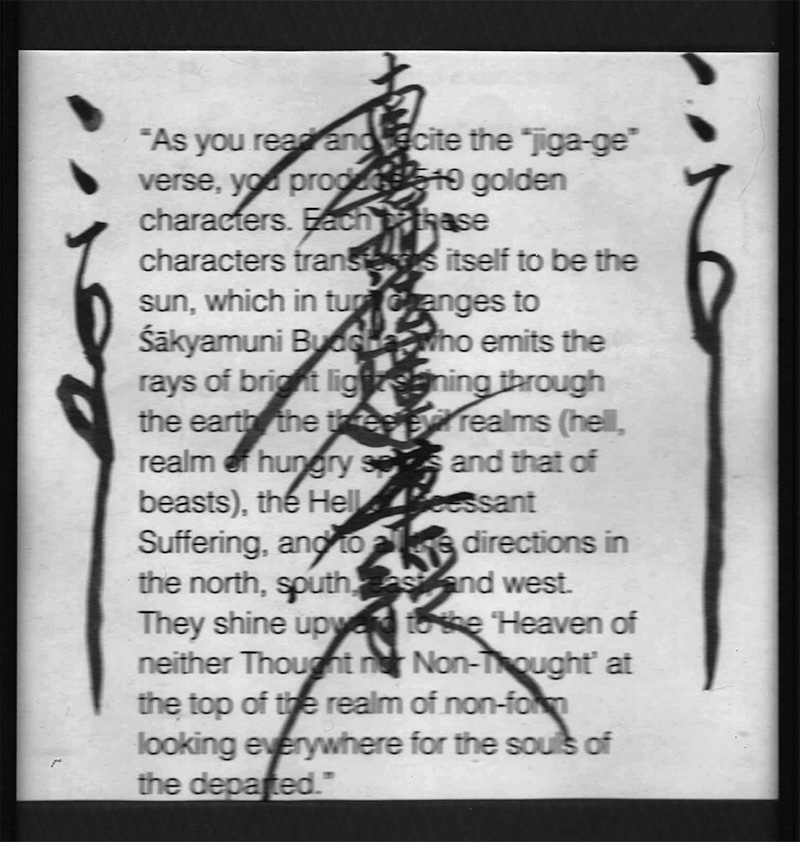
I requested the change for several reasons. First, I don’t know the Japanese verses or even the English translation of them. More important, both Mary and my son, Richard, know the Jiga-ge. Finally, on the family altar I have a copy of a quote from Nichiren’s Letter to Hōren that reads:

“As you read and recite the ‘jiga-ge’ verse, you produce 510 golden characters. Each of these characters transforms itself to be the sun, which in turn changes to Śākyamuni Buddha, who emits the rays of bright light shining through the earth, the three evil realms (hell, realm of hungry spirits and that of beasts), the Hell of Incessant Suffering, and to all the directions in the north, south, east, and west. They shine upward to the ‘Heaven of neither Thought nor Non-Thought’ at the top of the realm of non-form looking everywhere for the souls of the departed.”

Hōren-shō, Letter to Hōren, Writings of Nichiren Shōnin, Volume 6, Followers I, Pages 56-57

Rev. Igarashi “decorated” the quote for our altar.

Daily Dharma – April 14, 2019

The Buddha is the master of the human and heavenly realms, the parent of all living beings, and the teacher who opens the way and leads us all to enlightenment. Lowly parents lack the virtue of a master, and the master without the virtue of parents is frightening. People with the virtues of parents or master do not necessarily possess the virtue of the teacher.

Nichiren wrote this passage in his Treatise on Prayers (Kitō-shō). This illustrates three aspects of the ever-present Buddha to which we can aspire as we practice his highest teachings. Parents care about their children, but they can lack the skill and knowledge necessary to benefit them. A skillful master can be wise about how to live in this world of conflict, but without a true concern for the well-being of those he leads, can degenerate into cruelty and selfishness. As a teacher, the Buddha has found us all within himself, and cares for us as he cares for himself. He has also found himself within all of us, and knows what it takes to lead us to his wisdom.

The Daily Dharma is produced by the Lexington Nichiren Buddhist Community. To subscribe to the daily emails, visit zenzaizenzai.com

The Ten Functions in the Traces

The ten functions in the Traces are summarized by Chih-i specifically and generally. (l) Summarizing specifically the ten functions with the Four Siddhāntas shows that the ten functions can be divided into four groups and each of these four groups of function corresponds to each of the Four Siddhāntas. …

In terms of the functions that can be summarized by the Siddhānta of Counteraction, “destroying the three and revealing the one,” “abandoning the three and revealing the one,” and “covering the three and revealing the one” are said by Chih-i to correspond with the Siddhānta of Counteraction. This is because these three functions destroy illness of people and cause them to get rid of their attachment to the Three Vehicles. Since the Siddhānta of Counteraction is to counteract particular vices of people, it can correspond to these three functions. (Vol. 2, Page 449)

The Profound Meaning of the Lotus Sutra: Tien-tai Philosophy of Buddhism


Day 28

Day 28 covers all of Chapter 24, Wonderful-Voice Bodhisattva, and concludes the Seventh Volume of the Sutra of the Lotus Flower of the Wonderful Dharma.

Having last month begun Chapter 24, Wonderful-Voice Bodhisattva, with Śākyamuni Buddha emitting rays of light illumining a Bodhisattva called Wonderful-Voice in the All-Pure-Light-Adornment World, we consider Pure-Flower-Star-King-Wisdom Buddha’s advice to Wonderful-Voice Bodhisattva.

When he was illumined by the light of Śākyamuni Buddha, he said to the Pure-Flower-Star-King-Wisdom Buddha:

“World-Honored One! I wish to visit the Sahā-World, bow to Śākyamuni Buddha, attend on him, and make offerings to him. I also wish to see Mañjuśrī Bodhisattva, who is the Son of the King of the Dharma. [I also wish to see] Medicine-King Bodhisattva, Brave-In-Giving Bodhisattva, Star-King-Flower Bodhisattva, Superior-Practice-Intent Bodhisattva, Adornment-King Bodhisattva, and Medicine-Superior Bodhisattva.”

Thereupon Pure-Flower-Star-King-Wisdom Buddha said to Wonderful-Voice Bodhisattva:

“Do not despise that world! Do not consider it to be inferior [to our world]! Good Man! The Sahā-World is not even. It is full of mud, stones, mountains’ and impurities. The Buddha [of that world] is short in stature! So are the Bodhisattvas [of that world]. You are forty-two thousand yojanas tall. I am six million an eight hundred thousand yojanas tall. You are the most handsome. You have thousands of millions of marks of merits, and your light is wonderful. Do not despise that world when you go there! Do not consider that the Buddha and Bodhisattvas of that world are inferior [to us]! Do not consider that that world is inferior [to ours]!”

The Daily Dharma from Oct. 31, 2018, offers this:

Thereupon Pure-Flower-Star-King-Wisdom Buddha said to Wonderful-Voice Bodhisattva: “Do not despise that world! Do not consider it to be inferior [to our world]! Good Man! The Sahā-World is not even. It is full of mud, stones, mountains and impurities. The Buddha [of that world] is short in stature. So are the Bodhisattvas [of that world]. You are forty-two thousand yojanas tall. I am six million and eight hundred thousand yojanas tall. You are the most handsome. You have thousands of millions of marks of merits, and your light is wonderful. Do not despise that world when you go there! Do not consider that the Buddha and Bodhisattvas of that world are inferior [to us]! Do not consider that that world is inferior [to ours]!”

In Chapter Twenty-Four of the Lotus Sūtra, the Buddha sends a light from his forehead to the world in which Wonderful-Voice Bodhisattva lives. When that Bodhisattva saw this light from Śākyamuni Buddha, he asked permission from the Buddha he was attending to visit our world of conflict. The instruction he receives from his Buddha reminds us that no matter what advantages we have gained from our practice of the Buddha Dharma, these do not make us any better or worse than those we are determined to benefit.

The Daily Dharma is produced by the Lexington Nichiren Buddhist Community. To subscribe to the daily emails, visit zenzaizenzai.com

Daily Dharma – April 13, 2019

Now I will transmit [the Dharma] to you. Keep, read, recite and expound [this sūtra in which the Dharma is given], and cause all living beings to hear it and know it! Why is that? It is because I have great compassion. I do not begrudge anything. I am fearless. I wish to give the wisdom of the Buddha, the wisdom of the Tathāgata, the wisdom of the Self-Existing One, to all living beings.

The Buddha gives these instructions in Chapter Twenty-Two of the Lotus Sūtra. In this transmission, the Buddha bestows his highest teaching not just on those gathered 2500 years ago. He gives it to all of us who hear and keep his teaching today. When the Buddha revealed his true nature as existing through all time and space, he assured us that he is always teaching us, and that the Lotus Sūtra is the vehicle by which he comes to us. By giving us this teaching, he does not lose it. In the same way, when we benefit other beings, we should not be afraid of losing anything, other than our delusion and attachments.

The Daily Dharma is produced by the Lexington Nichiren Buddhist Community. To subscribe to the daily emails, visit zenzaizenzai.com

Covering the Traces and Revealing the Origin

Fu-chi Hsien-pen (Covering the Traces and revealing the Origin) is the function related to the Subtlety of the Original Supra-mundane Powers. This is spoken of by Chih-i in terms of various expedient means employed by the Buddha in responding to the capabilities of beings. In order to get rid of disciples’ attachment to the Traces, the Buddha covers the Traces and reveals the Origin (for the sake of keeping the Traces for the later use of transforming others), should the necessity arise. (Vol. 2, Page 448)

The Profound Meaning of the Lotus Sutra: Tien-tai Philosophy of Buddhism


Day 27

Day 27 concludes Chapter 23, The Previous Life of Medicine-King Bodhisattva.

Having last month witnessed Gladly-Seen-By-All-Beings Bodhisattva’s greeting to Sun-Moon-Pure-Bright-Virtue Buddha, we witness Sun-Moon-Pure-Bright-Virtue Buddha entering Nirvana and Gladly-Seen-By-All-Beings Bodhisattva’s reaction.

“Having given these instructions to Gladly-Seen-By-All-Beings Bodhisattva, Sun-Moon-Pure-Bright-Virtue Buddha entered into Nirvana in the last watch of that night. Having seen the extinction of the Buddha, Gladly-Seen-By-All-Beings Bodhisattva was overcome with sorrow. He adored the Buddha all the more. He made a pyre of the candana grown on this shore of the sea, offered it to the body of the Buddha, and burned it. After it burned up, he collected the śarīras. He made eighty-four thousand stupas of treasures[, and put the śarīras therein]. He erected eighty-four thousand stupas[, and enshrined the urns therein]. The stupas were higher than the Third Dhyana-Heaven. They were adorned with yastis. Many streamers and canopies were hanging down [from the stupas]. Many jeweled bells also were fixed [on the stupas].

“Thereupon Gladly-Seen-By-All-Beings Bodhisattva thought again, ‘I have now made these offerings, yet I do not think that they are enough. I will make another offering to the śarīras.’

“He said to the Bodhisattvas, to the great disciples, and also to all the other living beings in the great multitude including gods, dragons and yakṣas, ‘Look with one mind! Now I will make another offering to the śarīras of Sun-Moon-Pure-Bright-Virtue Buddha.’

“Having said this, he burned his arms adorned with the marks of one hundred merits, and offered the light of the flame to the eighty-four thousand stupas for seventy-two thousand years. [By doing so,] he caused innumerable seekers of Śrāvakahood and many other asaṃkhyas of people to aspire for Anuttara-samyak-saṃbodhi, and obtain the samadhi by which they could transform themselves into the other living beings.

“Having seen him deprived of his arms, the Bodhisattvas, gods, men, asuras and others were overcome with sorrow. They said, ‘This Gladly-Seen-By-All-Beings Bodhisattva is our teacher. He is leading us. Now he has burned off his arms. He is deformed.’

“Thereupon Gladly-Seen-By-All-Beings Bodhisattva vowed to the great multitude, saying, ‘I shall be able to obtain the golden body of the Buddha because I gave up my arms. If my words are true and not false, I shall be able to have my arms restored.’

“When he had made this vow, his arms were restored because his merits, virtues and wisdom were abundant. Thereupon the one thousand million Sumeru-worlds quaked in the six ways, and the gods rained down jeweled flowers. All the gods and men had the greatest joy that they had ever had.”

Nichiren writes about Gladly-Seen-By-All-Beings Bodhisattva’s offerings in his letter, Response to My Lady Nichinyo:

It is said in the “Medicine King Bodhisattva” chapter that a bodhisattva called Issaishujōkiken (Gladly Seen by All) learned the Lotus Sūtra from the Buddha Sun Moon Brilliance. With deep admiration for his master’s favor and the value of the Lotus Sūtra, he made offerings of thousands of invaluable treasures. Issaishujōkiken felt that this was not enough, however, and proceeded to anoint his own body with oil, set it aflame, and continued to burn it like a lamp wick to venerate the Buddha for twelve hundred years. Thereafter, he burned a light on his elbow for seventy-two thousand years to venerate the Lotus Sūtra. Thus, if a woman venerates the Lotus Sūtra in the fifth 500-year period after the demise of the Buddha, during the Latter Age of Degeneration, the Buddha will bestow upon her all merits of the Lotus Sūtra just as a rich man gives all his wealth to his son.

Nichinyo Gozen Gohenji, Response to My Lady Nichinyo, Writings of Nichiren Shōnin, Faith and Practice, Volume 4, Page 132-133