All posts by John Hughes

The Buddha’s Promise

Following the arrival of the Stupa comes a very important point in this grand drama, one we can easily overlook as we are in awe and amazement of the events that have just happened. The Buddha inquires of the assembly who will teach the Lotus Sutra in this world, the Saha world after the he has died. The Buddha in these requests shows his shift from the present to the future. We have already seen that all of those who received predictions of future enlightenment will perform their practices in some other realm but not this world. None of the contemporaries of the Buddha will attain enlightenment by doing their activities in our world. The Buddha wants to know, however, who will ensure that the Lotus Sutra is taught to future practitioners.

The Buddha makes a promise and this is significant to those of us who practice and teach the Lotus Sutra in the world in this age some several thousand years after the Buddha. A promise is made that whoever protects the Lotus Sutra in the Saha world, our world, will be able to be in the presence of not just the Buddha Shakyamuni but also all of his replica Buddhas as well as Many Treasures Buddha.

Lecture on the Lotus Sutra

Daily Dharma – April 12, 2019

They will not think
Of any other food [than the two kinds of food:]
The delight in the Dharma, and the delight in dhyāna.

The Buddha sings these verses in Chapter Eight of the Lotus Sūtra, speaking of the future lives of those who practice the Wonderful Dharma. In the existence we occupy now, it is difficult to imagine any other ways we could live. When the Buddha shows us the world as it is, he is not just opening our eyes to what is in front of us now. He shows us innumerable possibilities far better than anything we could dream up ourselves. To reach these other worlds, we only need to shed our attachment to our delusions and have faith in the path the Buddha opens to his enlightenment.

The Daily Dharma is produced by the Lexington Nichiren Buddhist Community. To subscribe to the daily emails, visit zenzaizenzai.com

The Manifestation of the Buddha’s Original Life-Span

Chu-chi Yung-pen (Abiding in the Traces and employing the Origin) is the function related to the Subtlety of the Original Life-span and the Subtlety of the Original Retinues. Chih-i illustrates that the Buddha not only reveals the Origin but uses it as well. Although he abides in the Traces, manifesting birth and death numerous times, this manifestation of life and death is actually the manifestation of the Original Life-span. Moreover, the Traces are represented by the disciples as the Three Vehicles that belong to the Original Retinues.

Day 26

Day 26 concludes Chapter 21, The Supernatural Powers of the Tathāgatas, includes Chapter 22, Transmission, and introduces Chapter 23, The Previous Life of Medicine-King Bodhisattva.

Having last month repeated the Supernatural Powers of the Tathāgatas in gāthās, we conclude the chapter with the vow of Śākyamuni that all will be able to attain enlightenment “definitely and doubtlessly.”

Anyone who keeps this sūtra
Will be able to see me. He also will be able to see
Many-Treasures Buddha,
[The Buddhas of] my replicas,
And the Bodhisattvas whom I have taught today.

Anyone who keeps this sūtra will be able to cause me to rejoice.
He also will be able to bring joy
To [the Buddhas of] my replicas
And also to Many-Treasures Buddha who once passed away.

He also will be able to see
The present, past and future Buddhas
Of the worlds of the ten quarters,
Make offerings to them, and cause them to rejoice.

The Buddhas sat at the place of enlightenment,
And obtained the hidden core.
Anyone who keeps this sūtra will be able
To obtain the same before long.

Anyone who keeps this sūtra
Will be able to expound
The meanings of the teachings,
And the names and words [of this sūtra].
Their eloquence will be as boundless
And as unhindered as the wind in the sky.

Anyone who understands why the Buddhas expound [many] sūtras,
Who knows the position [of this sūtra in the series of sūtras],
And who expounds it after my extinction
According to its true meaning,
Will be able to eliminate the darkness
Of the living beings of the world where he walks about,
Just as the light of the sun and the moon
Eliminates all darkness.
He will be able to cause innumerable Bodhisattvas
To dwell finally in the One Vehicle.

Therefore, the man of wisdom
Who hears the benefits of these merits
And who keeps this sūtra after my extinction,
Will be able to attain
The enlightenment of the Buddha
Definitely and doubtlessly.

Nichiren uses this section to underscore the importance of this teaching in the Latter Age:

In the Lotus Sūtra, after forty some years [wherein the other sūtras taught that women could not attain Buddhahood,] a woman at last attained Buddhahood; and even Devadatta, who was called an icchantika who broke the five rebellious sins, attained Buddhahood. Thus, there is no doubt that in this evil age those monks, laymen, nuns, and laywomen who are icchantika because they have broken the five rebellious sins and slandered the Dharma, will all attain Buddhahood through the Lotus Sūtra. Moreover, we must trust these words from fascicle seven of the Lotus Sūtra:

After my passing
He who upholds this sūtra
Will attain the Buddha Way
Definitely and without a doubt.

Minobu-san Gosho, Mt. Minobu Letter, Writings of Nichiren Shōnin, Volume 5, Page 131

Dealing With Our Defilements

The best approach to dealing with the defilements is simply to be aware of them in the light of the Buddha-nature. This is how the practice of chanting Namu Myoho Renge Kyo can help us change the poison of the defilements into the qualities of awakening, because chanting the Odaimoku is the practice of calling upon the Buddha-nature within. Through the Odaimoku, we are able to cultivate a sense of awareness and equilibrium that allows us to acknowledge and redirect our desires instead of getting caught up and swept away by them. The practice of chanting Namu Myoho Renge Kyo can help us to think and reflect before we act. It can even help us recognize negative thoughts and feelings for what they are, so that we do not identify with them and allow them to control our lives. On the other hand, the principle of Namu Myoho Renge Kyo does not condemn or negate these desires, but gives us the space and the strength to work with them and brings out their positive aspects.

Lotus Seeds

Daily Dharma – April 11, 2019

Anyone, be he a Śrāvaka or a Pratyekabuddha or a Bodhisattva, who believes this sūtra expounded by these sixteen Bodhisattvas, keeps it, and does not slander it, will be able to attain Anuttara-samyak-saṃbodhi, that is, the wisdom of the Tathāgata.

The Buddha makes this promise to all those gathered to hear him teach in Chapter Seven of the Lotus Sūtra. This promise is for all of us who practice the Buddha Dharma. When we live firmly assured that the Buddha’s unsurpassed enlightenment is available to us even within all the suffering in this world of conflict, then we have the clarity to truly benefit ourselves and others.

The Daily Dharma is produced by the Lexington Nichiren Buddhist Community. To subscribe to the daily emails, visit zenzaizenzai.com

‘Abiding in the Origin and Employing the Traces’

Chu-pen Yung-chi (Abiding in the Origin and employing the Traces) is the function related to the Subtlety of the Original Nirvāṇa and the Subtlety of the Original Benefits. Speaking from the teacher’s perspective, this function is referred by Chih-i to the immovability of the Buddha at the place of the Origin, while the Traces the Buddha manifests permeate the Dharma-realm. Chih-i delineates that the Traces are not origination, and yet the Buddha manifests rebirth; the Traces are not extinction, and yet the Buddha manifests death. Thus, with the Traces, the Buddha benefits living beings. Speaking from the disciple’s perspective, “abiding in the Origin and employing the Traces” refers to the bodhisattva in the Traces that is the manifestation of the dharmakāya. With the dharma of non-abiding, the Buddha abides in the place of the Origin; with the Relative Truth and nonaction, the Buddha inexhaustibly employs the Traces to teach and transform living beings. (Vol. 2, Page 448)

The Profound Meaning of the Lotus Sutra: Tien-tai Philosophy of Buddhism


Day 25

Day 25 covers all of Chapter 20, Never-Despising Bodhisattva, and opens Chapter 21, The Supernatural Powers of the Tathāgatas.

Having last month learned in gāthās the story of a Buddha Called Powerful-Voice-King and a Bodhisattva Called Never-Despising, we conclude Chapter 20, Never-Despising Bodhisattva.

Never-Despising [Bodhisattva] met
Innumerable Buddhas after the end of his life.
He expounded this sūtra,
And obtained innumerable merits,
He quickly attained the enlightenment of the Buddha
By these accumulated merits.

Never-Despising [Bodhisattva] at that time
Was myself.
The four kinds of devotees,
Who were attached to views at that time,
Were able to meet innumerable Buddhas
After they heard
The words of Never-Despising [Bodhisattva]:
“You will become Buddhas.”
They are now present here
In this congregation.

They are the five hundred Bodhisattvas
And the four kinds of devotees
Including men and women of pure faith,
Who are now hearing the Dharma from me.

In my previous existence
I encouraged them
To hear this sūtra,
That is, the most excellent Dharma.
In all my previous existences
I taught them the Way to Nirvana.
But really this is the sūtra
I taught them to keep.

This Sūtra of the Lotus Flower of the Wonderful Dharma
Can be heard only once
In hundreds of millions of billions of kalpas,
That is, in an inconceivable number of kalpas.

The Buddhas, the World-Honored Ones,
Expound this sūtra only once
In hundreds of millions of billions of kalpas,
That is, in an inconceivable number of kalpas.

Therefore, anyone who hears this sūtra
And practices the Way
After my extinction,
Should have no doubts about [this sūtra].

He should expound this sūtra with all his heart;
Then he will be able to meet Buddhas
Throughout all his existences,
And quickly attain the enlightenment of the Buddha.

This is a good time to recall that Nichiren Shu has a brochure that focuses on the lesson of Never-Despising Bodhisattva. The brochure begins:

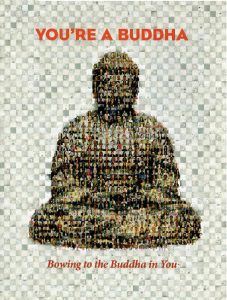
When we press our palms together in gassho and bow to greet others, we are seeing the Buddha within them that is part of their true nature. Never-Despising Bodhisattva never met a man or woman he didn’t like. Within every person, he could see the divine Buddha nature or Buddha seed within waiting to be acknowledged and nourished. This is one of the most compelling teachings of Buddhism. We are all Buddhas. Everything we need is already inside us. It’s just a matter of our faith and practice to peel away layers to reveal what is already there.

You're A Buddha
Click on the image to read the brochure.

Practicing During Menstruation

You also stated in your letter that you have worshipped daily chanting the seven characters of the daimoku three times a day and have chanted, “Namu Ichijō Myōden” (Hail to the One-Vehicle Teaching of the Lotus Sutra!) 10,000 times but have discontinued these practices as well as recitation of the sūtra during menstruation. You would like to know whether it is permissible to refrain from these daily practices during menstruation or not, and how many days after menstruation you can go back to the daily practices.

This is the anguish of every woman, which many people have tried to answer in the past. However, nobody has worked out an answer, based on sutras probably because it isn’t clearly explained anywhere in the sutras preached by Śākyamuni Buddha during His lifetime. Having read almost all the Buddhist scriptures, I, Nichiren, have found clear references in them against drinking liquor, eating meat and five very spicy vegetables, or having sexual relations on specific days and months, but I can’t think of any sūtra or discourse showing dislike of menstruation.

Many young women became nuns while Śākyamuni Buddha was still alive, but they weren’t rejected during their menstrual cycle. For this reason, I believe that menstruation isn’t uncleanliness coming from outside but a physiological phenomenon peculiar to women and is indispensable for continuing the human race. It is like a long illness. For example, excrement and urine are expelled from our bodies, but they don’t do any harm to us as long as we keep our bodies clean. The same is true of menstruation; we have never heard that menstruation is especially taboo in India or China.

Japan, however, is a country of gods. It is due to this country’s customs that Japanese gods, who are manifestations of Buddhas and bodhisattvas, strangely do not conform with sūtras and discourses, in many cases. Therefore, if you disregard these customs, you will be punished externally. Closely checking sūtras and discourses, we come across a doctrine called Zuihōbini, or adapting precepts to a locality. The spirit of this admonition preaches that we should not go against manners and customs of the country unless it means a serious breach of Buddhist precepts. Those wise men who do not know about this, however, insist strongly: “Japanese gods are demons, whom we should not revere.” Thus, they have lost the trust of their members. From this, I, Nichiren, think Japanese gods probably dislike menstruation. Therefore, women born in this country should refrain from appearing before these gods during their period.

However, daily practice of Buddhism should not be obstructed by menstruation. Those, who insist that you skip daily services during menstruation, don’t really believe in the Lotus Sūtra. Their original intention is to break your true faith somehow; but since they can’t advise you directly to reject the Lotus Sūtra, they try to keep you away from it on the pretext of menstruation. They also try to threaten you into committing the sin of abandoning the true dharma by saying that practicing the Lotus Sūtra during menstruation means showing disrespect to it.

Keeping this in mind you should chant only the daimoku, without reciting the Lotus Sūtra, during menstruation even if it lasts for a week. Your daily services should not be in front of the sūtra. In case the end of your life is unexpectedly near, you may eat fish and poultry, and recite the Lotus Sūtra, if you can, and chant the daimoku. You don’t have to talk about your menstruation.

As for chanting “Namu Ichijō Myōden,” although it means the same, you should chant “Namu Myōhō Renge Kyō” as Bodhisattva Vasubandhu, Grand Master T’ien-t’ai and others did. There is a reason for me to say this.

Gassui Gasho, A Letter on Menstruation, Nyonin Gosho, Letters Addressed to Female Followers, Page 36-42

Daily Dharma – April 10, 2019

Every Buddha vows at the outset:
“I will cause all living beings
To attain the same enlightenment
That I attained.”

The Buddha sings these verses in Chapter Two of the Lotus Sūtra. The Buddha holds nothing back from us. There is nothing hidden or secret in his teachings. He is not threatened by anyone who reaches his wisdom, since he knows this is the potential we all have in us. By his example we can discern between the knowledge that separates from others, and that which unites us with our fellow beings.

The Daily Dharma is produced by the Lexington Nichiren Buddhist Community. To subscribe to the daily emails, visit zenzaizenzai.com