
Chih-i emphasizes the superiority of the cause and effect that is stated in the Lotus Sūtra compared with that stated in other sūtras. The coarse or subtle gist is determined in terms of whether or not all Śrāvakas and bodhisattvas can enter one perfect cause of Buddhahood, and simultaneously attain realization as the ultimate effect of Buddhahood. The Lotus Sūtra is considered by Chih-i as subtle, since its cause is perfect and its effect is ultimate, which contains no expedience. Nevertheless, in view of all coarse or subtle causes and effects that can lead one to attain Buddhahood, all of them are subtle. The realization of such an absolute subtlety is through opening the coarseness and revealing the subtlety, by which all the coarse causes and effects in other sūtras are dissolved, and become subtle. (Vol. 2, Page 440)
The Profound Meaning of the Lotus Sutra: Tien-tai Philosophy of BuddhismAll posts by John Hughes
Day 32
Day 32 covers Chapter 28, The Encouragement of Universal-Sage Bodhisattva, closing the Eighth Volume of the Sutra of the Lotus Flower of the Wonderful Dharma.

Having last month concluded Chapter 28, The Encouragement of Universal-Sage Bodhisattva, we begin again with the arrival of Universal-Sage Bodhisattva, who was famous for his virtues and supernatural powers without hindrance.
Thereupon Universal-Sage Bodhisattva, who was famous for his virtues and supernatural powers without hindrance, came from a world [in the distance of many worlds] to the east [of this Sahā-World]. He was accompanied by innumerable, uncountable great Bodhisattvas. All the worlds quaked as he passed through. [The gods] rained down jeweled lotus-flowers, and made many hundreds of thousands of billions of kinds of music. He was also surrounded by a great multitude of innumerable gods, dragons, yakṣas, gandharvas, asuras, garuḍas, kiṃnaras, mahoragas, men and nonhuman beings. They reached Mt. Gṛdhrakūṭa of the Sahā-World by their virtues and supernatural powers. [Universal-Sage Bodhisattva] worshiped [the feet of] Śākyamuni Buddha with his head, walked around the Buddha [from left] to right seven times and said to the Buddha:
“World-Honored One! I heard the Sūtra of the Lotus Flower of the Wonderful Dharma, which you expounded in this Sahā World, from a remote world in which lives Treasure-PowerVirtue-Superior-King Buddha. I came here with many hundreds of thousands of billions of Bodhisattvas in order to hear and receive [this Sūtra].
Nichiren discusses this chapter in his letter Response to My Lady Nichinyo:
The chapter “Encouragement of Universal Sage Bodhisattva” says that among many disciples of Śākyamuni Buddha, Kāśyapa and Ānanda waited on Him. They were like ministers attending both sides of a king. But this was the Buddha preaching sūtras of the Lesser Vehicle. Among many bodhisattvas, the Bodhiattva Universal Sage and the Bodhisattva Mañjuśrī attended Śākyamuni Buddha, the Lord Teacher, like two ministers attending both sides of a king. During the last eight years of the life of Śākyamuni Buddha, in which He expounded the Lotus Sūtra, so many Buddhas and bodhisattvas, more than dust particles on the earth, gathered from ten quarters in the universe. But strangely, Bodhisattva Universal Sage, one of the attendants of Śākyamuni Buddha, was not found there.
However, when Śākyamuni Buddha was about to finish His preaching by expounding the chapter “Wonderful Adornment King,” Bodhisattva Universal Sage came late from the land of the Jeweled Dignity and Virtue Purity King Buddha, performing hundreds of thousands of pieces of music and accompanied by a countless number of eight kinds of gods and demi-gods. Concerned about the reaction of the Buddha toward his late arrival, the bodhisattva turned pale and obligingly vowed to protect the practicer of the Lotus Sūtra in the Latter Age of Degeneration. Śākyamuni Buddha was pleased and told that it was his obligation to spread the Lotus Sūtra in the whole world. Śākyamuni Buddha thus praised Bodhisattva Universal Sage more cordially than his superiors.
Nichinyo Gozen Gohenji, Response to My Lady Nichinyo, Writings of Nichiren Shōnin, Faith and Practice, Volume 4, Page 137-138
Daily Dharma – March 16, 2019
Rivers come together to form an ocean. Particles of dust accumulate to become Mt. Sumeru. When I, Nichiren, began having faith in the Lotus Sutra, it was like a drop of water or a particle of dust in Japan. However, when the sutra is chanted and transmitted to two, three, ten, a million and a billion people, it will grow to be a Mt. Sumeru of perfect enlightenment or the great ocean of Nirvāṇa. There is no way other than this to reach Buddhahood.
Nichiren wrote this passage in his essay on Selecting the Right Time (Senji-shō). In our quest for enlightenment, we may become discouraged by the enormity of our task. When we sweep away one delusion, another appears. When we benefit one being, the needs of millions more become clear. Nichiren reminds us persevering though these difficulties and strengthening our faith in the Buddha’s wisdom are more important than any outcome we seek.
The Daily Dharma is produced by the Lexington Nichiren Buddhist Community. To subscribe to the daily emails, visit zenzaizenzai.com
The Single Condition
[I]n Nichiren’s thought, enlightenment, or salvation, depends not on multiple factors but on one condition only—faith in the Lotus Sūtra, which is inseparable from the chanting of the daimoku. Anyone who chants the daimoku, man or woman, cleric or lay person, foolish or wise, realizes enlightenment. Correspondingly, there is but one single error or evil that can obstruct this enlightenment: “slander of the Dharma,” or willful disbelief in the sūtra. To discard the Lotus Sūtra, Nichiren writes, “exceeds even the sin of killing one’s parents a thousand or ten thousand times, or of shedding the blood of the Buddhas in the ten directions.” The modality of Nichiren’s doctrine on this point appears at first absolutely either/or: “Disbelief is the cause of the icchantika and of slander of the Dharma, while faith is the cause of wisdom (prajn͂ā) and corresponds to the stage of verbal identity.” So powerful is faith in the Lotus that no worldly evil can ever counteract it and pull the practitioner down into the evil paths. Conversely, slander of the Lotus Sūtra is so great an evil that no accumulation of worldly good deeds can ever offset it or save one who commits it from the Avīci Hell. On a deeper level, however, the dichotomy is dissolved, for even to slander the Lotus Sūtra is to form a connection with it. Thus in Nichiren’s view, even if one’s practice of shakubuku should arouse the enmity of others and cause them to slander the Lotus Sūtra, because it nonetheless allows them to form a “reverse connection” with the sūtra, that is far preferable to their having no connection at all. Once the retribution of their slander is expiated, they will, by virtue of that connection, encounter the sūtra again and attain Buddhahood. (Page 295-296)
Original Enlightenment and the Transformation of Medieval Japanese BuddhismThe Unique Cause and Effect of the Lotus Sūtra
Chih-i addresses the cause and effect that are stated in all sūtras, which can be similar or different from that of the Lotus Sūtra. However, Chih-i stresses that the cause and effect of the Origin stated in the Lotus Sūtra is unique. In terms of the cause and effect in the door of the Traces, in other sūtras, the gist can either refer to the cause, or the effect, or the combination of both cause and effect. Chih-i explains that the reason the gist is different in various sūtras is because different sūtras are expounded for different listeners. In terms of the cause and effect in the door of the Origin, it is unique as it is only expounded in the Lotus Sūtra. Its uniqueness differentiates itself from other sūtras, in view of the fact that the cause and effect in other sūtras is relative and belongs to the door of the Traces. This indicates that the gist of the Lotus Sūtra that refers to the cause and effect of the Origin is not contained in other sūtras. (Vol. 2, Page 440)
The Profound Meaning of the Lotus Sutra: Tien-tai Philosophy of BuddhismDay 31
Day 31 covers Chapter 27, King Wonderful-Adornment as the Previous Life of a Bodhisattva.
Having last month concluded Chapter 27, King Wonderful-Adornment as the Previous Life of a Bodhisattva, we begin again innumerable, inconceivable, asaṃkhya kalpas ago, in the realm of a Buddha called Cloud-Thunderpeal-Star-King-Flower-Wisdom.
Thereupon the Buddha said to the great multitude:
“Innumerable, inconceivable, asaṃkhya kalpas ago, there lived a Buddha called Cloud-Thunderpeal-Star-King-Flower-Wisdom, the Tathāgata, the Arhat, the Samyak-sambuddha. His world was called Light-Adornment; the kalpa in which he lived, Gladly-Seen. Under that Buddha lived a king called Wonderful-Adornment. His wife was called Pure-Virtue. They had two sons, Pure-Store and Pure-Eyes by name. The two sons had great supernatural powers, merits, virtues and wisdom. A long time ago, they had already practiced the Way which Bodhisattva should practice. They had already practiced the dana-pāramitā, the sita-pāramitā, the kṣānti-pāramitā, the vīrya-pāramitā, the dhyāna-pāramitā, the prajña-pāramitā, and the pāramitā of expediency. They also had already obtained the four states of mind towards all living beings:] compassion, loving-kindness, joy and impartiality. They also had already practiced the thirty-seven ways to enlightenment. They had done all this perfectly and clearly. They also had already obtained the samādhis of Bodhisattvas: that is, the samādhi for purity, the samādhi for the sun and the stars, the samādhi for pure light, the samādhi for pure form, the samādhi for pure brightness, the samādhi for permanent adornment, and the samādhi for the great treasury of powers and virtues. They had already practiced all these samādhis.
Nichiren uses this tale in discussing the plight of two Ikegami brothers, who were pitted against each other by their father in an effort to prompt them to abandon the Lotus Sūtra.
As you and your elder brother were born in the Latter Age of Degeneration in an outlying country and have faith in the Lotus Sūtra, I was sure that demons would possess the nation’s ruler or your parents and persecute you. But as I expected, despite your father disowning you repeatedly, you two brothers held onto your faith. Are you the reincarnation of Princes Pure Store and Pure Eyes, who led their father King Wonderful Adornment? Or is this through the discretion of Bodhisattva Medicine King and Bodhisattva Superior Practice [sic]? Your father’s disinheritance was revoked in the end and you were able to carry through with filial piety as before. Are you not filial sons in the truest sense of the word? I am sure the various heavenly beings are pleased, and the ten female rākṣasa demons, protectors of the Lotus Sūtra, accept your aspiration. Moreover, there is something heartfelt about you. When my doctrine spreads as widely as predicted in the Lotus Sūtra, I hope to share the joy with you.
Source
Daily Dharma – March 15, 2019
There are thousands of fish eggs, but few become fish. Hundreds of mango blossoms bloom, but few become fruit. It is the same with human beings, because most people are turned aside by evil distractions. There is an army of warriors wearing armor, but few are able to fight bravely. Many people search for truth, but few attain Buddhahood.
Nichiren wrote this passage in his Letter to Lord Matsuno. In Nichiren’s lifetime he saw many of his followers charmed by his teaching, but lacking the resolve to practice. This letter was one of many Nichiren used to encourage us not to waste our precious human life with frivolous pursuits, destructive actions, and selfish desires. It reminds us that we all carry the seed of Buddha nature, and to look for ways to nourish that seed.
The Daily Dharma is produced by the Lexington Nichiren Buddhist Community. To subscribe to the daily emails, visit zenzaizenzai.com
Nonlinearity
In Nichiren’s view, enlightenment is realized in the moment of practice. This enlightenment is a timeless state, in which original cause (the nine realms) and original effect (Buddhahood) exist simultaneously and is ever accessible in the act of chanting the daimoku. The practitioner does not progressively expunge defilements or accumulate merit with a view to reaching eventual enlightenment, because all merit is inherent in the daimoku and “naturally transferred” to the person who embraces it. As in other Buddhist teachings of this time that assert direct and full accessibility of salvation or enlightenment in the present moment, Nichiren’s doctrine nevertheless includes a discourse about the importance of continuing one’s practice or further deepening one’s faith. (Page 295)
Original Enlightenment and the Transformation of Medieval Japanese BuddhismThe Gist of Cause and Effect
Chih-i displays the gist in terms of the cause and effect of Buddhahood in the Traces and in the Origin that are stated in the Lotus Sūtra. He says that the gist of the Lotus Sūtra refers to the combination of the cause and effect of Buddhahood in the Origin (stated in the latter half of the Lotus Sūtra), and the cause and effect of Buddhahood in the Traces (stated in the first half of the Lotus Sūtra). (Vol. 2, Page 439)
The Profound Meaning of the Lotus Sutra: Tien-tai Philosophy of BuddhismDay 30
Day 30 covers all of Chapter 26, Dhāraṇīs
Having last month received the dhārāni spells of World-Holding Heavenly-King, we meet the 10 rākṣasas and their mother, Mother-Of-Devils.
There are rākṣasas called 1. Lambā, 2. Vilambā, 3. Crooked-Teeth, 4. Flower-Teeth, 5. Black-Teeth, 6. Many-Hairs, 7. Insatiable, 8. Necklace-Holding, 9. Kuntī, and 10. Plunderer-Of-Energy-Of-All-Beings. These ten rākṣasas [and their attendants] came to the Buddha, together with Mother-Of-Devils and her children and attendants. They said to the Buddha simultaneously:
“World-Honored One! We also will protect the person who reads, recites and keeps the Sūtra of the Lotus Flower of the Wonderful Dharma so that he may have no trouble. No one shall take advantage of the weak points of this teacher of the Dharma.”
Then they uttered spells before the Buddha:
“Ideibi (1), ideibin (2), ideibi (3), adeibi ( 4), ideibi (5), deibi (6), deibi (7), deibi (8), deibi (9), deibi (10), rokei (11), rokei (12), rokei (13), rokei (14), takei (15), takei (16), takei (17), tokei (18), tokei (19).”
[They said to the Buddha:]
“Anyone may step on our heads, but shall not trouble this teacher of the Dharma. Neither shall any yakṣa, rākṣasa, hungry spirit, pūtana, kṛtya, vetāda, kumbhāṇḍa, umāraka, apasmāraka, yakṣa-kṛtya or human kṛtya. Neither shall anyone who causes others to suffer from a fever for a day, two days, three days, four days, seven days or forever. Neither shall anyone who takes the shape of a man, a woman, a boy or a girl and appears in his dream.”
Then they sang in gāthās before the Buddha:
Anyone who does not keep our spells
But troubles the expounder of the Dharma
Shall have his head split into seven pieces
Just as the branches of the arjaka-tree [ are split].Anyone who attacks this teacher of the Dharma
Will receive the same retribution
As to be received by the person who kills his parents,
Or who makes [sesame] oil without taking out worms [from the sesame],
Or who deceives others by using wrong measures and scales,
Or by Devadatta who split the Saṃgha.Having sung these gāthās, the rākṣasas said to the Buddha:
“World-Honored One! We also will protect the person who keeps, reads and recites this sūtra, and acts according to it so that he may be peaceful, that he may have no trouble, and that poison taken by him may be neutralized.”
Lotus World offers this:
The ten rakshasis, or female rakshasas, are the daughters of Hariti.
Rakshasas are a kind of flesh eating, blood drinking, or spirit draining demon or spirit. The tamer ones are known as yakshas and are the spirits of the trees, forests, and villages. They are considered a powerful type of hungry ghost. They appear as beautiful women (though they are sometimes shown with fangs) in courtly attire bearing various weapons or other symbolic objects.
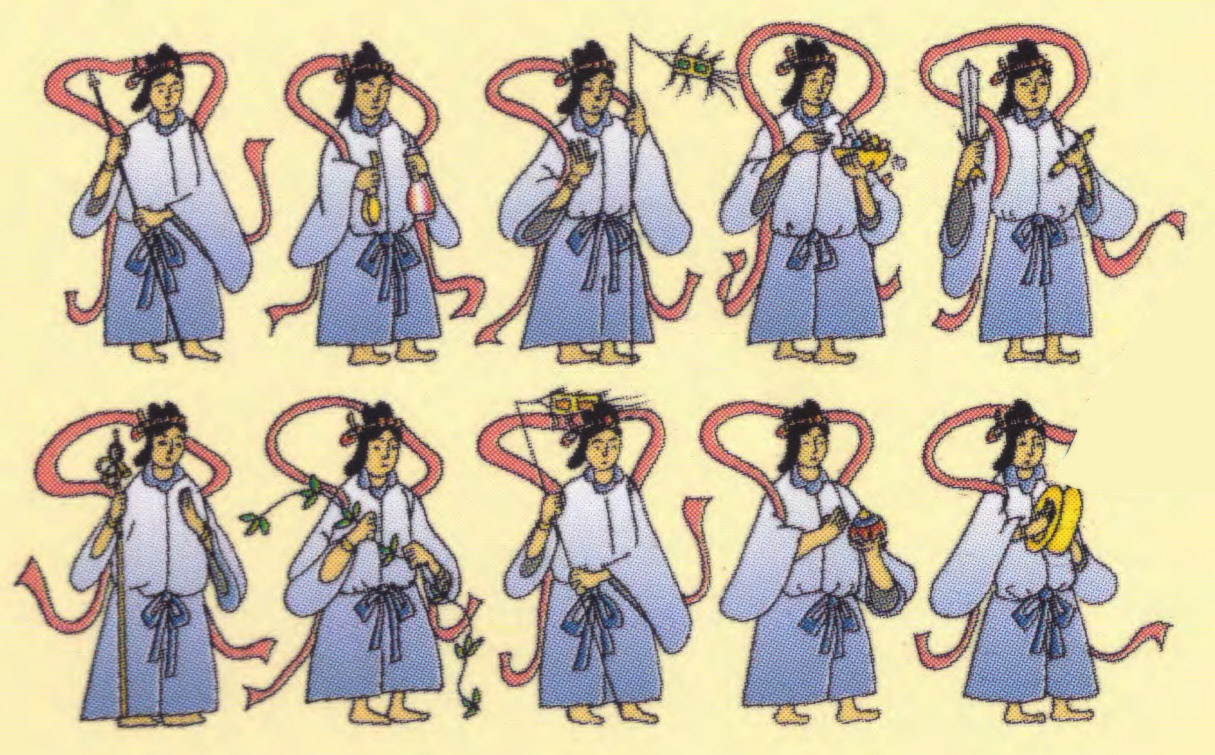
- Lamba holds a sword in her right hand and a sutra in her left.
- Vilamba carries cymbals.
- Crooked Teeth carries a tray of flowers.
- Flower Teeth carries the cintamani, or “wish-fulfilling gem.”
- Black Teeth carries a banner in her left hand.
- Many Hairs carries a banner in both hands.
- Insatiable carries a curved scepter in her right hand, while her left hand holds a flower vase.
- Necklace Holding holds a garland in both hands.
- Kunti carries a spear.
- Plunderer of Energy of All Beings holds a staff with rings.
The ten rakshasis and their mother, Hariti., appear in Chapter 26 of the Lotus Sutra and together offer dharanis for the protection of the teacher of the Lotus Sutra.