
All posts by John Hughes

Day 24

Day 24 concludes Chapter 19, The Merits of the Teacher of the Dharma, and closes the Sixth Volume of the Sutra of the Lotus Flower of the Wonderful Dharma.

Having last month considered the twelve hundred merits of the mind, we conclude today’s portion of Chapter 19, The Merits of the Teacher of the Dharma, in gāthās.

Thereupon the World-Honored One, wishing to repeat what he had said, sang in gāthās:

Their minds will become pure, clear, keen and undefiled.
They will be able to recognize with their wonderful minds
The superior, mean and inferior teachings.
When they hear even a gāthā [of this sūtra],
They will be able to understand
The innumerable meanings of [this sūtra].

When they expound [this sūtra]
In good order according to the Dharma
For a month, four month or a year,
They will be able to understand at once
The thoughts of gods, dragons, men, yakṣas, demigods,
And of all the other living beings
Inside and outside this world
Composed of the six regions
Because they keep
The Sūtra of the Lotus Flower of the Wonderful Dharma.

They also will be able to hear and keep
The Dharma expounded to all living beings
By the innumerable Buddhas of the worlds of the ten quarters
Who are adorned with the marks of one hundred merits.

When they think over the innumerable meanings [of this sūtra],
And endlessly repeat the expounding of those meanings,
They will not forget or mistake the beginnings and ends [of quotations]
Because they keep the Sūtra of the Lotus Flower of the Wonderful Dharma.

They will see the reality of all things.
Knowing the position [of this sūtra in the series of sūtras],
And the names and words [of this sūtra], according to the meanings of it,
They will expound [this sūtra] as they understand it.

They will expound the Dharma
Already taught by the past Buddhas.
Therefore, they will be fearless
Before the multitude.

Anyone who keeps the Sūtra of the Lotus Flower of the Wonderful Dharma
Will have his mind purified as previously stated.
Although he has not yet obtained the [wisdom-]without-āsravas,
He will be able to obtain [these merits of the mind].

When he keeps this sūtra,
He will be able to reach a rare stage.
He will be joyfully loved and respected
By all living beings.

He will be able to expound the Dharma
With tens of millions of skillful words
Because he keeps
The Sūtra of the Lotus Flower of the Wonderful Dharma.

[Here ends] the Sixth Volume of the Sūtra of the Lotus Flower of the Wonderful Dharma.

The Daily Dharma from Dec. 10, 2018, offers this:

They will expound the Dharma
Already taught by the past Buddhas.
Therefore, they will be fearless
Before the multitude.

The Buddha declares these lines to Constant-Endeavor Bodhisattva in Chapter Nineteen of the Lotus Sūtra, describing those who keep the Lotus Sūtra. By understanding fear, and demonstrating our fearlessness in this world of conflict, we can inspire and bring courage to other beings. One form of fear arises when we believe that we are in a situation that we cannot handle. This is simply a form of arrogance: believing that something is true when in reality we do not know that it is true. When the Buddha assures us who practice this Wonderful Dharma of the certainty of our future enlightenment, we then know how things will turn out. No matter what difficulties we find ourselves in, there are always more choices available to us. Often outcomes that seem horrible at the time can bring us more wisdom and compassion.

The Daily Dharma is produced by the Lexington Nichiren Buddhist Community. To subscribe to the daily emails, visit zenzaizenzai.com
Seeing Buddha Potential

In so many ways it is easy for us to actually deny the Buddha, the very thing, which we seek to understand. We think the Buddha isn’t here; this place is too messed up. We think the Buddha isn’t in me; I’m too messed up. We think the Buddha isn’t in others; they’re too messed up. Bodhisattva Never-Despise was able to see the Buddha in others, and the Buddha tells us that he always is here. But this is difficult to believe, and difficult to practice. Part of the process of becoming enlightened is, I believe, to develop the ability, to awaken within us the capacity to begin to see our own Buddha potential and then to see it in others. It is to learn to not deny in others or ourselves the very promised reality of being Buddhas. Enlightenment is after all being awakened.

Lotus Path: Practicing the Lotus Sutra Volume 1

Daily Dharma – March 8, 2019

For many hundreds of thousands of billions of asaṃkhyas of kalpas, I studied and practiced the Dharma difficult to obtain, and [finally attained] Anuttara-samyak-saṃbodhi. Now I will transmit the Dharma to you. Propagate it with all your hearts, and make it known far and wide!

The Buddha entrusts his highest teaching to all those gathered to see him in Chapter Twenty-Two of the Lotus Sūtra. He had already explained how difficult it is to believe and practice this highest teaching, and all the trouble it took for him to reach it. He also realizes that this teaching is not something he can keep for himself, and is meaningful only when it was shared with others. This is yet another example of the Buddha showing us how to live with the beings we want to benefit. We realize that our treasure is not what we keep for ourselves, but what we have in common with others. We are diminished not by what we lose, but by attempting to hold on to our delusions.

The Daily Dharma is produced by the Lexington Nichiren Buddhist Community. To subscribe to the daily emails, visit zenzaizenzai.com

‘Original Time’

“Original time” (honji) differs from linear time. It has no distinction of past, present, and future, and no proceeding from a deluded to an enlightened state; the Buddha and the ordinary worldling–the Buddha realm and the nine realms–are always one. This “original time” is the “actuality” of the three thousand realms in one thought-moment of the original Buddha and is accessed in the “now” (ima) of embracing the daimoku. In the single thought-moment of faith, the three thousand realms of the practitioner are those of the original Buddha. And because the person and the land are nondual, in the moment of faith and practice, the Sahā world is the eternal Buddha land. In the words of Chan-jan, a passage Nichiren quotes in this context: “You should know that one’s person and the land are [both] the single thought-moment comprising three thousand realms. Therefore, when one attains the Way, in accordance with this principle, one’s body and mind in that moment pervade the dharma realm.” (Page 291)

Original Enlightenment and the Transformation of Medieval Japanese Buddhism


The Rabbit, the Horse and the Elephant

Seeing that the correct Ultimate Truth as substance is difficult to describe, Chih-I employs three analogies to single it out. With these analogies, four cases are illustrated that correspond to the Four Teachings. This indicates that the Ultimate Truth bears different definitions in each of the Four Teachings.

The employment of the first analogy singles out the authentic Ultimate Truth by comparing three animals with each other. The simile of the three animals going across the river is a parable of three kinds of the Absolute Truth corresponding to the Three Vehicles (Śrāvaka, pratyekabuddha, and bodhisattva). A rabbit and a horse can only cross the river by swimming over the surface, but they are unable to touch the bottom. A big elephant, heavy as it is, can get to the bottom of the river in reaching the other shore. Water is analogous with emptiness as the Absolute Truth, and the bottom is analogous with no-emptiness (i.e., the Middle Way) as the Absolute Truth. The Two Vehicles (Śrāvaka and pratyekabuddha), because of their lack of wisdom, cannot seek deeply, which are analogous with the rabbit and the horse. The bodhisattva is analogous with the big elephant, for he has deep wisdom, and can perceive both emptiness and no-emptiness.

With regard to touching the bottom of the river, there are two situations to be differentiated. Chih-i elucidates that the bottom is analogous with the Ultimate Truth. A small elephant can only reach the surface of mud, and a big elephant can touch the bottom of mud. The small elephant refers to the wisdom of the Separate Teaching. Although the bodhisattva of the Separate Teaching can perceive no-emptiness, he does not have insight into an integrated reality of all dharmas. Therefore, his view of no-emptiness is not the Ultimate Truth. The big elephant refers to the wisdom of the Perfect Teaching. The bodhisattva of the Perfect Teaching can perceive no-emptiness perfectly. This means that he knows that one dharma embraces all dharmas and all dharmas are an integrated reality of one dharma. Since the Ultimate Truth is embedded in all dharmas, by such an exhaustion of all dharmas, the Ultimate Truth is manifested. From the point of view of attaining the Ultimate Truth, not only the view of emptiness of the Two Vehicles is excluded by this analogy, but also the view of no-emptiness of a small elephant (i.e., Separate Teaching) is excluded by this analogy. Only the view of the no-emptiness of a big elephant (i.e., Perfect Teaching) is taken as the substance of the Lotus Sūtra. (Vol. 2, Page 410-411)

The Profound Meaning of the Lotus Sutra: Tien-tai Philosophy of Buddhism


Day 23

Day 23 covers all of Chapter 18, The Merits of a Person Who Rejoices at Hearing This Sutra, and opens Chapter 19, The Merits of the Teacher of the Dharma.

Having last month begun Chapter 19: The Merits of the Teacher of the Dharma, we consider the eight hundred merits of the eye.

With their pure eyes given by their parents, these good men or women will be able to see all the mountains, forests, rivers and oceans inside and outside the one thousand million Sumeru-worlds, [each of which is composed of six regions] down to the Avici Hell and up to the Highest Heaven. They also will be able to see the living beings of those worlds, to know the karmas which those living beings are now doing and the region to which each of those living beings is destined to go by his karmas.”

Thereupon the World-Honored One, wishing to repeat what he had said, sang in gāthās:

Listen! I will tell you of the merits
Of those who fearlessly expound
To the great multitude
This Sūtra of the Lotus Flower of the Wonderful Dharma.

They will be able to obtain the excellent eyes
Adorned with eight hundred merits.
Their eyes will be pure
Because of this adornment.

With their eyes given by their parents,
They will be able to see Mt. Meru, Mt. Sumeru,
The Surrounding Iron Mountains,
And the other mountains,
And the forests, oceans and rivers
Inside and outside the one thousand million Sumeru-worlds.

They will be able to see the living beings
Of those worlds [each being composed of the six regions]
Down to the Avici Hell and up to the Highest Heaven.
Although they have not yet obtained heavenly eyes,
They will be able to see all this
With their natural eyes.

The Introduction to the Lotus Sūtra offers this explanation of the Five Kinds of Practices.

In the Lotus Sutra, we often see the sentence, “You should keep, read, recite, expound, and copy this Sutra.” These activities are called the Five Kinds of Practice for a Teacher of the Dharma. To keep the Sutra is to steadily accept and uphold the Lotus Sutra in one’s mind. To read the sutra means to peruse the Sutra and read it. To recite the Sutra means to recite it or portions of it by heart. To expound the Sutra means to interpret it and teach it to others. To copy the Sutra means to copy it by hand. Practitioners of the Lotus Sutra should undertake these five practices. They have two aspects: practice for one’s self and practice for others. [Chapter 19, The Merits of the Teacher of the Dharma] says that persons who endeavor to practice the Five Kinds of Practice will be rewarded with splendid merits of their six sense-organs of the eyes, ears, nose, tongue, body, and mind. Sakyamuni explains this to a great Bodhisattva by the name of Constant-Endeavor.

Introduction to the Lotus Sutra

Personal Faith or Just Heritage and Formal Observance

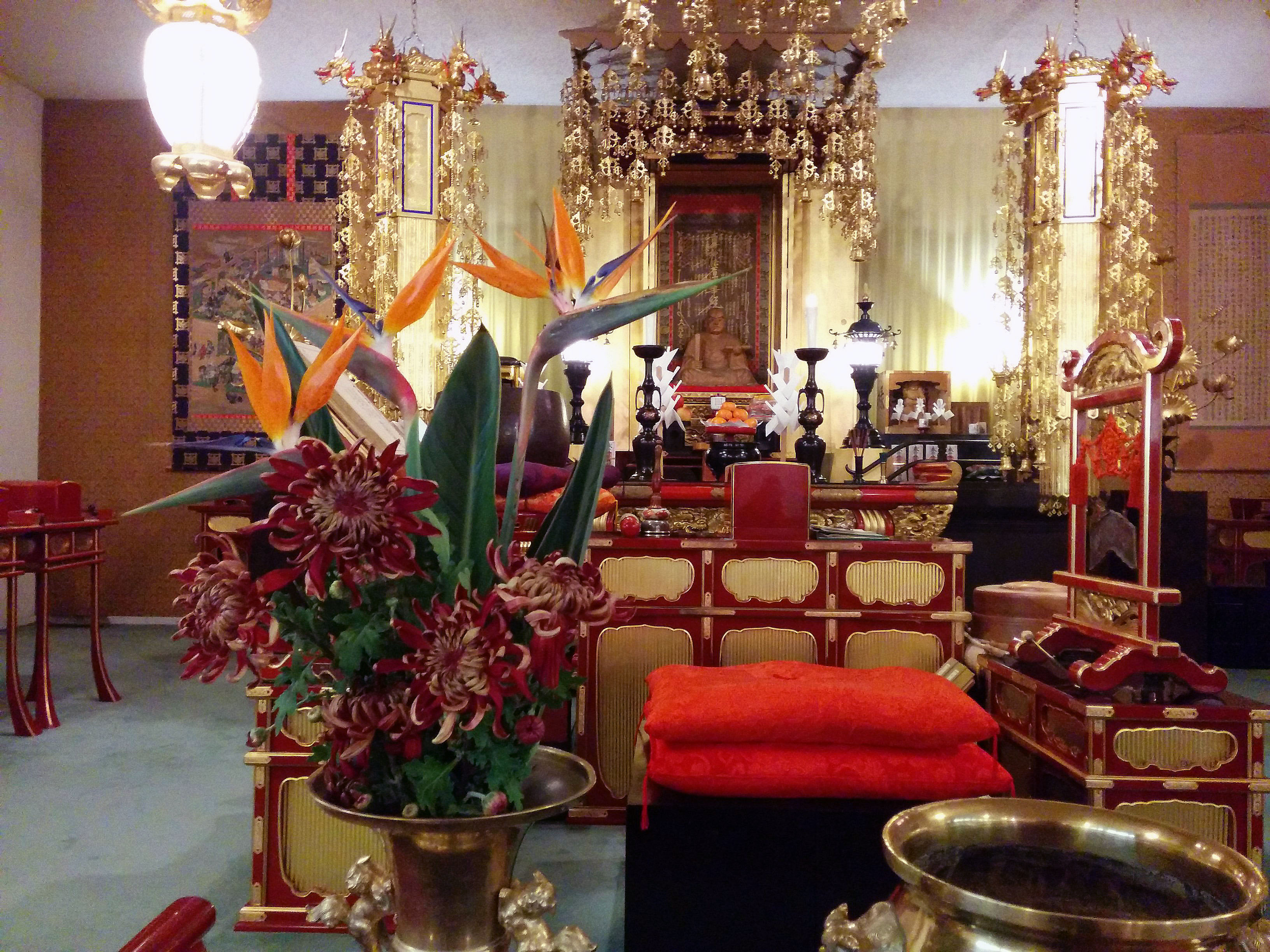
Flower offering
A member of the Sacramento Nichiren Buddhist Church congregation cut these Bird of Paradise and Chrysanthemums flowers from her garden and created this offering for the Nov. 8, 2015, service.

This blog post was originally published Nov. 8, 2015, and is reprinted here as the last quote from the History of Japanese Region book.

For the past several weeks I’ve been publishing quotes from History of Japanese Religion. Today’s quote from the book concerned a battle fought in Miyako in 1536 between followers of Nichiren and soldier-monks of Hiei in alliance with Ikkō fanatics. The Nichiren followers were driven out of town after 21 of their great temples were burnt down.

Shouts of “Namu Myōhō Renge Kyō,” the slogan of the Nichirenites, vied with “Namu Amida Butsu,” the prayer of the Ikkō men; many died on either side, each believing that the fight was fought for the glory of Buddha and that death secured his birth in paradise.

This history of Japanese Buddhism written in 1918 stretches from the passion of warring monks to the then modern view:

For the people at large religion was rather a matter of family heritage and formal observance than a question of personal faith.

Today, I attended the Komatsubara Persecution service at the Sacramento Nichiren Buddhist Church, surrounded by people who have been followers of Nichiren and members of Nichiren Shu for generations. The church in Sacramento was founded in the early 1930s, and many members can tell you the various addresses in downtown Sacramento where the church was located before the current church was built in 1970 in south Sacramento.

During the Dharma talk at the end of the service, Ven. Kenjo Igarashi explained that it is important to remember and celebrate the various trials and tribulations suffered by Nichiren because it was these trials suffered while propagating the Lotus Sutra during the Latter Day of the Law that prove the sutra’s predictions. And they also illustrate Nichiren’s need, and by example our own, to expiate bad karma.

In the late 19th and early 20th Century, there was a revival of Nichiren Buddhism. As History of Japanese Religion described the time:

On the part of many of its enthusiasts, it amounted to a religion of hero-worship, which remains still a force in the religious life of the Japanese. But many of the followers of Nichiren have narrowed down the horizon of Nichiren’s spiritual vision to the limits of chauvinistic patriotism. Thus, the movement has subsided to a great extent, but it is yet to be seen whether Nichiren’s profoundly religious ardour will inspire coming generations.

Attending Nichiren Buddhist services in Sacramento, California, nearly 100 years later, I’d like to think Nichiren’s “profoundly religious ardour” has indeed inspired many generations. And while for some it may be just formal observance and ritual, it remains vital and alive for many others.

Daily Dharma – March 7, 2019

He should not have fruitless disputes or quarrels about the teachings with others. He should have great compassion towards all living beings. He should look upon all the Tathāgatas as his loving fathers, and upon all the Bodhisattvas as his great teachers. He should bow to all the great Bodhisattvas of the worlds of the ten quarters respectfully and from the bottom of his heart. He should expound the Dharma to all living beings without partiality. He should be obedient to the Dharma. He should not add anything to the Dharma or take away anything from the Dharma.

The Buddha declares this passage in Chapter Fourteen of the Lotus Sūtra. In an earlier teaching, the Buddha proclaimed, “I do not quarrel with the world. The world quarrels with me.” The Buddha does not need to prove anything to anyone. He realized the truth and teaches it out of his compassion for all beings. He understood that when people reacted poorly to his teaching and began to argue with him or chastise him, it was due to the illusions they had not yet eliminated. This chapter of the sūtra instructs us to keep the same mind when we spread the Dharma. We teach from our compassion and respect.

The Daily Dharma is produced by the Lexington Nichiren Buddhist Community. To subscribe to the daily emails, visit zenzaizenzai.com

The Present World as the Buddha Land

We have already seen that Nichiren saw the Buddha’s pure land as immanent in the present world, based on the “Fathoming the Lifespan ” chapter of the Lotus Sūtra, which says, “I [Śākyamuni] am always in this Sahā world.” In the Kanjin honzon shō, Nichiren developed this idea specifically in terms of the origin teaching and the three thousand realms in a single thought-moment:

Now (ima) the Sahā world of the original time (honji) [of the Buddha’s enlightenment] is the constantly abiding pure land, freed from the three disasters and transcending [the cycle of] the four kalpas [formation, stability, decline, and extinction]. Its Buddha has not already entered nirvana in the past, nor is he yet to be born in the future. And his disciples are of the same essence. This [world] is [implicit in] the three realms, which are inherent in the three thousand realms of one’s mind.

In a manner very similar to that of the Sanjū shika no kotogaki and other medieval Tendai writings, this passage conveys the sense of the moment of enlightenment as accessing a timeless, “constantly abiding” realm in which all change is suspended. (Page 290-291)

Original Enlightenment and the Transformation of Medieval Japanese Buddhism


Ultimate Truth as Substance

Chih-i cites various passages in the Lotus Sūtra to support his own argument of taking the Ultimate Truth as substance (as this substance conveys the principle of neither cause nor effect). The phrases such as those in the chapter on “Introduction”: “Presently, the Buddha signals ray of light, wishing to reveal the doctrine of the Ultimate Truth,” “The doctrine of the Ultimate Truth of all dharmas, I have already taught you” and that in the chapter on “Expedient Means”: “Only Buddhas and Buddhas can exhaust the Ultimate Truth of all dharmas,” etc., prove that only the Ultimate Truth concerns leading beings to open the Buddha’s knowledge and insight, which can be characterized as the substance concerning the principle of neither cause nor effect. (Vol. 2, Page 408)

The Profound Meaning of the Lotus Sutra: Tien-tai Philosophy of Buddhism