All posts by John Hughes

The Influence of Spirits

Although we don’t know our ancestors as specific individuals, they know us verv well. Therefore, it is just as a mother is concerned for her children. If great grandchildren or descendants ignore them and do not take care of them by holding a Memorial Service, how sad they are. Nichiren Shonin said, “Even though we take our body from our parents, if, after your parent’s death, you do not take care of them and your ancestors no memorial service, no prayers, no respect – do you think that your deceased parents cannot say anything? They become malevolent spirits and curse not only you but also your children and grandchildren, as well as future descendants.”

Cursing means they will punish you with bad things. In fact, it is not a rare case where malevolent spirits have cursed a descendant, for example causing them to meet with a mishap, accident, sickness, domestic discord, relationship trouble, etc. We tend to see and think of everything based on only visible things, never thinking of spiritual influences. You might not believe it, but there are many cases connected with spiritual influences. In fact, most of the things that happen around us are affected by spirits.

Summer Writings

Daily Dharma – March 4, 2019

Some children of mine are pure in heart, gentle and wise.
They have practiced the profound and wonderful teachings
Under innumerable Buddhas
[In their previous existence].
I will expound this sūtra of the Great Vehicle to them,
And assure them of their future Buddhahood, saying:
“You will attain the enlightenment of the Buddha
In your future lives.”

The Buddha sings these verses in Chapter Two of the Lotus Sūtra. In the difficulties we face in this world of conflict and attachment, we can lose sight of our purpose to benefit all beings and try to avoid whatever is uncomfortable. When we hear the Buddha assure us of our inherent wisdom, and that our capacity to benefit others will continue to grow despite any obstacles we find, we learn to persevere through misfortunes, and increase our determination to lead all beings to enlightenment.

The Daily Dharma is produced by the Lexington Nichiren Buddhist Community. To subscribe to the daily emails, visit zenzaizenzai.com

A Worldwide Saṃgha

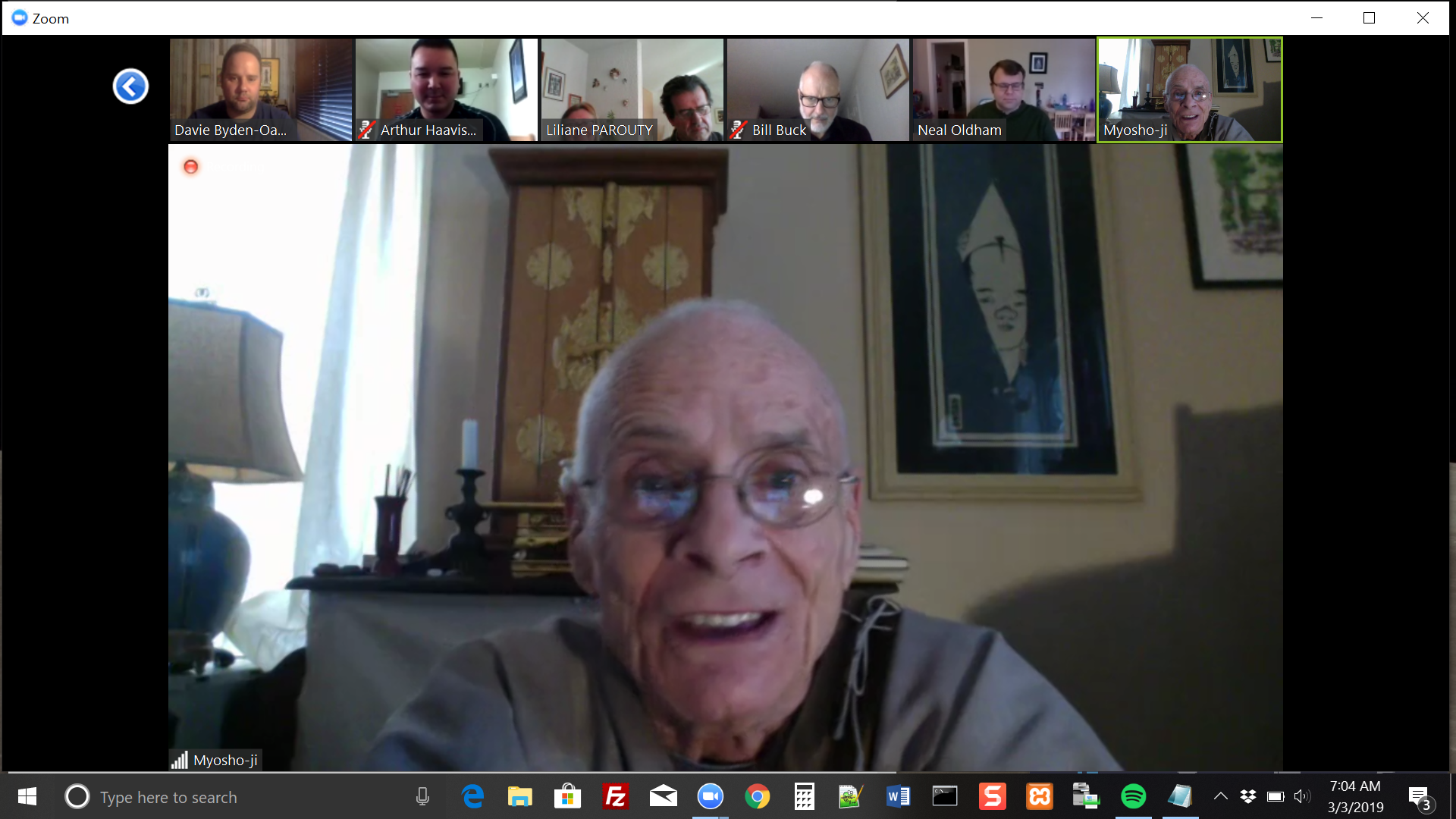
Sunday, March 3, 2019, online service with Rev. Ryusho Jeffus

Enjoyed attending the online Myoshoji service this morning. With services at the Sacramento Nichiren Buddhist Church and the meetings of the Oakland Nichiren Shu Saṃgha, I don’t have as many opportunities to attend these online sessions.

Today we had two couples in France, a young man in England as well as attendees in North Carolina, South Carolina, Iowa and Ohio. It was one of the best-attended services I’ve participated in.

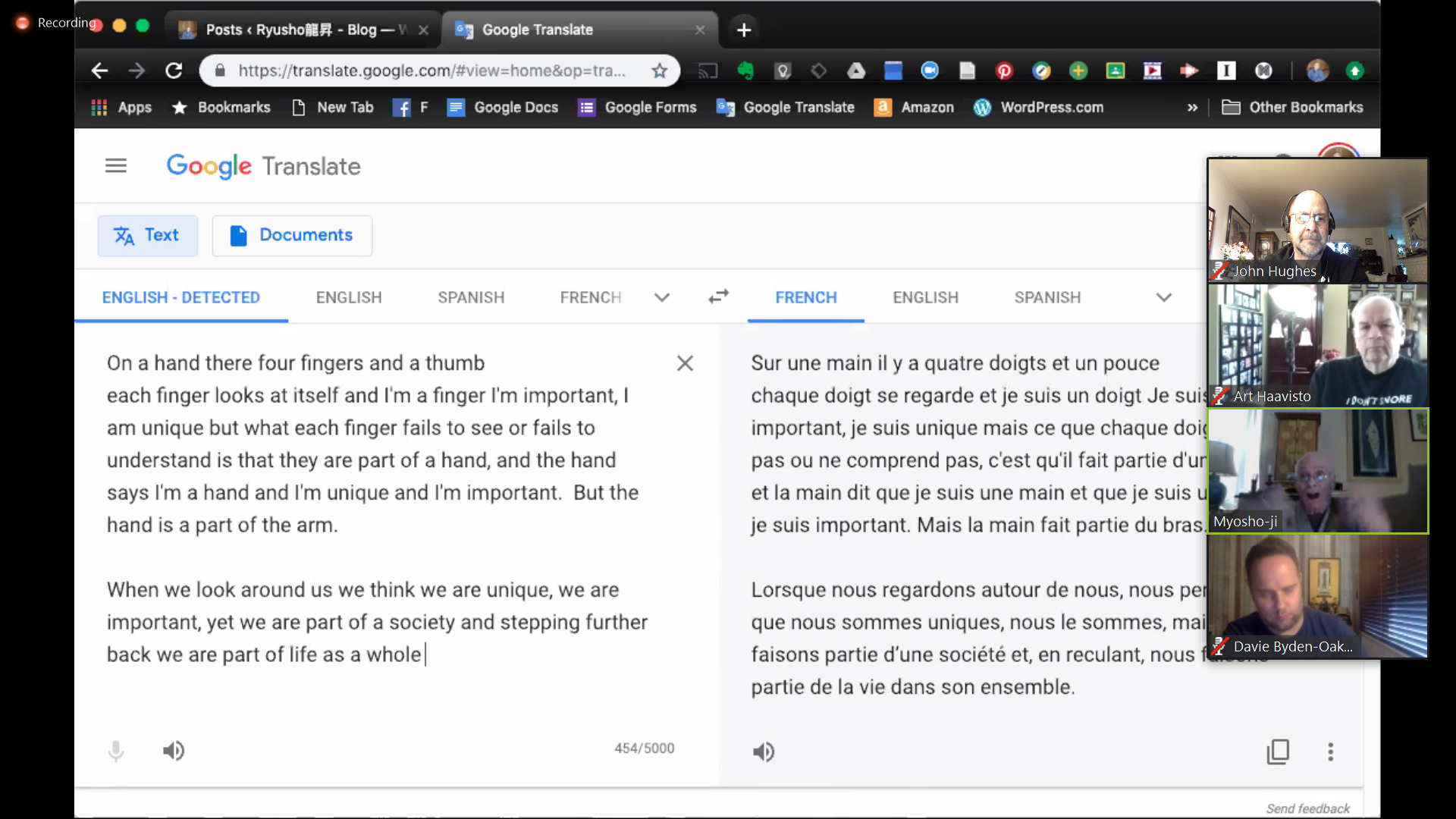
In an effort to help out those in France, Rev. Ryusho Jeffus tried out typing his Dharma talk live and having Google Translate display it in French. The French participants said it helped.

Using Google Translate to help attendees in France follow the Dharma talk.

These services are an excellent opportunity to learn about Nichiren Shu and participate in a gathering of like-minded people. The schedule for services are available on the Myoshoji Calendar.

Encompassing All Views of the Buddha

Śākyamuni is lord of this threefold world; all lesser rulers hold their territories in fief from him. With this concept of the Buddha, Nichiren asserted the superior authority of the Lotus Sūtra over that of worldly rule. Śākyamuni also presides over a pure land, the Pure Land of Eagle Peak (ryōzenjōdo), and Nichiren often assured his followers that their deceased relatives were with Śākyamuni there. In short, Nichiren’s concept of the object of worship not only posits a Buddha who encompasses all things, but itself attempts to encompass all views of the Buddha. (Page 274)

Original Enlightenment and the Transformation of Medieval Japanese Buddhism


The Final Teaching of the Buddha

In Chih-i’s system, various types of the Buddha’s teaching are arranged in an ascending order, so that beings can be led to receive the final teaching of the Buddha. To Chih-i, the final teaching of the Buddha should express the most profound doctrine, and the Origin in which the eternal Buddha abides can be regarded precisely as such a doctrine, whereby the Lotus Sūtra is legitimized to be the final teaching of the Buddha. (Vol. 2, Page 402)

The Profound Meaning of the Lotus Sutra: Tien-tai Philosophy of Buddhism


Day 19

Day 19 concludes Chapter 14, Peaceful Practices, and begins Chapter 15, The Appearance of Bodhisattvas from Underground.

Having last month concluded Chapter 14, Peaceful Practices, we consider the question posed by Bodhisattva-mahāsattvas, more than eight times the number of the sands of the River Ganges, who had come from the other worlds.

Thereupon the Bodhisattva-mahāsattvas, more than eight times the number of the sands of the River Ganges, who had come from the other worlds, rose from among the great multitude, joined their hands together towards the Buddha, bowed to him, and said:

“World-Honored One! If you permit us to protect, keep, read, recite and copy this sūtra, and make offerings to it strenuously in this Sahā-World after your-extinction, we will [do so, and] expound it in this world.”

Thereupon the Buddha said to those Bodhisattva-mahāsattvas:

“No, good men! I do not want you to protect or keep this sūtra because there are Bodhisattva-mahāsattvas sixty thousand times as many as the sands of the River Ganges in this Sahā-World. They are each accompanied by attendants also numbering sixty thousand times as many as the sands of the River Ganges. They will protect, keep, read, recite and expound this sūtra after my extinction.”

The Daily Dharma from June 23, 2018, offers this:

No, good men! I do not want you to protect or keep this sūtra because there are Bodhisattva-mahāsattvas sixty thousand times as many as the sands of the River Ganges in this Sahā-World. They are each accompanied by attendants also numbering sixty thousand times as many as the sands of the River Ganges. They will protect, keep, read, recite and expound this sūtra after my extinction.

The Buddha makes this declaration to the uncountable number of Bodhisattvas who came from other worlds to hear him teach in Chapter Fifteen of the Lotus Sūtra. These Bodhisattvas had responded to the Buddha’s question of who would keep and expound the Buddha’s highest teaching after his death. They promised that they would remain in this world of conflict and fulfill the Buddha’s request. After the Buddha spoke these words, an unimaginable number of Bodhisattvas came up from underground and paid their respects to the Buddha. We can understand this story, and this image, as showing that our capacity for enlightenment, and our ability to benefit all beings, is already within us. We do not need an outside agent to give these to us.

The Daily Dharma is produced by the Lexington Nichiren Buddhist Community. To subscribe to the daily emails, visit zenzaizenzai.com
Implicit and Explicit Predictions

In Chapter 13, the predictions for Maha-Prajapati Biksuni and Yasodhara Biksuni come about in an indirect sort of way. The Buddha notices his aunt, the woman who raised him after his mother died in child birth, looking at him. I can just imagine it to be one of those looks only a mother could give a child, something on the order of a scolding without words. This would be a look that probably told the Buddha, hey aren’t you forgetting something.

At any rate the Buddha guesses what his aunt is thinking and asks her if she thought that somehow she had been left out of all the predictions that have now covered every practitioner type, Sravakas, Pratyekabuddhas, Bodhisattvas. He says he had already assured the Sravakas of their enlightenment and that he did not exclude her from that general grouping. In this I believe the Buddha realizes that even though he had implicitly included women in the general prediction, he realizes now that the women really need it clearly stated not just for them but for the males in the congregation.

Lecture on the Lotus Sutra

Daily Dharma – March 3, 2019

Now I will tell you clearly. The merits of the person who gave all those pleasing things to the living beings of the six regions of four hundred billion asaṃkhya worlds, and caused them to attain Arhatship are less than the merits of the fiftieth person who rejoices at hearing even a gāthā of this Sūtra of the Lotus Flower of the Wonderful Dharma.

The Buddha gives this explanation to Maitreya (whom he calls Ajita – Invincible) in Chapter Eighteen of the Lotus Sūtra. He compares the benefit created by someone who teaches innumerable beings and makes exorbitant offerings through following the pre-Lotus sūtras to the benefits of finding joy in the Buddha’s Highest teaching. This joy is not the same as just getting what we want, or being relieved from what we do not want. It is the joy of seeing the world for what it is, and our place in it as Bodhisattvas who exist for the benefit of all beings.

The Daily Dharma is produced by the Lexington Nichiren Buddhist Community. To subscribe to the daily emails, visit zenzaizenzai.com

Nichiren’s Conception of the Buddha

Nichiren’s writings as a whole … present a spectrum of concepts of the Buddha, drawing on the implications, not only of the Dharma body, but of the recompense and manifested bodies as well. Nichiren’s Buddha is at once both immanent and transcendent. He is “our blood and flesh”; his practices and resulting virtues are “our bones and marrow.” Yet at the same time, he is “parent, teacher, and sovereign” to all beings of this, the Sahā world. In this connection, Nichiren also stressed that Śākyamuni was only the Buddha who, out of compassion for its beings, had actually appeared in this world—a frequent point in Nichiren’s criticism of devotion to Amida. (Page 274)

Original Enlightenment and the Transformation of Medieval Japanese Buddhism


The Cause and Effect of Buddhahood

For Chih-i, Buddhism consists of the cause and effect of Buddhahood. Looking at the cause and effect separately, the cause of Buddhahood concerns the Buddha’s self-cultivation of striving for Buddhahood, and the effect of Buddhahood concerns the Buddha’s activity of transforming others as the result of his attainment of Buddhahood. Hence, the Origin is considered by Chih-i as the cause of Buddhahood, and the Traces the effect of Buddhahood. However, Chih-i emphasizes that true reality is of no distinction between cause and effect. The cause and effect are contained in each other. The cause decides the realization of effect, and the effect is the manifestation of the cause. Since cause and effect are identical, the cause and effect of Buddhahood are complete in both the Origin and the Traces. (Vol. 2, Page 400-401)

The Profound Meaning of the Lotus Sutra: Tien-tai Philosophy of Buddhism