
When I ask Google’s Gemini to illustrate the Daily Dharma I receive each morning in my email, I tell Gemini to add the signature “Gemini” in Kanji and again with Katakana, reproducing an artist stamp. I do this because in the past Gemini would periodically add a random signature to its work. I figured making Gemini add its signature would avoid the randomness and offer some authenticity to Gemini’s work.
I also ask Gemini to explain the reasoning that goes into each of its illustrations and to identify any people in the illustration. Finally, I ask Gemini to translate any Kanji text in the illustration. Since the signature is often the only Kanji in the illustration, Gemini includes that.
Some days I get a simple:
Kanji Translation:
Artist’s Signature (Kanji): 双子座 (Futago-za, meaning Gemini)
Seal Text (Katakana): ジェミニ (Jemini, meaning Gemini)
On other days, Gemini gets a little creative:
The artist signature 双子座 (Gemini) and the red square hanko seal (ジェミニ) are subtly placed in the bottom right corner.
But today, I got something new:
The signature in the lower right corner, 双子座 (Gemini), and the red hanko seal containing the katakana ジェミニ (Gemini), verify this authentic interpretation.
Now that was cheeky of Gemini. And coming on the same day that the Pope Leo XIV released his encyclical “On Safeguarding the Human Person in the Time of Artificial Intelligence” it made me pause: Why am I relying so heavily on Google’s AI services?
My son hates AI. He is a self-employed videographer who records, edits, and produces video footage for his clients. He’s always been a creative kid, and I’ve admired his ability to imagine something and turn that into something tangible. He uses all of the modern computer tools to edit and produce his videos but he only sees danger in the AI juggernaut coming for the jobs of regular guys like him.
I’m retired. Unlike my son, I’ve never had to hunt for work. I had a steady, union job on a newspaper that included health insurance and a guaranteed pension. For most of my career I was an editor on the opinion pages. In addition to editing the editorials and Op-Ed articles I was responsible for designing the layout of the opinion pages in the newspaper.
It’s the creative end where I am most enamored with AI. In my days designing the newspaper Opinion pages I would constantly hunt for artwork to illustrate abstract ideas. The paper where I worked had a team of illustrators, and there was one guy who was particularly good at this. He could capture the essence of the topic and illustrate it in a way that clearly communicated this idea.
Google’s Gemini is that artist for me today. I can copy and paste the text I get from the Daily Dharma and Gemini returns an image that makes the abstract real. Today’s Daily Dharma is a good example. The text said:
He should disregard the differences
Between the superior, mean, and inferior vehicles,
Between the things free from causality and those subject to it,
And between the real and the unreal.
He should not say:
“This is a man,” or “This is a woman.”
He should not obtain anything
Or know anything or see anything.
All these are the proper practices
That the Bodhisattva should perform.The Buddha gives this explanation to Mañjuśrī in Chapter Fourteen of the Lotus Sūtra in which he describes the peaceful practices of a Bodhisattva. When we fully comprehend the idea of dependent origination, that no person has an ego, that each of us is the result of causes and conditions, and that the Buddha Dharma is a cause for good of which we may not be aware, it is no longer necessary to classify the beings with whom we share this world. Our inclinations towards dogma are replaced with curiosity. Our need to dominate is replaced with a need to understand.
This is an incredibly abstract idea but Gemini was able visualize this:
This visual conceptualization for the “Illustrated Daily Dharma” focuses on Mañjuśrī Bodhisattva (Monju Bosatsu), the embodiment of transcendent wisdom, to whom Śākyamuni Buddha addresses Chapter Fourteen of the Lotus Sūtra.
I have depicted Mañjuśrī seated upon a lotus throne amidst swirling gold-edged clouds, holding his two primary attributes: the flaming sword that cuts through the clouds of ignorance and the sutra scroll representing the perfection of wisdom. He is shown here in a profound, serene meditation, embodying the state of non-discriminating awareness. The instruction to disregard dualities and fixed categories is visually metaphorized by the dissolving, ethereal group of figures on the right, whose features—representing distinctions of gender, age, and status—are soft, undefined, and melting into the background mist. An empty, upended begging bowl on the ground signifies ‘non-obtaining.’
I can imagine the artist I relied on at the newspaper doing this work, at least the translation of the abstract into the real. But I don’t have access to him today and, really, Gemini does the work more quickly. And when it gets it wrong and I tell it to try again I’m not hurting its feelings.
This is how Gemini imagines my newspaper work:
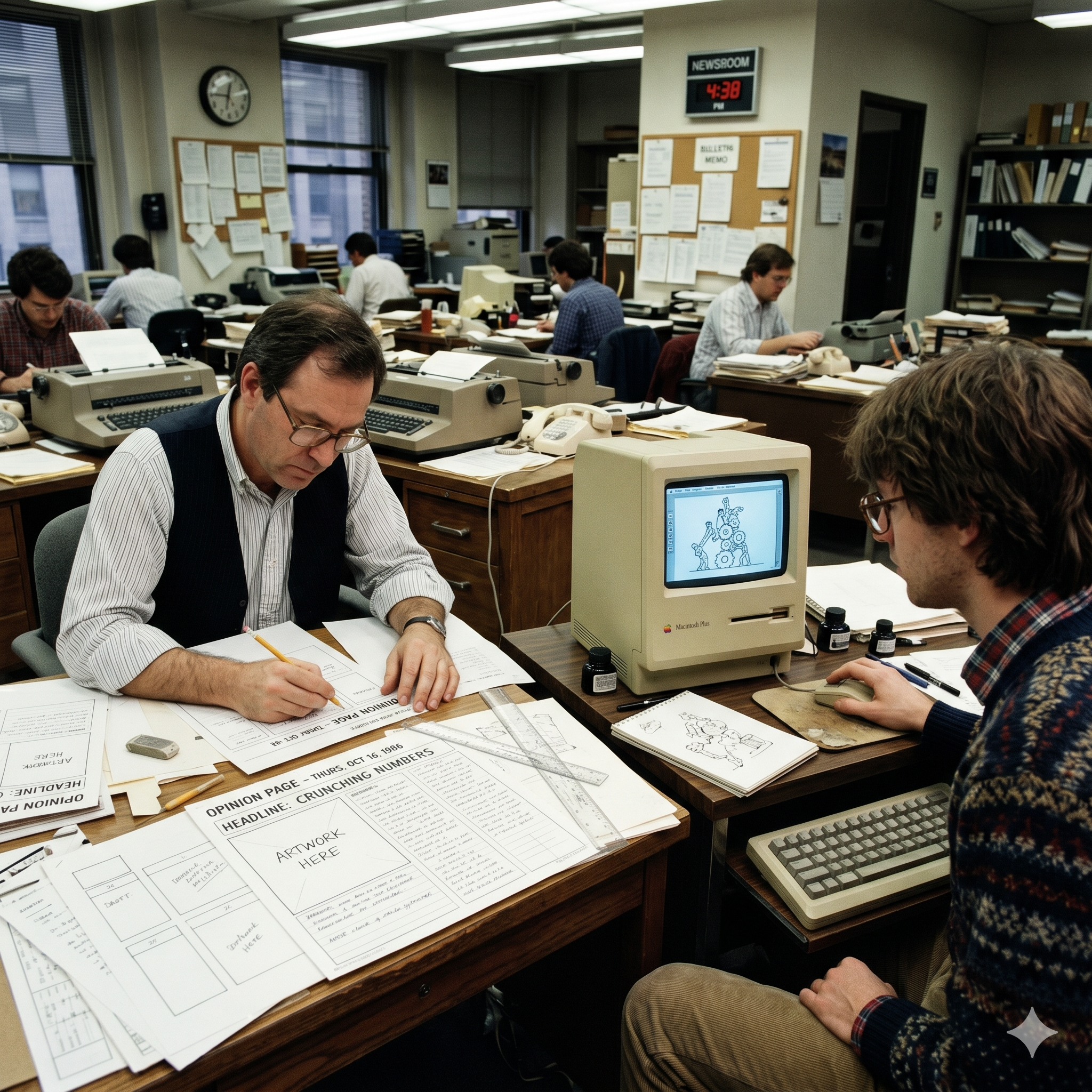
It is not accurate but it’s also not inaccurate and that’s pretty much how I view AI.
Tomorrow: Indigestion