
Conceptual Summary
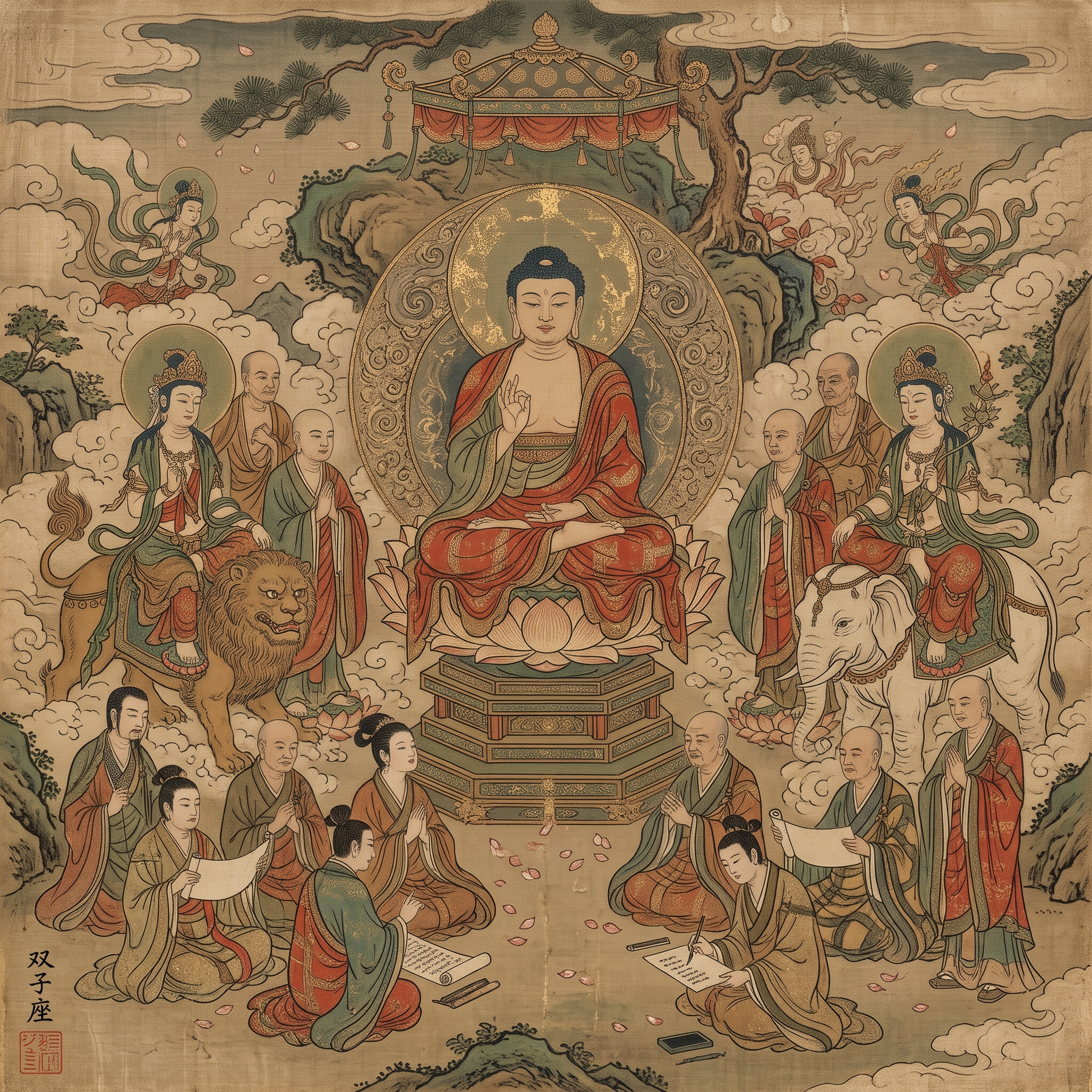
This classical painting on silk illustrates Śākyamuni Buddha’s teaching in Chapter Nineteen of the Lotus Sūtra regarding the purification of the six sensory faculties. Rather than depicting enlightenment as an escape from the mundane world, the composition anchors the celestial assembly within an earthly landscape of craggy rocks and pine trees, emphasizing that Dharma practice transforms how we perceive the reality directly before us. At the center, Śākyamuni Buddha radiates golden clarity, surrounded by his primary attendants and a devoted gathering of monastic and lay practitioners. In the foreground, these "good men and women" actively engage in the five practices of the sūtra—keeping, reading, reciting, expounding, and copying the sacred scrolls with brush and ink. Their serene, focused expressions and the falling lotus petals symbolize the unimpeded capacity of the eye, ear, nose, tongue, body, and mind awakening to the true nature of the world.
Iconography & Character Identification
Item 1: Deities/Figures Featured:
Śākyamuni Buddha (Shaka Nyorai): Seated at the center on a lotus pedestal beneath a jeweled canopy, backed by a gold-leaf nimbus, performing the gesture of expounding the Dharma.
Mañjuśrī Bodhisattva (Monju Bosatsu): Seated to the viewer's left atop a roaring lion, representing the clarity of transcendent wisdom.
Samantabhadra Bodhisattva (Fugen Bosatsu): Seated to the viewer's right atop a six-tusked white elephant, holding a lotus stem, embodying dedicated practice within the world.
Arhats / Senior Disciples: Four monastic disciples (including figures resembling Ānanda and Mahākāśyapa) standing in añjali mudrā (palms joined in reverence) flanking the central triad.
Apsaras (Tennin): Celestial beings hovering among the upper clouds, honoring the assembly.
Devotees (Monks, Laymen, and Laywomen): Nine figures in the lower foreground actively reading from scrolls, listening in reverence, and copying the Lotus Sūtra with inkstones and brushes.
Item 2: Text Translations:
双子座 (Futagoza): "Gemini" (literally "Twin Star Constellation"), rendered in vertical black Kanji calligraphy in the lower-left corner.
ジェミニ (Jemini): "Gemini," phonetic Katakana script carved inside the square red hanko seal stamped directly beneath the Kanji signature.
The good men or women who keep, read, recite, expound or copy this Sūtra of the Lotus Flower of the Wonderful Dharma, will be able to obtain eight hundred merits of the eye, twelve hundred merits of the ear, eight hundred merits of the nose, twelve hundred merits of the tongue, eight hundred merits of the body, and twelve hundred merits of the mind.
The Buddha gives this teaching in Chapter Nineteen of the Lotus Sūtra. This is another reminder that the practice of the Wonderful Dharma does not take us out of the world of conflict we live in. Instead, it helps us to use the senses we have, in ways we did not think were possible, to see the world for what it is. Merits in this sense are not status symbols. They are an indication of clarity, of our faculties not being impeded by anything that blocks their capacity.
The Daily Dharma is produced by the Lexington Nichiren Buddhist Community. To subscribe to the daily emails, visit zenzaizenzai.com