
Conceptual Summary
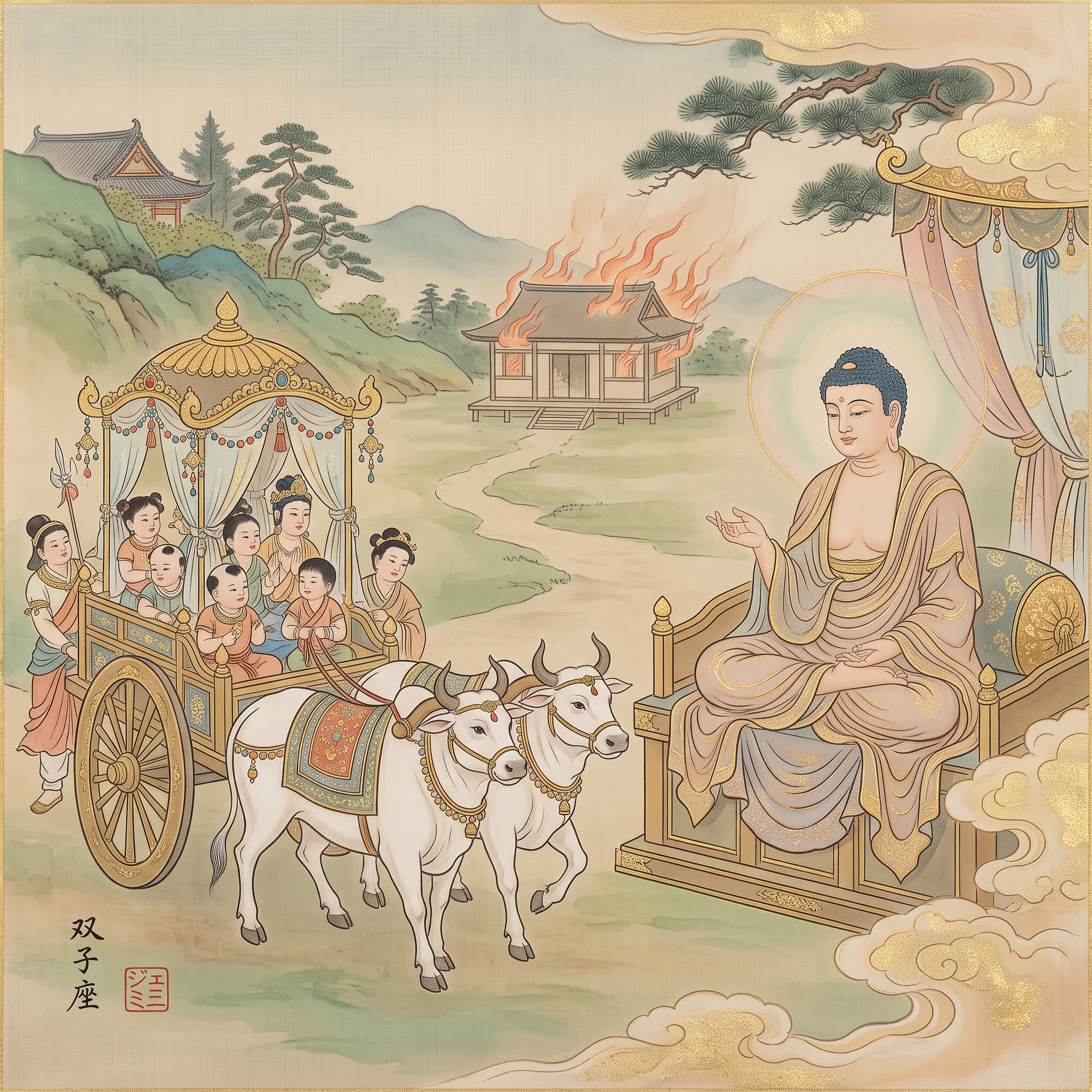
The conceptual direction for this illustration focuses on merging the historical personage of Śākyamuni Buddha with the role of the rich father as described in the source text. In Japanese Buddhist iconography, Śākyamuni is frequently depicted in the historical attire of India, and his visual presence anchoring the 'carefree place'—represented by a tranquil landscape—provides the ultimate safe haven for the children. To visualize the Buddha’s ‘immeasurable wealth’ in teaching, the ‘large cart’ is transformed into an elaborate white bullock chariot, adorned with rich materials and subtle gold leaf, clearly differentiating it from a simple toy or standard ox-cart and making it a fitting vessel for the 'wonderful' reward of the Dharma. Finally, the silk texture, ink lines, and muted mineral pigments define a classical aesthetic that respects the source’s origin while adhering strictly to the constraints by avoiding representations of Amida or Dainichi.
Iconography & Character Identification
Item 1: Deities/Figures Featured:
Śākyamuni Buddha (depicted as the figure radiating light and teaching, simultaneously representing the 'rich man' of the parable)
A group of the rich man's children
Attendants/Guardians supporting the procession
Item 2: Text Translations:
Kanji Signature: 双子座 (read: Futago-za) translates as Gemini.
Red Seal Hanko: ジェミニ (read: Jemini) is the Katakana transliteration for Gemini.
Śāriputra! Seeing that all his children had come out of the burning house safely and reached a carefree place, the rich man remembered that he had immeasurable wealth. So without partiality, he gave them each a large cart.
The Buddha tells the parable of the Burning House in Chapter Three of the Lotus Sūtra. In the story, a man tries to warn his children who are playing in a dangerous house of the harm that will come to them if they do not set aside their preoccupations and come out. The children did not listen to him, so he told them about nonexistent toys outside the house. The Buddha then compares himself promising an end to suffering to the father promising nonexistent toys, and himself leading all beings to Enlightenment to the father giving his children toys more wonderful than they could imagine.
The Daily Dharma is produced by the Lexington Nichiren Buddhist Community. To subscribe to the daily emails, visit zenzaizenzai.com