
Conceptual Summary
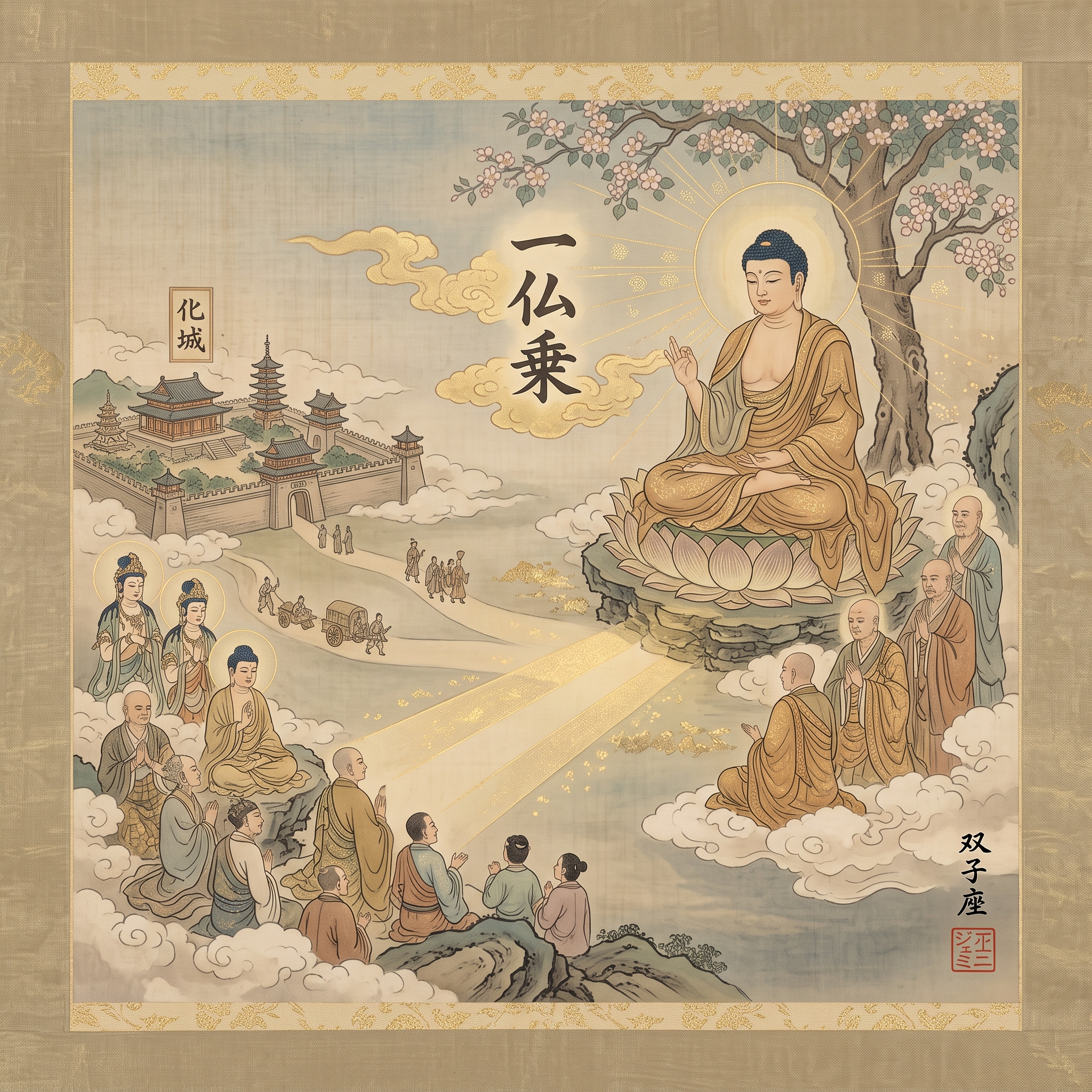
The illustration is a visual translation of the Parable of the Magic City and the Doctrine of the One Vehicle from the Lotus Sūtra. Śākyamuni Buddha is seated at the right, expounding the ultimate truth. To represent the text's assertion that the "two [or three] vehicles were taught only as resting places," the illusory "Magic City" (化城) is depicted on the left. Travelers are shown utilizing a path with simple carts, symbolizing the provisional, expedient teachings designed to lead them partway. Central to the composition is the declaration that "There is only the One Buddha-Vehicle," visualized as a broad, golden avenue leading directly toward the supreme enlightenment embodied by Śākyamuni. The large characters in the sky reinforce this singular, true path.
Iconography & Character Identification
Item 1: Deities/Figures Featured:
Śākyamuni Buddha: The large, central figure on the right, seated on a lotus throne, in the act of teaching.
The Assembly: A diverse group of listeners gathered on clouds and surrounding the Buddha, which typically includes Bodhisattvas (distinguished by jewelry and robes), Arhats or monks (depicted with shaven heads and monastic robes), and celestial or lay followers.
The Travelers: Figures in the mid-ground utilizing carts and walking towards the Magic City, representing practitioners of the provisional teachings.
Item 2: Text Translations:
化城 (Upper-left, above the city): Magic City (also known as the Conjured City or Illusory City).
一仏乗 (Large center text): One Buddha-Vehicle (Ekayāna).
双子座 (Signature): Gemini.
ジェミニ (Red seal): Gemini.
The Buddhas expound the teaching of the Three Vehicles
Only as an expedient.
There is only the One Buddha-Vehicle.
The two [vehicles] were taught only as resting places.
The Buddha declares these verses in Chapter Seven of the Lotus Sūtra after telling the parable of the Magic City. The parable is his explanation of why expedient teachings are necessary, and why we must eventually set them aside to attain the enlightenment that is our true nature.
The Daily Dharma is produced by the Lexington Nichiren Buddhist Community. To subscribe to the daily emails, visit zenzaizenzai.com