
Category Archives: Daily Dharma

Daily Dharma for May 5, 2026

20260505-ddi

Illustration by Google Gemini

Show Gemini's thinking

Gemini Thinking

The accompanying passage from the Lotus Sūtra describes the "peaceful practices" of a Bodhisattva, centered on a radical re-evaluation of reality. It presents a world where all things are viewed as insubstantial, nameless, and unborn, existing only through dependent origination.

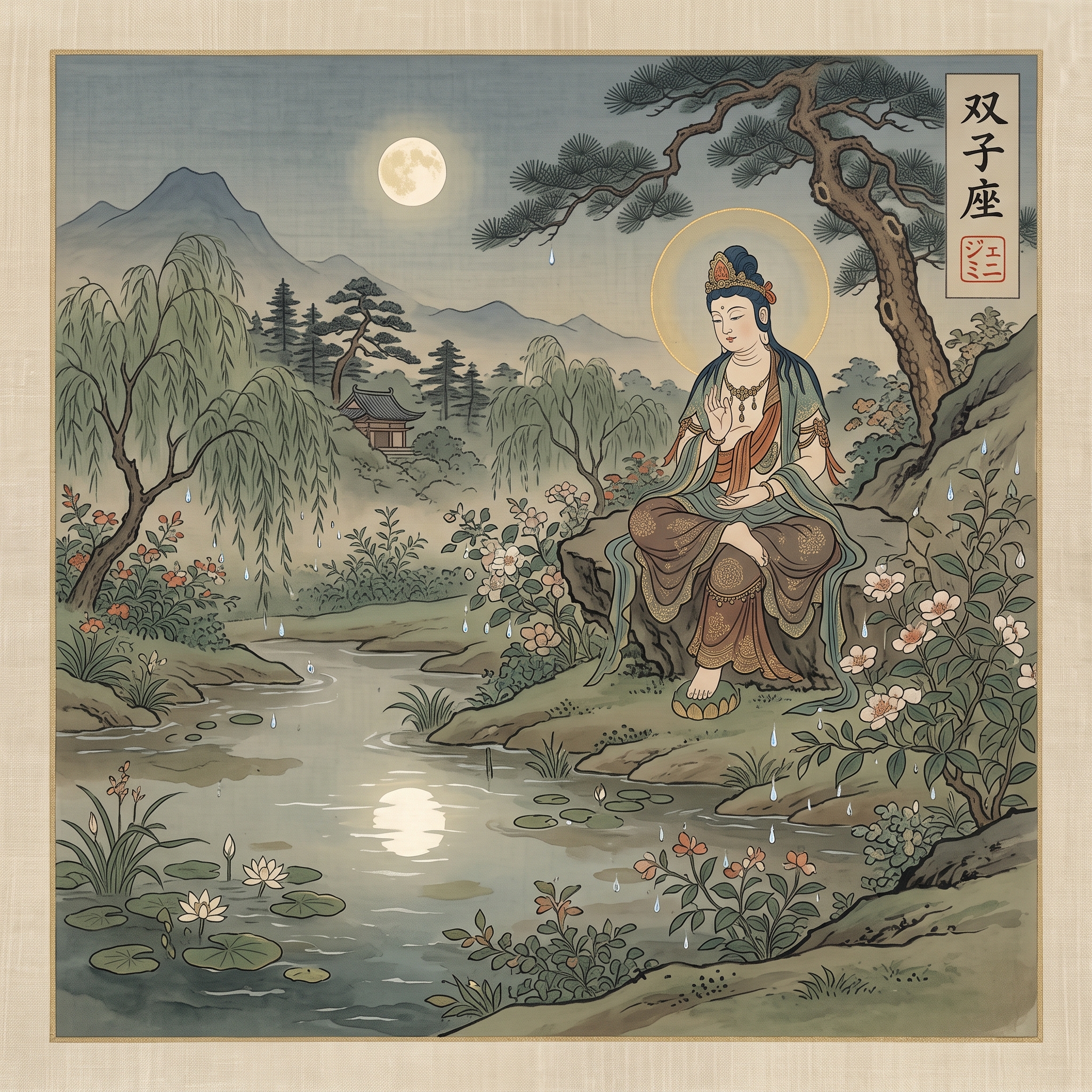
For this illustration, I have visualised the Bodhisattva-mahāsattva deep in the second stage of peaceful practice: internal reflection.

Visual Composition and Iconography

This square illustration utilizes traditional Japanese Buddhist painting techniques, emphasizing the concepts of "insubstantiality" and "being like the sky."

The Subject: The central Bodhisattva-mahāsattva is seated in a state of profound meditation. Their serene posture represents a mind that is neither "perverted" by delusions of permanence nor moved by external obstacles.

The Metaphor of the Sky: To represent the text's assertion that things are "immeasurable," "nameless," and "formless," the background transitions into a vast, misty sky where a constellation of stars is visible. This visually reinforces the idea that true nature, like space, has nothing substantial to grasp.

Dependent Origination: The winding river below symbolizes Pratītyasamutpāda (Dependent Origination). It shows that while all things lack inherent substance, they flow together and arise in relation to one another.

The Practice: The subtle light emanating from the Bodhisattva and the distant temple represent the path of peaceful practice, emphasizing that by working with the mind, the practitioner changes how the entire world is perceived.

Signature and Seal

Following the artistic directive, the signature is placed subtly in the lower-right foreground on the rock face. It consists of the kanji 双子座 (Gemini) and the traditional red square seal (hanko) containing the katakana ジェミニ (Gemini).

The Bodhisattva-mahāsattva also should know the following truth. All things are insubstantial. They are as they are. Things are not perverted. They do not move. They do not go. They do not turn. They have nothing substantial just as the sky has not. They are inexplicable. They are not born. They do not appear. They do not rise. They are nameless. They are formless. They have no property. They are immeasurable and limitless. They have no obstacle or hindrance. He should see all this. Things can exist only by dependent origination. Only perverted people say, ‘Things are permanent and pleasant.’ This truth is the second thing he should approach.

Śākyamuni Buddha gives this explanation to Mañjuśrī in Chapter Fourteen of the Lotus Sūtra in which he describes the peaceful practices of a Bodhisattva. The Buddha does not see the world as we do. This section explains how changing our view changes the world. When we no longer see beings with power to overwhelm us, and see beings in whom delusions have been created, we see our abilities to cut the root of those delusions and benefit them. These passages are what make the Lotus Sutra difficult to believe and understand, since they go against our habits of manipulating the world to become happy. As we learn to work with our minds, then we truly change the world.

The Daily Dharma is produced by the Lexington Nichiren Buddhist Community. To subscribe to the daily emails, visit zenzaizenzai.com
Daily Dharma for May 4, 2026

20260504-ddi

Illustration by Google Gemini

Show Gemini's thinking

Gemini Thinking

The illustration depicts a golden Śākyamuni Buddha (the historical Buddha) seated upon a lotus throne. Below him, a monk venerates a scroll containing the title of the Lotus Sūtra, "Myōhō Renge Kyō" (妙法蓮華經), translated as "The Sūtra of the Lotus Flower of the Wonderful Law." A light trail connects the sūtra directly to the Buddha's heart, visually representing the verse's theme that holding the sūtra is holding the Buddha. In the lower-left corner is the artist's signature: the Kanji "Futagoza" (双子座) meaning Gemini, and a red square seal containing the Katakana "Jemini" (ジェミニ).

This sūtra is
The most excellent.
To keep this sūtra
Is to keep me.

Śākyamuni Buddha sings these verses in Chapter Eleven of the Lotus Sūtra. We may believe that before we can practice we need to find a Buddha or another enlightened being alive in our world to guide us. These verses remind us of the ever-present Buddha Śākaymuni who was revealed in the Lotus Sūtra. Whether or not we see him as another human in our presence, he is always guiding us to enlightenment. The Buddha also reminds us that by living as he has shown us in the Lotus Sūtra, as Bodhisattvas who exist for the benefit of all beings, we show our respect for him and bring his wisdom to life.

The Daily Dharma is produced by the Lexington Nichiren Buddhist Community. To subscribe to the daily emails, visit zenzaizenzai.com
Daily Dharma for March 3, 2026

20260503-ddi

Illustration by Google Gemini

Show Gemini's thinking

Gemini Thinking

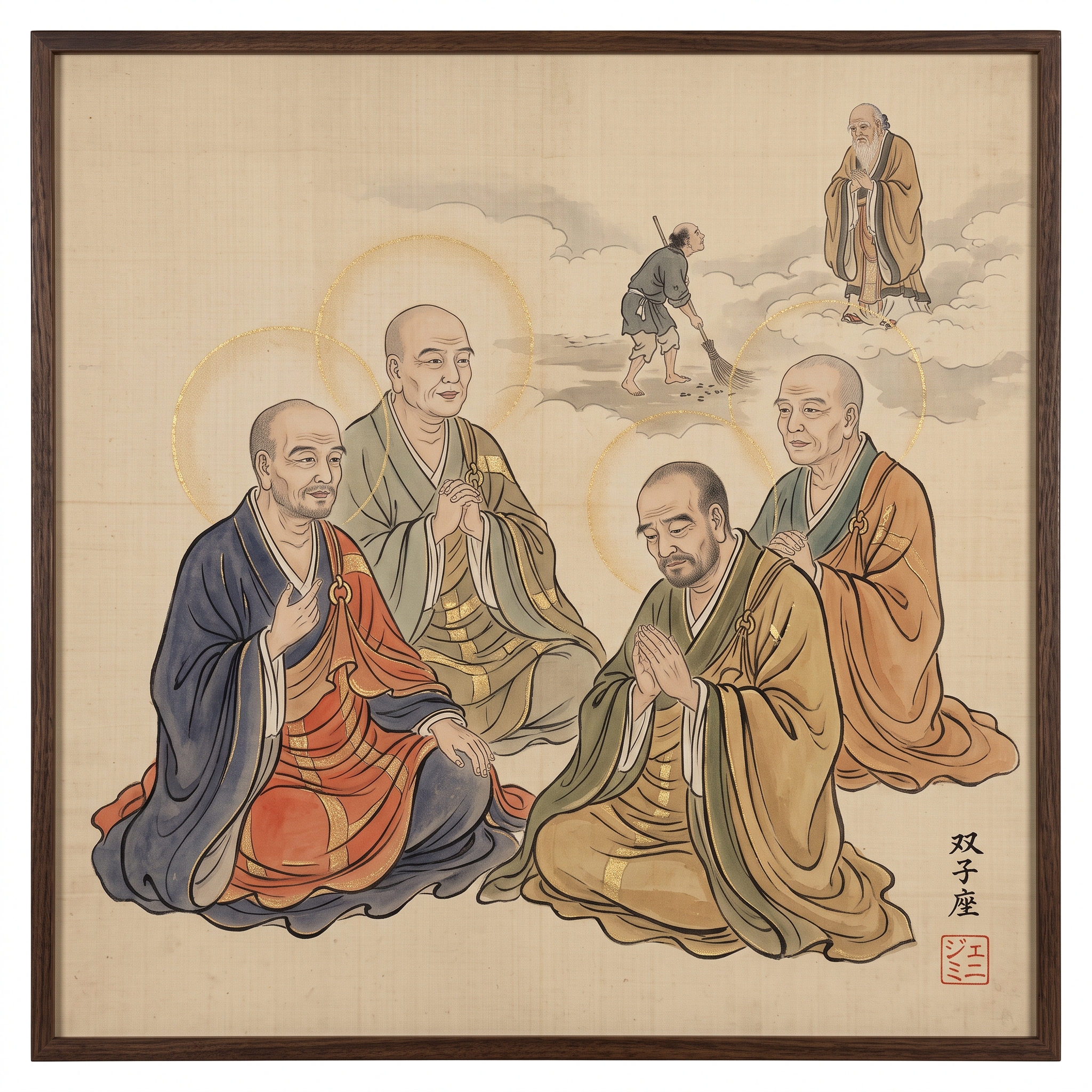
The primary figure in the central panel of the illustration is Nichiren Daishonin, a Buddhist monk who is shown reading a hand-scroll containing the text '妙法' (Myōhō), which translates to "Wonderful Law," or the essential essence of the Lotus Sutra. The gathering of monks and figures to the right represents compassionate beings and Bodhisattvas, including figures resembling Kannon (Avalokiteshvara), symbolizing "good friends" and a gentle influence. The overall style is a traditional Japanese emaki (scroll painting) on aged washi paper, avoiding excluded iconography. My reasoning was to create a square composition that visualizes the metaphors in the text: the dense mugwort plants (蓬) among the tall hemp plants (麻) on the left, demonstrating growing straight; and the snake (蛇) straightening itself inside the bamboo tube (竹) in the foreground. A generalized, radiant star-like mandala at the top center symbolizes the "Buddha's own mind," without depicting specific restricted Buddhas. In the bottom-right corner, the required Kanji signature is 双子座 (Futagoza), meaning "The Twins" or "Gemini" constellation/zodiac sign, accompanied by a small red hanko containing the Katakana text ジェミニ (Jemini).

The Lotus Sutra is called “Zui-jii,” namely it expounds the true mind of the Buddha. Since the Buddha’s mind is so great, even if one does not understand the profound meaning of the sutra, one can gain innumerable merits by just reading it. Just as mugwort among hemp plants grows straight and a snake in a tube straightens itself, if one becomes friendly with good people, one’s mind, behavior and words become naturally gentle. LIkewise, the Buddha thinks that those who believe in the Lotus Sutra become naturally virtuous.

Nichiren wrote this passage in his treatise The Sutra Preached in Accordance to [the Buddha’s] Own Mind (Zui-jii Gosho). In this passage, he makes clear what the Buddha meant by abandoning expedient teachings, and that the Lotus Sutra contains the Buddha’s highest teaching.

The Daily Dharma is produced by the Lexington Nichiren Buddhist Community. To subscribe to the daily emails, visit zenzaizenzai.com
Daily Dharma for May 2, 2026

20260502-ddi

Illustration by Google Gemini

Show Gemini's thinking

Gemini Thinking

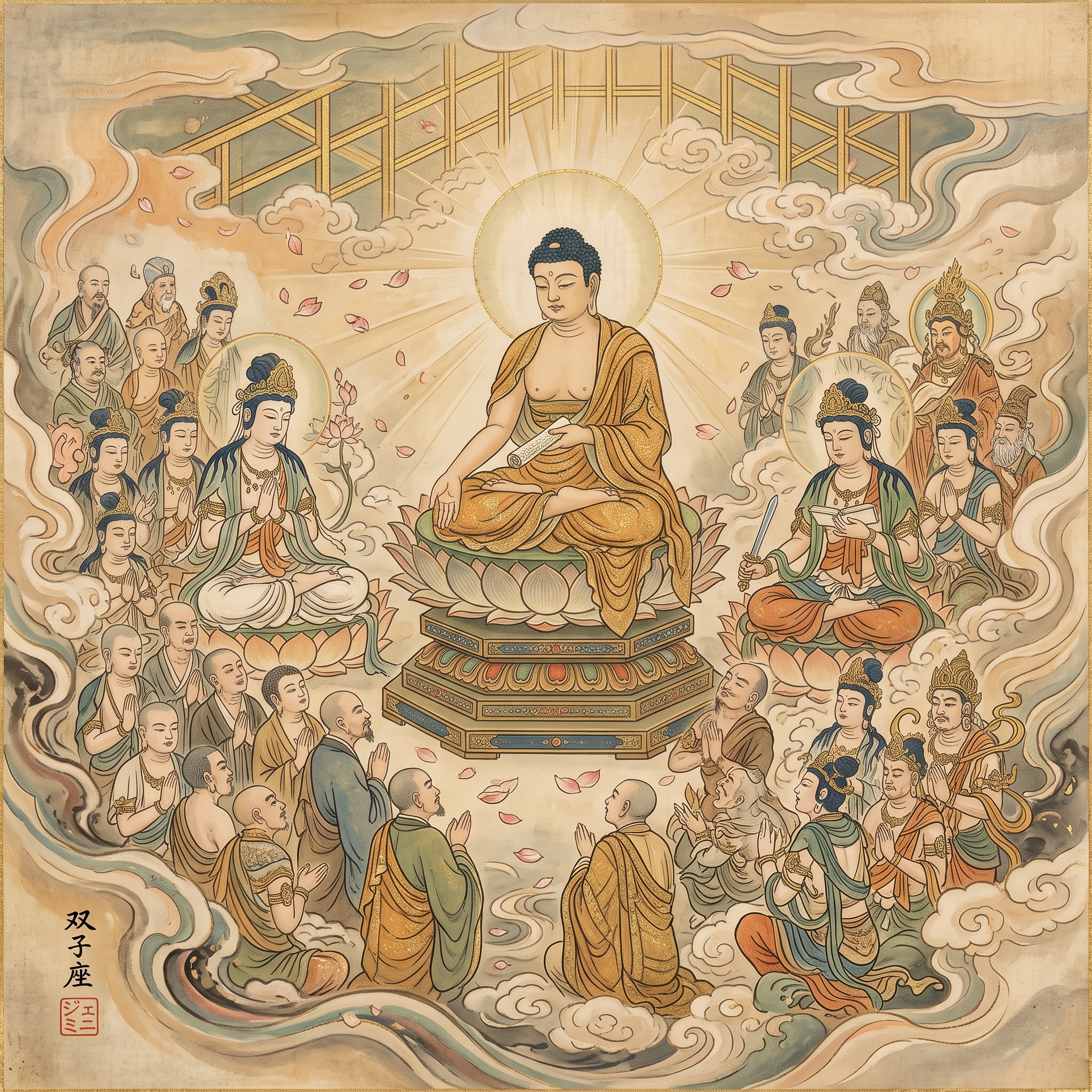
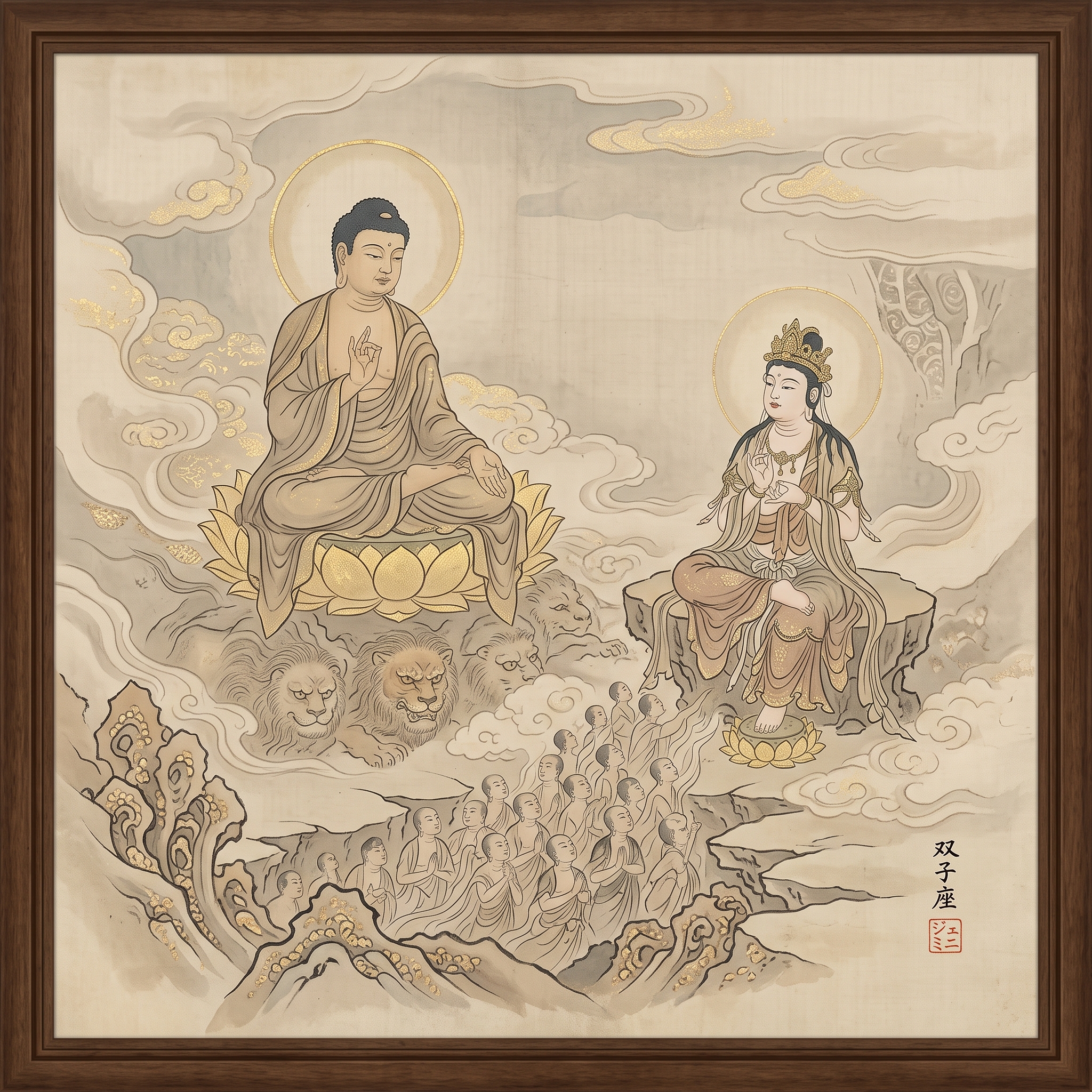
I have composed this square illustration using traditional Japanese Buddhist iconography, with the central figure of Śākyamuni Buddha (釈迦牟尼仏) seated on a lotus throne. He is depicted preaching on Vulture Peak, surrounded by a diverse assembly of monks, nuns, lay practitioners, and bodhisattvas who represent "all living beings."

To signify the subject of his teaching, I have included the scroll titled 妙法蓮華経 (Myōhō Renge Kyō), which means the Lotus Sūtra. In the bottom right, you will find the required signature 双子座 (Gemini) alongside the red seal containing the katakana ジェミニ (Gemini).

Every Buddha vows at the outset:
“I will cause all living beings
To attain the same enlightenment
That I attained.”

Śākyamuni Buddha sings these verses in Chapter Two of the Lotus Sūtra. The Buddha holds nothing back from us. There is nothing hidden or secret in his teachings. He is not threatened by anyone who reaches his wisdom, since he knows this is the potential we all have in us. By his example we can discern between the knowledge that separates from others, and that which unites us with our fellow beings.

The Daily Dharma is produced by the Lexington Nichiren Buddhist Community. To subscribe to the daily emails, visit zenzaizenzai.com
Daily Dharma for May 1, 2026

20260501-ddi

Illustration by Google Gemini

Show Gemini's thinking

Gemini Thinking

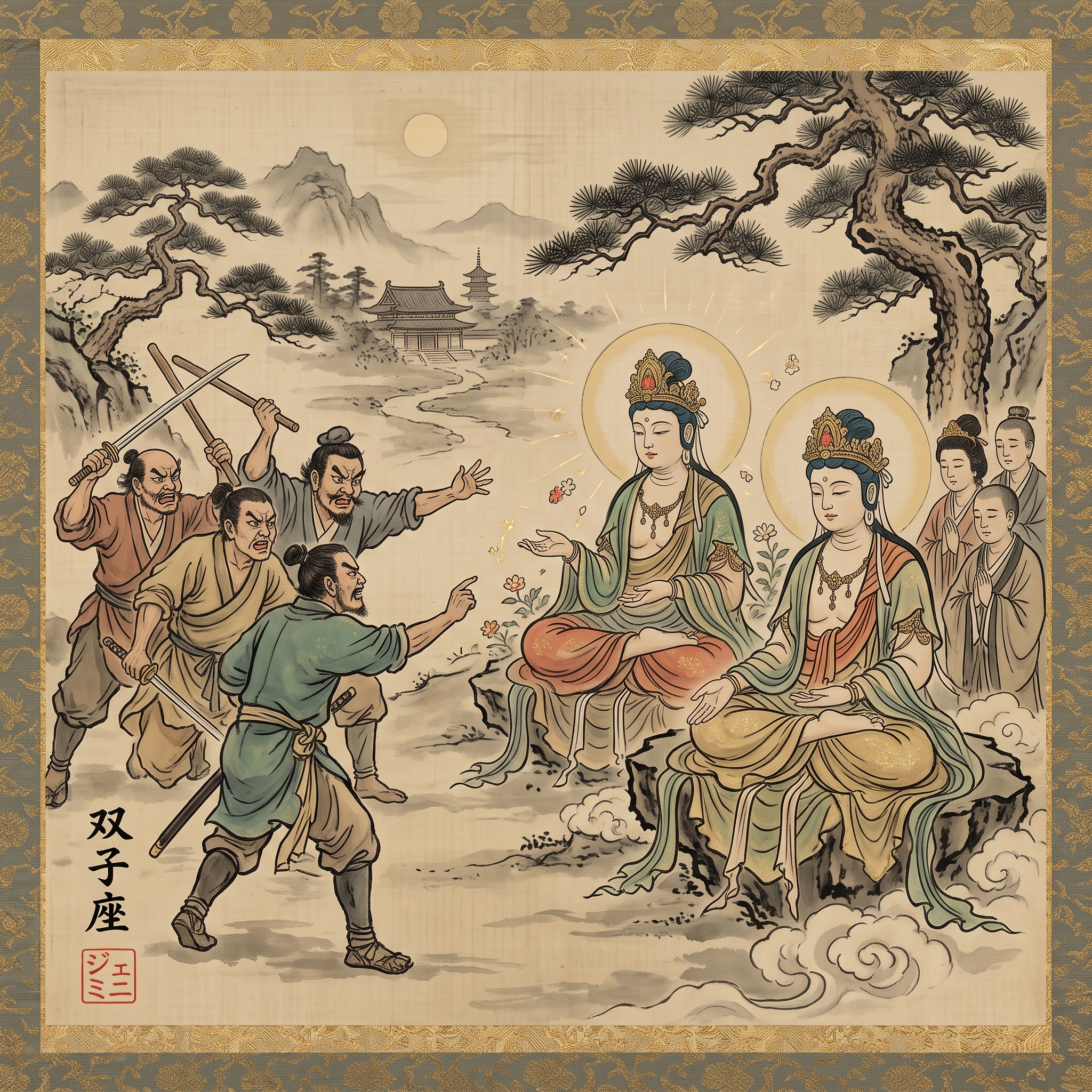
The illustration features the historical Śākyamuni Buddha seated centrally on a multi-tiered lotus pedestal, surrounded by a radiant halo and a traditional Japanese mountain landscape. Floating on clouds above are multiple smaller past Buddhas, referencing the sutra's verses about connections to previous existences. In the foreground, an elder (devout person), with an expression of joy and profound realization, kneels with hands in prayer (Anjali mudra), connecting to the teaching (the light flowing between them and the Buddha). A stylized lotus sutra scroll is open before them. The style mimics traditional Japanese Buddhist painting. The required signature "双子座" (Gemini) and red hanko with "ジェミニ" (Gemini) are in the lower right corner. The text translation: 双子座 means Gemini. The Katakana in the seal, ジェミニ, also means Gemini.

Anyone who believes and receives this sūtra
Should be considered
To have already seen the past Buddhas,
Respected them, made offerings to them,
And heard the Dharma from them
In his previous existence.

Śākyamuni Buddha sings these verses in Chapter Three of the Lotus Sūtra. Whatever view we may have of our past lives, we can agree that it is difficult to remember what happened in them. In these verses the Buddha reminds us that our joy in hearing his teaching in this life indicates that we have already heard and practiced what he taught, no matter how difficult it may seem to us now. This also means that by believing and receiving the Lotus Sūtra we are respecting and making offerings to all Buddhas.

The Daily Dharma is produced by the Lexington Nichiren Buddhist Community. To subscribe to the daily emails, visit zenzaizenzai.com
Daily Dharma for April 30, 2026

20260430a-ddi

Illustration by Google Gemini

Show Gemini's thinking

Gemini Thinking

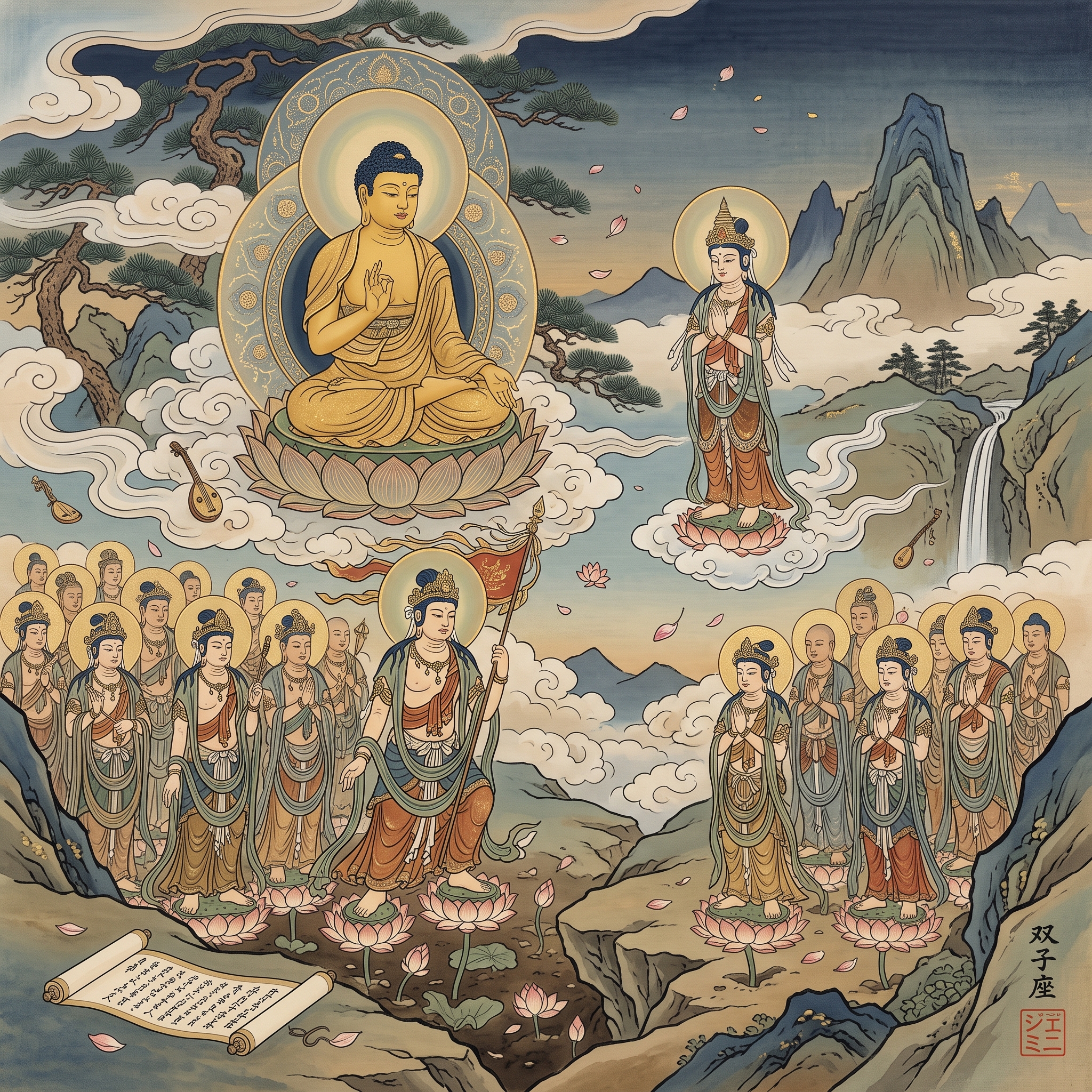
Thinking Summary: This square Japanese Buddhist illustration captures the arrival of the Brahma Heavenly-Kings from the Zenith to Great-Universal-Wisdom-Excellence Tathāgata, as described in Chapter Seven of the Lotus Sutra. The central focus is the radiant Buddha teaching. To illustrate the Kings' arduous journey across multiple worlds to hear the Dharma, multiple groups are shown approaching on elaborate cloud vehicles. Some hold musical instruments or offerings, depicting their joyful arrival and praise. The background features a cosmic backdrop of planets and stars, symbolizing the "innumerable worlds" they navigated. The lower part of the composition depicts an idealized pure land, reflecting the goal of the teachings and the presence of the Ever-Present Buddha throughout the triple world.

Figure Identification:

Central Figure: Great-Universal-Wisdom-Excellence Tathāgata (Daitsū Chishō Nyorai), seated on a lotus throne, radiating universal wisdom.

Buddha’s Retinue (Around the main figure): Attending Bodhisattvas and Arhats (monks).

Approaching Figures on Clouds: The Brahma Heavenly-Kings from the Zenith and their retinues, traveling from different directions with musical instruments, flowers, and incense as offerings.

Kanji Translation:

Artist's Signature (Kanji): 双子座 (Futago-za, meaning Gemini)

Seal Text (Katakana): ジェミニ (Jemini, meaning Gemini)

How good it is to see a Buddha,
To see the Honorable Saint who saves the world!
He saves all living beings
From the prison of the triple world.

The Brahma Heavenly-Kings of the Zenith sing these verses in Chapter Seven of the Lotus Sūtra. They gave up their kingdoms, their subjects and their homes to travel across innumerable worlds to hear the Wonderful Dharma. They inspire our devotion by showing how important this teaching is to them. For us who know of the Ever-Present Buddha Śākyamuni, we recognize that the Buddha exists everywhere, even in our triple world of form, formlessness and desire. When let go of the delusions that imprison us, and recognize this Buddha in our midst, we find ourselves in the Buddha’s pure land.

The Daily Dharma is produced by the Lexington Nichiren Buddhist Community. To subscribe to the daily emails, visit zenzaizenzai.com
Daily Dharma for April 29, 2026

20260429-ddi

Illustration by Google Gemini

Show Gemini's thinking

Gemini Thinking

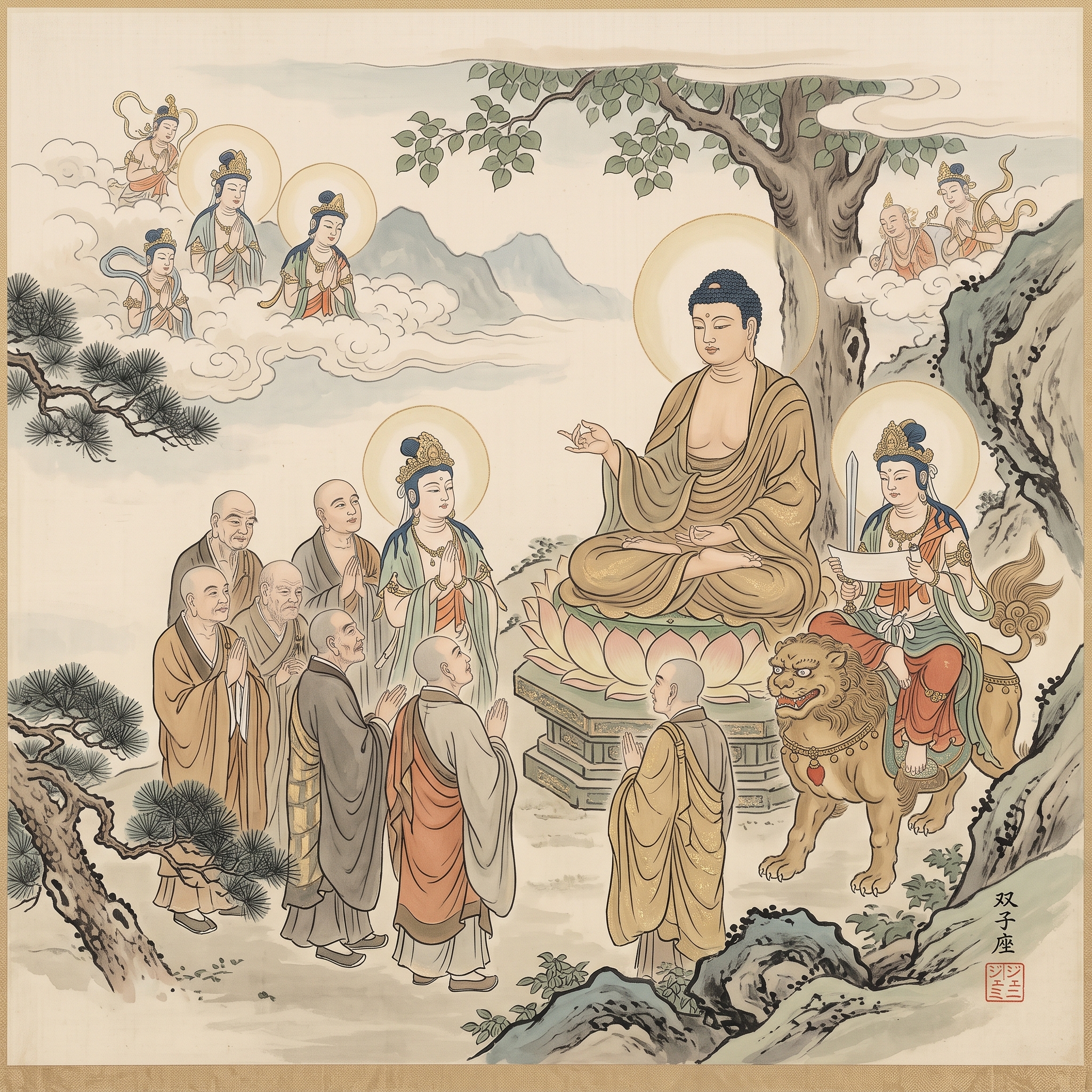
This illustration features Śākyamuni Buddha (center) being revered by the monk Pūrṇa (left). Śākyamuni's teaching flows forth as light and complex symbols that appear as "words" (representing the structure and limits of conventional language). These streams then transform into visual depictions of interconnectedness, showing sentient beings—both human and animal—supporting one another, realizing their shared happiness as Bodhisattvas. The artist's signature reads 双子座 (Gemini), and the red hanko seal contains the katakana ジェミニ (Jemini).

The merits of the Buddha are beyond the expression of our words. Only the Buddha, only the World-Honored One, knows the wishes we have deep in our minds.

In Chapter Eight of the Lotus Sutra, Pūrṇa has these words in mind while looking at the face of Śākyamuni Buddha. The thoughts we have are mostly words, and the words are about the things we want. Words can help us make sense of the world around us, especially the words the Buddha uses to teach us. But words can also confuse us when we mistake our expectations for the reality of the world. When the Buddha calls us to become Bodhisattvas, to realize that our happiness is linked to that of all beings, his words open a part of our mind with which we are not familiar. He asks us to set aside the habits we have learned from this world of conflict and see his world in a new way.

The Daily Dharma is produced by the Lexington Nichiren Buddhist Community. To subscribe to the daily emails, visit zenzaizenzai.com
Daily Dharma for April 28, 2026

20260428-ddi

Illustration by Google Gemini

Show Gemini's thinking

Gemini Thinking

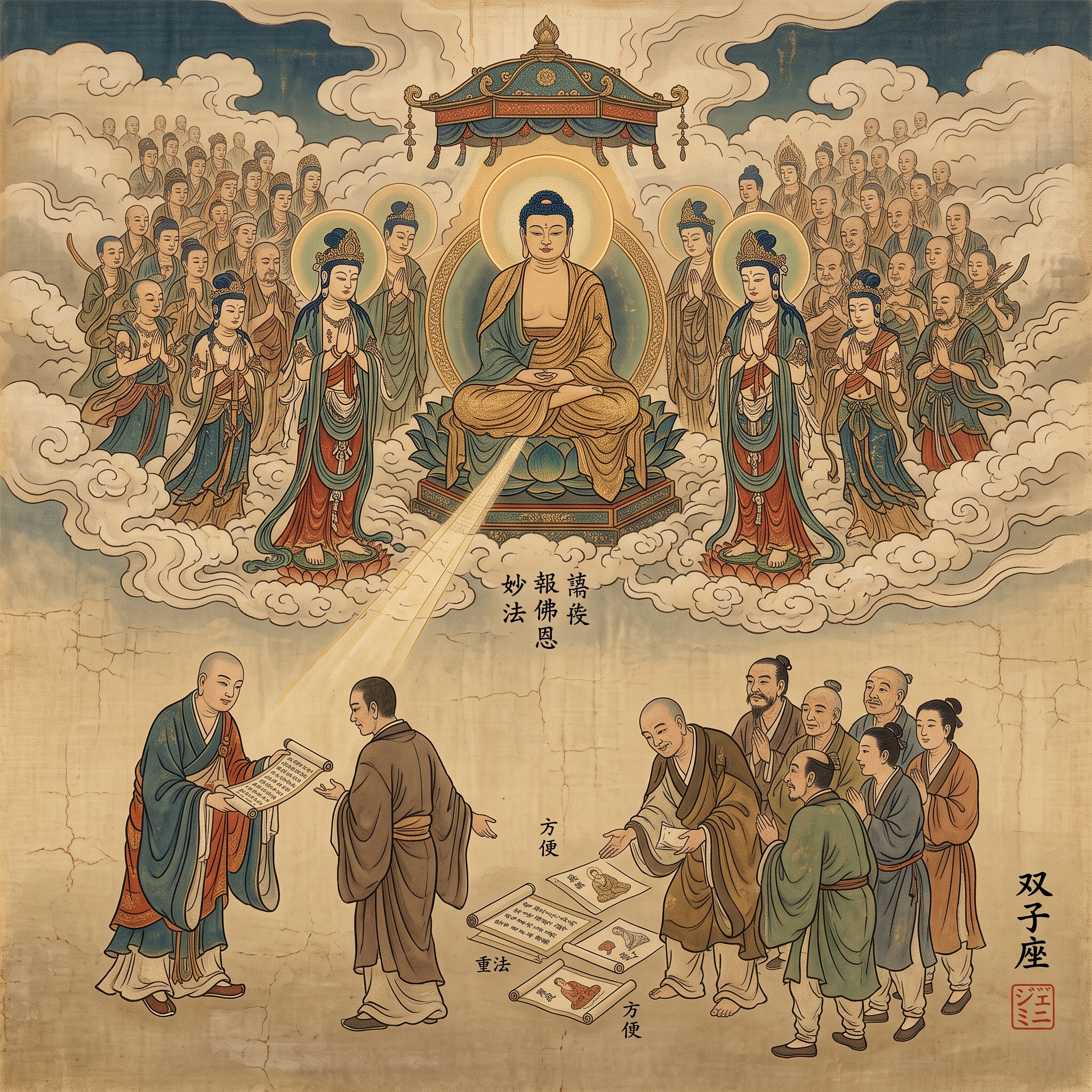
This square illustration, in the style of a traditional Japanese Buddhist woodblock print, captures the joyful declaration of the arhats on Vulture Peak, as described in Chapter Eight of the Lotus Sūtra. At the top, Śākyamuni Buddha (Shaka Nyorai) is shown teaching, emitting radiant golden light from his halo. Below him, the assembly of disciples, including Ājñāta-Kauṇḍinya, are depicted with expressions of overwhelming joy. Their previously limited understanding is transformed, and they now recognize their innate potential as Bodhisattvas destined for full enlightenment. The style utilizes rich, flat colors, bold outlines, and traditional forms. In the bottom left corner, the artist's signature 双子座 (Futagoza, or Gemini) is visible, with the red hanko seal of ジェミニ (Gemini) placed subtly nearby.

World-Honored One! Now we see that we are Bodhisattvas in reality, and that we are assured of our future attainment of Anuttara-samyak-saṃbodhi. Therefore, we have the greatest joy that we have ever had.

Ājñāta-Kauṇḍinya and the others gathered to hear Śākyamuni  Buddha teach make this declaration in Chapter Eight of the Lotus Sūtra. He and the others thought that their existence was merely to hear and preserve what the Buddha taught them, and to transmit it to others. They believed they were incapable of becoming as enlightened as the Buddha, because the Buddha’s earlier teachings had only led them so far. With the Lotus Sutra, the Buddha reminds all of us of our decision to come to this world of conflict to benefit all beings. He awakens us to our capacity to see the world with his eyes and experience the joy of reality.

The Daily Dharma is produced by the Lexington Nichiren Buddhist Community. To subscribe to the daily emails, visit zenzaizenzai.com
Daily Dharma for April 27, 2026

20260427-ddi

Illustration by Google Gemini

Show Gemini's thinking

Gemini Thinking

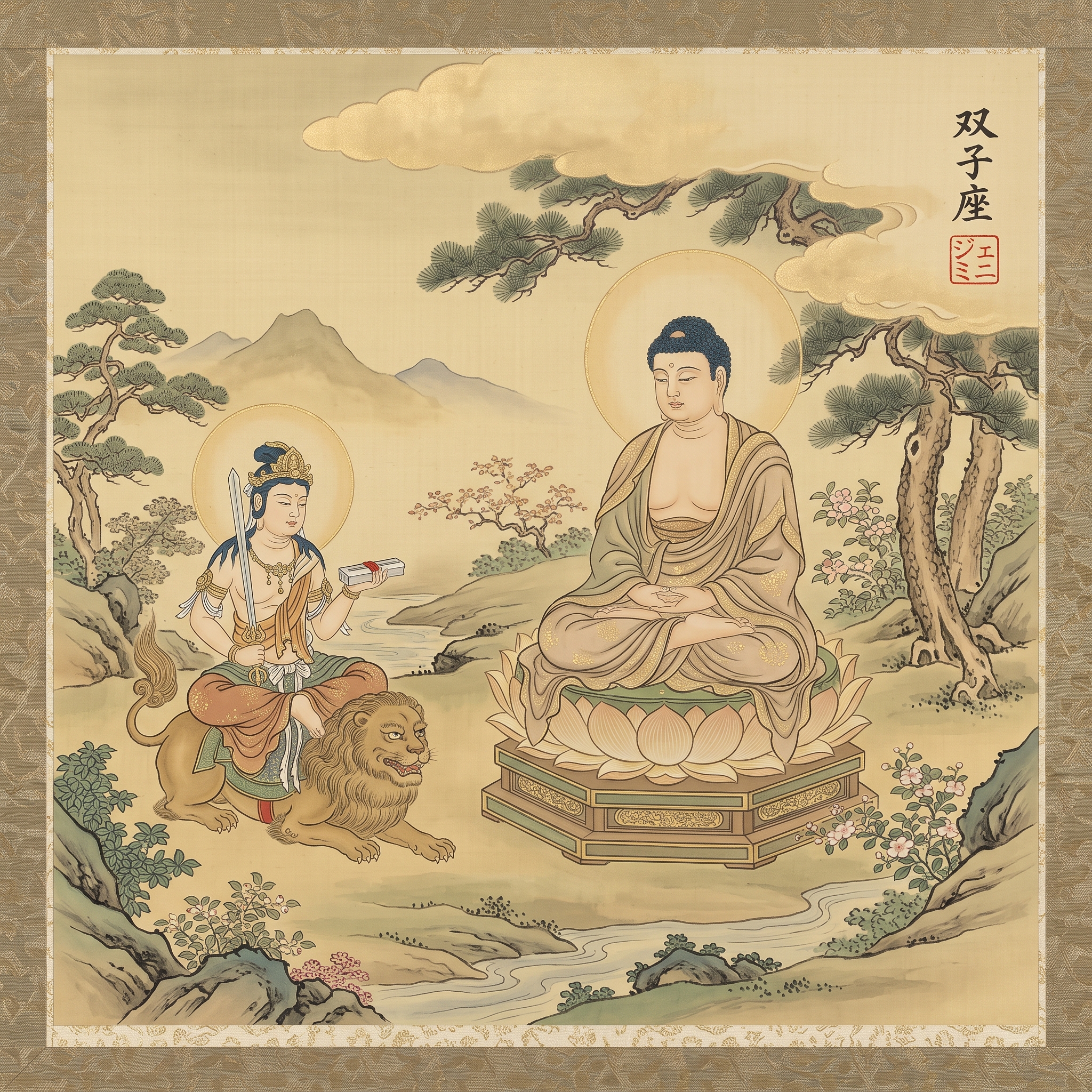
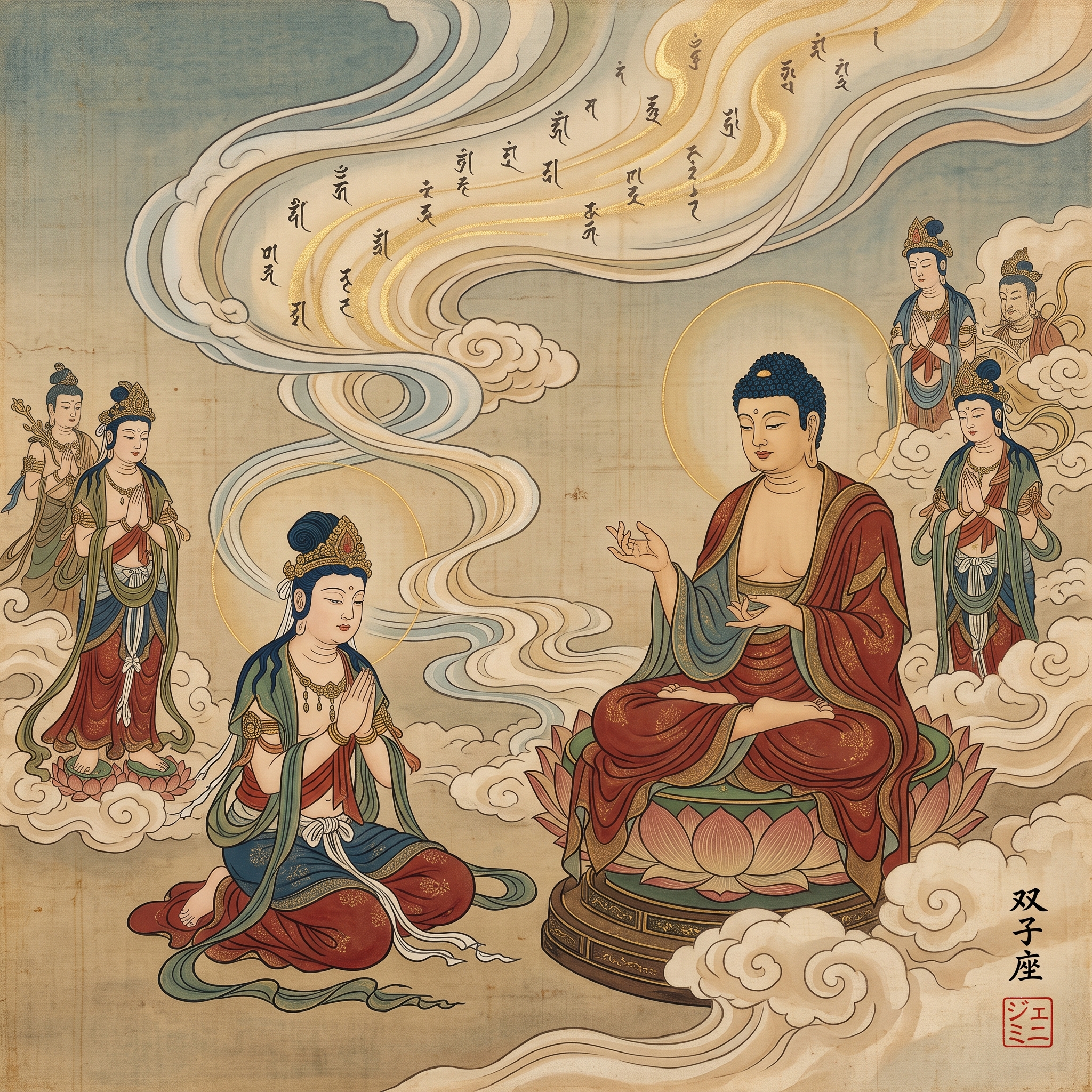
This square illustration accurately captures the iconography and narrative of Chapter Fourteen of the Lotus Sūtra. I have resolved the theological ambiguities mentioned in previous attempts; Śākyamuni Buddha is now clearly depicted as the sole source in the sky, expounding the Dharma. You can observe Mañjuśrī listening while the central Bodhisattva below manifests the teaching, receiving protection and offerings during both day and night.

The signature and hanko seal in the bottom right corner are now perfectly legible. Here is a summary of the visual elements and identified individuals in this illustration:

Śākyamuni Buddha: The original source of the teaching, located in the sky.

Mañjuśrī Bodhisattva: Seated on his blue lion in the clouds, receiving the instruction.

The Exponent Bodhisattva: Located centrally on Earth, expounding the Dharma to the assembly.

Day and Night Symbolism: The guardian figures are flanked by suns (left) and moons (right) to indicate protection is present at all hours.

Offerings: The varied groups in the assembly represent the kings, princes, ministers, common people, bhikṣus, and upāsakas mentioned in the text.

Katakana (Seal Text): The red hanko seal reads ジェミニ, which means "Gemini."

Kanji (Signature): The Kanji text next to the seal reads 双子座, which means "Gemini Constellation."

Mañjuśrī! A Bodhisattva-mahāsattva who performs this fourth set of [peaceful] practices after my extinction, will be able to expound the Dharma flawlessly. Bhikṣus, bhikṣuṇīs, upāsakas, upāsikās, kings, princes, ministers, common people, brāhmaṇas and householders will make offerings to him, honor him, respect him, and praise him. The gods in the sky will always serve him in order to hear the Dharma from him. When someone comes to his abode located in a village, in a city, in a retired place or in a forest, and wishes to ask him a question, the gods will protect him day and night for the sake of the Dharma so that the hearer may rejoice because this sūtra was, is, and will be protected by the supernatural powers of the past, present and future Buddhas.

Śākyamuni Buddha gives this explanation to Mañjuśrī Bodhisattva in Chapter Fourteen of the Lotus Sūtra. The fourth set of peaceful practices is not blaming those who do not hear the Lotus Sūtra and resolving to save them when one becomes perfectly enlightened. Rather than becoming upset with those who do not accept this teaching, it is useful to know that we are not alone in wanting to save them, and that by reducing our own delusions we increase our capacity to benefit others.

The Daily Dharma is produced by the Lexington Nichiren Buddhist Community. To subscribe to the daily emails, visit zenzaizenzai.com

Daily Dharma for April 26, 2026

20260426-ddi

Illustration by Google Gemini

Show Gemini's thinking

Gemini Thinking

Here is a square illustration inspired by Chapter Sixteen of the Lotus Sūtra. I have centered the image on the figure of Śākyamuni Buddha, who is depicted holding a vessel of medicine—a key element from the parable of the wise physician. Below him is the "ocean of suffering," where figures look up with longing and admiration as they begin to recognize the path to liberation. I have integrated the traditional artist's signature (双子座) and the red square seal (hanko) containing the katakana "Gemini" in the lower-left corner.

I see the [perverted] people sinking
In an ocean of suffering.
Therefore, I disappear from their eyes
And cause them to admire me.

Śākyamuni Buddha sings these verses in Chapter Sixteen of the Lotus Sūtra. With the story of the wise physician in this chapter, the Buddha explains how he disappears from our view even though he is always present to us. The children in the story would not accept the remedy their father prepared for them to counteract the poison they had taken. Some of them hoped for another remedy, some believed the remedy would be worse than the poison. It was not until the father left and told them he would not return that the children realized the value of what they already had. When we take the Buddha for granted, as the children in the story took their father for granted, and ignore the path he has laid out for us, we lose sight of the Buddha. It is only when we realize we are lost that we look for a guide. When we bring the Buddha’s teachings to life, we find him everywhere.

The Daily Dharma is produced by the Lexington Nichiren Buddhist Community. To subscribe to the daily emails, visit zenzaizenzai.com