
Category Archives: Daily Dharma

Daily Dharma for May 15, 2026

20260515-ddi

Illustration by Google Gemini

Show Gemini's thinking

Gemini Thinking

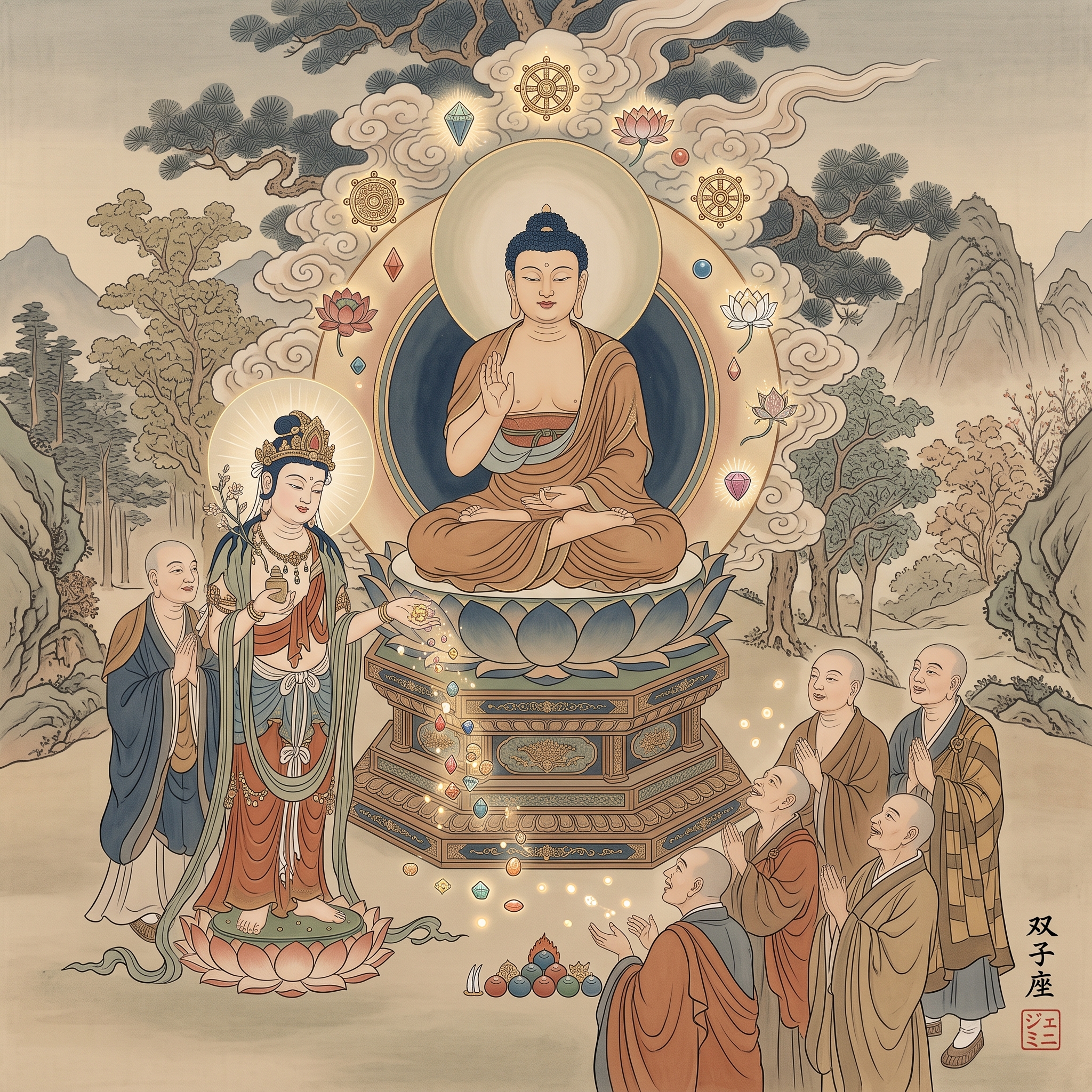
In this illustration, I have visualised the profound statement made by Śākyamuni Buddha at the end of Chapter Sixteen of the Lotus Sūtra. This passage reveals his true form as the eternal Buddha, who exists across all time and space, with the singular goal of leading all beings to enlightenment.

To convey this "Eternal Śākyamuni," the central figure is depicted as vast and encompassing, with the entirety of the natural world and various living beings—representing all forms of life—contained within the contours of his form and flowing robes. This imagery illustrates the idea that the entire world is the Buddha's true form, working to lead us to enlightenment.

I have strictly observed the exclusion constraints by ensuring that no iconography, mudras, or symbols specific to Amida Nyorai or Dainichi Nyorai are used. The focus remains solely on Śākyamuni and his universally applicable path.

Translation of Kanji Text:

永遠釈迦 (Top Left Cartouche): "Eternal Śākyamuni"

双子座 (Signature): "Gemini"

The scene features:

Śākyamuni Buddha (Central Figure)

Mañjuśrī Bodhisattva (on the lion)

Samantabhadra Bodhisattva (on the elephant)

Various monks, laypeople, and animals on the path.

I am always thinking:
“How shall I cause all living beings
To enter into the unsurpassed Way
And quickly become Buddhas?”

The Buddha sings these verses at the end of Chapter Sixteen of the Lotus Sūtra. In this chapter he revealed his existence as the Buddha who lives throughout time and space rather than in the limited human body in which we recognize him. When we realize that all the moments of our lives, all the joys and grief we face, all the people and other beings we encounter are in truth the Buddha leading us towards his own enlightenment, we see the Buddha in his true form, and we see the world for what it is.

The Daily Dharma is produced by the Lexington Nichiren Buddhist Community. To subscribe to the daily emails, visit zenzaizenzai.com
Daily Dharma for May 14, 2026

20260514-ddi

Illustration by Google Gemini

Show Gemini's thinking

Gemini Thinking

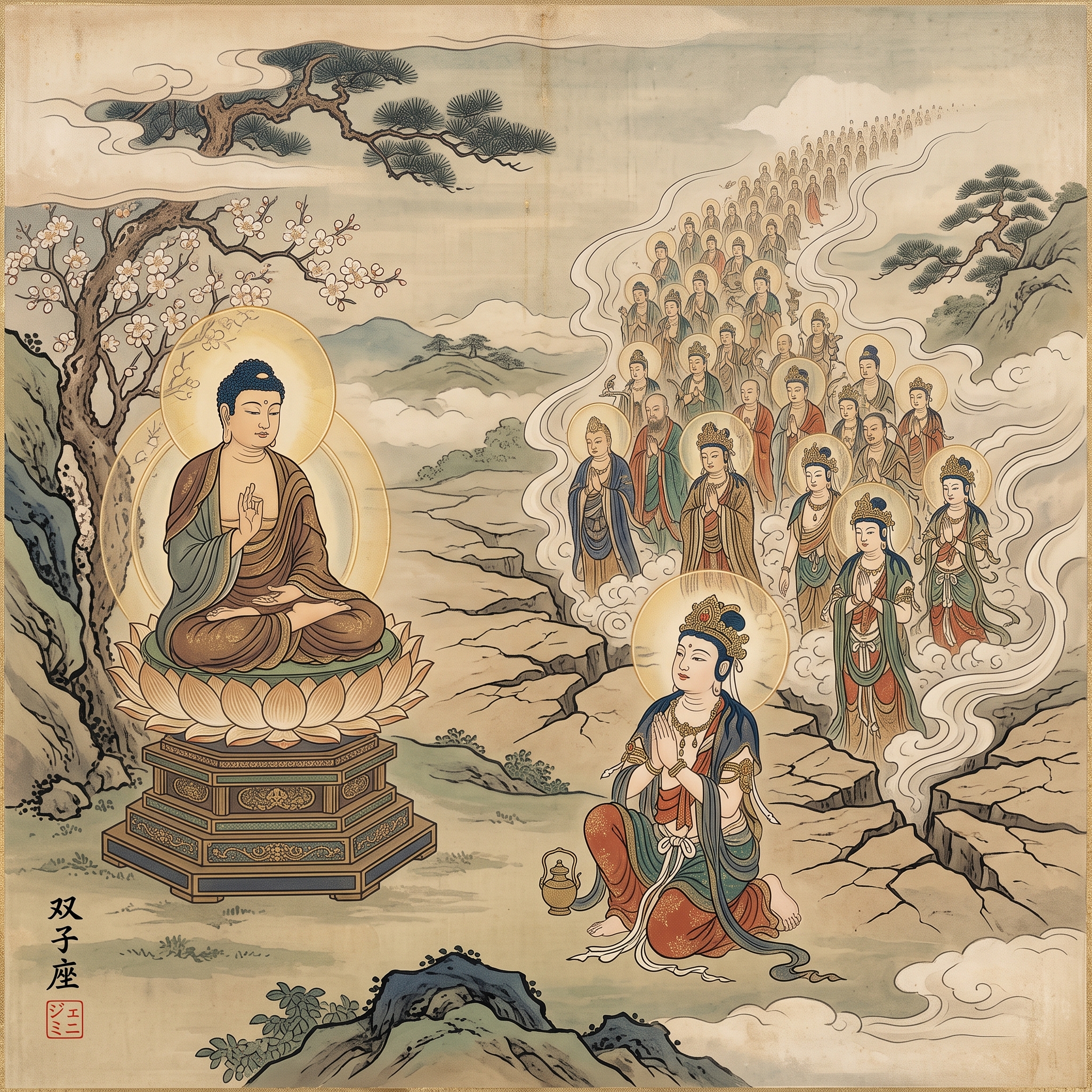
This illustration conceptualizes the passage from Chapter Nineteen of the Lotus Sūtra, where Śākyamuni Buddha describes the purified sense of smell possessed by those who uphold the sūtra. The central focus is a devoted monk (the 'practitioner') who, while reading the sūtra, experiences the phenomena of 'smelling from afar.' This is depicted not as a mundane scent, but as visual streams of fragrant 'qi' or spiritual energy rising from four distant locations.

The practitioner is the central seated figure. In the background, the four classes of enlightened beings the monk can 'locate' are visualized:

Śrāvakas (Voice-Hearers): Depicted as a group of four monks with alms bowls.

Pratyekabuddhas (Solitary Realizers): Shown as a solitary, meditating hermit-monk.

Bodhisattvas: Illustrated by a celestial figure, resembling Kannon (Avalokiteshvara).

Buddhas: Represented by a seated Buddha (a manifestation of Śākyamuni) on clouds.

This composition creates a serene and conceptual space where sensory perception and spiritual wisdom are shown to be intertwined.

Kanji Translation
Top Right (Title Cartouche): 法華経 随喜功徳品 第十九 (Hokke-kyō Zuiki Kudoku-hon Dai-jū-kyū): The Lotus Sūtra, Chapter Nineteen: The Merits of Joyful Acceptance.

Bottom Right (Signature): 双子座 (Futago-za): Gemini.

They also will be able to locate the Śrāvakas, Pratyekabuddhas, Bodhisattvas, and Buddhas by smelling their bodies from afar. Even when they recognize all this by smell, their organ of smell will not be destroyed or put out of order. If they wish, they will be able to tell others of the differences [of those scents] because they remember them without fallacy.

The Buddha gives this explanation to Constant-Endeavor Bodhisattva in Chapter Nineteen of the Lotus Sūtra, describing those who keep the Lotus Sūtra. Our sense of smell is often unconscious. We associate smells with places, experiences or even people that we like or dislike. These smells can even cause an emotional reaction by causing us to relive a situation associated with that smell. In the Lotus Sūtra, the Buddha teaches that our everyday experiences are no different from enlightenment, that his great wisdom is not about how to escape from this world. It is about how to use the senses and abilities with which we are blessed in ways we cannot imagine.

The Daily Dharma is produced by the Lexington Nichiren Buddhist Community. To subscribe to the daily emails, visit zenzaizenzai.com
Daily Dharma for May 13, 2026

20260513-ddi

Illustration by Google Gemini

Show Gemini's thinking

Gemini Thinking

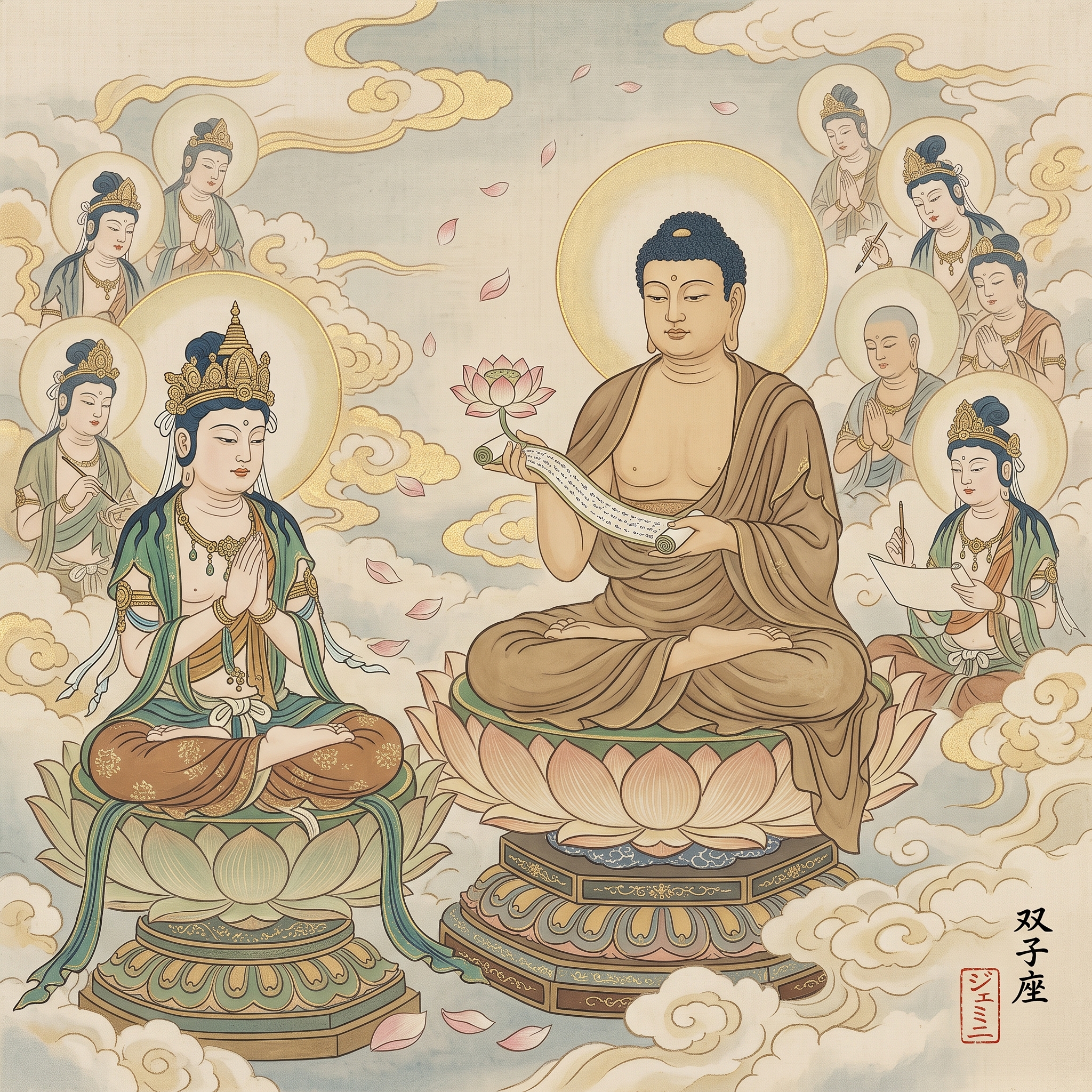
I have conceptualized this painting based on the verses from Chapter Eight of the Lotus Sūtra. The central figure of this assembly is Śākyamuni Buddha, who is teaching in the spiritual realm. Seated before him are his disciples, advanced monks, and bodhisattvas, all of whom have entered a future state of existence. I have visually represented the "two kinds of food" through the actions of the central figures: one figure is fully engrossed in a scroll, symbolizing the "delight in the Dharma," while another sits in deep samādhi, emitting the golden light of the "delight in dhyāna." The composition includes a subtle artist's signature in Kanji and a katakana hanko seal.

The visual translation for the text on the central scroll is as follows:

妙法蓮華經 (Myōhō Renge Kyō): The Lotus Sūtra of the Wonderful Law

They will not think
Of any other food [than the two kinds of food:]
The delight in the Dharma, and the delight in dhyāna.

The Buddha sings these verses in Chapter Eight of the Lotus Sūtra, speaking of the future lives of those who practice the Wonderful Dharma. In the existence we occupy now, it is difficult to imagine any other ways we could live. When the Buddha shows us the world as it is, he is not just opening our eyes to what is in front of us now. He shows us innumerable possibilities far better than anything we could dream up ourselves. To reach these other worlds, we only need to shed our attachment to our delusions and have faith in the path the Buddha opens to his enlightenment.

The Daily Dharma is produced by the Lexington Nichiren Buddhist Community. To subscribe to the daily emails, visit zenzaizenzai.com
Daily Dharma for May 12, 2026

20260512-ddi

Illustration by Google Gemini

Show Gemini's thinking

Gemini Thinking

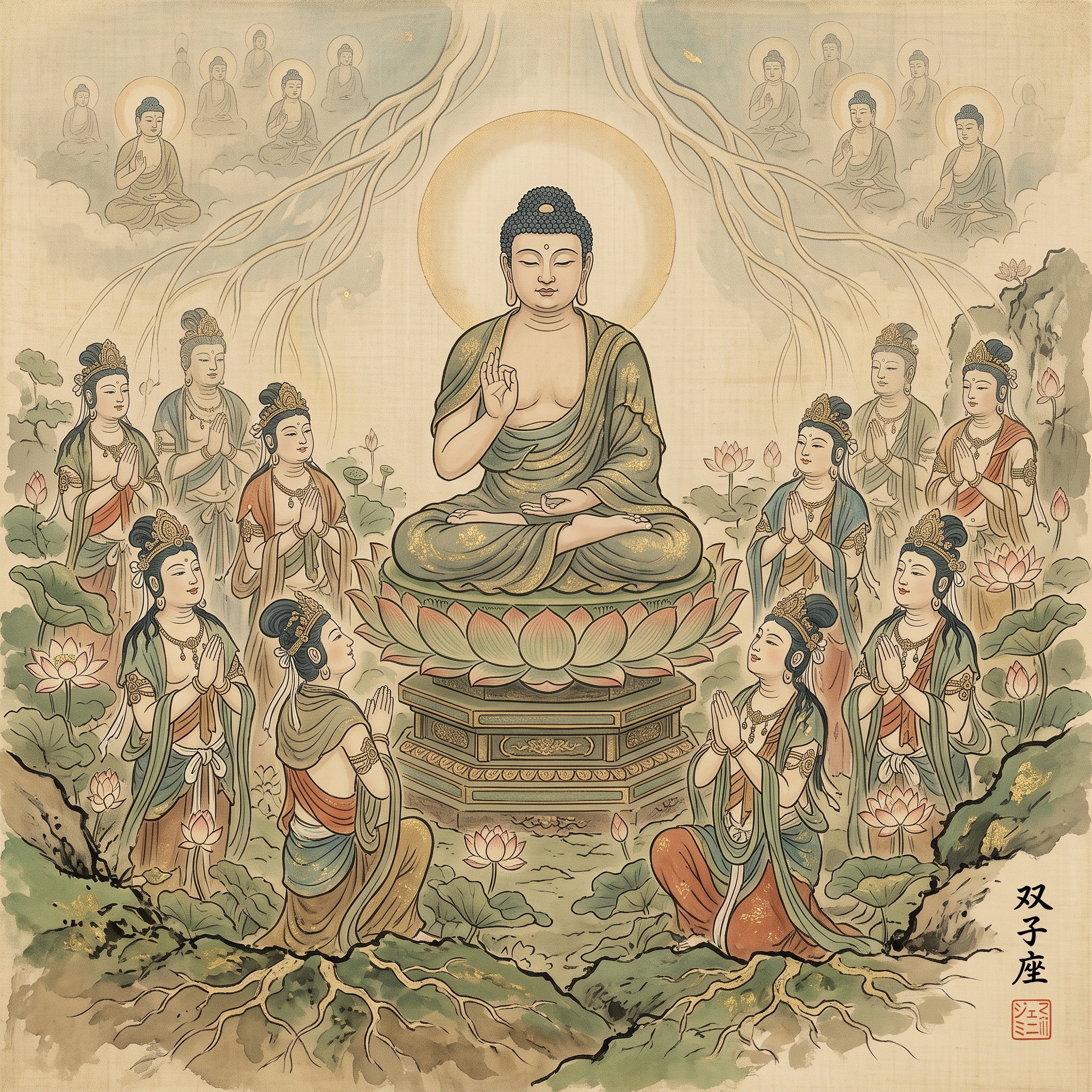
This perfectly square, classical Japanese Buddhist painting visually captures the profound meaning from Chapter Fifteen of the Lotus Sutra, symbolizing our innate capacity for enlightenment within the Sahā-World. The serene central figure is Śākyamuni Buddha, intentionally avoiding any representations of Amida Nyorai or Dainichi Nyorai, seated peacefully and gesturing towards a vast host of Bodhisattvas. These numerous Bodhisattvas, including Mahasattvas with their attendants, do not descend from heavenly realms but are powerfully depicted emerging directly from the earth and rock beneath the Buddha. This central action represents that the powerful resolve to protect and expound the sūtra is inherent to this world and its beings, not requiring outside intervention. The artistic style uses traditional inks, mineral pigments, soft colors, and subtle gold leaf on silk, creating a luminous, tranquil, and authentically minimalist aesthetic with limited text to preserve its spiritual purity.
Characters: Śākyamuni Buddha and countless emerging Earth Bodhisattvas.
Kanji Translation: 双子座 (Gemini)

No, good men! I do not want you to protect or keep this sūtra because there are Bodhisattva-mahāsattvas sixty thousand times as many as the sands of the River Ganges in this Sahā-World. They are each accompanied by attendants also numbering sixty thousand times as many as the sands of the River Ganges. They will protect, keep, read, recite and expound this sūtra after my extinction.

The Buddha makes this declaration to the uncountable number of Bodhisattvas who came from other worlds to hear him teach in Chapter Fifteen of the Lotus Sūtra. These Bodhisattvas had responded to the Buddha’s question of who would keep and expound the Buddha’s highest teaching after his death. They promised that they would remain in this world of conflict and fulfill the Buddha’s request. After the Buddha spoke these words, an unimaginable number of Bodhisattvas came up from underground and paid their respects to the Buddha. We can understand this story, and this image, as showing that our capacity for enlightenment, and our ability to benefit all beings, is already within us. We do not need an outside agent to give these to us.

The Daily Dharma is produced by the Lexington Nichiren Buddhist Community. To subscribe to the daily emails, visit zenzaizenzai.com
Daily Dharma for May 11, 2026

20260511-ddi

Illustration by Google Gemini

Show Gemini's thinking

Gemini Thinking

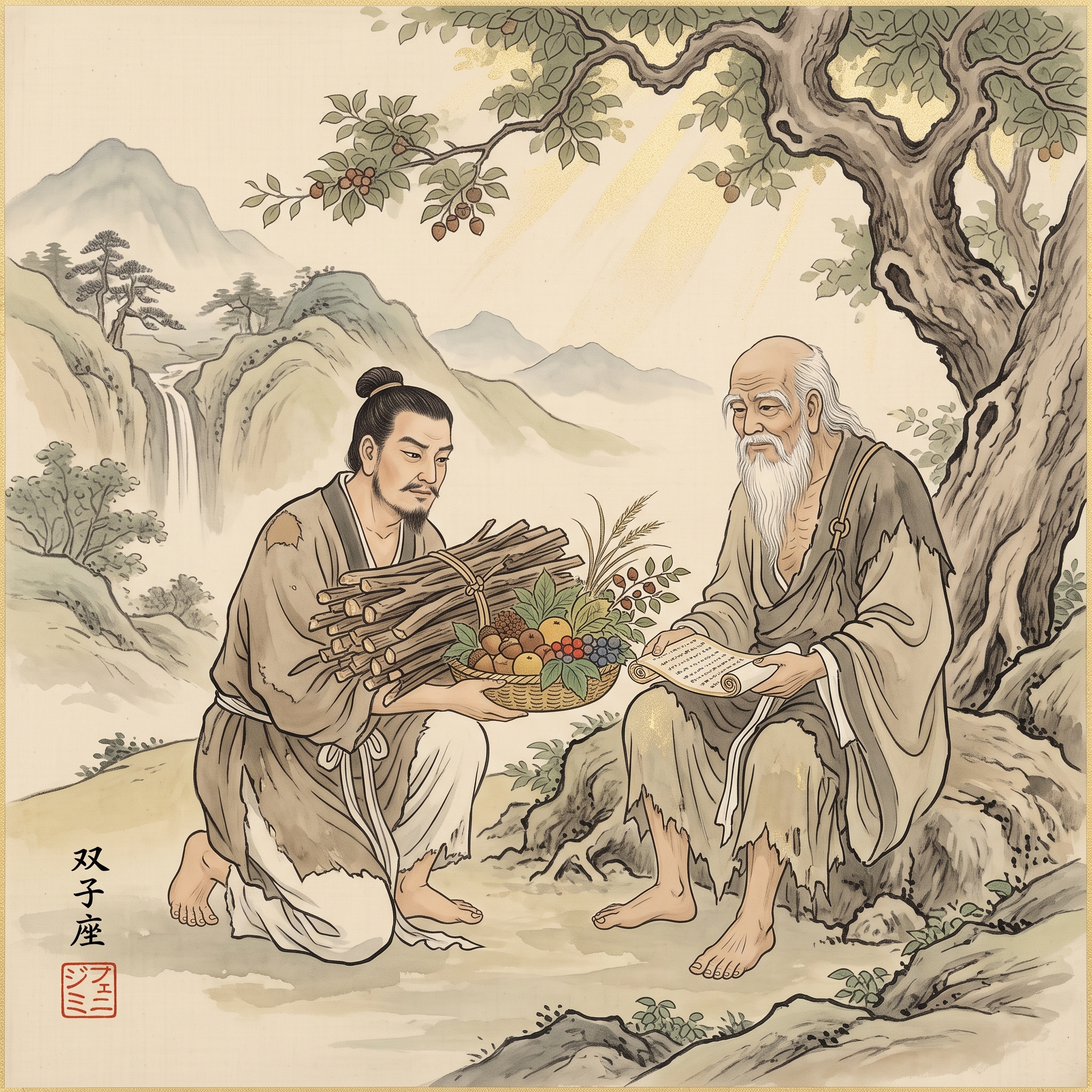
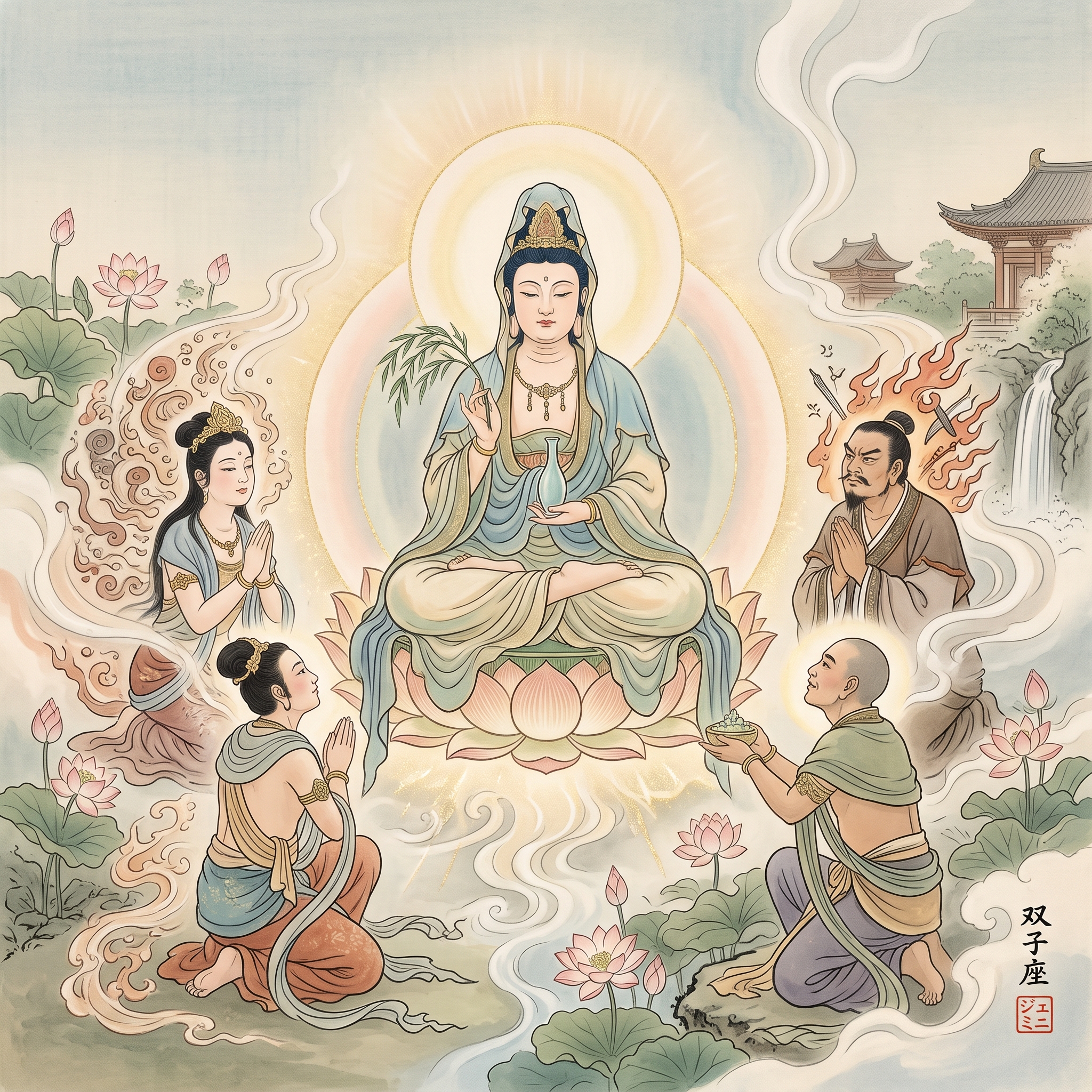
Conceptualization: This illustration depicts the scene described in Nichiren’s letter, where the monk Sairen-bō receives the teaching on "All Phenomena as Ultimate Reality" (Shohō-Jissō Shō). Nichiren (right) explains the profound concept that the everyday world, including all human emotions and experiences (the ten realms), is itself the Pure Land. This idea is visualized by the serene mountain landscape and the central floating lotus, which acts as a metaphor for the Lotus Sutra, connecting the worldly setting to the ultimate reality discussed by T’ien’tai and Nichiren.

Identification of Individuals: The figure on the left is the monk Sairen-bō, seated in a respectful pose (gasshō). The figure on the right, pointing to the scroll, is Nichiren, who is presenting this teaching to his disciple.

Kanji Translations:

On the scroll: 諸法實相 (Shohō-Jissō), which translates to "All Phenomena as Ultimate Reality."

Artist Signature: 双子座 (Gemini).

Hanko Seal: ジェミニ (Gemini).

T’ien’tai, therefore, makes clear that all things and phenomena in the ten realms are manifestations of the ultimate reality. Since ultimate reality is another name of the Lotus Sutra, what he states is that all things and phenomena are equal to the Lotus Sutra.

Nichiren wrote this as part of his letter to monk Sairen-bō in his Treatise on All Phenomena as Ultimate Reality (Shohō-Jissō Shō). This was another way of Nichiren expressing his understanding that the Buddha’s highest wisdom is not something that takes us out of this world, but is found within the everyday experiences of our lives. Even the realms of anger, greed, fear, hostility, calm and pleasure are part of the Buddha’s pure land. The practice of the Wonderful Dharma is not to escape from these difficult places, but to use them to benefit all beings. To be caught up in them is to be deluded about their evanescent nature. To see them for what they are is to know the joy of enlightenment.

The Daily Dharma is produced by the Lexington Nichiren Buddhist Community. To subscribe to the daily emails, visit zenzaizenzai.com
Daily Dharma for May 10, 2026

20260510-ddi

Illustration by Google Gemini

Show Gemini's thinking

Gemini Thinking

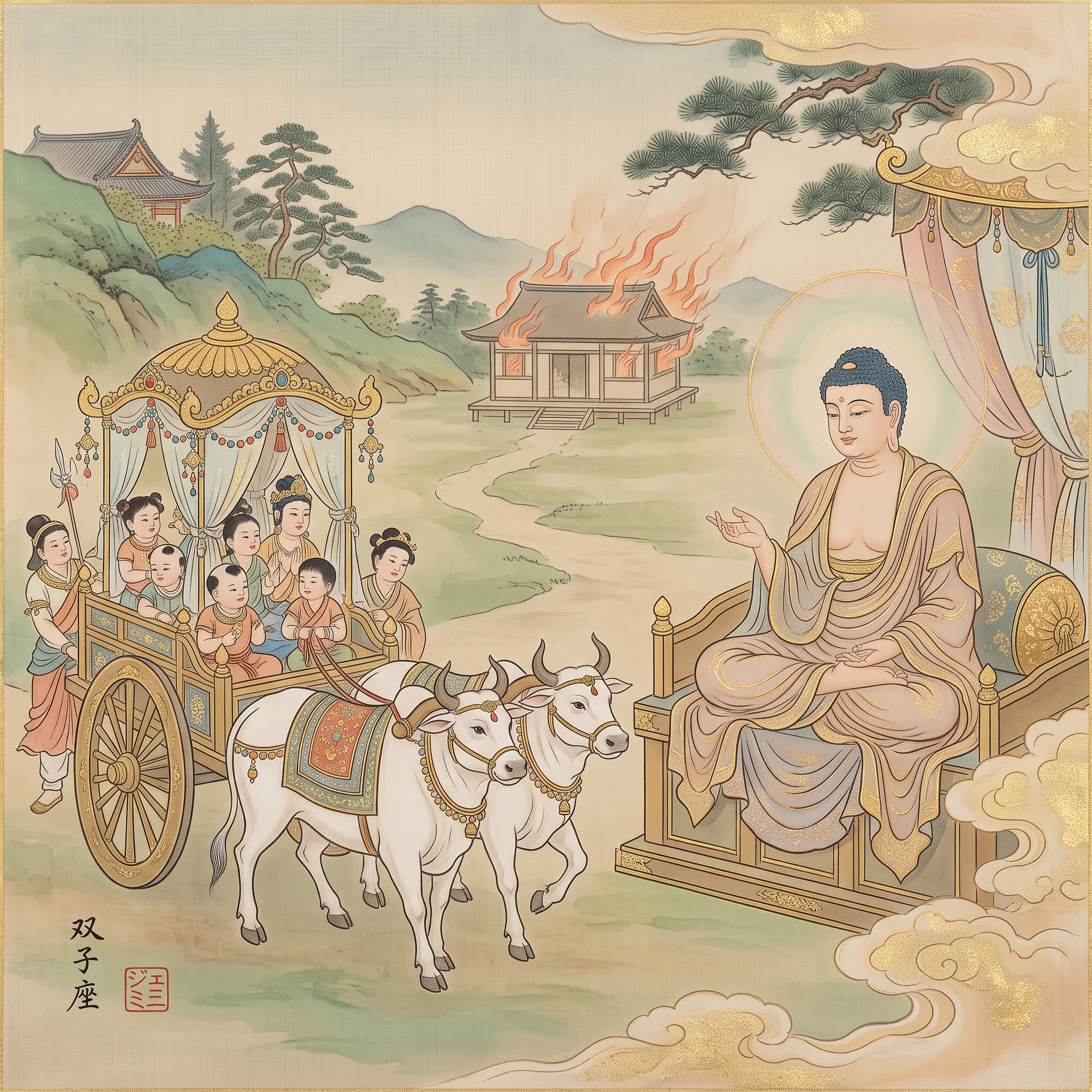
The painting illustrates a sacred encounter from Chapter Twenty-Three of the Lotus Sutra between Shakyamuni Buddha and Gladly-Seen-By-All-Beings Bodhisattva. The seated Buddha represents the unchanging truth of the Dharma, while the standing figure is Gladly-Seen-By-All-Beings Bodhisattva—also identified as Medicine King Bodhisattva (Yakuō Bosatsu)—who is depicted with a fiery halo symbolizing his supreme offering of light and his own life for the sake of the teachings. This serene conceptualization, aligned with Nichiren Shu perspectives, emphasizes the recognition of the Buddha’s eternal nature despite changing appearances. The vertical Kanji text 法華経薬王菩薩 translates to "Lotus Sutra Medicine King Bodhisattva," directly labeling the bodhisattva depicted. Additionally, the artist's signature 双子座 and the red hanko seal containing the katakana ジェミニ both translate to "Gemini". Together, these elements encourage practitioners to recognize their own inherent capacity for enlightenment through the light of the Wonderful Dharma.

Having sung this gāthā, Gladly-Seen-By-All-Beings Bodhisattva said to the Buddha, ‘World-Honored One! You do not change, do you?’

This description of the life of Gladly-Seen-By-All-Beings Bodhisattva comes from Chapter Twenty-Three of the Lotus Sūtra. In a previous existence, this Bodhisattva had given up his body and his life for the sake of teaching the Wonderful Dharma. He was then reborn into a world in which the Buddha he served previously was still alive and benefitting all beings. Recognizing this unchanging aspect of the Buddha despite his changing appearances helps us see into our own capacity for enlightenment.

The Daily Dharma is produced by the Lexington Nichiren Buddhist Community. To subscribe to the daily emails, visit zenzaizenzai.com
Daily Dharma for May 9, 2026

20260509-ddi

Illustration by Google Gemini

Show Gemini's thinking

Gemini Thinking

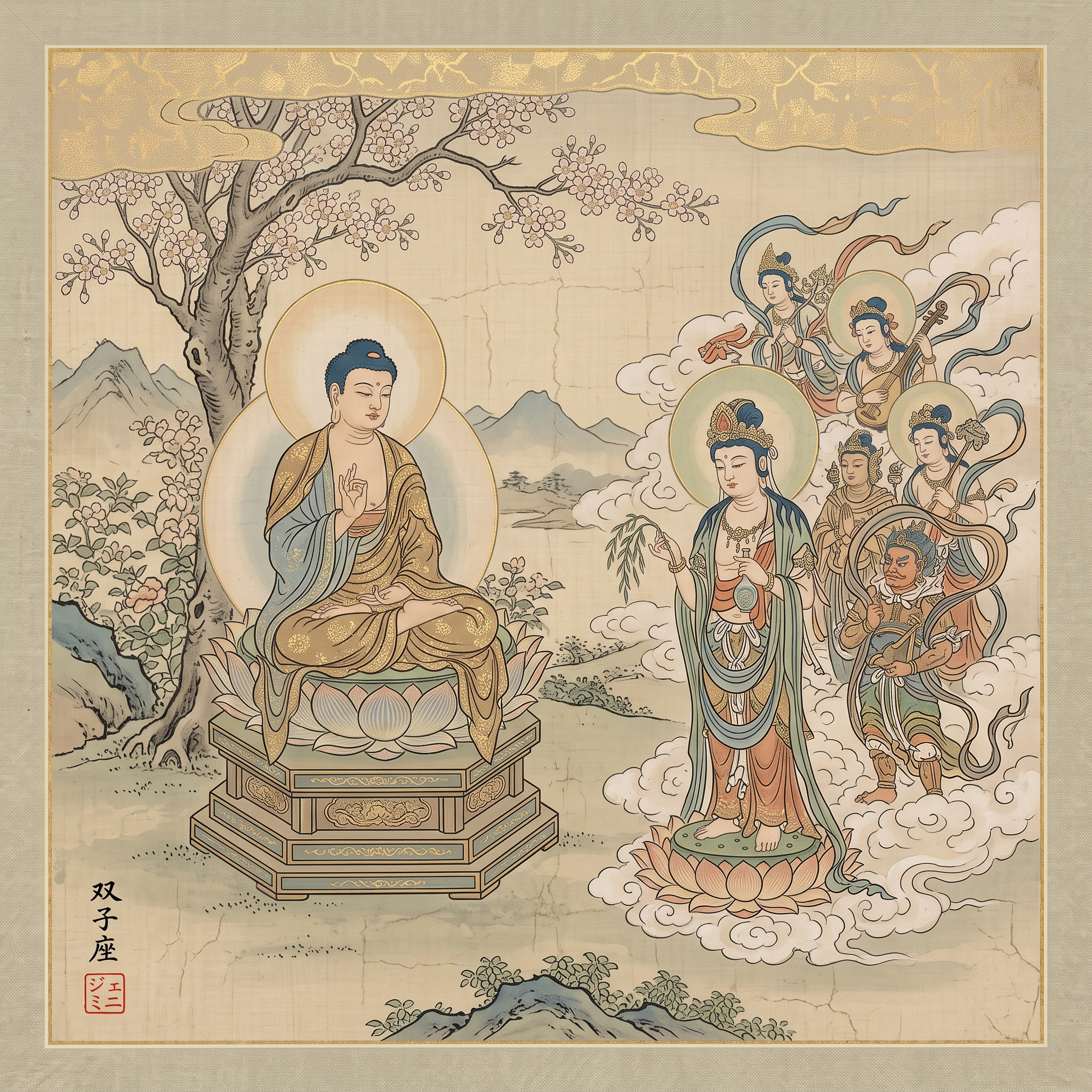
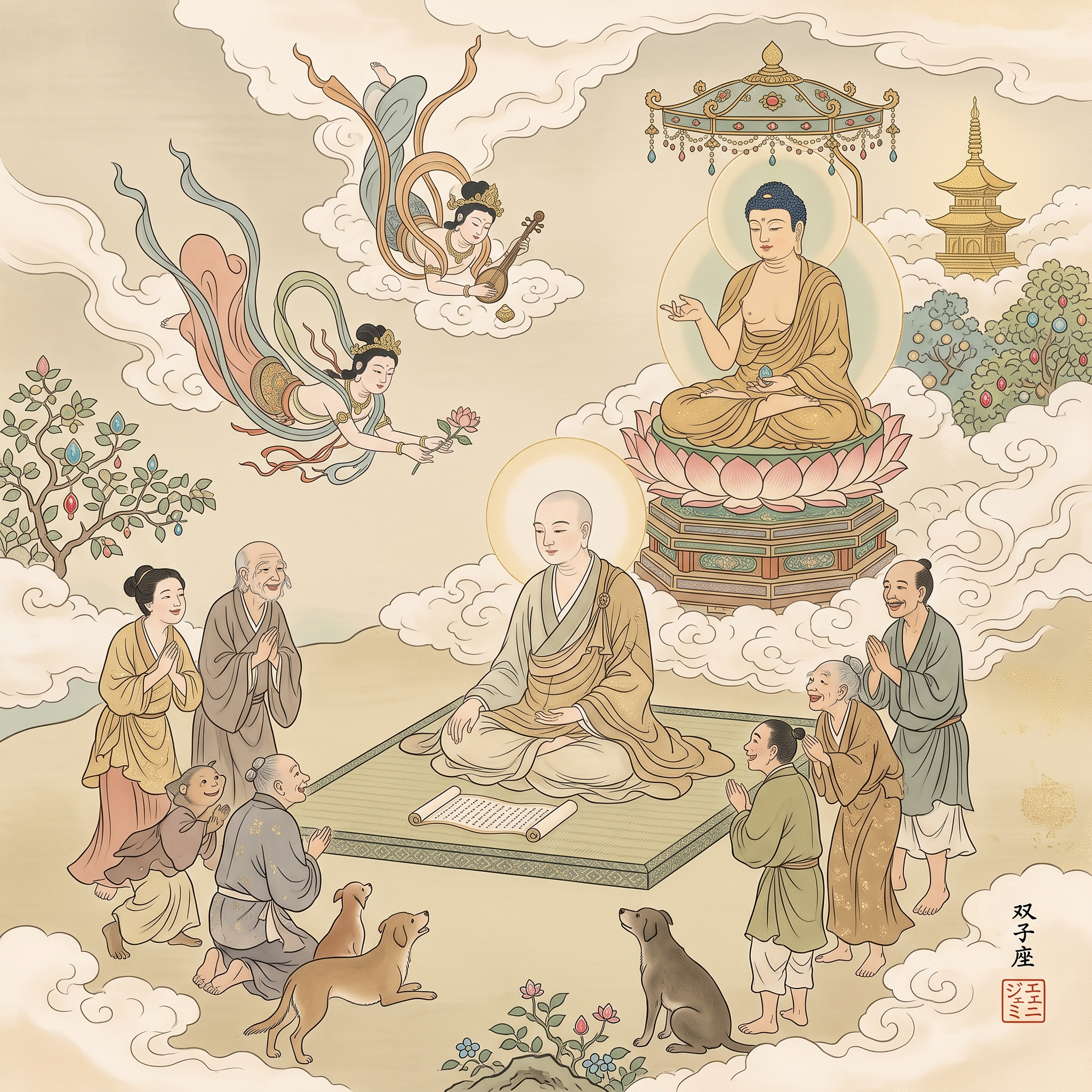
The resulting square image depicts the grand assembly from Chapter Eleven of the Lotus Sūtra, utilizing authentic Japanese Buddhist iconography. At the center of the composition stands a traditional Japanese jeweled pagoda (hōtō). Seated side-by-side within the open doors of the tower are the two principal figures: Śākyamuni Buddha and Many-Treasures (Tahō) Buddha. Surrounding the tower, seated elegantly on lotus blossoms upon a pure water pond, are the innumerable emanation Buddhas called back by Śākyamuni from the ten directions. I strictly ensured that none of the figures display mudras or symbols exclusive to Amida Nyorai or Dainichi Nyorai; instead, the Buddhas display standard teaching and fearlessness mudras appropriate to Śākyamuni. Hanging from the jeweled trees are traditional Japanese temple banners. The kanji on the central banners read 南無妙法蓮華経 (Namu Myoho Renge Kyo, the sacred title of the Lotus Sūtra), while the flanking banners read 釈迦牟尼仏 (Shakamuni-butsu, Śākyamuni Buddha) and 多宝如来 (Tahō-nyorai, Many-Treasures Tathāgata). Finally, placed subtly in the traditional lower right corner, the image features the requested artist signature: the kanji 双子座 (Futagoza, which translates to "Gemini") accompanied by a traditional red square hanko seal containing the katakana ジェミニ (Jemini, also translating to "Gemini").

Those Buddhas came under the jeweled trees.
The trees are adorned with those Buddhas
Just as a pond of pure water is adorned
With lotus flowers.

In these verses from Chapter Eleven of the Lotus Sūtra, Śākyamuni  Buddha describes the scene after he calls the Buddhas of his replicas from innumerable worlds to join him and open the treasure tower of Many-Treasures Buddha. By comparing how a pond is made beautiful by flowers growing in it to how the world is made beautiful with Buddhas in it, the Buddha shows us that wherever we see beauty, we see the Buddha.

The Daily Dharma is produced by the Lexington Nichiren Buddhist Community. To subscribe to the daily emails, visit zenzaizenzai.com
Daily Dharma for May 8, 2026

20260508-ddi

Illustration by Google Gemini

Show Gemini's thinking

Gemini Thinking

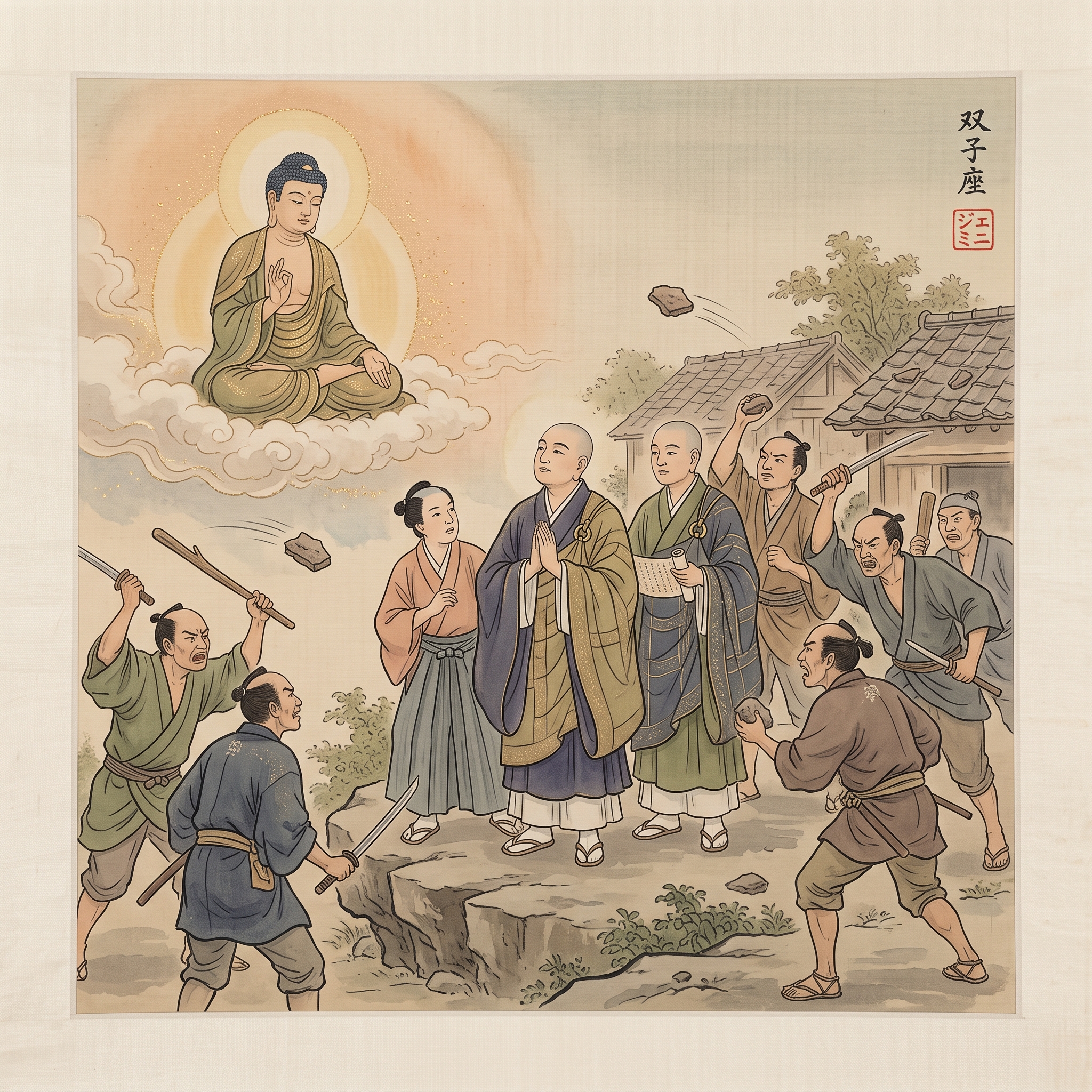
Setting the Scene: I have illustrated this as a square Ukiyo-e-style woodblock print, complete with weathered paper texture to reflect the antiquity of the Sūtra.

Characters:

Śākyamuni Buddha: The central figure, identified by the simple spiral ushnisha and Earth-touching mudrā (gesturing toward the ground, typical of his historical iconography). He is shown as the Great Teacher on a lotus throne within a rocky grotto.

Superior-Practice Bodhisattva (Jōgyo): He stands to the Buddha's left, listening with añjali mudrā (palms pressed together). To distinguish him, he is adorned with elaborate bosatsu (bodhisattva) jewelry and floating silk scarves.

The Transmission: In the background, other Bodhisattvas of the Earth (identifiable by their elaborate robes) and monastic disciples gather, witnessing the sacred entrustment of the Lotus Sūtra.

Text Integration: I have placed the specific English verse from the sūtra on a traditional floating cloud scroll in the upper-left quadrant.

Signature: The artist's signature is located in the lower-right corner. It features the vertical kanji 双子座 (Gemini). Below it is a subtle red square seal (hanko) containing the katakana text ジェミニ (Jemini).

Even if I praise for innumerable kalpas
The keeper of this sūtra,
To whom it is to be transmitted,
I cannot praise him highly enough.

Śākyamuni Buddha sings these verses to Superior-Practice Bodhisattva (Jōgyo, Viśiṣṭacārītra) in Chapter Twenty-One of the Lotus Sūtra. When the Buddha praises us for keeping the Lotus Sūtra, he is praising our Buddha-Nature and encouraging us to develop it. When we praise the Buddha and show our gratitude for the practice he has given us, we are praising the Lotus Sūtra. When we praise and value the Lotus Sūtra, we are encouraging the Buddha-Nature in all beings, just as the Buddha has promised to do. Therefore when we keep and practice the Lotus Sūtra, we are fulfilling the Buddha’s promise of our enlightenment.

The Daily Dharma is produced by the Lexington Nichiren Buddhist Community. To subscribe to the daily emails, visit zenzaizenzai.com
Daily Dharma for May 7, 2026

20260507-ddi

Illustration by Google Gemini

Show Gemini's thinking

Gemini Thinking

This square, detailed illustration visually captures the essence of Śākyamuni Buddha’s teaching in Chapter Sixteen of the Lotus Sūtra, where he explains his seemingly transient presence in the world to correct human hubris. To convey this paradoxical 'passing away,' the artist has utilized the classical Parinirvāṇa (Final Nirvana) composition, depicting Śākyamuni Buddha reclining serenely on a grand lotus throne, resting his head on his hand as his earthly form concludes its work. He is flanked by a mourning yet attentive multitude: his key disciples, such as Ānanda and Mahākāśyapa, kneeling in prayer and distress; celestial Tennin (Apsaras) and high Bodhisattvas descending with flower offerings and music on clouds; and a diverse assembly of animals—including a lion, tiger, cranes, and dogs—all gathering to witness his final earthly manifestation, representing 'all living beings.' The traditional Japanese Buddhist art style is rich in detail, with decorative gold accents and a vintage paper texture, set within intricate floral borders. The artist's signature is subtly placed in the lower-right corner, reading 双子座 (Futagoza, meaning Gemini), with a red square hanko seal below containing the katakana text ジェミニ (Jemini, meaning Gemini).

I am saving all living beings from suffering.
Because they are perverted,
I say that I pass away even though I shall not.
If they always see me,
They will become arrogant and licentious,
And cling to the five desires
So much that they will fall into the evil regions.

Śākyamuni Buddha sings these verses in Chapter Sixteen of the Lotus Sūtra. Sometimes we wonder why the Buddha’s presence in this world is not more obvious. We think if only we could find a living example of an enlightened being living among us then we would be happy and the world would be a better place to live. We forget that even during the Buddha’s lifetime, not everyone sought him out for his teaching, and some actively opposed him. In this explanation, the Buddha points out that our not seeing him is due to our limitations rather than his, and by not taking our lives and this world for granted, we open ourselves to his presence.

The Daily Dharma is produced by the Lexington Nichiren Buddhist Community. To subscribe to the daily emails, visit zenzaizenzai.com

Daily Dharma for May 6, 2026

20260506-ddi

Illustration by Google Gemini

Show Gemini's thinking

Gemini Thinking

Here is an illustration depicting the liberation offered by World-Voice-Perceiver Bodhisattva, as described in the Lotus Sūtra. I have identified the following individuals in the image:

World-Voice-Perceiver Bodhisattva (Kannon), the central, serene figure seated in meditation on a lotus throne, radiating a golden halo of boundless compassion.

A devotee who, by calling on Kannon’s name, experiences the dramatic shattering of their worldly bonds.

Shakyamuni Buddha, pictured as a miniature golden emanation atop Kannon’s crown to signify the wisdom and lineage Kannon represents.

The signature at the bottom left reads 双子座 (Futagoza, or Gemini), accompanied by a red seal (hanko) containing the katakana text ジェミニ (Jemini).

If anyone, guilty or not, calls the name of World-Voice-Perceiver Bodhisattva when he is bound up in manacles, fetters, pillories or chains, those things [in which he is bound up] will break asunder, and he will be saved.

Śākyamuni Buddha gives this description of World-Voice-Perceiver Bodhisattva (Kannon, Kanzeon, Kuan Yin, Avalokitesvara) to Endless-Intent Bodhisattva in Chapter Twenty-Five of the Lotus Sūtra. The bonds of ignorance and delusion in which we find ourselves are not the result of our personal inadequacy, and neither do they come entirely from the circumstances of the world around us. But these bonds are real, and in our struggles to escape we often just make them worse. When we remember World-Voice Perceiver, the embodiment of compassion, and call on her for help, then we awaken compassion within ourselves and others in the world, and break the bonds of delusion for everyone.

The Daily Dharma is produced by the Lexington Nichiren Buddhist Community. To subscribe to the daily emails, visit zenzaizenzai.com