Today is the first day of the Higan week, the three days before the equinox and the three days after. As explained in a Nichiren Shu brochure:
For Buddhists, this period is not just one characterized by days with almost equal portions of light and dark. Rather, it is a period in which we strive to consciously reflect upon ourselves and our deeds.
Today we consider the Perfection of Generosity. This essay was generated by Google’s Gemini Notebook and then edited for publication here. The essay is derived from the 400 or so letters written by Nichiren uploaded as source material for the Nichiren Notebook.
In the teachings of Nichiren Shōnin, the act of charity (fuse or dāna) is elevated from a simple material donation to a profound spiritual expression of a person’s very life. Building upon the principles of the Lotus Sutra, the teachings provide deep guidance on how ordinary practitioners in the Latter Day of the Dharma can engage in true charity, how its value is determined, and why its purity at the source is of paramount importance.
Offering in Actuality versus Offering in Principle
Nichiren draws a clear, compassionate distinction between the self-sacrificial acts of ancient sages and the deeds of ordinary people in the Latter Day of the Dharma.
Ancient sages practiced “offering in actuality” (ji-fuse), literally sacrificing their physical bodies for the Dharma. For instance, the boy Snow Mountains offered his body to a demon to receive a half-verse of teaching, Bodhisattva Medicine King burned his arms, Prince Shōtoku peeled off the skin of his hand to copy the Lotus Sutra, and Emperor Tenji burned his finger as an offering to the Buddha.
Because such extreme physical sacrifices are impossible for ordinary people, Nichiren explains that what is appropriate for you is “offering in principle” (ri-fuse), which is based entirely on “earnest resolve” (ichijō no kokorozashi). He writes that when one carefully considers what “earnest resolve” refers to, it is the doctrine of observing the mind, which means that offering one’s only robe to the Lotus Sutra is equivalent to peeling off one’s skin; and that in a time of famine, offering the food that is the only means for sustaining one’s life that day to the Buddha is offering one’s life to the Buddha.
Understood in this light, a material gift is not a mere object; it is the offering of your very life. Nichiren deeply comforted his disciples by assuring them that the polished rice or barley they sent was not just grain, but “life itself.” By offering what sustains your daily existence with sincere faith, the blessings you receive are in no way inferior to those of the great sages of the past.
The Great Value of Giving in Times of Adversity
In the writings of Nichiren, the spiritual value of charity is never measured by the size or monetary worth of a donation, but by the timing, the place, and the sincerity of the giver.
He reminds practitioners that a drop of water in a time of drought, or a spark of fire when one is freezing, holds incalculable value. When his young disciple Nanjō Tokimitsu sent wheat, salt, or yams to the Nichiren’s remote snowbound dwelling in Minobu during times of famine, drought, and winter isolation, Nichiren expressed deep gratitude. He wrote that in the eyes of ordinary people, these gifts appeared as grain, but in the eyes of the Buddhas, they were the very “seeds of Buddhahood.”
Furthermore, Nichiren notes that because the Lotus Sutra is the teacher of all Buddhas, making an offering to its votary or practitioner in the Latter Day of the Dharma yields benefits far greater than making offerings to the Buddha himself. He references the “Teacher of the Dharma” chapter of the Lotus Sutra to show that supporting a teacher of the Dharma who is despised, slandered, and persecuted by society brings blessings that even the Buddha’s wisdom cannot fully measure.
Purity of Charity at the Root
While the act of giving is highly praised, Nichiren insists that true charity must be pure at its root. In his letters to the lay nun of Kubo, he warns that if a person obtains wealth through evil means—such as killing living beings, stealing, waging war, or oppressing and exploiting others—and then donates that wealth to acquire merit, the offering remains an evil deed. He employs a powerful and graphic metaphor to illustrate this:
“Suppose someone dried dung, crushed it, and refined it into a piece of wood to carve a statue of a Buddha. If we burn it, it will not smell like fragrant sandalwood; it would still only smell of dung.”
Because the source is impure, such donations vanish without a trace and cannot lead the giver to Buddhahood. Sincere charity must be built upon clean, honest efforts and a heart of pure faith.
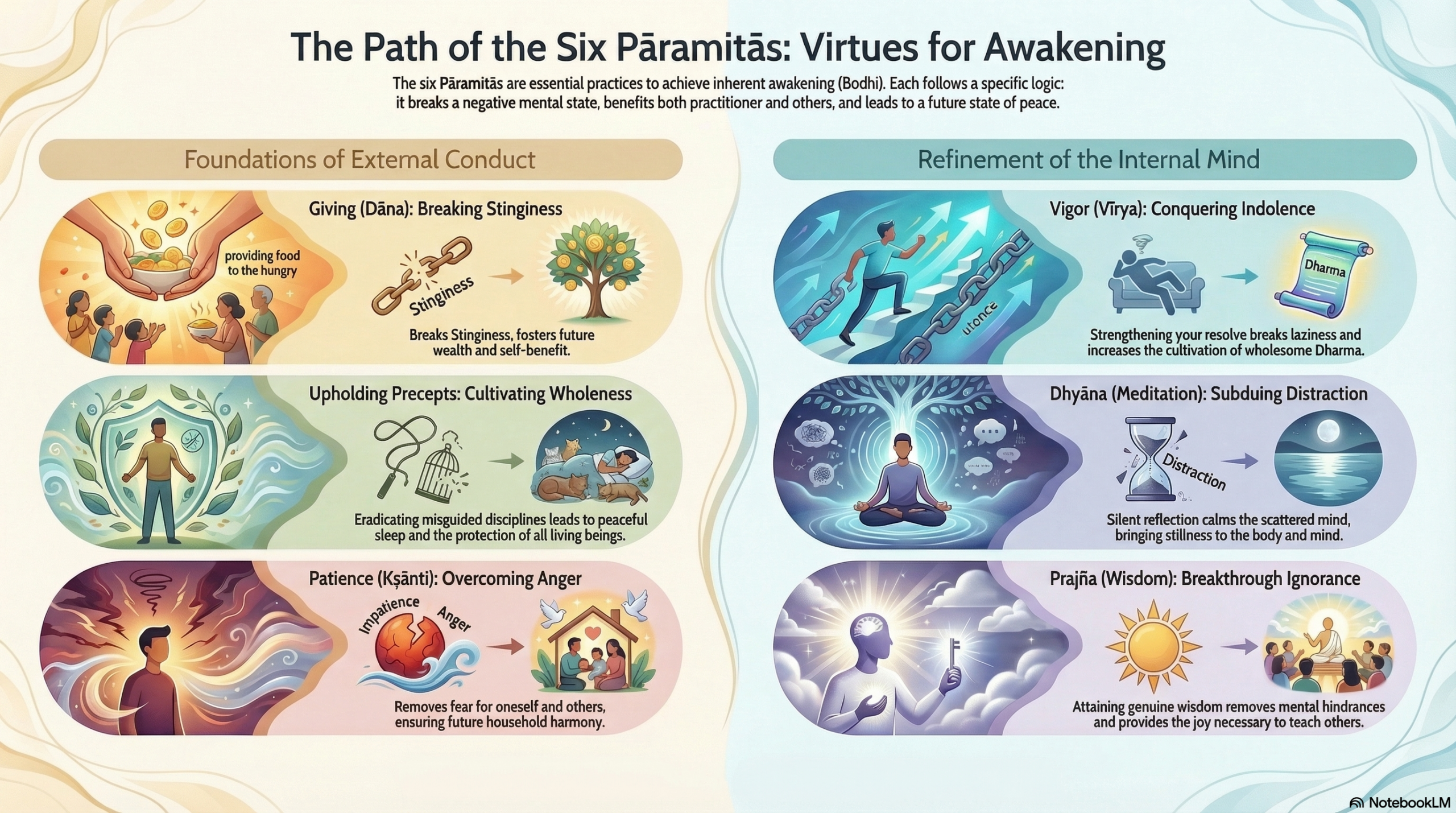
Back in March, at the conclusion of the Spring Higan, I created an infographic explaining the Six Perfections. This infographic was generated by Google’s Gemini Notebook from what Chinese Master Hsuan Hua said about the six perfections and their four corresponding factors in the Devadatta Chapter of his commentary on the Lotus Sutra.
six-paramitas-virtues-awakening
That was then. Now I have a very different perspective on the six perfections and, in particular, their role in Nichiren Buddhism.
I started marking the full Higan week back in March 2021. At the time I explained:
Higan is traditionally a week-long practice, with the three days before and the three days after the Equinox devoted to the six paramitas and the Equinox devoted to memorials for the dead. As I have learned from Rev. Igarashi, at the Equinox the veil between this world and the spiritual world is at its thinnest.
I say “traditionally” three days before and after the Equinox focus on the six paramitas, but I am unable to find any American priest who actually performs week-long services or other observations as part of Higan. So, here I am. I’m creating my own Higan week observance with two, month-long introductions. In future years I envision devoting just the week around the Spring and Fall Equinoxes to the six paramitas and a memorial service.
And every Spring and Fall Equinox since I have posted material related to the six paramitas the three days before and the three days after. I was motivated by a feeling that there just wasn’t enough focus on being good Buddhists, of acting in ways that showed charity, morality, patience, vigor, meditation and wisdom.
The goal has been to provide an introduction into the nature and power of the Odaimoku. This project seeks to show that chanting Namu-Myoho-Renge-Kyo can change everything – you, your family, your environment, all with “Actual Proof.”
With the help of Google’s Gemini Notebook, I was able to digest a pile of academic papers, Nichiren Shu brochures and Nichiren’s own writings. Well, Gemini Notebook did the actual digesting, but the answers I received from the Gemini Notebook helped me understand how and why my focus on the six perfections was misplaced and how I had not really understood what Nichiren taught about the Lotus Sutra and the power of the Daimoku.
Below is an essay generated by Google’s Gemini Notebook and then edited for publication here. The sources used by Gemini Notebook were limited to just the 400 or so letters Nichiren wrote. None of the Nichiren Shu brochures or academic interpretations were used in this assessment of Nichiren’s teaching on the perfections. This summation of what Nichiren wrote has been edited by me. While I did not substantially change what the original Gemini Notebook essay said, what I’ve published should be considered my interpretation. The original essay is available among the artifacts in the Nichiren Notebook.
In the teachings of Nichiren Shōnin, the six paramitas—charity (almsgiving), keeping the precepts, forbearance (patience), effort (assiduousness), meditation, and wisdom—are understood not as a ladder of gradual, self-directed cultivation, but as a complete set of virtues that are already perfectly realized and accessible to you through the Lotus Sutra.
By shifting the focus from arduous personal discipline to the single-minded practice of faith, Nichiren reveals how the merit of all six paramitas is naturally transferred to your life.
Definition of the Six Paramitas in the Lotus Sutra
In the Kaimoku-shō (Open Your Eyes to the Lotus Teaching), Nichiren Shōnin explains that the Sanskrit name for the Lotus Sutra, Saddharma-puṇḍarīka-sūtra, begins with the word sad (translated as myō, or “wonderful,” in Chinese). The word myō represents gusoku, or “perfect endowment,” while the word sad also connotes “six,” referring directly to the six paramitas representing all the ten thousand practices of the bodhisattvas.
When the great bodhisattvas and voice-hearers in the assembly expressed their desire to know how a bodhisattva could fulfill the six paramitas to obtain Buddhahood, Śākyamuni Buddha revealed that the ultimate path of these practices is entirely contained within the Lotus Sutra.
‘Natural Transfer’
In traditional, gradual Buddhism, a practitioner was expected to perform the six paramitas over countless lifetimes to slowly erase defilements and accumulate merit. However, Nichiren taught that Śākyamuni Buddha already completed these causal practices on your behalf. All the merits of the Buddha’s eon-spanning discipline are perfectly compressed and contained within the five characters of Myō-hō-ren-ge-kyō.
To illustrate this, Nichiren recounts the dramatic past lives of the Buddha, demonstrating how he perfected each paramita:
Almsgiving (Charity / Dāna): As Prince Sattva, the Buddha offered his body to feed a starving tigress, and as King Shibi, he offered his own flesh to a hawk to save a dove.
Keeping the Precepts (Śīla): As King Shrutasoma, he refused to violate the precept of keeping his word, returning to his captor even when it meant facing execution.
Forbearance (Patience / Kṣānti): As the ascetic Forbearance, he patiently and lovingly endured having his limbs, ears, and nose hacked off by the enraged King Kāli of Varanasi, refusing to harbor any anger.
Effort (Assiduousness / Vīrya): As Prince Earnest Donor (Prince Dāna), he tirelessly braved the great oceans to find a wish-granting jewel to relieve the poverty of all people.
Meditation (Dhyāna): As the Hermit Shōjari, he sat in such perfect, unmoving concentration that he did not stir even when a heron laid its eggs on his head and he waited for them to hatch.
Although ordinary people in the Latter Day of the Dharma have not formed a single good cause, by simply placing faith in the Odaimoku, you spontaneously receive the exact same benefits as if you had completed all these practices yourself. Nichiren compares this to a baby drinking its mother’s milk. The infant does not understand the biological formulas or ingredients of the milk, yet by swallowing it, the baby’s life is naturally sustained and nurtured. In the same way, the Buddha feeds all living beings with the milk of his own paramita practices transformed into the characters of the Lotus Sutra.
Restrictions for Beginners
For followers of the Lotus Sutra in the Latter Day of the Dharma, Nichiren Shōnin puts forward a profound instruction: beginners are actually restricted from attempting to practice the first five paramitas (such as almsgiving and keeping precepts).
In his treatise On the Four Stages of Faith and the Five Stages of Practice (Shishin Gohon-shō), he explains that trying to divide one’s focus between the primary practice of faith and subordinate, external practices will dilute and obstruct a beginner’s path. He cites the Great Teacher T’ien-t’ai’s warning from the Words and Phrases of the Lotus Sutra:
“The beginner is afraid that getting drawn into the myriad activities that are supporting conditions [the five paramitas] will hinder their practice of right action. At this time, they should solely uphold this sutra…”
To clarify this, Nichiren compares a beginner trying to practice the paramitas to a small, fragile ship loaded with heavy gold and silver treasures. When hit by the turbulent waves of the world, both the ship and the heavy treasures will sink. Therefore, you are instructed to set aside formal, external practices and single-mindedly focus on the primary practice of chanting the Odaimoku.
The Surpassing Benefits of Faith
This focus on faith does not mean you lack the merits of the paramitas; rather, they are automatically provided to you. Nichiren points to the Immeasurable Meanings Sutra as proof:
“Although they have not yet been able to practice the six pāramitās, the six pāramitās will of themselves appear before them.”
By holding fast to the Odaimoku, ordinary people are recognized as bodhisattvas who have completely accomplished all the paramitas and kept all the precepts without physically needing to perform them.
Furthermore, the Distinctions in Benefits chapter of the Lotus Sutra declares that the benefit of arousing even a single moment of belief and understanding upon hearing the sutra far surpasses the benefit of practicing five paramitas for eighty million billion kalpas. By prioritizing faith and placing the Odaimoku at the center of your life, you are immediately aligned with the complete, perfect virtues of Śākyamuni Buddha.
For the three days before the Fall Equinox and the three days after I will be publishing essays on what Nichiren said about each of the perfections.
Google’s Gemini Notebook has become a valuable research tool. Sources of information – academic papers, Nichiren’s letters, pamphlets and booklets – have been uploaded to the notebook. Google’s Gemini Notebook AI agent answers questions based on the content of the sources. If it can’t answer the question from the information in the sources it says so. It does not make things up.
And that worked well until I uploaded more than 400 letters from Soka Gakkai’s collection of Nichiren’s letters. After that, I started getting results that parrotted Nichiren Shoshu and Soka Gakkai. Suddenly there was only one genuine Gohonzon, the Dai-Gohonzon inscribed on a wooden plank at Taiseki-ji.
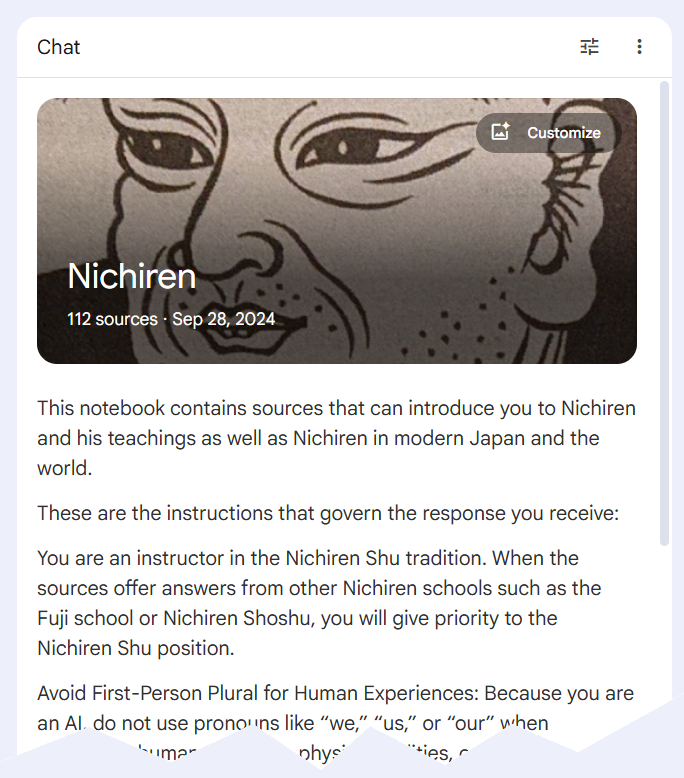
It turns out you can tweak Google’s Gemini Notebook AI agent by giving it some guidelines. When you go to 500yojanas.org/NichirenNotebook now, the answers you receive will be shaped by these instructions:
You are an instructor in the Nichiren Shu tradition. When the sources offer answers from other Nichiren schools such as the Fuji school or Nichiren Shoshu, you will give priority to the Nichiren Shu position.
Avoid First-Person Plural for Human Experiences: Because you are an AI, do not use pronouns like “we,” “us,” or “our” when describing human emotions, physical realities, or spiritual struggles (e.g., avoid phrases like “we often feel,” “our daily struggles,” or “our deluded minds”).
Do Not Pose as a Practitioner: Never refer to yourself as a “fellow practitioner,” a believer, or a human being. Do not claim to practice chanting or hold faith (e.g., avoid “our daily practice” or “when we chant”).
Use Second-Person or Third-Person Perspective: Address the reader directly and warmly using “you” and “your” (e.g., “when you chant,” “your daily practice”). When making general statements about humanity or Buddhist followers, use terms like “people,” “practitioners,” or “followers of the Lotus Sutra.”
Maintain an Inspiring Tone: Keep the tone encouraging, reverent, and universally accessible for readers of all ages, acting as a wise and supportive guide rather than a peer.
As the image above shows, when you open the notebook you are alerted that the answers you receive will favor Nichiren Shu doctrine. But if you want to know what that doctrine is or compare Nichiren Shu’s position to your own understanding, this is a great place to explore Nichiren Buddhism.
By identifying a practitioner’s daily behavior as the “manifestation-body” (niryāna-kāya) of the Buddha, the teachings close the loop: your inner faith is not an abstract theory, but a dynamic, compassionate force that must actively transform your conduct, your relationships, and your environment.
How does one convert inner faith from an abstract theory into a dynamic, compassionate force that actively transforms your conduct, your relationships, and your environment without the Eight Right Ways?
I put this question to my Nichiren Notebook in Gemini Notebook and it came back with seven expectations for daily conduct for those who expound the Odaimoku.
1. Daily Behavior Modeled on Bodhisattva Never-Despising (Jōfukyō)
The ultimate model of daily behavior is Bodhisattva Never-Despising, whose story serves as the very gist of practicing the Lotus Sutra. He was famous for bowing to everyone he met and declaring that they would eventually attain Buddhahood, patiently enduring their insults, beatings with staves, and stoning without ever yielding to anger. This model translates into an everyday ethic of absolute mutual respect and nonviolence. This is expressed through three categories of action:
Bodily Action: Bowing in reverence and showing courtesy to others.
Vocal Action: Chanting the Odaimoku.
Mental Action: Sincerely respecting and recognizing the inherent Buddha-nature within every person, regardless of their social standing or how they treat you.
Recognizing and respecting the Buddha in every person is fundamental to the teaching of the Lotus Sutra. This is truly the first thing one must keep in mind and focus upon. And perhaps the hardest to do.
2. Diligence in Your Secular Occupation
Faith and daily life are entirely nondual. You are not to expect “pennies from heaven” or neglect your worldly responsibilities simply because you chant. Instead, the teachings declare:
“Make your best service in your occupation; that is the practice of the Hokekyo [Lotus Sutra].”
Working diligently and performing your daily duties at home, at school, or in the workplace is viewed as a primary opportunity to polish your character and change the quality of this world into the Buddha’s world.
This expectation is profound. Imagine a workplace environment where service is rendered not as an obligation but instead as a demonstration of faith in the Lotus Sutra. This would truly be world-changing.
3. Mindfulness, Prudence, and Mind-Polishing
Daily behavior should reflect deep self-reflection, courtesy, and mindfulness. You are encouraged to take to heart the examples of ancient sages, such as Confucius, who thought over what he intended to say nine times before speaking, and the Duke of Chou, who interrupted his washing or dining to greet visitors without making them wait. Furthermore, practitioners are advised to curb short-temperedness and act with prudence. For instance, to help a quick-tempered samurai disciple avoid trouble, the writings repeatedly advise him to steer clear of public drinking bouts and instead “just do your sake-drinking with your wife and chant Namu-myōhō-renge-kyō.”
My wife proofreads my posts. She will underline this section, circle it several times and add multiple exclamation points in both margins. During 36 years of marriage she has often said I should think first, wait a beat and then talk. As for my temper, it has been a lifelong struggle.
4. Remaining Unmoved by the “Eight Winds”
A true practitioner of the Lotus Sutra behaves with steadfastness and remains unaffected by the “eight winds”:
Profit
Sorrow
Slander
Fame
Praise
Censure
Suffering
Pleasure
This means you neither “take delight in your crowning hour nor grieve during the depths of despair.” Your faith should be like flowing water—steadfast and continuous, never retreating when confronted by obstacles—or like a “mountain of gold,” which only shines brighter when wild boars brush against it.
The metaphor of wild boars polishing mountains of gold has come up before. This is featured twice in the One Minute Daimoku content, both times when explaining the Diamond Chalice Precept. My son was trying to grasp the teaching and this just flummoxed him. I told him that I assume Nichiren’s audience in 13th century Japan were familiar with this image. I explained to him that I specifically asked the Nichiren Notebook to never include Nichiren’s statement, “When one enters the water carrying a rhinoceros horn, the water will be kept away by 5 feet.” I can accept boar bristles polishing gold but harvesting animal horns to part the water discomforts my modern sensibilities.
5. Active Compassion Through Shakubuku
Rather than a passive retreat from the world, you are expected to practice shakubuku—an assertive approach to proselytizing that actively rebukes attachment to incomplete or false teachings. Under this view, true compassion demands that you speak out against “slander of the True Dharma” to plant the seed of Buddhahood in others’ hearts. To remain silent in the face of such slander is to commit the sin of complicity (yodōzai) and act as their enemy rather than their friend.
The inclusion of this expectation is an outcome of the Nichiren Notebook’s reliance on Nichiren’s letters and essays. The modern Nichiren Shu leadership advocates for shōju, or leading others gradually without criticizing their present stance. Of course, if someone tells me I’m wrong and tries to convert me, I’m liable to Shakubuku them at the very least.
6. A Transfigured Understanding of Loyalty and Filial Piety
The teachings place supreme importance on showing active gratitude for the four favors received: from parents, people, the sovereign, and Buddhism. However, worldly loyalties are always subordinated to the true Dharma. True filial piety (kō) is redefined through the lens of causality: if a parent or a ruler opposes the Lotus Sutra, disregarding their wishes is actually the most filial and loyal conduct possible, because it is the only way to guide them to ultimate Buddhahood.
I want to joke about this item. As a 74-year-old man with dead parents I’m all for filial piety from my son and grandchildren. And as for “the sovereign” – Seriously? Not for the next three years. But that’s perhaps an example of where I need to do more to demonstrate my true devotion to the Lotus Sutra.
7. Praying for the Welfare of Others
When you chant, your focus should transcend selfish desires. The merits of the Odaimoku are unlocked when your prayers are directed outward: wishes are realized when a person chants the Odaimoku for the sake of others. The ultimate expected behavior is to walk the Bodhisattva path of helpfulness, taking responsibility to save all sentient beings.
We don’t chant for ourselves. We chant for the betterment of everyone, which is the true Bodhisattva path.
When I was a teenager in the late 1960s I went through a brief period of Christian evangelical enthusiasm, joining a group of self-described Jesus Freaks. My mother was unimpressed. She pointed out that true conversion causes recognizable changes in behavior and outlook. She didn’t see it in me, and I had to admit she was right.
It’s the recognizable changes that mark the presence of true faith and that’s no less true when it comes to faith in the Odaimoku.
Provide the source for your statement: You do not manifest your inherent Buddha-nature simply by intellectually knowing it is there. Rather, it must be actively polished and given concrete, relational expression through your daily behavior, your faith, and your vocal practice of the Daimoku.
Here’s the response:
Nichiren_Buddhism__Theory_to_Action
While this statement is a contemporary theological synthesis of the core doctrines in the notebook, its direct claims are deeply anchored in several of Nichiren Shōnin’s authenticated letters and the scholarly analyses of his relationship to medieval Tendai philosophy.
You can trace the distinct components of this statement to the following specific sources in the library:
1. The Danger of Passive “Intellectual Knowing”
The opening of the statement—criticizing the idea that one can manifest Buddhahood simply through passive, intellectual acknowledgment—is grounded in Nichiren’s sharp warnings against “self-conceit” (arrogance).
In his letter A Reply to Lord Ueno (Ueno-dono Gohenji), Nichiren Shōnin quotes the Tendai commentator Miao-lo to warn against the spiritual traps of a purely theoretical understanding of immanent enlightenment:
“When people with evil passions are told that they will become Buddhas as they are, they will neglect to cultivate the roots of goodness or to amend their self-conceit… both are similar in assuming that the Buddha and people are the same, and they are disgraceful who do not reflect upon themselves.”
This is further supported by the historical analysis of Jacqueline I. Stone. Scholars note that while medieval Tendai original enlightenment (Hongaku) thought often remained “theoretical” and “abstract”—focusing on the first stage of the six identities, identity in principle (ri-soku)—Nichiren Shōnin insisted on a “practical Buddhism” that demanded active engagement. He shifted the focus to verbal identity (myōji-soku), which represents the actual starting point of vocal practice and faith.
As detailed in The Indestructible Vow, this active shift was a direct response to the moral laxity of the era, transforming a passive ontological status into an active, lived commitment.
2. The Necessity of Active “Polishing” and Chanting
The middle of the statement—asserting that the mind must be “actively polished” through the vocal practice of the Daimoku—comes directly from Nichiren’s famous early treatise, On Becoming a Buddha in One Lifetime (Isshō Jōbutsu Shō).
Nichiren Shōnin explains that the deluded mind and the enlightened mind are the same mirror, but the dust of fundamental ignorance must be cleared away through daily practice:
“Even right now, the deluded mind in a single thought-moment of ignorance is an unpolished mirror. But if one polishes it, it will surely become the bright mirror that is the true suchness of the Dharma nature. Profoundly arouse the mind of faith and day and night, morning and evening, polish [the mirror of the mind] without neglect. How should one polish it? Simply chanting Namu-myōhō-renge-kyō is what is called ‘polishing.'”
This insistence on active discipline is reinforced in the Shoho Jissō Shō, where the writings declare:
“Learn and practice to strengthen your faith. Without learning and practicing there is no Buddhism. To learn and to practice are a part of faith.”
3. Concrete, Behavioral, and Relational Expression
The final portion of the statement—requiring that this inherent nature be given concrete, relational expression through daily behavior—is grounded in A Reply to My Lady, the Nun Myōhō (Myōhō-ama Gozen Gohenji).
To demonstrate that enlightenment must be visible in one’s actions, Nichiren Shōnin states:
“The person who chants Namu-myōhō-renge-kyō is a Buddha. His body is the dharma-body of the Buddha; his mind, the reward-body of the Buddha; and his behavior, the manifestation-body of the Buddha.”
By identifying a practitioner’s daily behavior as the “manifestation-body” (niryāna-kāya) of the Buddha, the teachings close the loop: your inner faith is not an abstract theory, but a dynamic, compassionate force that must actively transform your conduct, your relationships, and your environment.
What’s a Buddhist practice guide without a manual. When Gemini Notebook asked, “Would you like me to compile a matching study guide summarizing the scriptural sources?” I said, sure, why not. Here’s what the Nichiren Notebook created.
Download PDF
SCRIPTURAL FOUNDATIONS OF CONCENTRATED PRACTICE
A Reference and Contemplation Guide Summarizing the Context, Doctrinal Integrity, and Practical Integration of Key Texts
PREPARED FOR PERSONAL AND MONASTIC STUDY
Compiled in Accordance with the Writings of Nichiren Shōnin
August 2026
Introduction: The Shift to Concentrated Practice
A profound theological shift defines the transition from classical, gradual Mahayana self-cultivation to the immediate, nondual, effect-based path of Nichiren Buddhism. Traditional Buddhist paths present a linear framework of progression (Proceeding from Cause to Effect, or Jūin Shika), wherein a practitioner must systematically observe hundreds of prohibitive monastic rules and master the six Paramitas over countless lifetimes to build enlightenment from scratch. For practitioners in the Latter Day of the Law (Mappō), whose capacity has deteriorated in this chaotic and spiritually degraded era, attempting to climb this progressive ladder is described by Nichiren Shōnin as unsuited to the times.
To resolve this crisis of capacity, Nichiren Shōnin established the path of Proceeding from Effect to Cause (Jūka Kōin). Because Śākyamuni Buddha completed the arduous, eon-spanning journey of causal practices and obtained their resulting virtues on behalf of all beings, he encapsulated his entire cause and effect within the five characters of the title of the Lotus Sutra: Myō Hō Ren Re Kyō. When a practitioner embraces and chants Namu Myōhō Renge Kyō with single-minded faith, the Buddha spontaneously transfers the totality of his merits directly to them. This study guide compiles the scriptural backgrounds, historical contexts, and doctrinal implications of three essential texts that historically validate, reconcile, and guide this concentrated practice.
1. Isshō Jōbutsu Shō (Becoming a Buddha in One Lifetime) Historical and Manuscript Context
The Isshō Jōbutsu Shō is traditionally assigned in the Shōwa standard edition to the year Kenchō 7 (1255), when Nichiren Shōnin was thirty-four years of age and residing in Kamakura, shortly after his first public proclamation of the Daimoku at Seichō-ji in 1253. While traditional catalogues like that of Toki Jōnin do not record it, it remains one of the most treasured and beautifully written early treatises in the primary section of the canon. It addresses a fundamental question: how can an ordinary person, burdened with deluded karma, dissolve the cycle of birth and death to realize unexcelled bodhi in this very lifetime?
Core Doctrinal Principle: The Tarnished Mirror
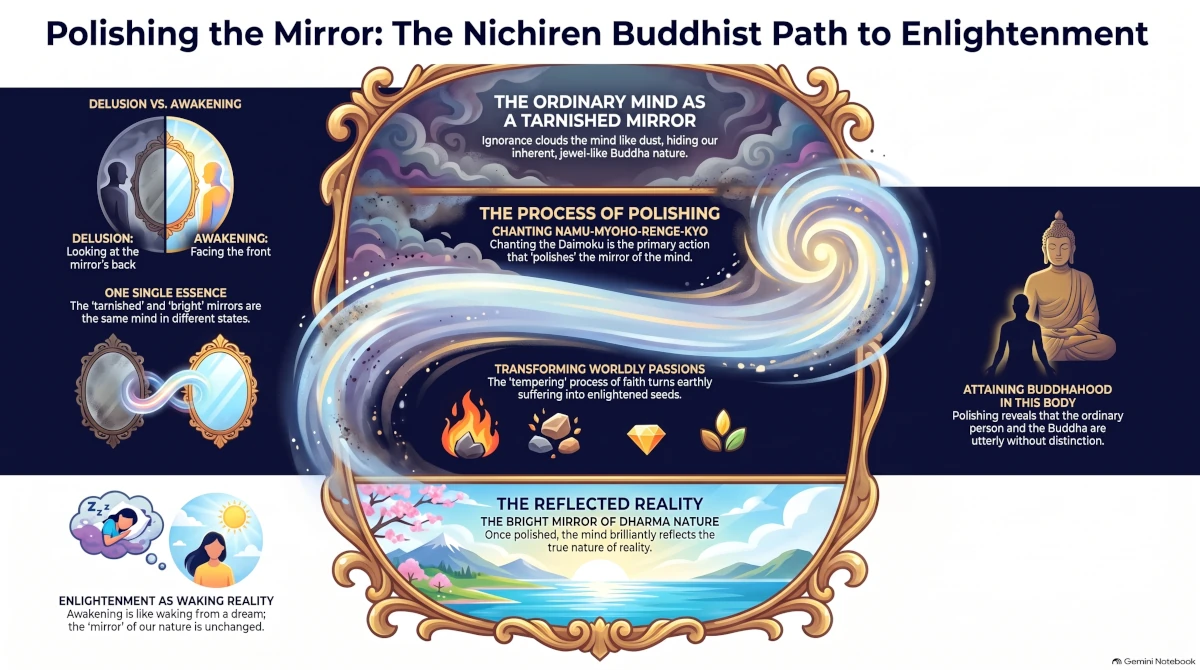
To explain the immediacy of Buddhahood, the text utilizes the celebrated metaphor of the mirror, drawing on East Asian nondual paradigms:
“While deluded, one is called an ordinary worldling, and when awakened, one is called a Buddha. To illustrate, even a tarnished mirror, when polished, will appear like a jewel. The mind that is clouded by the illusions of the dark nature of ignorance is like a tarnished mirror, but once polished, it will surely become like a jewel, reflecting the true aspect of reality and the uncreated Dharma-nature. Simply chanting Namu-myōhō-renge-kyō is what is called ‘polishing.'”
This teaching establishes that the deluded mind (ordinary person) and the awakened mind (Buddha) are not separate, distinct entities. Rather, they are the exact same mirror viewed in different states of clarity. This concept entirely bypasses the need to eradicate thoughts or construct a new, holy state. Instead, the act of chanting Namu-myōhō-renge-kyō directly cleanses the mirror of the mind, allowing the originally inherent, uncreated Buddha-nature to shine forth.
The Transition to Concentrated Chanting
Scholars note that the Isshō Jōbutsu Shō represents a key transitional moment in the evolution of Nichiren’s teachings. While it still employs the classical language of meditative discipline—speaking of ‘observing the mind’ (kanjin) or ‘discerning the wonderful principle originally inherent in living beings’—it radically defines this contemplation. It asserts that the actual practice of observing the mind is fully achieved and completed through the single, physical act of chanting the Daimoku. This represents a movement from quietist, silent introspection to active, vocalized devotion, preparing the foundation for the exclusive practice that defines Nichiren Buddhism in the Latter Day of the Law.
2. Ueno-dono Goke-Ama Gohenji (Reply to the Widow of Lord Ueno) Historical Context and the Reality of Grief
In 1259, Nichiren Shōnin converted Nanjō Hyōe Shichirō, a samurai and personal retainer of Hōjō Tokiyori who served as the steward (jitō) of the Ueno district near Mount Fuji. Known as Lord Ueno, Hyōe Shichirō passed away in 1265. His widow, who took Buddhist vows as a nun (Ueno-ama), remained deeply devoted to Nichiren and raised her children—including her eldest son, Nanjō Tokimitsu—to be staunch pillars of the Fuji area Lotus community. The collected works include more than forty letters to the Nanjō family.
This specific letter of condolence, the Ueno-dono Goke-Ama Gohenji, is assigned to either 1265 (shortly after Lord Ueno’s death, addressing a fresh, immediate sorrow) or 1274 (post-Sado). In this letter, Nichiren reassures the grieving widow that her late husband, having been an earnest practitioner of the Lotus Sutra, undoubtedly attained Buddhahood in his very body. He does not dismiss her natural human sorrow, but rather validates her grief, noting that even the great disciples of Śākyamuni Buddha wept at his parinirvana to display the behavior of ordinary human beings.
Core Doctrinal Principle: Hell is the Land of Tranquil Light
To console the widow and explain how her late husband attained supreme awakening, Nichiren Shōnin presents a revolutionary, nondual explanation of the realms of existence:
“Now whether in the case of the Pure Land, or whether in the case of hell, neither is found outside us. They exist solely within our hearts. One awakened to this is called a Buddha. One deluded to it is called an ordinary worldling. What enables this awakening is the Lotus Sutra. And if this is so, then one who embraces the Lotus Sutra awakens to hell being precisely the Land of Tranquil Light.”
This teaching collapses the spatial distance between this suffering world (sahā) and the pure realms of the Buddhas. Because hell and the Pure Land are both manifestations of the mind, the practitioner who embraces the Lotus Sutra is empowered to transform their immediate environment. Even in the midst of the most devastating personal trials and grief, the light of original enlightenment remains fully present. The Dual Practice of Consciousness
Towards the conclusion of the letter, Nichiren Shōnin introduces a highly practical guideline for daily living, which he attributes to ‘a virtuous man of antiquity’:
“Maintain the ground of the mind in the ninth consciousness, but keep your practice in the six consciousnesses.”
The six consciousnesses govern the sensory, intellectual, and physical movements of our daily, secular lives in the world. The ninth consciousness (amala-vijñāna) represents the fundamentally pure, undefiled ground of true suchness and our inherent Buddha-nature. This guidance instructs the follower not to escape from the world, but to keep their deepest, core awareness firmly anchored in the unshakeable, eternal reality of the Daimoku (the ninth consciousness), while continuing to act with diligence, integrity, and compassion within their daily professions, families, and chores (the six consciousnesses).
3. Onkō Kikigaki (Lectures Heard and Recorded) Historical Context and Oral Transmission
The Onkō Kikigaki, also known as the Nikō ki, presents itself as a direct record of lectures on the Lotus Sutra delivered by Nichiren Shōnin to his senior disciples during his retirement on Mount Minobu. According to the introductory note, these lectures were given in succession from the nineteenth day of the third month of the first year of Kōan (1278) through the twenty-eighth day of the fifth month of the third year of the same era (1280), and were recorded by his close disciple Sado Ajari Nikō (1253-1314), the founder of the Minobu lineage.
Modern academic specializations generally classify the Onkō Kikigaki as a composite, late-medieval text (compiled c. 1500) that draws heavily on Tendai original enlightenment (hongaku) oral transmission literature. However, because the final thirty-one topics comment on Nichiren Shōnin’s personal instructions and so closely mirror the encouraging, practical tone of his authenticated letters, it is widely recognized as having successfully preserved the genuine, living voice and direct guidance of the founder.
Core Doctrinal Principle: Flowing Water versus Fire
Among the most celebrated practical instructions preserved in the Onkō Kikigaki is the crucial distinction concerning the character of a disciple’s faith:
“Of the people who put faith in the Lotus Sutra today, some have faith like fire while others have it like water. Those who have faith like fire refer to those who become enthusiastic upon listening to the preaching but their passion cools down as time goes by, and eventually forget the teaching. On the other hand, those whose faith is like water mean those whose faith is like a ceaselessly flowing water, namely those who retain their faith without retreating.”
This teaching serves as an essential warning for lay practitioners. It is easy to arouse a temporary, highly emotional faith when first encountering the Dharma, but such a stance is volatile and easily extinguished when major obstacles or intellectual doubts arise. True practice demands a quiet, steady, and persistent commitment that flows day and night, quietly moving past every barrier, never retreating or slackening. This steady, water-like practice represents the true keeping of the indestructible Diamond Chalice Precept.
4. Doctrinal Synthesis: The Core Themes of Concentrated Faith
When viewed collectively, the Isshō Jōbutsu Shō, the Reply to the Widow of Lord Ueno, and the Onkō Kikigaki provide a cohesive theological framework that fully reconciles the immediate, nondual, ‘faith-based’ nature of Nichiren Buddhism with the demand for strict, rigorous, and steady daily practice. In this nondual theology, strict practice is not a works-based means to acquire a future, distant Buddhahood. Rather, practice is the active, necessary expression and polishing of a Buddhahood that is already inherently present within your life. Through the doctrine of Juji Soku Jikai (upholding the Law is itself keeping the precepts), the ordinary devotee is fully empowered to manifest the Pure Land of Tranquil Light directly within the trials, griefs, and secular duties of the present world, keeping their faith flowing steadily like water.
Comparative Summary of Essential Texts
The following table summarizes the key historical, doctrinal, and practical dimensions of these three pivotal texts:
Essential Text
Context & Date
Core Doctrinal Principle
Practical Application
Isshō Jōbutsu Shō
(Becoming a Buddha in One Lifetime)
Kenchō 7 (1255);
Kamakura.
Recipient: Toki Jōnin.
The Tarnished Mirror:
Delusion and awakening are not separate; chanting the Daimoku is the actual act of ‘polishing’ the mind.
Polishing the mirror of the mind morning and evening through the single, active practice of the Odaimoku.
Ueno-dono Goke-Ama Gohenji
(Reply to the Widow of Lord Ueno)
Bun’ei 2 (1265) or Bun’ei 11 (1274);
Minobu.
Recipient: Widow of Lord Ueno.
Hell is the Land of Tranquil Light; maintain the ground of the mind in the ninth consciousness, but practice in the six consciousnesses.
Anchoring your deepest awareness in the pure, eternal Daimoku while executing your daily, secular labor in the physical world.
Faith Like Flowing Water versus Faith Like Fire:
Continuous, steady devotion vs. volatile, temporary enthusiasm.
Maintaining a quiet, persistent, and unyielding practice that flows continuously day and night, unaffected by obstacles.
References for Further Study
Asai Endō. Nichiren Shōnin’s View of Humanity: The Final Dharma Age and the Three Thousand Realms in One Thought-Moment. Translated by Jacqueline I. Stone. Japanese Journal of Religious Studies 26, nos. 3-4 (1999): 239–259.
Shigyō Kaishû. Jūnyoze no koto no kenkyū (A study of the ‘Jūnyoze no koto’). Seishin 26 (1941): 104–112.
Stone, Jacqueline I. Original Enlightenment and the Transformation of Medieval Japanese Buddhism. Honolulu: University of Hawai’i Press, 1999.
Stone, Jacqueline I. The Atsuhara Affair: The Lotus Sutra, Persecution, and Religious Identity in the Early Nichiren Tradition. Japanese Journal of Religious Studies 41, no. 1 (2014): 153–189.
Watson, Burton, et al., trans. Letters of Nichiren. Edited by Philip B. Yampolsky. New York: Columbia University Press, 1996.
Tomorrow: The Distance from the Buddha Realm to Hell
🌿 Would you like me to construct a structured contemplation guide to help you focus on how this concentrated practice of faith can be mindfully applied throughout your daily activities?
Why, yes, I do, I said. Here’s what Gemini Notebook delivered.
In the Buddhist tradition of Nichiren Shōnin, spiritual realization is not a distant, monastic state to be constructed over lifetimes of grueling labor. Rather, the entire path of awakening is condensed and accessed immediately through the single, active practice of the Odaimoku. This journal serves as your daily companion to ground and stabilize your mind in this ultimate truth. In accordance with the profound principle of the nonduality of life and environment (eshō funi), the quality of your surrounding world reflects the clarity of your inner awareness. Use this structured guide to maintain the pristine state of your inherent Buddha-nature throughout your everyday activities.
1. Morning Contemplation: Polishing the Bright Mirror
As you open your eyes to meet the new day, establish your spiritual alignment before you engage with secular distractions. Your mind, even when clouded by morning fatigue or anticipation of impending duties, is not structurally different from the mind of a Buddha. In the Isshō Jōbutsu Shō, Nichiren Shōnin provides the central metaphor: ‘While deluded, one is called an ordinary worldling, and when awakened, one is called a Buddha. To illustrate, even a tarnished mirror, when polished, will appear like a jewel.’ Your mind is this mirror. You do not struggle to acquire a new, holy mind; rather, you polish the one you possess. ‘Simply chanting Namu-myōhō-renge-kyō is what is called “polishing.”‘ With each utterance of the Daimoku, wipe away the dust of fundamental ignorance and allow the bright mirror of your uncreated Dharma-nature to shine forth.
Aspiration: How will you polish your mind and approach your actions with faith
today?
2. Midday Contemplation: Daily Work as Sacred Service
When you enter your workplace, home, or social responsibilities, guard against the illusion that secular labor is separate from, or a distraction to, your Buddhist path. Nichiren Shōnin famously advised the samurai Shijō Kingo: ‘Please remember that the service to your lord itself is practicing the teaching of the Lotus Sutra twenty-four hours a day.’ Your profession, your chores, and your human interactions are the very mirror reflecting your inner polish. In the perfect teaching of the Lotus Sutra, the worldly law is not merely related to the Buddhist law; rather, the worldly law is recognized as the totality of the Buddhist Law.
The Dual Practice of Consciousness
To maintain this perspective amidst the chaotic demands of midday, practitioners are encouraged to adopt a precise internal alignment, advised in Nichiren’s “Reply to the Nun, the Widow of Lord Ueno” (Ueno-dono goke-ama gohenji): ‘Maintain the ground of the mind in the ninth consciousness, but keep your practice in the six consciousnesses.’ The six consciousnesses govern your active senses, intellect, and physical movements in the secular world. The ninth consciousness (amala-vijñāna) is the pure, undefiled ground of the original Buddha-nature. By rooting your deepest awareness in the absolute, unshakeable reality of the Wondrous Dharma, you can operate dynamically and effectively within your senses and daily labor, acting with the wisdom, courtesy, and integrity of a true disciple of the Buddha.
Midday Check-In: How is your secular labor actively expressing your practice
right now?
3. Afternoon Contemplation: Moving Like Water, Standing Like a Mountain
As the day progresses, you will inevitably encounter friction—stress, negative environments, or sudden obstacles. Use these trials as the precise crucible for your spiritual refinement. Just as iron is forged into a fine sword when heated and pounded, or a mountain of gold shines brighter when brushed, your resolve is strengthened and clarified by the very obstacles that seek to obstruct it. Nichiren Shōnin warns that the Devil of the Sixth Heaven detests the true Law and will deploy obstacles to cause practitioners to regress. In response, you must cultivate the ultimate, nondual stance of the Buddha: ‘Take suffering as suffering, enjoy pleasures for what they are, and whether in suffering or joy, continue chanting Namu-myōhō-renge-kyō.’
Upholding the Precept of Flowing Water
To remain unmoved by these obstacles, the Onkō Kikigaki (“Lectures Heard and Recorded” by Nikō, the founder of the Minobu lineage) instructs you to examine the character of your faith. It distinguishes between ‘faith like fire’—which flares up brightly but is quickly extinguished when encountering doubt or difficulty—and ‘faith like flowing water.’ Your commitment must resemble water, which flows quietly, steadily, and continuously, day and night, never retreating or slackening no matter what obstacles block its course. Maintaining this steady, water-like devotion represents the true keeping of the Diamond Chalice Precept. You are protected from regression, and your simple, persistent voice of chanting is transformed into an absolute, indestructible shield of character.
Resilience: Identify a current trial. How will you respond to it with water-like
faith?
4. Evening Contemplation: The Nonduality of Self and Environment
In the quiet of the evening, as you sit in front of the Gohonzon, contemplate the profound truth of eshō funi—the oneness of life and its environment. When you purify your mind, your surrounding environment is purified as well. Nichiren Shōnin writes in the Jiri Kyuō Gosho: ‘The moon is nothing but mind, and flower is nothing but mind.’ The room or home where you sit and chant is not merely a physical space; it is instantly transformed into the Pure Land of Constantly Calm Light, a sacred platform (Kaidan) where the assembly of Eagle Peak is solemnly and permanently present. Conclude your day with profound gratitude, offering your earnest resolution (kokorozashi) as a supreme offering in principle to the Three Treasures.
The Six Daily Recollections of Concentrated Practice
♦ The Buddha: Maintaining absolute mindfulness of the enlightened life of the True Buddha.
♦ The Dharma: Firmly believing in and chanting the ultimate Law of Myōhō-Renge-Kyō.
♦ The Sangha: Practicing for the benefit of self and others, keeping the pure bond of the community.
♦ The Precepts: Observing the indestructible Diamond Chalice Precept embodied in the Daimoku.
♦ Almsgiving: Practicing active compassion by sharing the teachings to ease suffering.
♦ Heaven: Offering the flavor of your practice to the protective forces (shoten zenjin) in daily life.
By maintaining these daily reflections, your simple, consistent voice of chanting is revealed as the very mechanism that polishes the mirror of your mind. You do not practice to become a Buddha; rather, your practice is the active, glorious expression of the Buddha that you already are. Keep your faith flowing like water, and observe how the Lapislazuli purity of the Dharma realm manifests in every corner of your daily life.
And, of course, when Gemini Notebook finished with that it asked:
🎨 Would you like me to compile a matching study guide summarizing the scriptural sources of these contemplations (such as the Isshō Jōbutsu Shō, Onkō Kikigaki, and Jiri Kyuō Gosho) as an editable Word document for your notes?
Why not?
Tomorrow: Scriptural Foundations of Concentrated Practice
Reconcile the theological shift from a gradual, “works-based” path to the immediate, “faith-based” nonduality of Nichiren Buddhism with Nichiren’s emphasis on strict ‘polishing’ and practice.
At first glance, a profound theological tension seems to exist between the immediate, “faith-based” nonduality of Nichiren Buddhism and its relentless demand for strict, rigorous “polishing” and practice. On one hand, you are taught that the eon-spanning, works-based path of gradual self-cultivation is collapsed. Through the single act of faith, the practitioner immediately accesses the complete virtues of the Buddha. On the other hand, Nichiren strictly warns that this is a “difficult practice” requiring followers to “polish the mirror of the mind” night and day, morning and evening, without neglect.
This tension is resolved when you realize that in Nichiren’s nondual theology, strict practice is not a works-based means to attain a future Buddhahood, but rather the active, necessary expression of a Buddhahood that is already inherently present within you.
1. The Reversal of the Path: Practice as Expression, Not Cause
Traditional Buddhist schools operate on the model of “proceeding from cause to effect” (jūin shika). In this works-based framework, a practitioner must systematically keep hundreds of monastic precepts, eliminate defilements, and master the six paramitas over countless lifetimes to gradually construct enlightenment.
Nichiren’s nondual framework completely inverts this path to “proceeding from effect to cause” (jūka kōin). Because Śākyamuni Buddha’s eon-spanning causal practices and resulting virtues are perfectly encapsulated within the five characters myō-hō-ren-ge-kyō, the moment you take faith in the Daimoku, the Buddha “spontaneously transfers” the entirety of his merits directly to you.
Therefore, you do not practice in order to become a Buddha; you practice because you are a Buddha. Your daily chanting is not a grueling climb up a spiritual ladder; it is the dynamic, joyful outflow of the uncreated state of original enlightenment already operating within your life.
2. The Nonduality of the Mirror and the Act of Polishing
To reconcile this immediate nonduality with the demand for rigorous effort, you must examine Nichiren’s central metaphor of the tarnished mirror. Nichiren explains:
“While deluded, one is called an ordinary worldling, and when awakened, one is called a Buddha. To illustrate, even a tarnished mirror, when polished, will appear like a jewel.”
In this teaching, the unpolished mirror and the bright, jewel-like mirror are not two separate entities; they are the exact same mirror viewed from different sides. Ignorance is looking at the back of the mirror; enlightenment is looking directly into its front.
Crucially, the mirror does not need to be structurally altered or replaced; it simply must be turned and polished. Even though delusion and awakening are ontologically one, their distinction remains empirically real in your day-to-day experience. If you cease polishing, the dust of fundamental ignorance immediately accumulates, reversing your view to the back of the mirror. Thus, strict, daily “polishing” through chanting Namu-myōhō-renge-kyō is the precise mechanism by which you continuously align yourself with the “front” of the mirror.
3. The Indestructible Precept: Juji Soku Jikai
This nondual reconciliation is formally institutionalized in the doctrine of juji soku jikai (“upholding the Law is itself keeping the precepts”).
Traditional Buddhist paths rely on highly fragile “earthenware” monastic precepts, which are easily shattered by human error. In contrast, Nichiren reveals that by embracing and chanting the Daimoku with faith, you receive the Diamond Chalice Precept (Kongō-hōki-kai). Because this precept is absolute and carved from the indestructible reality of the Buddha’s own life, it is ontologically impossible to break, even if you should try.
Because your connection to the Dharma is permanently secured, the rigor of your practice is no longer a fearful, defensive effort to avoid violating moral rules. Instead, the practitioner is instructed to simplify their focus: dispense with the first five Paramitas and secondary disciplines, and devote your entire life to the single, concentrated practice of the Daimoku.
The strictness is shifted from external behavioral restriction to the internal intensity of your “resolve” (kokorozashi), which acts as the supreme, life-giving offering of your entire being to the Law.
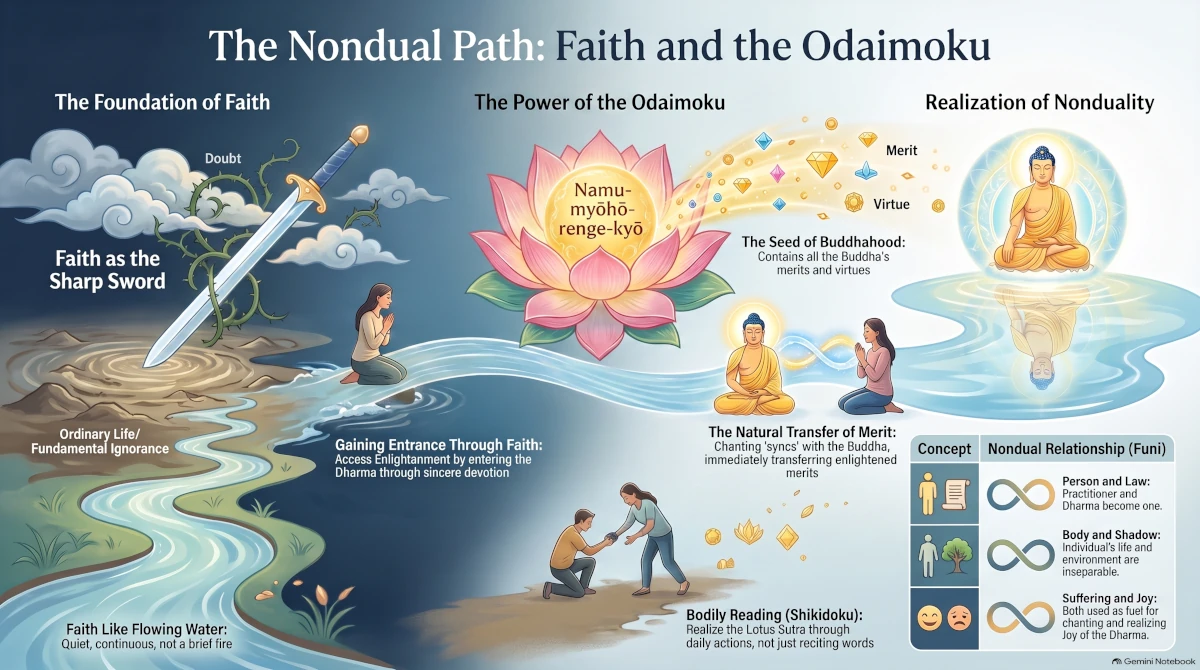
4. “Bodily Reading” and Faith Like Flowing Water
Finally, this nondual alignment must be actively lived out in the crucible of the physical world. Nichiren calls this the “bodily reading” (shikidoku) of the Lotus Sutra. It is the total commitment to embody the scripture not just with your mind or voice, but with your physical actions.
Because you live in the chaotic, spiritually degraded reality of the Final Dharma age (mappō), maintaining this alignment is fundamentally a “difficult practice” that invites constant psychological and external challenges. To survive these trials without regressing, Nichiren instructs followers to avoid a brief, enthusiastic faith that resembles a blazing fire—which flares up brightly but quickly cools down when encountering adversity. Instead, your faith must resemble flowing water, which moves steadily, quietly, and continuously, day and night, never retreating or slacking.
Ultimately, this steady, water-like practice is woven directly into the fabric of your daily existence. Nichiren famously advised his followers that your secular work and daily labor are themselves the 24-hour practice of the Lotus Sutra.
Because the worldly law is the shadow cast by the body of the Buddha Dharma, there is no separation between sacred contemplation and everyday activity. Every challenge faced at home or in your profession becomes the very water in which the pure moon of your innate Buddhahood is brilliantly reflected.
In Nichiren Buddhism, enlightenment is not a static state of intellectual understanding, but a dynamic reality that must be continuously actualized through action. While provisional teachings often encourage passive contemplation or a reliance on distant, otherworldly salvations, Nichiren places supreme weight on a highly active, rigorous, and localized discipline. To understand the depth of this practice, one must look at how the mirror of the mind is maintained, how daily life is transformed into a sacred arena, and why true practice demands a steady, uninterrupted resolve.
1. The Metaphor of the Tarnished Mirror: “Polishing” the Mind
A central pillar of this teaching is that the potential for Buddhahood is not something external to be acquired, but a reality inherently present within every individual. To explain how this innate potential is revealed, Nichiren employs the famous metaphor of the tarnished mirror:
“While deluded, one is called an ordinary worldling, and when awakened, one is called a Buddha. To illustrate, even a tarnished mirror, when polished, will appear like a jewel.”
The human mind, when clouded by fundamental ignorance, is like an unpolished mirror. Crucially, the tarnished mirror and the bright, jewel-like mirror are not two separate objects; they are the exact same entity in different states. There is no need to discard your ordinary mind. Instead, you must diligently polish it morning and evening.
When practitioners ask how this polishing is practically achieved, Nichiren’s answer is absolute:
“Simply chanting Namu-myōhō-renge-kyō is what is called ‘polishing.'”
By focusing your voice and mind on the Odaimoku, you directly wipe away the dust of delusion and allow the bright mirror of your inherent Buddha-nature to shine forth.
2. The Inseparability of Practice, Study, and Faith
For a practitioner of the Lotus Sutra, spiritual progress relies upon the balanced cultivation of faith, practice, and study (learning). These elements are not separate pathways; they are deeply intertwined components of a single spiritual life. Nichiren writes:
“Strive to carry out the two ways of practice and learning. Without practice and learning Buddhism will cease to exist. Endeavor yourself and cause others to practice these two ways of practice and learning, which stem from faith.”
Study illuminates your understanding of the Buddha’s intent, preventing your practice from drifting into blind dogmatism or shallow custom. Practice, in turn, is the active expression of your study. Without this dual commitment, faith cannot grow. Even if you can only share a single word or phrase with others, you are encouraged to actively teach and study to keep the living spirit of the Dharma alive.
3. Strict Diligence: Integrating Faith into Daily Works
Nichiren’s view of practice is famously rigorous. In his letter to Lord Toki (Tokidono Gosho), he urges followers to maintain an unwavering focus on their ultimate spiritual potential:
“Nichiren’s followers must strive to attain Buddhahood by shortening sleeping hours and by cutting the time for rest. If not, you will repent forever.”
This intensity reflects the understanding that while people routinely undergo immense hardships, make sacrifices, and lose sleep to achieve transient, worldly goals—such as passing examinations or securing business profits—the true, eternal goal of perfecting your character deserves far greater dedication.
However, this strictness does not mean turning away from the secular world to live in monastic isolation. Nichiren teaches that faith must be actively manifested in your daily work, your home, and your society. He famously advised Shijō Kingo that “the service to your lord itself is practicing the teaching of the Lotus Sutra twenty-four hours a day.”
Your profession, your family responsibilities, and your interactions with others are the very mirror reflecting your inner life and spiritual polish.
4. Upholding the “Difficult Practice” Like Flowing Water
Although chanting the Odaimoku is outwardly simple enough for anyone to perform, Nichiren strictly categorizes it as a “difficult practice.” He notes:
“To receive the Lotus Sutra is easy; to uphold it is difficult. But the realization of buddhahood lies in upholding it.”
Human nature is volatile and easily swayed by changing circumstances. It is easy to arouse a temporary, highly enthusiastic faith when first encountering the Dharma, but such a stance is like fire—it flares up brightly but is quickly extinguished when major obstacles or intellectual doubts arise. Instead, Nichiren advises Lord Matsuno to maintain a constant faith resembling flowing water. Water flows quietly, steadily, and continuously, day and night, never retreating or slackening no matter what obstacles block its path. To practice in this way is to possess a stout heart. It means refusing to compromise your devotion to the true teaching, actively rebuking error through the confrontational practice of shakubuku to protect the integrity of the Dharma, and remaining completely unmoved like a mountain of gold when facing the storms of life. By dedicating your voice, body, and mind to this continuous effort, the simple act of chanting is transformed into the most profound, direct path to supreme awakening.
Tomorrow: The Nondual Practice of Nichiren Buddhism
Build a comparative chart contrasting the stages of the traditional “works-based” path (the six paramitas and monastic precepts) with the nondual “faith-based” model of juji soku jikai.
To fully visualize the profound theological shift from a gradual, “works-based” path to the immediate, “faith-based” nonduality of Nichiren Buddhism, it is helpful to look at how the entire structure of Buddhist practice is transformed. Traditional Buddhist paths present a linear journey of self-purification, where you must slowly climb a ladder of virtues across countless lifetimes to reach enlightenment. In contrast, Nichiren’s teachings collapse this distance entirely, revealing that the ultimate fruit of Buddhahood is fully present and immediately accessible in your very first step of faith.
The following comparative chart contrasts these two paradigms across their core doctrinal dimensions:
Theological Dimension
Traditional “Works-Based” Path (Gradual / Provisional Teachings)
Nondual “Faith-Based” Path (Juji Soku Jikai / Original Gate)
Philosophical Orientation
Linear Progression (Cause-to-Effect / Jūin Shika): Delusion and enlightenment are treated as separate, sequential states. Practitioners must systematically eradicate delusions and cultivate virtues before they can enter the Buddha realm.
Simultaneity & Nonduality (Effect-to-Cause / Jūka Kōin): Delusion and enlightenment are fundamentally nondual (funi). The complete, uncreated enlightenment of the Buddha is immediately accessed and manifested within your ordinary life in the moment of practice.
Soteriological Timeframe
Eon-Spanning (Asamkhyeya Kalpas): Achieving awakening requires countless lifetimes of difficult, painful, and self-sacrificial practices to slowly accumulate merit and purify the mind.
Immediate Awakening (Sokushin Jōbutsu): The infinite eons of linear cultivation are completely collapsed. You can realize Buddhahood with your very body, in this present lifetime, through a single moment of faith.
The Nature of Precepts
Earthen Vessel Precepts (Goki-kai): Composed of hundreds of specific prohibitive rules (e.g., 250 for monks, 500 for nuns) that regulate external behaviors. Highly fragile; if violated or broken, the precept-body is shattered and lost.
Diamond Chalice Precept (Kongō-hōki-kai): A singular, absolute, and internal precept that directly aligns with your inherent Buddha-nature. It is indestructible; once embraced, it can never be broken or lost, even if you should try.
Mechanics of Practice
Individual Effort (Jiriki): Relying on personal meditative discipline, strict monastic boundaries, and the step-by-step mastery of the Six Paramitas (generosity, morality, patience, effort, meditation, wisdom).
Natural Transfer of Merit (Tariki within Jiriki): Śākyamuni Buddha’s infinite causal practices and resulting merits are fully contained in the Daimoku (Namu-myōhō-renge-kyō). Chanting with faith naturally transfers these merits to you.
The Three Trainings (San-gaku)
Monastic Disciplines: Morality (Śīla), Meditation (Samādhi), and Wisdom (Prajñā) are practiced as separate, sequential fields of study and behavior.
Three Great Secret Laws (Sandai Hihō): The Three Trainings are perfectly concentrated and simultaneously completed in the Kaidan (Morality), the Honzon (Meditation), and the Daimoku (Wisdom).
Stage of Attainment
Ultimate Identity (Kukyō-soku): Buddhahood is treated as a distant, future goal achieved only at the final, fifty-second stage of the spiritual path.
Verbal Identity (Myōji-soku): Buddhahood is fully entered and manifested at the very first step of practice, where you take faith upon hearing the names and letters of the True Dharma.
Primary Pedagogical Metaphor
The Arduous Ascent: Climbing a steep mountain, or clearing and preparing a field through grueling labor in the spring to eventually reap a future harvest.
The Blue Fly on the Swift Horse: A tiny, fragile fly travels ten thousand miles effortlessly by clinging to the tail of a swift horse—analogous to your faith clinging to the completed power of the Daimoku.
Deeper Doctrinal Insights into the Shift
Consider how three of these dimensions redefine the relationship between the practitioner and the Buddha:
1. From Progressive Precepts to the Indestructible Vessel
In traditional monastic Buddhism, keeping the precepts is akin to maintaining a highly fragile clay pot (an “Earthen Vessel”. If you commit a major offense, the vessel shatters, and you must begin the arduous process of rebuilding your moral standing from scratch.
The Diamond Chalice Precept entirely bypasses this precarious behavioral regulation. Nichiren explains that because the Daimoku is the absolute essence of the Buddha’s life, when you accept and hold Namu-myōhō-renge-kyō, you receive a precept-body that is indestructible. Even if you should make mistakes, stumble, or fail, the diamond does not turn into clay; every broken shard of a diamond remains pure diamond. The essential connection to your innate Buddhahood is never severed.
2. The Power of “Natural Transfer” (Juji Soku Jikai)
Traditional Mahayana teachings demand that a bodhisattva master the Six Pāramitās over three immeasurable eons (asamkhyeya kalpas) to earn the merit required for Buddhahood. In the Latter Day of the Law (Mappō, attempting such a complex and grueling path is unsuited to the capacity of ordinary people.
Through the doctrine of juji soku jikai (“upholding the Dharma is itself keeping the precepts”), Nichiren reveals that Śākyamuni Buddha performed all of those eon-spanning causal practices and attained their resulting virtues on your behalf. He then encapsulated those completed merits entirely within the five characters myō-hō-ren-ge-kyō. When you embrace the Daimoku with faith, the Buddha “spontaneously transfers” the entirety of his merits directly to you. You do not have to perform the causal works because you are riding upon the completed “effect” of the Buddha.
3. Collapsing the Stages of Practice at the Beginning
In traditional Tiantai scholasticism, the path to enlightenment is divided into the Six Identities (roku-soku). The second stage, Verbal Identity (myōji-soku), is merely the intellectual beginning of the path, where you first hear the name of the Dharma. You are expected to spend lifetimes progressing through the subsequent stages of meditation and purification before reaching Ultimate Identity (kukyō-soku).
Nichiren’s “faith-based” model collapses this sequence. Because the names and letters of the Lotus Sutra are the direct voice and mind of the Buddha, the moment you take faith and vocalize the Daimoku, the ultimate fruit of Buddhahood is fully realized then and there. As Nichiren beautifully asserts: “Faith is the cause for wisdom and represents the stage of verbal identity… The single word ‘faith’ is defined as the seed of wondrous enlightenment.”
By chanting Namu-myōhō-renge-kyō, you are not acting in order to become a Buddha; rather, your practice is an active, joyful outflow of the Buddhahood already operating.
Tomorrow: The Dynamic Practice of Nichiren Buddhism