
Back in March, at the conclusion of the Spring Higan, I created an infographic explaining the Six Perfections. This infographic was generated by Google’s Gemini Notebook from what Chinese Master Hsuan Hua said about the six perfections and their four corresponding factors in the Devadatta Chapter of his commentary on the Lotus Sutra.
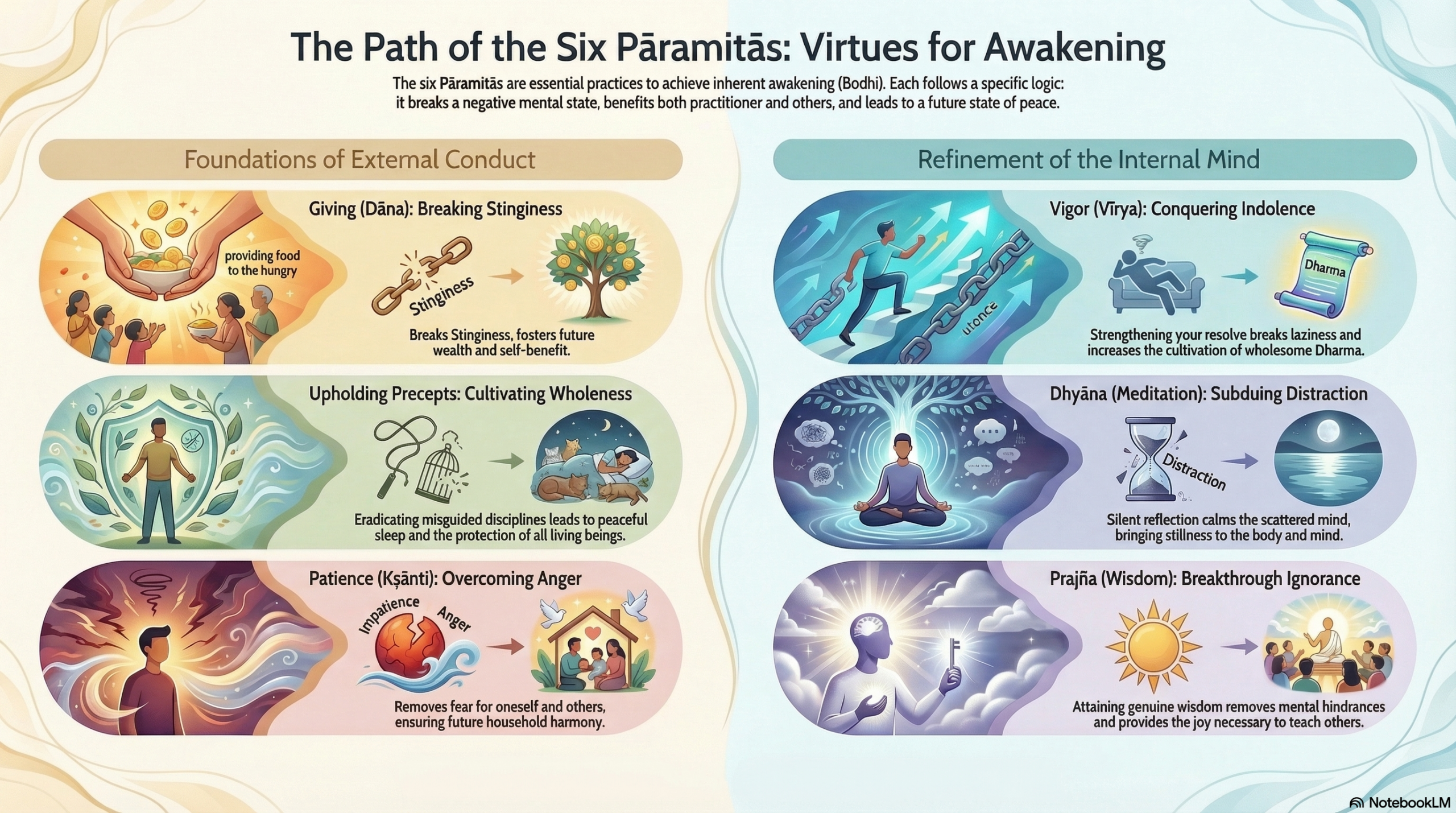
That was then. Now I have a very different perspective on the six perfections and, in particular, their role in Nichiren Buddhism.
I started marking the full Higan week back in March 2021. At the time I explained:
Higan is traditionally a week-long practice, with the three days before and the three days after the Equinox devoted to the six paramitas and the Equinox devoted to memorials for the dead. As I have learned from Rev. Igarashi, at the Equinox the veil between this world and the spiritual world is at its thinnest.
I say “traditionally” three days before and after the Equinox focus on the six paramitas, but I am unable to find any American priest who actually performs week-long services or other observations as part of Higan. So, here I am. I’m creating my own Higan week observance with two, month-long introductions. In future years I envision devoting just the week around the Spring and Fall Equinoxes to the six paramitas and a memorial service.
And every Spring and Fall Equinox since I have posted material related to the six paramitas the three days before and the three days after. I was motivated by a feeling that there just wasn’t enough focus on being good Buddhists, of acting in ways that showed charity, morality, patience, vigor, meditation and wisdom.
But my recent series of articles on the Faith and Practice in Nichiren Buddhism was, frankly, an eye opener for me.
The Faith and Practice in Nichiren Buddhism articles were an outgrowth of my Diamond Path of Daimoku project, which had a very simple objective:
The goal has been to provide an introduction into the nature and power of the Odaimoku. This project seeks to show that chanting Namu-Myoho-Renge-Kyo can change everything – you, your family, your environment, all with “Actual Proof.”
With the help of Google’s Gemini Notebook, I was able to digest a pile of academic papers, Nichiren Shu brochures and Nichiren’s own writings. Well, Gemini Notebook did the actual digesting, but the answers I received from the Gemini Notebook helped me understand how and why my focus on the six perfections was misplaced and how I had not really understood what Nichiren taught about the Lotus Sutra and the power of the Daimoku.

Below is an essay generated by Google’s Gemini Notebook and then edited for publication here. The sources used by Gemini Notebook were limited to just the 400 or so letters Nichiren wrote. None of the Nichiren Shu brochures or academic interpretations were used in this assessment of Nichiren’s teaching on the perfections. This summation of what Nichiren wrote has been edited by me. While I did not substantially change what the original Gemini Notebook essay said, what I’ve published should be considered my interpretation. The original essay is available among the artifacts in the Nichiren Notebook.
In the teachings of Nichiren Shōnin, the six paramitas—charity (almsgiving), keeping the precepts, forbearance (patience), effort (assiduousness), meditation, and wisdom—are understood not as a ladder of gradual, self-directed cultivation, but as a complete set of virtues that are already perfectly realized and accessible to you through the Lotus Sutra.
By shifting the focus from arduous personal discipline to the single-minded practice of faith, Nichiren reveals how the merit of all six paramitas is naturally transferred to your life.
Definition of the Six Paramitas in the Lotus Sutra
In the Kaimoku-shō (Open Your Eyes to the Lotus Teaching), Nichiren Shōnin explains that the Sanskrit name for the Lotus Sutra, Saddharma-puṇḍarīka-sūtra, begins with the word sad (translated as myō, or “wonderful,” in Chinese). The word myō represents gusoku, or “perfect endowment,” while the word sad also connotes “six,” referring directly to the six paramitas representing all the ten thousand practices of the bodhisattvas.
When the great bodhisattvas and voice-hearers in the assembly expressed their desire to know how a bodhisattva could fulfill the six paramitas to obtain Buddhahood, Śākyamuni Buddha revealed that the ultimate path of these practices is entirely contained within the Lotus Sutra.
‘Natural Transfer’
In traditional, gradual Buddhism, a practitioner was expected to perform the six paramitas over countless lifetimes to slowly erase defilements and accumulate merit. However, Nichiren taught that Śākyamuni Buddha already completed these causal practices on your behalf. All the merits of the Buddha’s eon-spanning discipline are perfectly compressed and contained within the five characters of Myō-hō-ren-ge-kyō.
To illustrate this, Nichiren recounts the dramatic past lives of the Buddha, demonstrating how he perfected each paramita:
- Almsgiving (Charity / Dāna): As Prince Sattva, the Buddha offered his body to feed a starving tigress, and as King Shibi, he offered his own flesh to a hawk to save a dove.
- Keeping the Precepts (Śīla): As King Shrutasoma, he refused to violate the precept of keeping his word, returning to his captor even when it meant facing execution.
- Forbearance (Patience / Kṣānti): As the ascetic Forbearance, he patiently and lovingly endured having his limbs, ears, and nose hacked off by the enraged King Kāli of Varanasi, refusing to harbor any anger.
- Effort (Assiduousness / Vīrya): As Prince Earnest Donor (Prince Dāna), he tirelessly braved the great oceans to find a wish-granting jewel to relieve the poverty of all people.
- Meditation (Dhyāna): As the Hermit Shōjari, he sat in such perfect, unmoving concentration that he did not stir even when a heron laid its eggs on his head and he waited for them to hatch.
Although ordinary people in the Latter Day of the Dharma have not formed a single good cause, by simply placing faith in the Odaimoku, you spontaneously receive the exact same benefits as if you had completed all these practices yourself. Nichiren compares this to a baby drinking its mother’s milk. The infant does not understand the biological formulas or ingredients of the milk, yet by swallowing it, the baby’s life is naturally sustained and nurtured. In the same way, the Buddha feeds all living beings with the milk of his own paramita practices transformed into the characters of the Lotus Sutra.
Restrictions for Beginners
For followers of the Lotus Sutra in the Latter Day of the Dharma, Nichiren Shōnin puts forward a profound instruction: beginners are actually restricted from attempting to practice the first five paramitas (such as almsgiving and keeping precepts).
In his treatise On the Four Stages of Faith and the Five Stages of Practice (Shishin Gohon-shō), he explains that trying to divide one’s focus between the primary practice of faith and subordinate, external practices will dilute and obstruct a beginner’s path. He cites the Great Teacher T’ien-t’ai’s warning from the Words and Phrases of the Lotus Sutra:
“The beginner is afraid that getting drawn into the myriad activities that are supporting conditions [the five paramitas] will hinder their practice of right action. At this time, they should solely uphold this sutra…”
To clarify this, Nichiren compares a beginner trying to practice the paramitas to a small, fragile ship loaded with heavy gold and silver treasures. When hit by the turbulent waves of the world, both the ship and the heavy treasures will sink. Therefore, you are instructed to set aside formal, external practices and single-mindedly focus on the primary practice of chanting the Odaimoku.
The Surpassing Benefits of Faith
This focus on faith does not mean you lack the merits of the paramitas; rather, they are automatically provided to you. Nichiren points to the Immeasurable Meanings Sutra as proof:
“Although they have not yet been able to practice the six pāramitās, the six pāramitās will of themselves appear before them.”
By holding fast to the Odaimoku, ordinary people are recognized as bodhisattvas who have completely accomplished all the paramitas and kept all the precepts without physically needing to perform them.
Furthermore, the Distinctions in Benefits chapter of the Lotus Sutra declares that the benefit of arousing even a single moment of belief and understanding upon hearing the sutra far surpasses the benefit of practicing five paramitas for eighty million billion kalpas. By prioritizing faith and placing the Odaimoku at the center of your life, you are immediately aligned with the complete, perfect virtues of Śākyamuni Buddha.
For the three days before the Fall Equinox and the three days after I will be publishing essays on what Nichiren said about each of the perfections.