Tag Archives: 6paramitas

Higan: Four Factors of Wisdom

Today is the final day of Higan week, the three days before the equinox and the three days after. As explained in a Nichiren Shu brochure:

For Buddhists, this period is not just one characterized by days with almost equal portions of light and dark. Rather, it is a period in which we strive to consciously reflect upon ourselves and our deeds.

The today we consider the Perfection of Wisdom. For this Spring Higan week I’m using Hsuan Hua‘s commentary on the Lotus Sutra in which he discusses the perfections’ four kinds of corresponding factors.

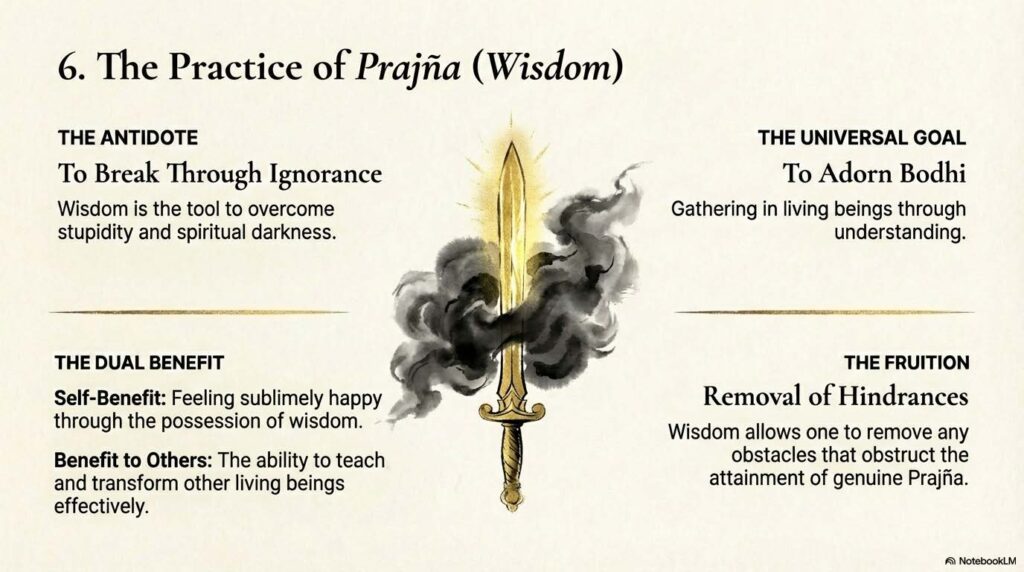
The pāramitā of prajña. There are also four corresponding factors for practicing the pāramitā of prajña.

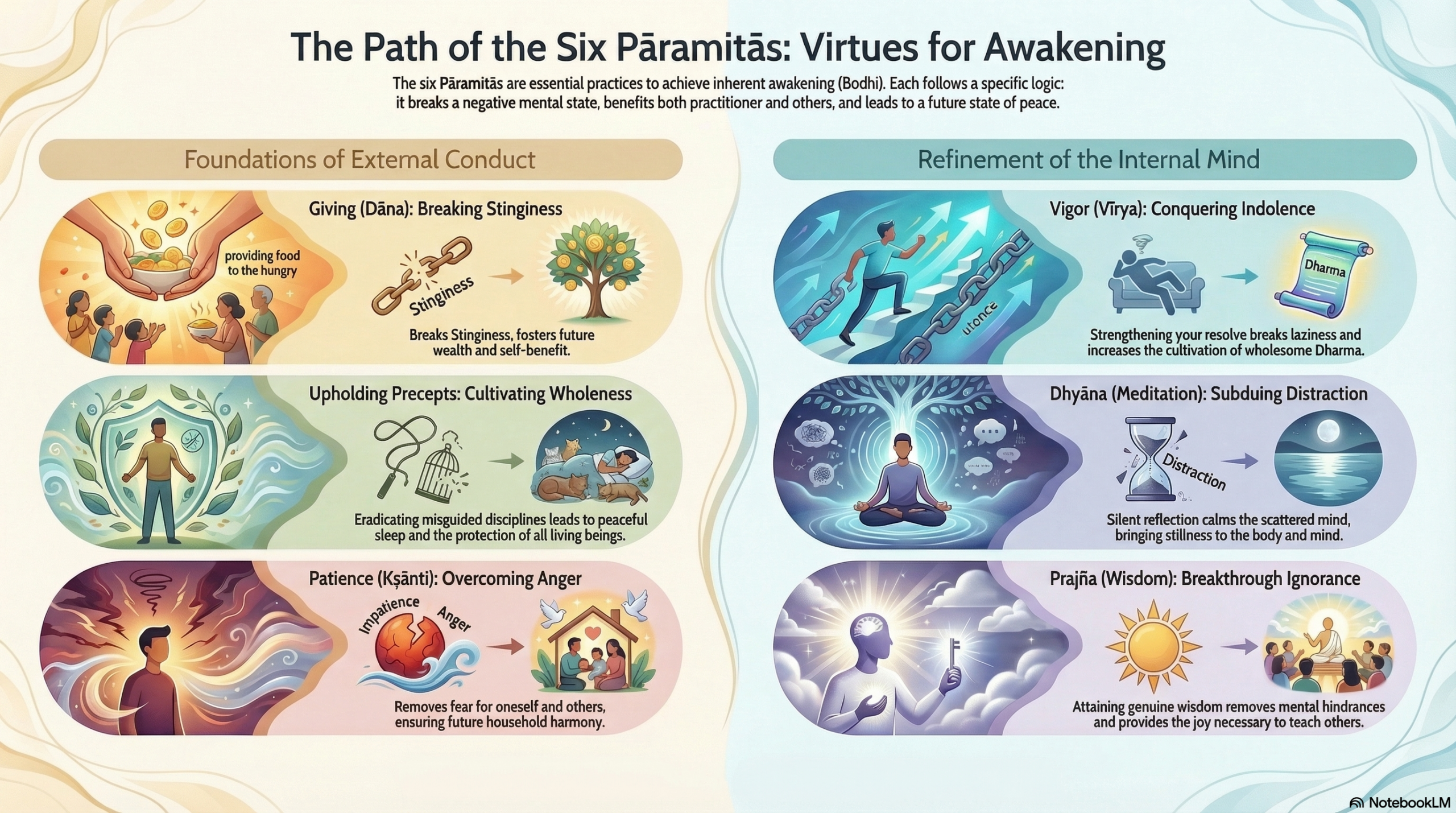
  1. To break through ignorance. By practicing the pāramitā of prajña, you can overcome your ignorance. Ignorance is stupidity.
  2. To adorn bodhi and gather in living beings.
  3. To attain joy through wisdom. When you have wisdom, you’ll feel sublimely happy; this is to benefit yourself. When you have wisdom, you can also teach and transform other living beings; this is to benefit others.
  4. To remove hindrances that obstruct wisdom. If you have wisdom, you can remove any obstacles that hinder the attainment of wisdom so that you can attain genuine wisdom, prajña.
Hsuan Hua Lotus Sutra Commentary, v8,ch12, p188-189

Higan: Four Factors of Dhyana

Today is the sixth day of Higan week, the three days before the equinox and the three days after. As explained in a Nichiren Shu brochure:

For Buddhists, this period is not just one characterized by days with almost equal portions of light and dark. Rather, it is a period in which we strive to consciously reflect upon ourselves and our deeds.

The today we consider the Perfection of Dhyana. For this Spring Higan week I’m using Hsuan Hua‘s commentary on the Lotus Sutra in which he discusses the perfections’ four kinds of corresponding factors.

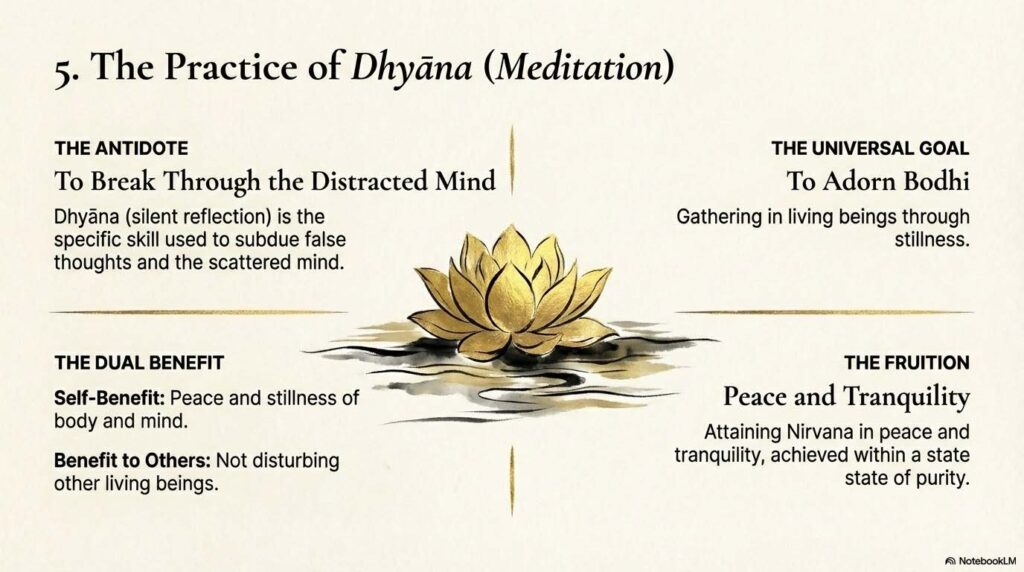
The pāramitā of dhyana. Dhyana means “the practice of contemplation.” It also means “silent reflection.” There are also four corresponding factors for practicing the paramitā of dhyāna.

  1. To break through the distracted mind. The skill of dhyana can subdue the scattered mind. You can stop having a lot of false thoughts through the practice of dhyāna.
  2. To adorn bodhi and gather in living beings.
  3. To remain still in body and mind and not disturb other living beings. By practicing dhyana, you’ll attain peace and stillness in body and mind; this is to benefit yourself. By not bothering living beings, you benefit others.
  4. To attain nirvāṇa in peace and tranquility. Within a state of purity [while in dhyana], you’ll attain nirvāņa in peace and tranquility.

Hsuan Hua Lotus Sutra Commentary, v8, ch12, p188

202603_The_Six_Pāramitās_Page_07

Higan: Four Factors of Vigor

Today is the fifth day of Higan week, the three days before the equinox and the three days after. As explained in a Nichiren Shu brochure:

For Buddhists, this period is not just one characterized by days with almost equal portions of light and dark. Rather, it is a period in which we strive to consciously reflect upon ourselves and our deeds.

The today we consider the Perfection of Vigor. For this Spring Higan week I’m using Hsuan Hua‘s commentary on the Lotus Sutra in which he discusses the perfections’ four kinds of corresponding factors.

The pāramitā of vigor. There are also four corresponding factors for practicing the paramita of vigor.

  1. To break through indolence. If you cultivate with vigor, you’ll be able to overcome indolence. You’ll conquer your tendency to be lazy. If you lack vigor, your laziness will control you. With vigor, you’ll be able to break through laziness.
  2. To adorn bodhi and gather in living beings.
  3. To increase [cultivation of] wholesome Dharma and not bother other people. By increasing your cultivation of wholesome Dharma, you bring benefit to yourself. By not bothering others, causing them trouble, or bringing them afflictions, you benefit them.
  4. To attain bodhi through great strength. By drawing on your great strength, you’ll attain the reward of bodhi.

Hsuan Hua Lotus Sutra Commentary, v8, ch12, p187-188

202603_The_Six_Pāramitās_Page_06

Higan: Four Factors of Patience

Today is the third day of Higan week, the three days before the equinox and the three days after. As explained in a Nichiren Shu brochure:

For Buddhists, this period is not just one characterized by days with almost equal portions of light and dark. Rather, it is a period in which we strive to consciously reflect upon ourselves and our deeds.

Today we consider the Perfection of Patience. For this Spring Higan week I’m using Hsuan Hua‘s commentary on the Lotus Sutra in which he discusses the perfections’ four kinds of corresponding factors.

The paramita of patience. There are also four corresponding factors for practicing the pāramitā of patience.

  1. To break through impatience. By practicing the pāramitā of patience, you’ll be able to overcome impatience. When the mind no longer thinks, “I can’t endure this!” then you’ll have patience.
  2. To adorn bodhi and gather in living beings.
  3. To enable both oneself and others to be free of fear. By practicing patience, people around you won’t be afraid, and you’ll no longer experience fear either.
  4. To be free of anger in the next life. If you cultivate patience in this life, you won’t have a bad temper in your next life, nor will you have much hatred or resentment. Why do you have such a bad temper in this life? You have a bad temper in this life because you didn’t cultivate patience in former lives. If you cultivate patience, your family members won’t be separated from one another. Your household will always be peaceful and harmonious, and your family members won’t suffer separation and distress. Because of the merit attained through the cultivation of patience, you won’t undergo suffering and hardship in your next life. In the future, you’ll attain the bliss of nirvāṇa.

Hsuan Hua Lotus Sutra Commentary, v8, ch12, p187

202603_The_Six_Pāramitās_Page_05

Higan: Four Factors of Precepts

Today is the second day of Higan week, the three days before the equinox and the three days after. As explained in a Nichiren Shu brochure:

For Buddhists, this period is not just one characterized by days with almost equal portions of light and dark. Rather, it is a period in which we strive to consciously reflect upon ourselves and our deeds.

The today we consider the Perfection of Precepts. For this Spring Higan week I’m using Hsuan Hua‘s commentary on the Lotus Sutra in which he discusses the perfections’ four kinds of corresponding factors.

The paramita of upholding precepts. There are four corresponding factors for practicing the pāramitā of upholding precepts.

  1. To cultivate all wholesome practices and eradicate misguided disciplines. You shouldn’t cultivate just one form of good deeds. You must do all manner of good deeds. Your good deeds will go toward offsetting your wrong deeds.
  2. To adorn bodhi and gather in living beings. You gather in and transform living beings as you adorn and bring to perfection the bodhi of your inherent nature. You teach all living beings, forsaking none. You shouldn’t think, “I have no affinity with this living being, so I’m not going to save him. I’ll save that living being because he has affinities with me.” Whether you have affinities with someone is irrelevant; you must teach them all.
  3. To be peaceful and without regret, whether asleep or awake. You’ll feel tranquil whether you’re asleep or awake. Your inherent nature will be serene, and your physical body will be calm. You’ll have neither regret nor hatred. You won’t lament over the past, nor will you bear grudges against anyone. You’ll have no intention to harm any living being. By upholding precepts, one is protecting living beings.
  4. To attain the bliss of humans and gods, as well as nirvāṇa in the future.

These are the four corresponding factors for practicing the pāramitā of upholding precepts.

Hsuan Hua Lotus Sutra Commentary, v8, ch12, p186

202603_The_Six_Pāramitās_Page_04

Higan: Four Factors of Giving

Today is the first day of Higan week, the three days before the equinox and the three days after. As explained in a Nichiren Shu brochure:

For Buddhists, this period is not just one characterized by days with almost equal portions of light and dark. Rather, it is a period in which we strive to consciously reflect upon ourselves and our deeds.

The today we consider the Perfection of Generosity. For this Spring Higan week I’m using Hsuan Hua‘s commentary on the Lotus Sutra in which he discusses the perfections’ four kinds of corresponding factors.

The paramita of giving. The paramita of giving is dana pāramitā in Sanskrit. There are four corresponding factors related to it. What are they?

  1. To break through stinginess. By practicing the pāramitā of giving, you can get rid of your stinginess.
  2. To adorn bodhi, your own inherent awakening.
  3. To benefit both oneself and others. To give when you want to and feel delighted afterwards is self-benefit. For people who are hungry, you give them food to relieve their hunger. For people who are thirsty, perhaps you give them a soft drink to quench their thirst. By giving, you relieve them of their hunger and thirst, which is benefiting others.
  4. To attain a great fruition in the future. If you give now, you’ll be wealthy and honorable in future lives. Why will you be wealthy? Because you’re not stingy and always give to others. As a reward, you’ll have more wealth in your next life. However, you shouldn’t give wishing that you’ll become wealthy in your next life. You should dedicate the merit obtained from giving toward seeking unsurpassed bodhi.

Hsuan Hua Lotus Sutra Commentary, v8, ch12, p185

understanding-the-six-paramitas-and-their-corresponding-factors-of-transformation

Illustrating the Four Factors of the Six Pāramitās

For Higan week I’m using quotes from Chinese Master Hsuan Hua’s commentary on the Lotus Sutra. Each pāramitā and its corresponding four factors is illustrated by a slide created by Google’s NotebookLM.

While discussing the Devadatta chapter of the Lotus Sutra, Hsuan Hua outlined four corresponding factors that are related to each of the six pāramitās. I copied this text, which runs from page 185 in volume 8 to page 189, and used it as the source material in Google’s NotebookLM. One of the features of NotebookLM is its ability to create slides based on the source material. I gave NotebookLM this prompt:

Create a deck suitable for religious instruction on the Six Paramitas and the Four Factors for each.

This slideshow is the result:

202603_The_Six_Pāramitās_Page_01
previous arrow
next arrow


NotebookLM can also create Infographics. I asked NotebookLM to “Use Japanese iconography from medieval Japan to illustrate this infographic.” Here’s the result:

six-paramitas-four-factors-poster

The Bodhisattva Practice for Others

As a final follow up to Higan Week, I offer Chinese Master Hsuan Hua’s discussion of Bodhisattva practice from his commentary on the Lotus Sutra.


Śākyamuni Buddha continued, “Medicine King, there are many people who, whether at home – upāsakās and upāsikās – or having renounced the home life – bhikṣus and bhikṣunīs – practice the Bodhisattva Path.” Both laypeople and monastics can practice the Bodhisattva Path.

What is the Bodhisattva Path? Benefiting others is practicing the Bodhisattva Path. What is the Bodhisattva Path? Benefiting not only oneself but also others is practicing the Bodhisattva Path. What is the Bodhisattva Path? Putting yourself aside to help others is practicing the Bodhisattva Path. It’s also giving advantage to others and taking disadvantage upon yourself. A person who practices the Bodhisattva Path is like water, which benefits all but never brags about its merit. All living creatures, whether they are born from wombs, eggs, moisture, or via metamorphosis, depend upon water for the sustenance of their lives. Without water, they can’t survive. But water itself doesn’t brag about its merit, saying, “I’ve helped you all so much. My merit is great indeed.” It doesn’t harbor this kind of thought. Those who practice the Bodhisattva Path should be the same way. Don’t think, “I’ve benefited living beings, so I have merit.” Lao Zi said,

The highest goodness is like water. Water benefits all yet does not contend. It goes to places people despise, and so it is close to the Path.

Water flows right into lowly places, places where nobody wants to live. To be like that is to practice the Bodhisattva Path.

When you practice the Bodhisattva Path, you must give credit to others and take the blame upon yourself. “But then I won’t get any credit,” you object. The more you give credit to others, the greater your merit becomes. On the surface you’re giving the credit away, but underneath, in the essence of things as they really are, the credit remains yours. People who don’t understand how to cultivate are always struggling to grab the spotlight, to be number one, and to make sure everyone knows who they are. People who have true understanding don’t seek recognition. It’s said that:

The deeds that are done for others to see are not truly good.
The deeds that are done fearing others will know are truly evil.

Bodhisattvas don’t want people to know about their good deeds. Conversely, if they make mistakes, they don’t care if people find out. Practicing the Bodhisattva Path is benefiting oneself and others. As you benefit yourself, you should benefit others more, even when it’s at your own expense.

Practicing the Bodhisattva Path is practicing the six pāramitās and the myriad practices. The six pāramitās are giving, upholding precepts, patience, vigor, dhyāna, and wisdom (prajña). To practice giving is to give to others without asking them to give to you. You shouldn’t complain, “I’m one of the Three Jewels. Why doesn’t anybody make offerings to me?” Being a member of the Three Jewels, you’re supposed to give. Upholding precepts means that you hold them yourself; it doesn’t mean that you go around telling other people to hold them. Patience means that you are patient, not that you tell others to be patient. Vigor means the same: that you’re the one who is vigorous, not that you tell others to be vigorous while remaining lazy yourself. You shouldn’t think, “I’ve already become a Bodhisattva, so I don’t need to be vigorous. I’m a senior Bodhisattva and don’t need to be vigorous; I’ll just tell the junior Bodhisattvas to be vigorous.”

As for dhyāna, you must cultivate it yourself. You can’t pester people by saying, “Hey! Why can’t you achieve dhyāna?” Finally, you yourself must have prajña. You can’t tell others to cultivate it while failing to do so yourself.

The six pāramitās are not to be practiced for just one day. You must practice them every single day and never take a breather for even a second. Practicing the Bodhisattva Path means that you’re busy working all the time. Busy doing what? Teaching and transforming living beings. Living beings are drowning in the sea of suffering. Unless you push yourself a little, how are you ever going to be able to save them all? There’s no time for naps; there’s no time for false thinking. Both monastics and laypeople should practice the Bodhisattva Path.

Hsuan Hua Lotus Sutra Commentary, v7, 220-223

The 10 Pāramitās of the Great Vehicle Bodhisattvas

As another follow up to Higan Week, I offer Chinese Master Hsuan Hua’s explanation of the  ten pāramitās of the Great Vehicle Bodhisattvas from his commentary on the Lotus Sutra.


I’ve explained the six perfections or six pāramitās practiced by the Bodhisattvas. What do Great Vehicle Bodhisattvas practice? They practice the ten perfections or the ten pāramitās.

7. The pāramitā of skillful means. Applying skillful means, you can turn the dust of the world into the Buddha’s work. Whatever a Buddha does is skillful means; what-ever Dharma he teaches is also skillful means. What are skillful means? Skillful means aren’t something that can be used forever. They’re provisional and temporary in nature. The Dharma-door of skillful means suits a par-ticular living being’s potential only at a given time.

8. The pāramitā of vows. You make vows to teach and rescue all living beings.

9. The pāramitā of powers. You need strength to realize this pāramitā.

10. The pāramitā of wisdom. This refers to provisional wisdom, the expedient wisdom used to teach and transform living beings.

Great Vehicle Bodhisattvas cultivate these ten pāramitās. Speaking of the six pāramitās and four infinite states of the mind, these ten pāramitās are already encompassed by the four infinite states of the mind. If I were to elaborate in detail, the endless elaborations could go on and on. Such explanations could go into infinite detail. For now, I can only give a general explanation.

Hsuan Hua Lotus Sutra Commentary, v8, p190-191

Six Pāramitās and 10 Good Deeds

As another follow up to Higan Week, I offer Chinese Master Hsuan Hua’s explanation of the  the six pāramitās from the perspective of the ten good deeds from his commentary on the Lotus Sutra.


Let’s explain the six pāramitās from the perspective of the ten good deeds. No killing, no stealing, no sexual misconduct, and no false speech correspond to the pāramitā of giving. No divisive speech corresponds to the pāramitā of upholding precepts. No harsh speech corresponds to the pāramitā of patience. No frivolous speech corresponds to the paramita of vigor. No greed and no hatred correspond to the pāramitā of dhyāna. No wrong views corresponds to the paramita of prajña. The ten good deeds correspond to the six pāramitās in this way.

Hsuan Hua Lotus Sutra Commentary, v8, p135