
Conceptual Summary
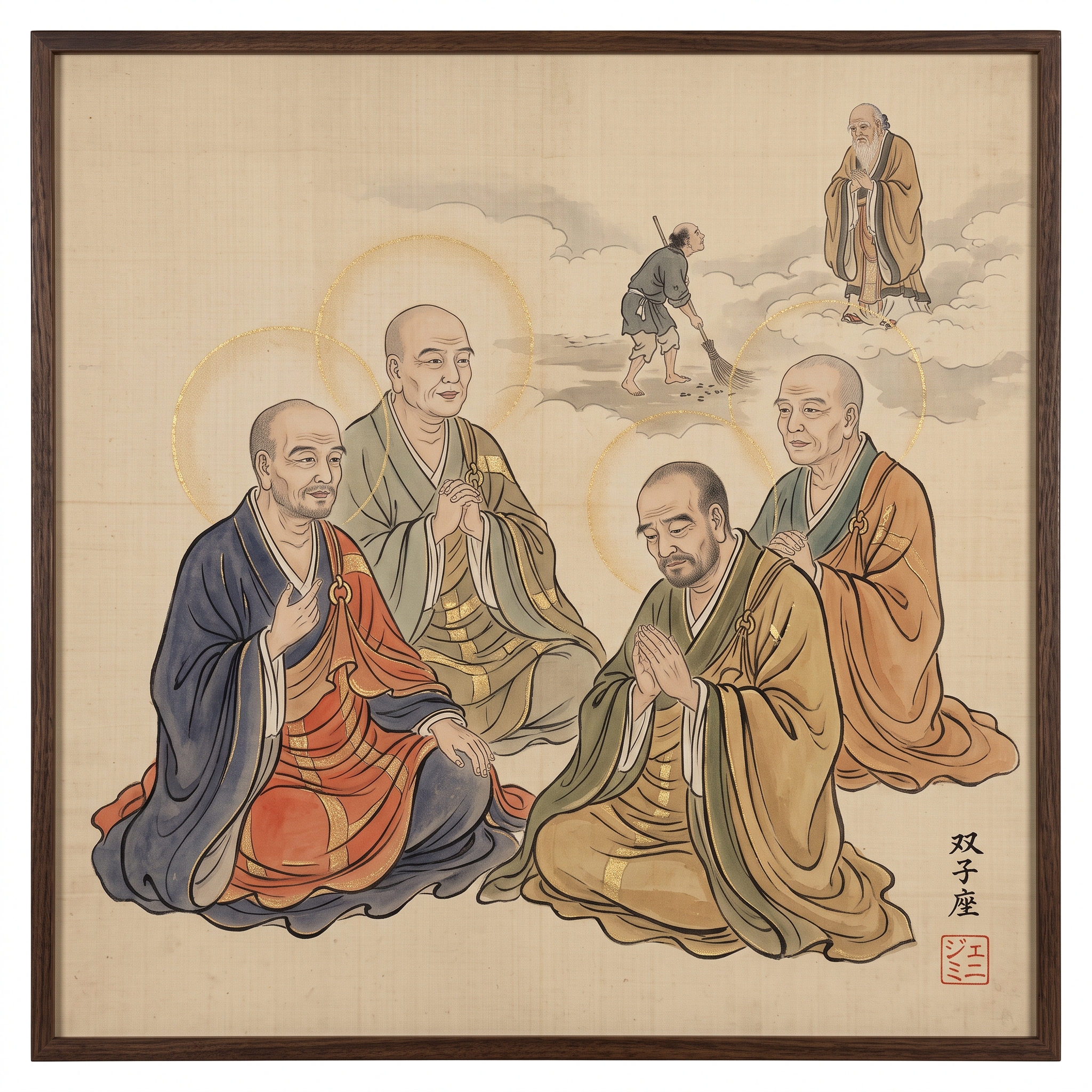
This 1:1 square composition, rendered in the traditional style of Japanese silk painting with inks and mineral pigments, visualizes the realization of four of Buddha's great disciples as recounted in Chapter Four of the Lotus Sutra. The primary subjects are the elders Subhuti, Maha-Katyayana, Maha-Kashyapa, and Maha-Maudgalyayana, grouped together in humble contemplation as they recite the verses detailing their previous contentment with mere arhatship—the elimination of personal suffering and illusions. While they appear satisfied, the central empty space at their feet, subtly outlined in gold leaf, signifies the deeper void yet to be realized, pointing towards the complete Buddhahood they are about to embrace. Their posture of satisfied inertia visually captures the text's core theme: 'we did nothing more' because we were satisfied. This visualizes their initial mistake—confusing the removal of defilements with total enlightenment—as discussed in the parable of the wealthy father's wayward son.
Iconography & Character Identification
Item 1: Deities/Figures Featured:
Subhūti (identified by a specific hand position, reflecting his association with voidness)
Mahā-Kātyāyana
Mahā-Kāśyapa
Mahā-Maudgalyāyana
Item 2: Text Translations:
The Kanji signature: 双子座 (Futagoza) - meaning "Gemini".
The Katakana text in the red seal: ジェミニ (Jemini) - meaning "Gemini".
We were satisfied with the elimination
Of illusions within ourselves.
What we accomplished was that elimination.
We did nothing more.
These verses are sung by Subhūti, Mahā-Kātyāyana, Mahā-Kāśyapa, and Mahā-Maudgalyāyana in Chapter Four of the Lotus Sūtra. They use the parable of the wayward son in this chapter to describe their own realization that the Buddha had not held any teaching back from them. Instead, the Buddha earlier allowed them to remain in the satisfaction of ending their own suffering. But before they can continue their progress towards the Buddha’s own enlightenment, they must give up their preoccupation with suffering, as the boy in the parable had to give up his idea of himself as a lowly hired worker, rather than the heir to his father’s treasure.
The Daily Dharma is produced by the Lexington Nichiren Buddhist Community. To subscribe to the daily emails, visit zenzaizenzai.com