
Conceptual Summary
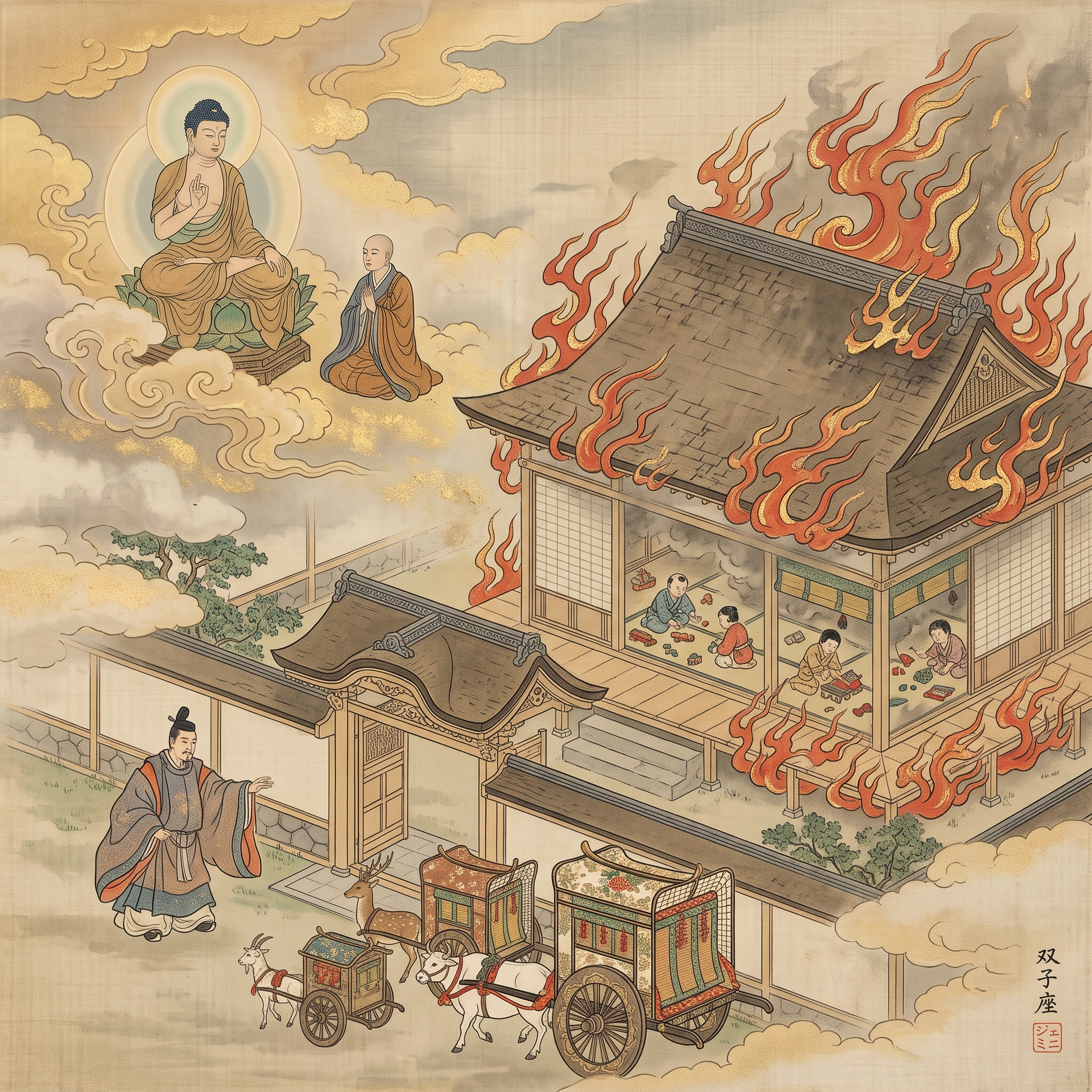
This classical Japanese silk painting illustrates the "Parable of the Burning House" (Kataku no Tatoe) from Chapter Three of the Lotus Sūtra, capturing the tension between worldly delusion and compassionate skillful means (upāya). On one side of the composition, stylized crimson and gold-leaf flames engulf an aging wooden estate—symbolizing the "triple world" consumed by the fires of birth, aging, sickness, and sorrow. Inside, children play joyfully with toys, oblivious to the encroaching peril and mirroring sentient beings absorbed in sensory desires. Outside the gate in a calm, mineral-pigmented courtyard stands the anxious yet benevolent father, gesturing toward three ornate animal-drawn carts (drawn by a goat, a deer, and a great white ox) that represent the liberating teachings of the Buddha. Above the narrative clouds, Śākyamuni Buddha imparts this wisdom directly to his disciple Śāriputra, inviting the viewer to transcend fleeting distractions for the awakening of a Bodhisattva.
Iconography & Character Identification
Item 1: Deities/Figures Featured:
Śākyamuni Buddha (Shaka Nyorai): Seated amidst golden clouds in the upper register, depicted in the traditional teaching mudra (vitarka / seppō-in), expounding the Lotus Sūtra.
Śāriputra (Sharihotsu): The venerable monastic disciple kneeling in reverence before Śākyamuni Buddha, receiving the teaching on skillful means.
The Nobleman Father (Chōja): Dressed in classical court robes outside the burning gates, representing the Buddha's compassionate guidance as he beckons the children to safety.
The Playing Children: Young figures inside the burning manor distracted by games and toys, representing sentient beings entranced by the five desires inside the triple world.
The Three Carts (Sansha): The goat-drawn cart, deer-drawn cart, and great white ox-drawn cart waiting in the courtyard, symbolizing the Three Vehicles (Śrāvaka, Pratyekabuddha, and Bodhisattva paths) and the ultimate One Buddha Vehicle (Ekayāna).
Item 2: Text Translations:
双子座 (Futagoza): "Gemini" (literally, the constellation of the Twins, rendered in Kanji).
ジェミニ (Jemini): "Gemini" (phonetic transliteration rendered in Katakana inside the red hanko seal).
I see that all living beings are burned by the fires of birth, old age, disease, death, grief, sorrow, suffering and lamentation. They undergo various sufferings because they have the five desires and the desire for gain…Notwithstanding all this, however, they are playing joyfully. They are not conscious of the sufferings. They are not frightened at the sufferings or afraid of them. They do not dislike them or try to get rid of them. They are running about this burning house of the triple world, and do not mind even when they undergo great sufferings.
The Buddha offers this explanation to his disciple Śāriputra in Chapter Three of the Lotus Sūtra. He compares his teaching of suffering and Nirvāṇa to a father luring his children from a dangerous house with a promise of better toys. The children were so preoccupied with their own entertainment that they could not hear their father’s warning. In this triple world of beautiful forms, fascinating ideas and consuming desires, it is easy to stay with our childish games and ignore the Buddha’s teaching. Our maturity as Bodhisattvas comes when we set these aside for the benefit of all beings.
The Daily Dharma is produced by the Lexington Nichiren Buddhist Community. To subscribe to the daily emails, visit zenzaizenzai.com