
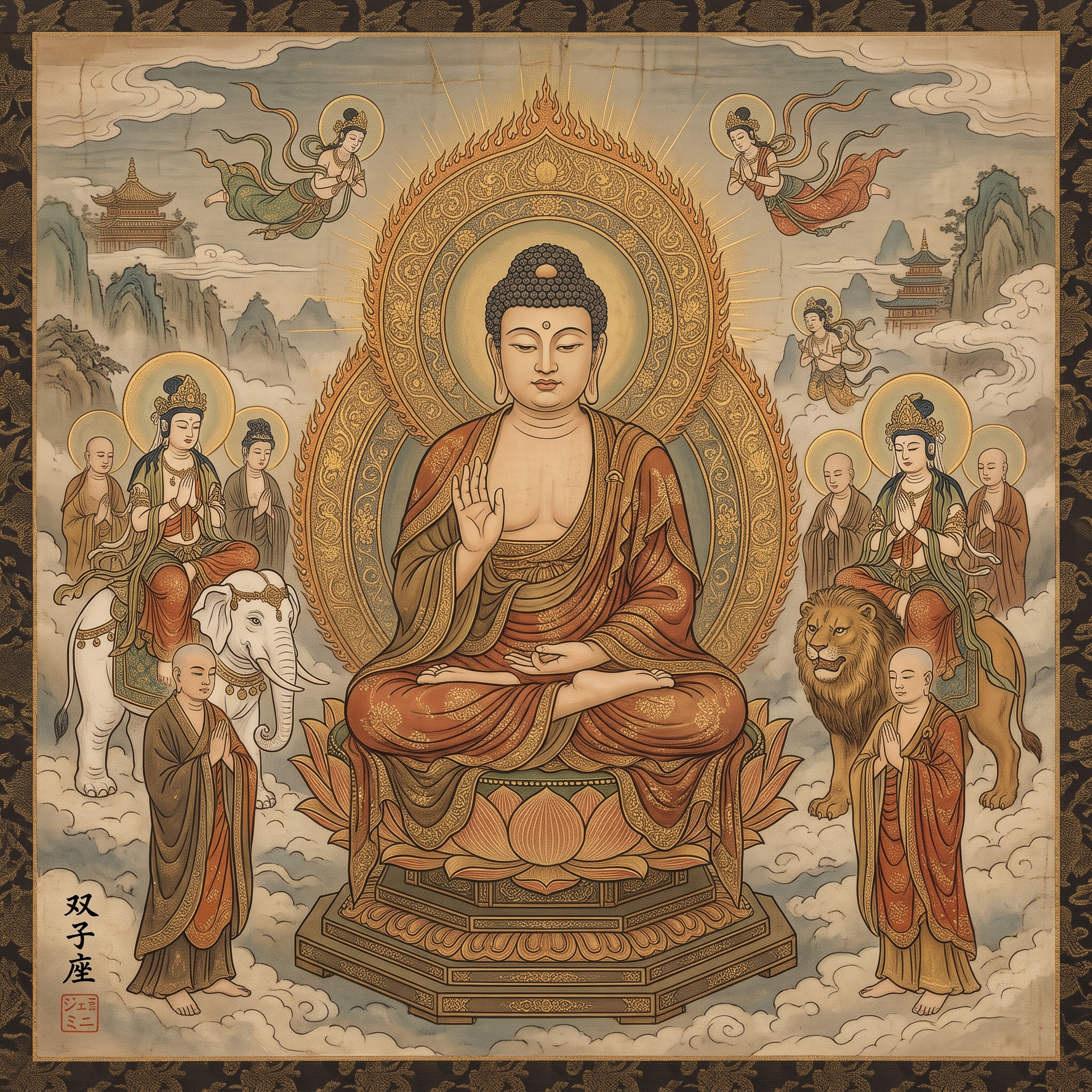
Conceptual Summary
This illustration interprets Chapter Sixteen of the Lotus Sūtra by visualizing the eternal, cosmic presence of Śākyamuni Buddha (Shaka Nyorai) as he reveals the true nature of the 'triple world' (the realms of desire, form, and formlessness). Positioned at the center on an ornate multi-tiered lotus throne, the Buddha is depicted in the act of preaching, with his hands in the Semui-in and Yogan-in mudras to represent fearlessness and the granting of wishes. The surrounding swirl of clouds, celestial beings, and ancient landscapes symbolizes the illusory 'triple world' where birth and death do not ultimately exist, contrasting the temporal human perception with his vast, unchanging insight. Accompanied by Bodhisattvas like Samantabhadra on a white elephant and Manjusri on a lion, as well as venerable disciples, the assembly on Vulture Peak highlights the transition from seeing him as a historical figure to the ever-present, cosmic guide. Fine gold leaf, aged silk textures, and mineral pigments convey the sacred, timeless quality of this revelation.
Iconography & Character Identification
Item 1: Deities/Figures Featured:
-
Śākyamuni Buddha (Shaka Nyorai): The central, eternal Buddha seated upon an elaborate multi-tiered lotus throne, utilizing the traditional gestures of fearlessness (Semui-in/Abhaya mudra) and wish-granting (Yogan-in/Varada mudra).
-
Bodhisattva Samantabhadra (Fugen Bosatsu): Seated on a multi-tusked white elephant (bottom left), representing the practice and meditation of the Buddha.
-
Bodhisattva Manjusri (Monju Bosatsu): Seated on a lion (bottom right), representing the transcendent wisdom of the Buddha.
-
Venerable Disciples: Key monastic followers (such as Mahākāśyapa and Ānanda) with shaved heads and halos, shown in reverent gasshō (prayer/pressed hands) in the foreground and midground.
-
Celestial Beings (Tennyo / Apsaras) & Devas: Divine figures hovering on swirling clouds in the upper section, representing heavenly listeners.
Item 2: Text Translations:
-
双子座 (Futago-za): Japanese Kanji for "Gemini" (the constellation), used as the hand-brushed artist's signature.
-
ジェミニ (Jemini): Japanese Katakana for "Gemini", enclosed in the red square hanko (seal) beneath the signature.
All that I say is true, not false, because I see the triple world as it is. I see that the triple world is the world in which the living beings have neither birth nor death, that is to say, do not appear or disappear, that it is the world in which I do not appear or from which I do not disappear, that it is not real or unreal, and that it is not as it seems or as it does not seem. I do not see the triple world in the same way as [the living beings of] the triple world do. I see all this clearly and infallibly.
The Buddha makes this revelation in Chapter Sixteen of the Lotus Sūtra. In the story, he has just explained that although beings see him as a man who became enlightened after growing up as a crown prince, in reality he has been enlightened since an unimaginable amount of time in the past, and will continue to lead all beings to enlightenment for twice that period of time into the future. As we learn to see the historical Śākyamuni Buddha as the ever-present Śākyamuni Buddha, our vision of the world changes too.
The Daily Dharma is produced by the Lexington Nichiren Buddhist Community. To subscribe to the daily emails, visit zenzaizenzai.com