
Conceptual Summary
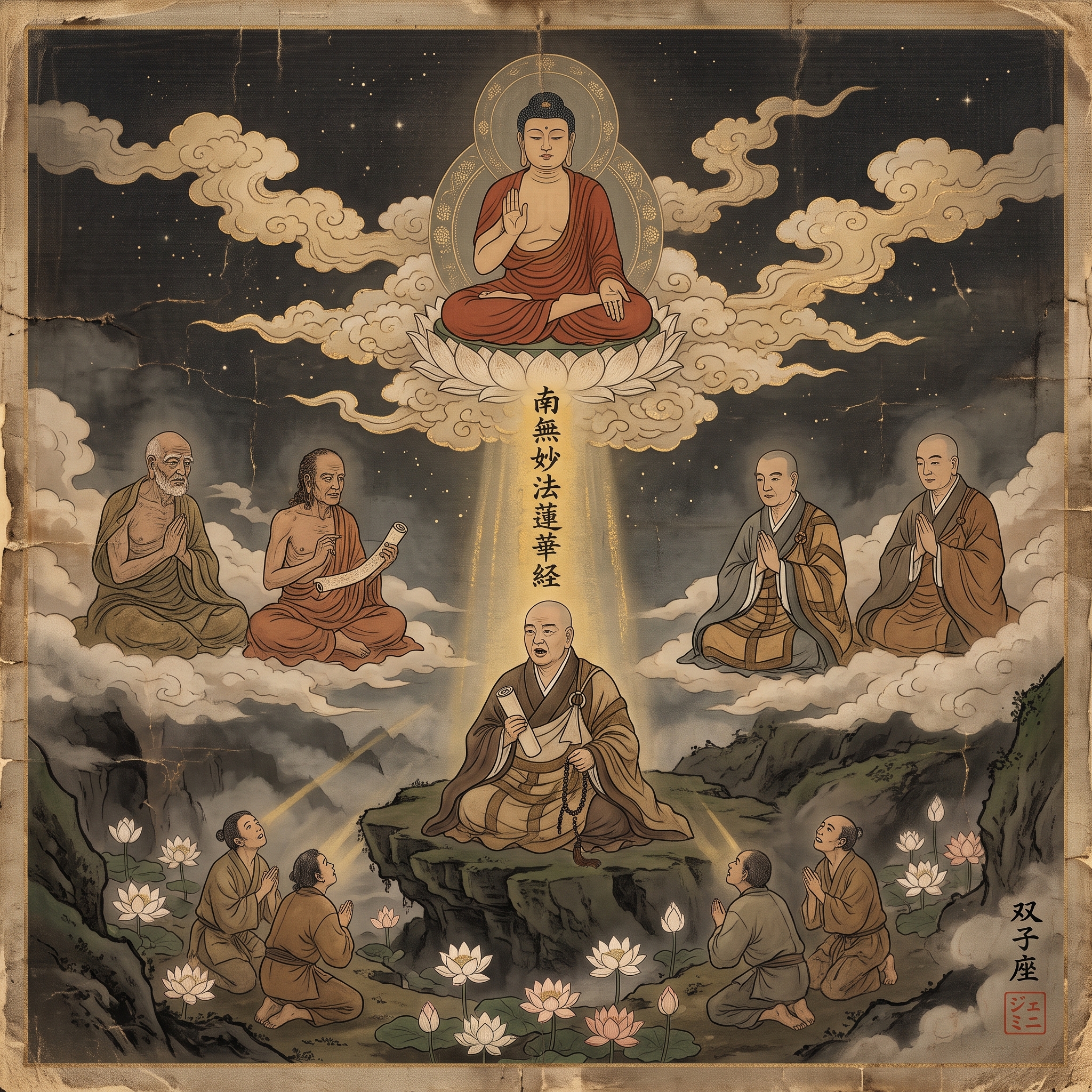
This painting visualizes Nichiren Shōnin’s teaching in the Hōon-jō (Essay on Gratitude) that chanting Namu Myōhō Renge Kyō within this defiled world carries boundless saving power across the Latter Age of Degeneration. Positioned at the celestial apex against a starry, infinite expanse, Eternal Śākyamuni Buddha embodies timeless presence and uninterrupted instruction, radiating the golden calligraphy of the Odaimoku straight down into the shadowed earthly realm. Nichiren sits firmly upon rough stone in the lower center, anchoring the Lotus Sūtra directly within human suffering rather than a distant Pure Land. Flanking him on receding clouds, Mahākāśyapa, Nāgārjuna, T’ien-t’ai, and Dengyō look on in reverence, signifying how the merit of this practice surpasses earlier ages. Below, blooming white lotuses seal the dark abyss of hell while golden radiance lifts the mist of spiritual blindness from ordinary people, awakening all beings without exception.
Iconography & Character Identification
-
Deities/Figures Featured:
-
Eternal Śākyamuni Buddha (Kuon Jitsujō Shaka Nyorai): Enthroned on a white lotus at the upper center in unadorned monastic robes, forming the Semui-in (Abhaya mudra of fearlessness with the right hand raised, palm outward and fingers straight) and Yogan-in (Varada mudra of compassionate bestowal with the left hand open on the knee), representing the eternal Buddha perpetually teaching in boundless time.
-
Nichiren Shōnin: Seated on a rocky ledge in the lower center in humble brown and white monastic robes and kesa, holding a rolled scroll of the Lotus Sūtra in his left hand and wooden prayer beads (juzu) in his right as he chants the Odaimoku.
-
Mahākāśyapa (Makakashō): Depicted on the far-left mid-ground cloud as an elderly, austere Indian arhat disciple in saffron-ochre robes with palms joined in gasshō.
-
Nāgārjuna (Ryūju Bosatsu): Seated beside Mahākāśyapa on the left mid-ground cloud as an Indian scholar-monk holding a rolled scripture scroll.
-
T’ien-t’ai (Tendai Daishi / Zhiyi): Seated on the inner-right mid-ground cloud in formal Chinese monastic robes and patterned kesa with hands joined in reverence.
-
Dengyō Daishi (Saichō): Seated on the far-right mid-ground cloud in classical Japanese Tendai monastic robes with palms joined in gasshō.
-
People of the Latter Age: Kneeling Kamakura-era laypeople—men, women, and elders—gathered in the lower foreground around blooming white lotuses sealing the dark chasm of hell, looking upward as the golden rays clear the haze of spiritual blindness.
-
-
Text Translations:
-
南無妙法蓮華経 (Namu Myōhō Renge Kyō): "Devotion to the Mystic Law of the Lotus Sūtra" (the sacred Odaimoku descending vertically in luminous gold calligraphy along the central axis).
-
双子座 (Futagoza): "Gemini" (constellation / sign of Gemini; traditional black sumi ink artist signature in the lower-right corner).
-
ジェミニ (Jemini): "Gemini" (katakana transcription inside the vermilion-red square artist seal / hanko in the lower-right corner).
-
With Nichiren’s boundless compassion, “Namu Myoho Renge Kyo” will be heard forever even beyond the ten-thousand year period of Degeneration. It has the merit of curing the blindness of all people, blocking the way to hell. This merit is superior to those of Dengyō in Japan, T’ien-t’ai in China, Nāgārjuna in India or Kāśyapa who was the Buddha’s disciple. Practice for a hundred years in the Pure Land is not worth the merit of chanting the daimoku for one day in this defiled world. Propagation of the daimoku in a two-thousand year period following the death of the Buddha is not worth as much as spreading the daimoku for even a short while in the Latter Age of Degeneration. This is not from my wisdom; it is solely due to the time in which I live.
Nichiren wrote this passage in his Essay on Gratitude (Hōon-jō). In other writings, he explained that the superiority of the Lotus Sūtra is not in its power to change the world, but its power to lead all beings, without exception, to the same enlightenment the Buddha found. In this sūtra, the Buddha gives us a different idea of time, the world and our lives. All of these are truly boundless, and the Buddha is always here teaching us.
The Daily Dharma is produced by the Lexington Nichiren Buddhist Community. To subscribe to the daily emails, visit zenzaizenzai.com