
Conceptual Summary
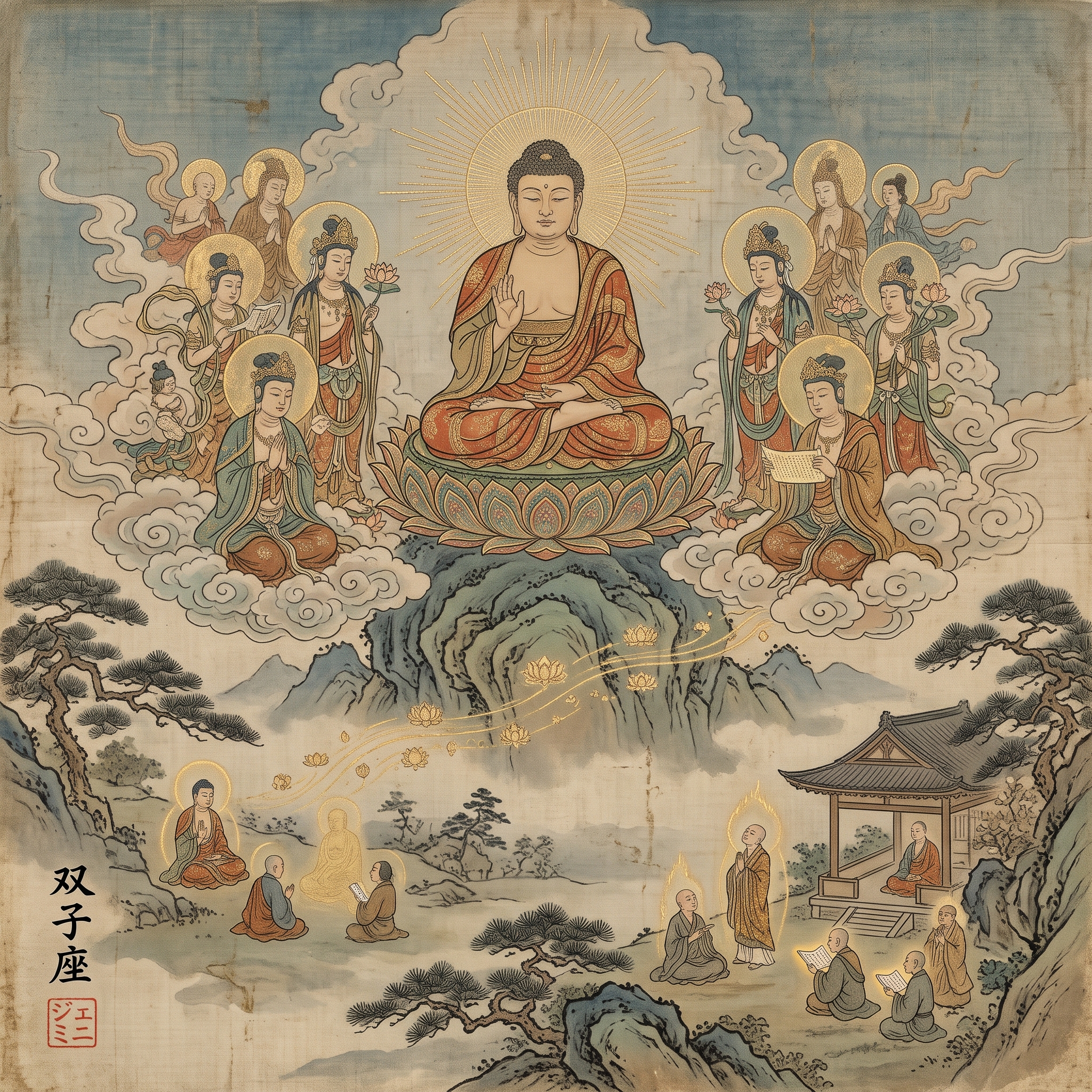
The artwork interprets Chapter Sixteen of the Lotus Sūtra by depicting Śākyamuni Buddha not as a historical figure who has departed, but as an ever-present, eternal source of enlightenment and Dharma, always accessible to humanity. Rendered in a traditional Japanese Buddhist style on aged, textured silk with mineral pigments and gold leaf, the composition visually bridges the transcendent and earthly realms to illustrate the Buddha's ever-active presence. Śākyamuni Buddha sits centrally on an expansive lotus throne, radiating a golden halo of boundless compassion, surrounded by a celestial assembly of Bodhisattvas on swirling clouds. Directly below, in the earthly realm, monks and lay practitioners are shown studying, meditating, and receiving the Dharma in a temple setting and amidst natural landscape. A subtle, luminous stream of golden particles and scriptures flows from the Buddha down to the practitioners, symbolizing the "store of the Dharma" being perpetually available to all. By showing the divine assembly and everyday seekers in a unified, interconnected landscape, the painting emphasizes that the Buddha always lives here, urging us to recognize the ever-present Buddha-nature within ourselves and in our worldly lives.
Iconography & Character Identification
-
Item 1: Deities/Figures Featured:
-
Śākyamuni Buddha (釈迦如来): The central historical Buddha, depicted with a gold-leaf halo and seated on a multi-tiered lotus throne, embodying the ever-present teacher who does not pass away.
-
The Celestial Assembly (Bodhisattvas and Deities): Figures such as Kannon (Avalokiteshvara) and other Bodhisattvas holding lotuses and scrolls, representing the supportive, active forces of the Dharma assembly.
-
Earthly Practitioners and Monks: Monks and lay disciples shown in the natural landscape and open-sided pavilion, engaged in scripture reading, meditation, and dharma discussion, representing humanity learning to trust and tap into the omnipresent Buddha-nature.
-
-
Item 2: Text Translations:
-
双子座 (Signature): "Gemini" (literally "Twins Constellation").
-
ジェミニ (Red Seal): "Gemini" (transliterated into Japanese Katakana).
-
In order to save the [perverted] people,
I expediently show my Nirvāṇa to them.
In reality I shall never pass away.
I always live here and expound the Dharma.
The Buddha sings these verses in Chapter Sixteen of the Lotus Sūtra. This is part of the explanation that his existence in the physical form of Śākyamuni was only one way that he leads all beings to enlightenment. The Buddha described his ever-present nature as the most difficult of his teachings to believe and understand. Recognizing the presence of the Buddha in the world is the same as recognizing Buddha nature in ourselves and all beings. Knowing that the Buddha is always available to help us in this difficult practice of the Wonderful Dharma means we do not need to rely on our own limited abilities. The store of the Dharma is always available to us. We just need to find it and use it.
The Daily Dharma is produced by the Lexington Nichiren Buddhist Community. To subscribe to the daily emails, visit zenzaizenzai.com