
Conceptual Summary
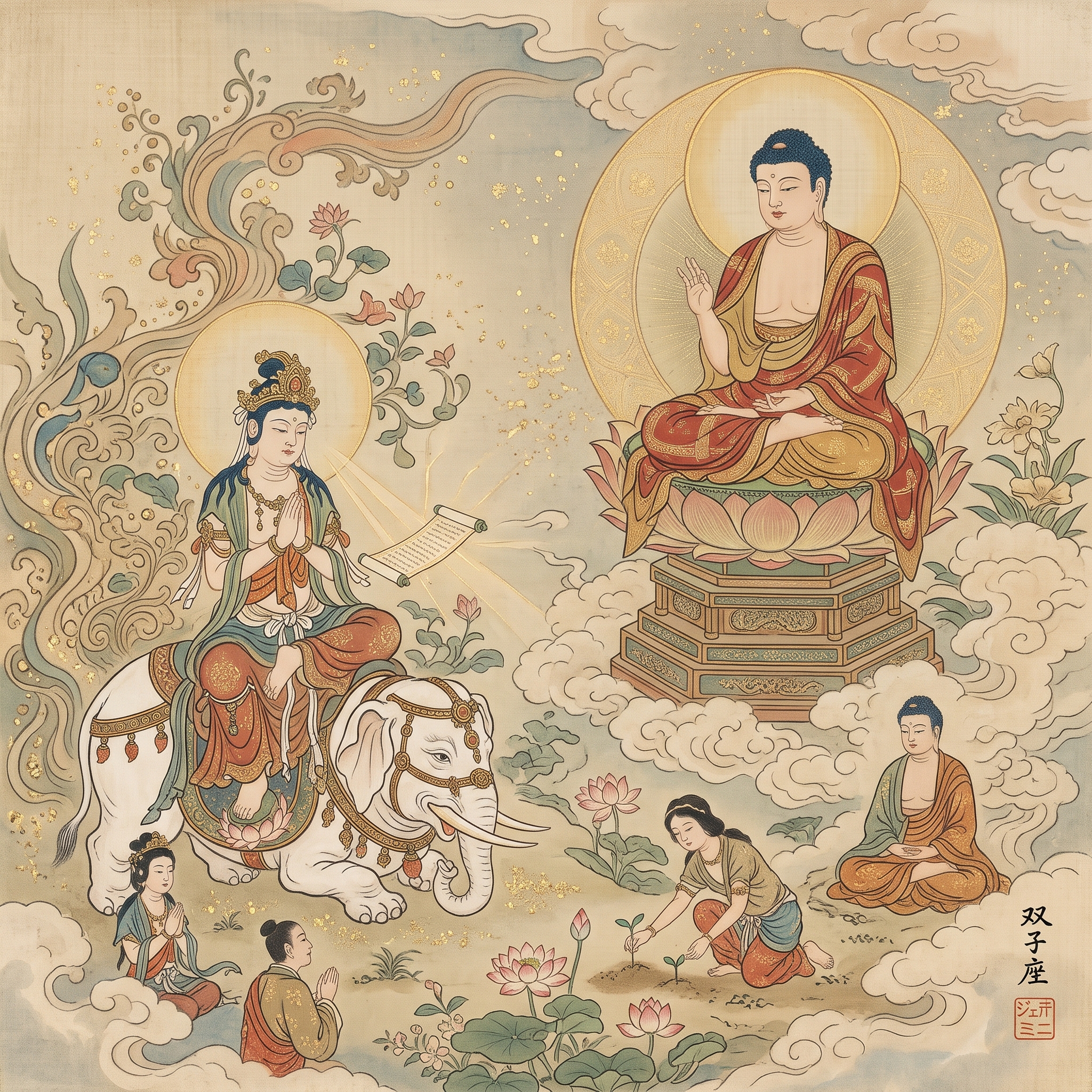
This classical Japanese silk-style illustration visually interprets Chapter Twenty-Eight of the Lotus Sūtra, wherein Śākyamuni Buddha instructs Universal-Sage Bodhisattva on the four prerequisites for obtaining and maintaining the Wonderful Dharma. In the upper right, Śākyamuni raises his right hand in the abhaya mudra to embody the first condition—securing the overarching protection of the Buddhas—while a radiant sūtra scroll floats between him and Universal-Sage Bodhisattva, who listens in prayerful reverence atop a caparisoned white elephant. Beneath this celestial exchange, human figures enact the remaining three practices amid blooming lotuses: a kneeling woman tends young green shoots in the soil to symbolize nourishing the roots of virtue, a composed practitioner meditates cross-legged to represent reaching the stage of steadiness, and a layman and laywoman kneel with palms pressed together, reflecting universal respect and the resolve to save all beings.
Iconography & Character Identification
Item 1: Deities/Figures Featured:
-
Śākyamuni Buddha (Shaka Nyorai): Seated on an elevated lotus pedestal in the upper right, framed by a double golden halo and wearing red-and-gold monastic robes, raising his right hand in the abhaya mudra (gesture of fearlessness and protection).
-
Universal-Sage Bodhisattva (Samantabhadra / Fugen Bosatsu): Seated on a lotus mount in the middle left, adorned with a jeweled crown and flowing celestial robes, pressing his palms together in añjali mudra before the illuminated scroll of the Lotus Sūtra.
-
Caparisoned White Elephant: Universal-Sage Bodhisattva’s traditional mount, depicted beneath him wearing ornate gold-and-red ceremonial trappings.
-
Kneeling Laywoman Tending Seedlings: Located in the lower center-right beside pink lotus blossoms, planting and tending small green shoots in the earth to represent cultivating the roots of virtue.
-
Meditating Practitioner: Seated cross-legged in serene contemplation in the lower right, wearing ochre and muted green robes to represent steadfastness on the path to enlightenment.
-
Two Kneeling Lay Devotees ("Good Men and Women"): A woman and a man kneeling in the lower left with hands joined in añjali mudra, gazing upward in devotion.
Item 2: Text Translations:
-
Kanji Signature (
双子座): Written vertically in black ink in the lower right corner; translates literally to "Gemini" (the constellation/zodiac sign Futagoza, literally "Twins Seat"). -
Red Square Seal / Hanko (
ジェミニ): Stamped in red ink directly beneath the signature (accompanied by a small decorative seal-script filler stroke in the upper-right quadrant); transliterates phonetically from Katakana (Jemini) as "Gemini." -
Illuminated Sūtra Scroll: Contains stylized, non-lexical brushwork lines suggesting classical scripture rather than literal readable characters.
The Buddha said to Universal-Sage Bodhisattva: “The good men or women will be able to obtain this Sūtra of the Lotus Flower of the Wonderful Dharma after my extinction if they do the following four things: (1) secure the protection of the Buddhas, (2) plant the roots of virtue, (3) reach the stage of steadiness [in proceeding to enlightenment], and (4) resolve to save all living beings. The good men or women will be able to obtain this sūtra after my extinction if they do these four things.”
For us who aspire to this difficult practice of the Wonderful Dharma, the Buddha gives this guide in Chapter Twenty-Eight of the Lotus Sūtra. For us to have even heard of this sūtra in this life we must have already done these four things. In order to maintain this practice, we need to use the Buddha’s protection for the benefit of all beings, not just for our benefit alone. We need to nourish the virtuous seeds we have already planted, remain steady and confident on the path to enlightenment, and sustain our determination to maintain our respect for everyone.
The Daily Dharma is produced by the Lexington Nichiren Buddhist Community. To subscribe to the daily emails, visit zenzaizenzai.com