
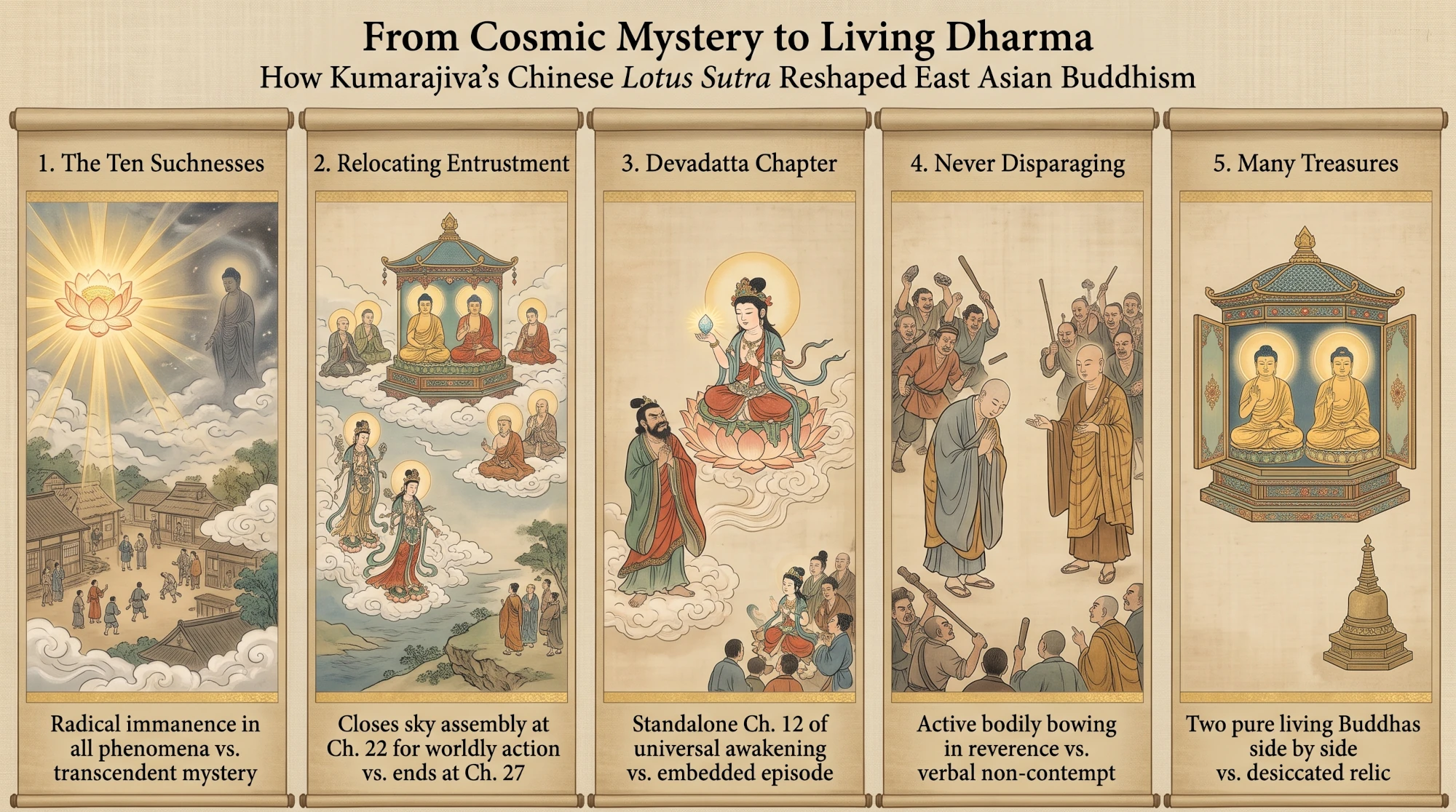
A comparative look at Jan Hendrik Kern’s Sanskrit translation and Kumārajīva’s Chinese recension reveals how five pivotal textual divergences transformed an Indian liturgical scripture into the metaphysical engine of East Asian Buddhism.

When the Kuchean translator-monk Kumārajīva (334–413 CE) completed the Miaofa lianhua jing (The Sutra of the Lotus Flower of the Wonderful Dharma, T262) in Chang’an in 406 CE, his translation bureau avoided mechanical word-for-word literalism in favor of lively doctrinal debate and literary clarity. Nearly fifteen centuries later, in 1884, the Dutch orientalist Jan Hendrik Kern (1833–1917) published The Saddharmapuṇḍarīka, or The Lotus of the True Law, the first complete English translation rendered directly from Sanskrit manuscripts—primarily Nepalese copies dating from the eleventh century or later. Because the early Sanskrit manuscripts used by Chinese translators have long since vanished to history, a straight comparison of original manuscripts is impossible. However, when modern readers compare Kern’s Sanskrit-based edition with Kumārajīva’s Chinese recension they encounter two remarkably distinct scriptures. Virtually the entire commentarial and devotional edifice of East Asian Buddhism—along with most modern Western translations—rests upon Kumārajīva’s text rather than the surviving Sanskrit. Placed side by side, five major variations between Kumārajīva’s Chinese and Kern’s Sanskrit demonstrate that these differences are far more than philological curiosities: they fundamentally redirected the philosophical, cosmological, and practical trajectory of Mahāyāna Buddhism across China, Korea, and Japan.
The Ten Suchnesses: From Unfathomable Transcendence to Radical Immanence
Nowhere is the philosophical divide between the two recensions more consequential than in Chapter 2, “Skillful Means” (Fangbian pin). In the standard Kern-Nanjio Sanskrit edition, Śākyamuni praises the profundity of awakened wisdom through a sequence of five relative-interrogative clauses repeated in two parallel groups (ye ca te dharmāḥ, yathā ca, yādṛśāś ca, yal-lakṣaṇāś ca, yat-svabhāvāś ca), asking what phenomena (dharmāḥ) are, how they are, what they are like, what their characteristics are, and what their nature is, while insisting that only a Tathāgata can fathom them. The rhetorical thrust of the Sanskrit is apophatic and transcendent: it underscores the epistemic gulf separating ordinary sentient perception from the omniscience of a Buddha regarding ultimate reality (dharmatā).
Kumārajīva’s recension, by contrast, crystallizes those fluid Sanskrit questions into a kataphatic, tenfold ontological taxonomy known as the “Ten Suchnesses” (Chinese: 十如是, shí rúshì; Japanese: jūnyoze): appearance, nature, entity, power, activity, cause, condition, result, retribution, and their ultimate consistency from beginning to end. Strikingly, this tenfold list is absent from Dharmarakṣa’s earlier 286 CE Chinese translation (Zheng fahua jing, T263), the classical Tibetan translation, and every extant Sanskrit manuscript recovered from Nepal, Gilgit, and Central Asia. Contemporary scholars have proposed several non-mutually exclusive explanations for this anomaly: Jean-Noël Robert’s “triangular” hypothesis that Kumārajīva expanded Dharmarakṣa’s sixfold Chinese rendering to match the tenfold syntax of the Sanskrit; Paul Groner and Jacqueline Stone’s argument that Kumārajīva acted as a “master editor” prioritizing ultimate meaning (siddhānta), importing a ninefold analytical list from the Dazhidulun—which his workshop was translating concurrently—and appending a tenth summarizing clause; and the sixth-century testimony of Jñānagupta and Dharmagupta (in the preface to T0264) that Kumārajīva worked from a distinct Central Asian Sanskrit manuscript from his homeland of Kucha on the Northern Silk Road.
Whatever its precise manuscript or workshop genesis, Kumārajīva’s rendering pivoted the passage from transcendence to radical immanence. Ultimate reality was no longer an inscrutable mystery locked within a Buddha’s mind, but an intelligible architecture actively present within every phenomenon. For the Tiantai master Zhiyi, the Ten Suchnesses became the indispensable scriptural engine for the doctrine of “Three Thousand Realms in a Single Thought-Moment” (ichinen sanzen). Reading each of the ten factors through the lens of the Threefold Truth—emptiness, provisional existence, and the middle—East Asian thinkers demonstrated that Buddhahood permeates every instant of mundane consciousness. Centuries later, Nichiren Buddhism carried this immanence directly into vocal practice, teaching that the Ten Suchnesses are dynamically embodied and activated in the very breath of chanting the daimoku, Namu-myōhō-renge-kyō.
Relocating the “Entrustment”: Staging the Cosmic and Worldly Realms
Macro-structural choices in chapter sequence proved equally formative for East Asian hermeneutics. In the surviving Sanskrit manuscripts and Kern’s translation, the “Entrustment” (Anuparīndanā) chapter stands at the conclusion of the entire work as Chapter 27, serving as a final benediction and dismissal. In Kumārajīva’s recension, however, “Entrustment” is positioned at Chapter 22, immediately following “Supernatural Powers of the Thus Come One.”
That placement gives the Lotus Sutra a dramatic and liturgical symmetry absent from the Sanskrit arrangement. Positioning “Entrustment” at Chapter 22 formally closes the magnificent “Assembly in the Air” (kūchū-e), the suspended cosmic gathering in which Śākyamuni and Many Treasures Buddha sit side by side within the floating jeweled stūpa. At this liturgical climax, Śākyamuni strokes the heads of the assembled bodhisattvas to entrust them with the sutra and returns the innumerable emanation Buddhas to their home universes.
Because the ceremony in the sky concludes at Chapter 22, the remaining six chapters (Chapters 23–28)—spotlighting figures of fierce devotion and boundless compassion such as Medicine King, Avalokiteśvara, and Samantabhadra—do not read as loose appendices tacked onto a finished scripture. Instead, they unfold on earthly ground as the active, worldly implementation of the One Vehicle. Within Tiantai and Tendai exegesis, this structural hinge anchors the classic division of the scripture into the “Trace Teaching” (shakumon, Chapters 1–14) and the “Origin Teaching” (honmon, Chapters 15–22), followed by a dedicated commission sending bodhisattvas back into a turbulent, defiled world to enact what was revealed in cosmic space.
The Independence of the Devadatta Chapter: Centering the Marginalized
A comparable shift in structural emphasis occurs in the middle of the scripture. In Kern’s Sanskrit text and the Tibetan recension, the twin narratives of the schismatic monk Devadatta and the eight-year-old daughter of the Dragon King (Nāgakanyā) appear as an embedded episode inside Chapter 11, “Apparition of the Stūpa.” Although Dharmarakṣa’s 286 CE Chinese translation included the Devadatta passage, Kumārajīva’s original twenty-seven-chapter translation of 406 CE lacked it. Translated separately in the early fifth century and integrated into Kumārajīva’s text during the sixth century as a standalone Chapter 12, the Devadatta chapter gave the popular East Asian Lotus Sutra its twenty-eight-chapter form.
Setting these accounts apart as an independent chapter elevated two socially and soteriologically radical teachings from supporting episodes within the stūpa narrative into headline doctrines of universal liberation. First, Śākyamuni’s prophecy that Devadatta—the archetype of spiritual malice and schism—will awaken in a future age as the Buddha Devarāja provided East Asian Buddhism with decisive scriptural proof for the salvation of the icchantika: even beings guilty of the gravest offenses possess innate Buddha-nature and remain destined for enlightenment. Second, the Dragon Girl’s instantaneous attainment of Buddhahood before the assembly became the foundational locus classicus for sokushin jōbutsu—”attaining enlightenment in this very body.” Whereas earlier scholastic traditions insisted that women and non-human beings faced eons of rebirth and prior transformation before awakening, her immediate realization became a rallying cry across China and Japan for the unobstructed spiritual capacity of women and marginalized beings.
Bodhisattva Never Disparaging: Turning Non-Contempt into Bodily Liturgy
Divergences between the Sanskrit and Chinese texts also reshaped the everyday physical comportment of Buddhist practitioners, most visibly in the story of Bodhisattva Never Disparaging (Sadāparibhūta). In the Sanskrit recension, this monk neither expounds nor recites the scriptures, instead approaching monastics and laypeople with a strictly negative verbal formula: “I do not contemn you, worthies. You deserve no contempt, for you all observe the course of duty of Bodhisattvas.” Nowhere in the Sanskrit account does he bow.
Adapting the passage to Chinese rhetorical and ritual sensibilities, Kumārajīva recasts this restraint into an ardent, affirmative confession—”I have profound reverence for you; I would never dare disparage you, for you will all practice the bodhisattva path and become Buddhas” (我不輕汝等,汝等皆當作佛)—and explicitly states that the bodhisattva “bowed in obeisance” to every person he met. That single addition transformed an inward mental posture of non-contempt into a somatic praxis of Buddha-nature, turning the human body itself into an instrument of veneration. Even more consequentially, Never Disparaging’s persistence in bowing to detractors who pelted him with stones and staves gave rise to the East Asian doctrine of the “reverse relationship” (gyaku-en), which holds that honoring the latent Buddhahood of one’s persecutors establishes an unbreakable karmic bond (kechien) toward their eventual awakening. Both Nichiren’s theology of compassionate propagation amid hostility and the street-level ethics of twentieth-century Japanese lay movements—including Reiyūkai and Risshō Kōsei-kai—draw their lifeblood directly from Kumārajīva’s bowing bodhisattva.
The Body of Many Treasures: From Desiccated Relic to Living Non-Duality
A final, haunting contrast emerges at the opening of the seven-jeweled stūpa when Śākyamuni reveals the ancient Buddha Many Treasures (Prabhūtaratna) seated within. Extant Sanskrit and Tibetan manuscripts describe Prabhūtaratna’s form as pariśuṣka—emaciated, desiccated, and withered like a mummified ascetic. Within an Indian cultural horizon, this imagery resonated naturally with the funerary cult of the stūpa as a reliquary housing bodily remains (śarīra), rendering the miraculous voice issuing from a dried corpse a dramatic vindication of relic worship.
Kumārajīva’s lineage, however, reflects a reading corresponding to pariśuddha—”perfectly pure,” whole, and undiminished—depicting Many Treasures seated serenely as though absorbed in meditation. Freed from funerary associations, the spectacle of two radiant, living Buddhas sharing a single lion throne inside the stūpa became one of East Asian Buddhist art and philosophy’s supreme icons. Commentators read this dual presence as the visual embodiment of the non-duality of Ri (Principle—timeless, unchanging truth personified by Many Treasures) and Chi (Wisdom—dynamic, historical engagement personified by Śākyamuni). Truth in the Miaofa lianhua jing is never an entombed relic of the past; it sits alive and whole beside present awakening.
 Learn More About This Topic
Taken together, these five textual divergences illuminate why the Lotus Sutra known to Indologists through Kern’s Sanskrit edition feels so markedly different in texture from the scripture chanted daily in temples across East Asia. Kern’s Sanskrit preserves a fluid, liturgical Indian Mahāyāna vision steeped in cosmic spectacle, transcendent omniscience, and the veneration of relics. Kumārajīva’s Chinese recension—and the textual lineage that coalesced around it—forged something altogether distinct: an actionable, immanent metaphysics of universal salvation. By grounding ultimate reality in ten concrete factors of everyday existence, structuring the cosmos to culminate in bodhisattva return, spotlighting the enlightenment of the outcast and the Dragon Girl, bowing physically before every sentient being, and seating living Principle beside living Wisdom, Kumārajīva bequeathed to East Asian Buddhism the exact vocabulary needed to proclaim that the One Buddha Vehicle is already pulsing within the ordinary world.