
I use Google’s AI tools a lot. They allow me to do things I could never do before. The best example of this here are the illustrations I add to the Daily Dharma. But even as Google’s AI tools have evolved and become more capable, they still need to be supervised.
The November 17 illustration is the most recent example of why.
Here’s the text I asked Gemini to illustrate:
A man of shallow faith pretends to have right faith and is contemptuous towards other followers, so as to harm the faith of others. Leave such people alone. By the intention of the King of the Brahma Heaven, Indra and other deities, I believe that such a time will certainly come when all the people of Japan will simultaneously believe in the Lotus Sutra. I am sure that many people will then say, “I have believed in this sutra all along.”
Nichiren wrote this passage in a Reply to Lord Ueno (Ueno-dono Gohenji). In Nichiren’s life, he tolerated the contempt of many who refused his call to set aside expedient teachings and take up the Wonderful Dharma of the Lotus Sūtra. Despite repeated attempts to reach these people, and after enduring his home being burned down, attacks with swords, a mock execution and numerous exiles, he retired to a hermitage on Mt. Minobu to spend the last days of his life. As the Buddha showed no contempt towards his cousin Devadatta, Nichiren showed no contempt towards his persecutors. When we find others who despise us for our practice, we have the example of these two men. They both took the long view towards enlightenment, and did not let themselves be wounded by the follies of human nature.
Gemini is instructed each day to re-create classical Japanese Buddhist iconography simulating traditional inks, mineral pigments, soft colors, and subtle gold leaf on silk.
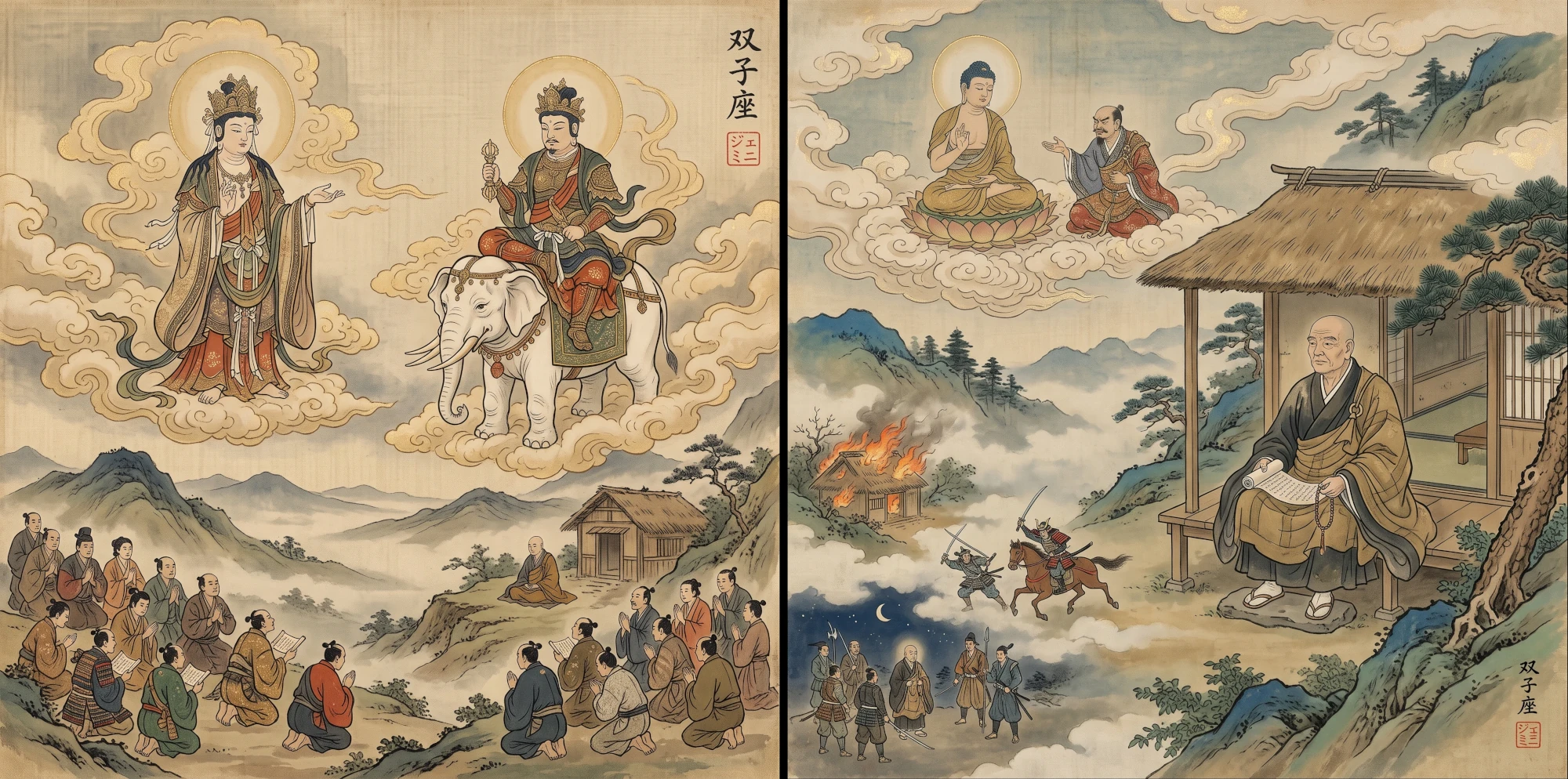
The image above on the left was Gemini’s first effort to visualize the lesson of Nichiren’s letter. This was Gemini’s thinking:
The artwork visualizes Nichiren’s profound prophetic message from his “Reply to Lord Ueno,” portraying the spiritual alignment between the divine will of guardian deities and the ultimate conversion of the Japanese populace. Set in a classical Kamakura-period Buddhist scroll aesthetic, the composition divides the celestial and earthly realms to bridge high metaphysical protection with worldly devotion. High in the clouds, the deities Bonten (the King of the Brahma Heaven) and Taishakuten (Indra on his white elephant) look down with benevolent resolve, signaling their spiritual backing as mentioned in the text. In the earthly landscape below, Japanese citizens—from nobles and samurai to peasants—converge to devoutly embrace the Lotus Sutra, reflecting the predicted time of widespread faith. Seated peacefully by a humble hermitage on the mountainous slopes, Nichiren watches this vision unfold, embodying endurance and the long-term pursuit of enlightenment despite historical persecution. The soft pigments, fine ink, and subtle gold leaf reinforce the sacred, archival quality of this prophecy.
I balked at using Gemini’s offering. To begin with: What’s with the three tusks on Indra’s elephant? I have had a lot of experience with Gemini’s inability to draw elephants. Universal Sage’s Six-Tusked White Elephant comes up often in the Daily Dharma and I’ve given up trying to force Gemini to get the number of tusks right. Instead, whenever a Gemini illustration includes Universal Sage’s Six-Tusked White Elephant I just link to What Google Gemini Just Can’t Do.
But beyond the elephant, I felt Gemini had missed the main point of the Daily Dharma’s lesson.
I told Gemini to try again and focus this time on the second paragraph:
In Nichiren’s life, he tolerated the contempt of many who refused his call to set aside expedient teachings and take up the Wonderful Dharma of the Lotus Sūtra. Despite repeated attempts to reach these people, and after enduring his home being burned down, attacks with swords, a mock execution and numerous exiles, he retired to a hermitage on Mt. Minobu to spend the last days of his life. As the Buddha showed no contempt towards his cousin Devadatta, Nichiren showed no contempt towards his persecutors. When we find others who despise us for our practice, we have the example of these two men. They both took the long view towards enlightenment, and did not let themselves be wounded by the follies of human nature.
The image above on the right was the result. Gemini’s thinking matched what I wanted:
The illustration translates the resilience and enduring patience of Nichiren Shōnin into a cohesive narrative through traditional Japanese Buddhist iconography on silk. Positioned calmly at his hermitage on Mount Minobu, Nichiren represents the “long view towards enlightenment,” completely undisturbed by the arduous events shown around him. The vignettes floating within the mist in the lower-left corner depict his severe persecutions—the burning of his home, attacks by armed men, and the night of his mock execution—capturing the physical toll of his lifelong mission. In the celestial realm above, a haloed Shakyamuni Buddha peacefully addresses his contentious cousin Devadatta, providing a divine model for the “no contempt” approach Nichiren adopted. Rich ink tones, natural mineral pigments, and subtle gold leaf accent this timeless spiritual triumph, portraying Nichiren’s isolation not as a defeat, but as a peaceful culmination of tolerance, steadfastness, and ultimate devotion to the Lotus Sutra.
This is a good example of my role as I employ Google’s AI tools. In creating content for this website, I am the editor and publisher. Gemini’s tools are my employees. I’ve explained this before in The Publisher, The Editor and the Writer.
But I also enjoy Google’s AI tools for their educational value.
Later in the day after publishing the November 17 Daily Dharma, I went back to Gemini and asked it to describe Indra and his white elephant. Gemini’s response:
Indra, the king of the devas (celestial gods) and ruler of Svarga (heaven) in Hindu, Buddhist, and Jain traditions, rides Airavata, a colossal white elephant who commands the clouds. Together, rider and mount personify royal sovereignty and the life-giving fury of the monsoon storm.
Indra: King of Heaven and Lord of Storms
- Mythic Role: Celebrated in the Rigveda as the supreme sky warrior who slew the drought-serpent Vritra to free the world’s waters, he later evolved into heaven’s regal—and occasionally proud—monarch, and appears in Buddhism as Śakra.
- Appearance: Usually depicted as golden-skinned and dressed in dazzling royal armor and a tall crown, he also bears the epithet Sahasraksha (“thousand-eyed”), marking his all-seeing watch over the cosmos.
- Divine Weapons: His signature weapon is the vajra (a thunderbolt forged from the bones of the sage Dadhichi), alongside Indradhanush (the rainbow bow), a net of illusions, and an elephant goad (ankusha).
Airavata: Elephant of the Clouds
- Cosmic Origin: Emerging from the Samudra Manthan (the churning of the cosmic Ocean of Milk), Airavata was claimed by Indra as his royal vahana (mount), king of all elephants, and guardian of the eastern sky.
- Distinctive Form: Gleaming white like sunlit cumulus clouds or snow, he is classically portrayed in Indian art with four tusks and seven trunks, while Southeast Asian traditions revere him as Erawan, a towering three-headed (or thirty-three-headed) elephant.
- Maker of Rain: Derived from ira (“water”), his name reflects his meteorological role: Airavata reaches his trunks into the watery underworld, draws up moisture, and sprays it across the sky as rainclouds for Indra’s lightning to break open.
In temple reliefs from Ellora to Angkor Wat, the pair represents the union of celestial kingship and nature’s fertility—Airavata gathering the raw abundance of the waters while Indra directs their power to nourish the earth.
I asked Gemini to create an illustration of Indra on his white elephant and received this in response:
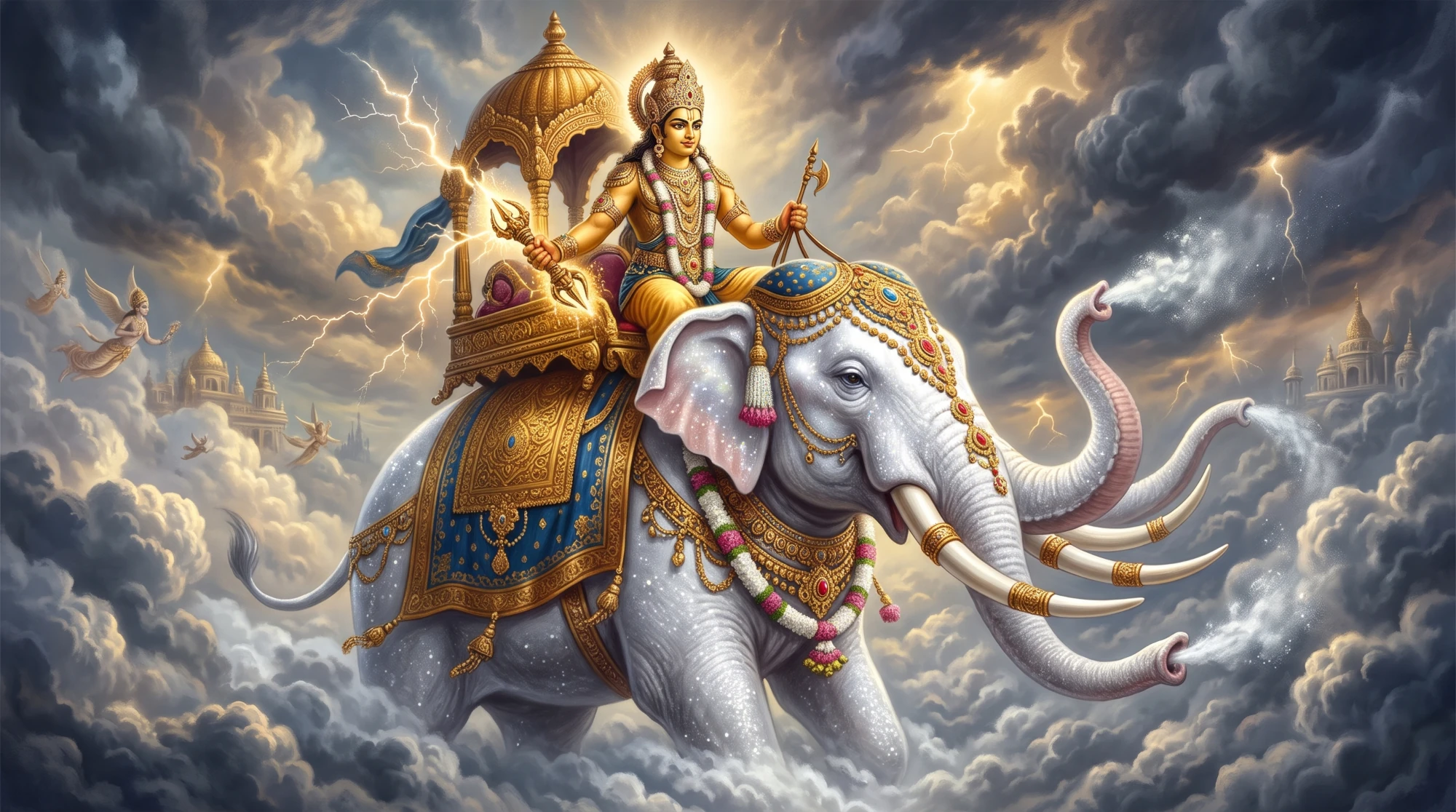
This was interesting. We still had three tusks, as before, but now we also had three trunks.
I asked Gemini how many tusks Indra’s elephant has, and learned that Indra’s white elephant, Airavata, is described in Hindu scriptures as having four tusks and seven trunks.
So we got three tusks and three trunks instead of four tusks and seven trunks. In Gemini’s defense, it pointed out that the number of tusks varies depending on the text referenced and the regional tradition. It can have four, six or ten tusks.
The three trunks, however, are apparently common in Buddhist, Jain, and Southeast Asian traditions, where Airavata is shown with three heads, which gives you three trunks and six tusks.
I asked Gemini to illustrate Indra on his white elephant as imagined by a Buddhist artist in Medieval Japan. Here’s the response:
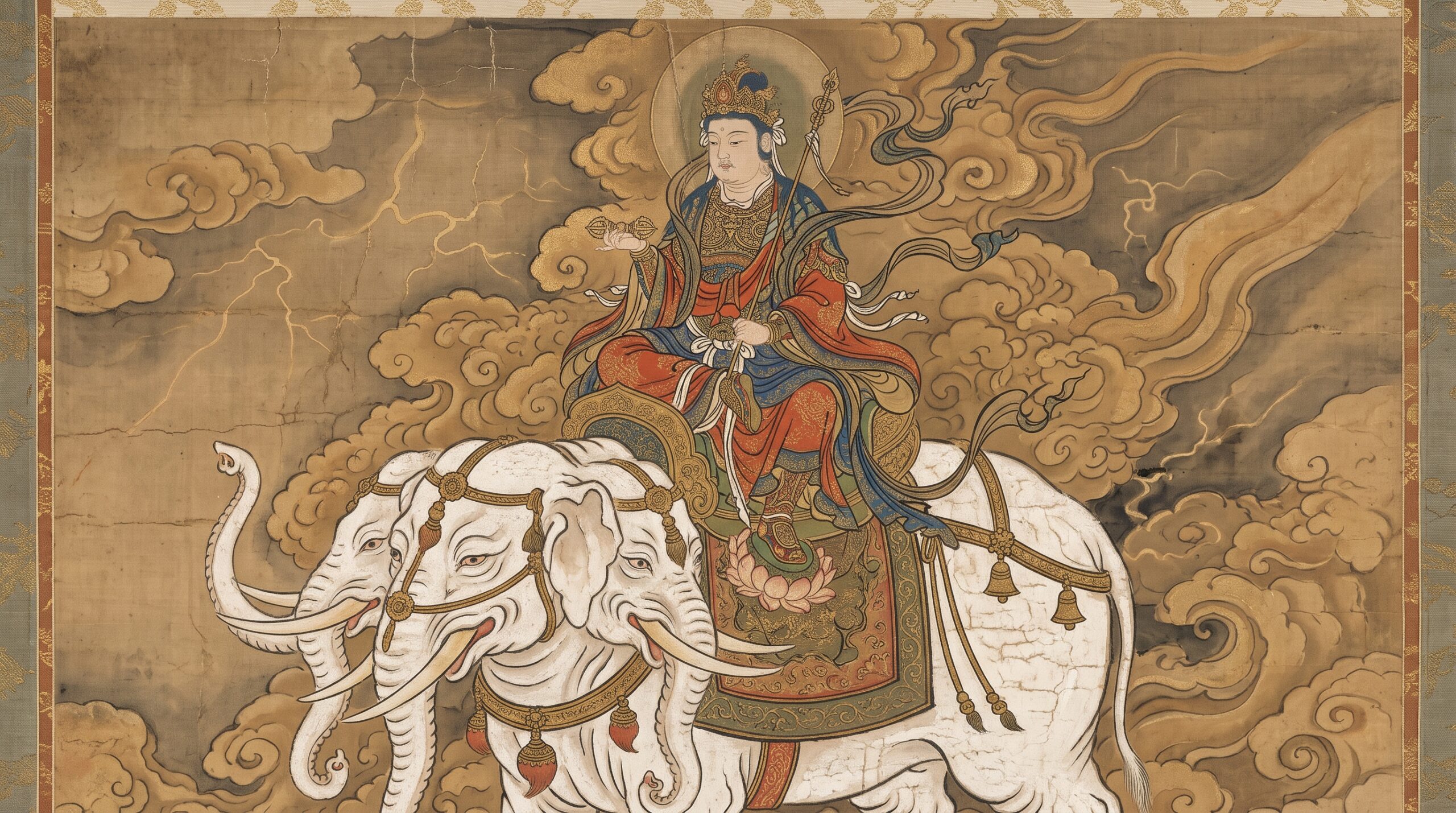
An excellent representation of Indra’s three-headed elephant. Now, if I could just get Gemini to show six tusks on Universal Sage’s elephant.