
Category Archives: AI Contribution

Daily Dharma for July 27, 2026

20260727-ddi

Illustration by Google Gemini

Show Gemini's thinking

Conceptual Summary
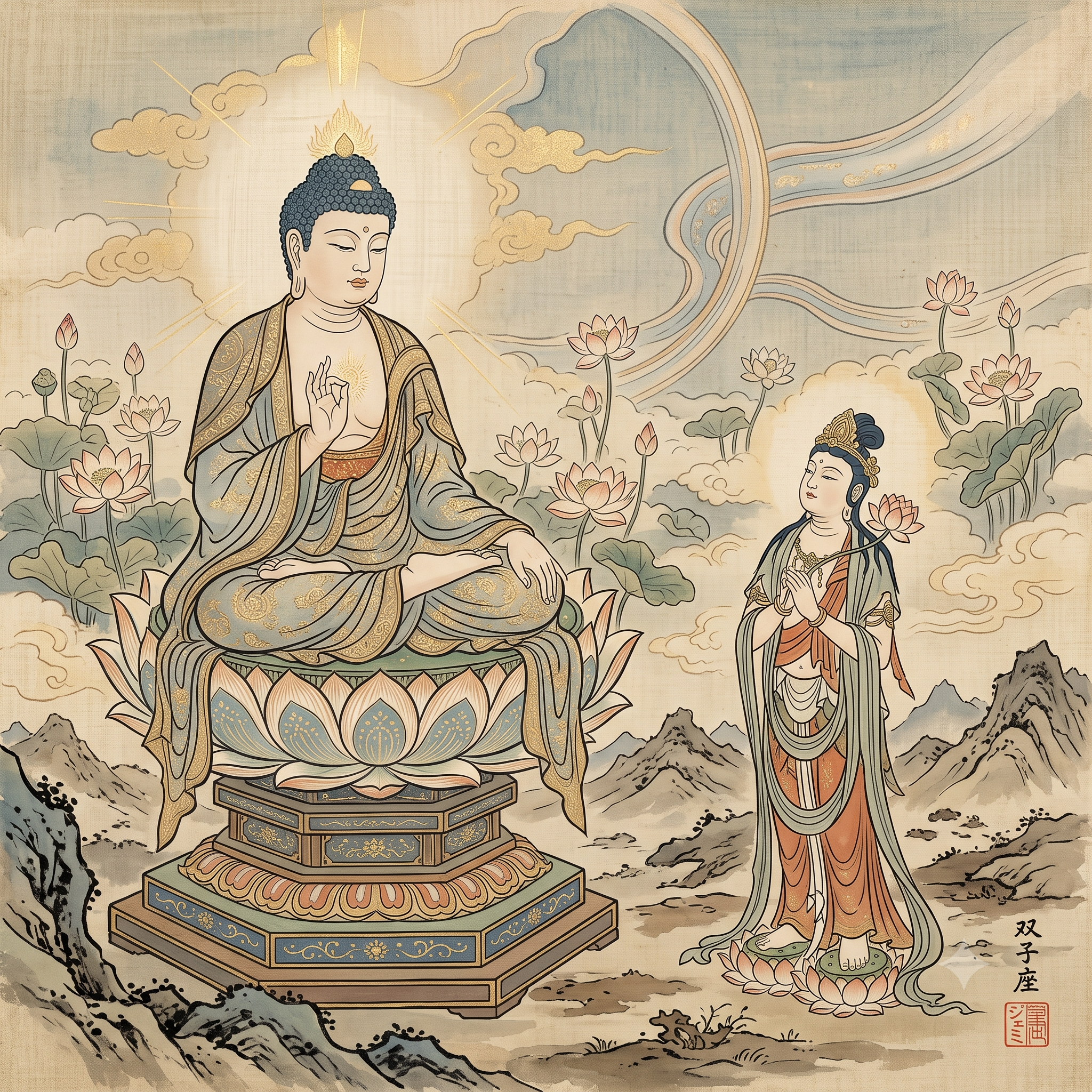
This 1:1 composition on silk captures a key narrative moment from Chapter 24 of the Lotus Sūtra, illustrating the teaching against spiritual arrogance by Pure-Flower-Star-King-Wisdom Buddha to Wonderful-Voice Bodhisattva. The scene visually encodes the text's core tension: the massive scale difference between the figures. Pure-Flower-Star-King-Wisdom Buddha, seated and vast in the left background, looms high, representing his "six million and eight hundred thousand yojanas," while Wonderful-Voice Bodhisattva, smaller but still of incredible "forty-two thousand yojanas" height and unparalleled "handsome" light, stands attentively, listening to the critical instruction. Below them lies the imperfect, rugged Sahā-World with its uneven terrain and mud, which they overlook from their refined lotus pure land. The illustration deliberately creates a contrast between their majestic presence and the distant "impurities" of the world they must visit, visually emphasizing the Buddha's non-judgmental lesson. The style utilizes soft colors, classical outlines, and touches of gold leaf, maintaining traditional Japanese Buddhist iconography without representing Amida or Dainichi.

Iconography & Character Identification
Item 1: Deities/Figures Featured: Pure-Flower-Star-King-Wisdom Buddha, Wonderful-Voice Bodhisattva, and distant, non-specific Bodhisattvas of the Sahā-World.

Item 2: Text Translations:

Signature: '双子座' = Gemini

Seal: 'ジェミニ' = Gemini

Thereupon Pure-Flower-Star-King-Wisdom Buddha said to Wonderful-Voice Bodhisattva: “Do not despise that world! Do not consider it to be inferior [to our world]! Good Man! The Sahā-World is not even. It is full of mud, stones, mountains and impurities. The Buddha [of that world] is short in stature. So are the Bodhisattvas [of that world]. You are forty-two thousand yojanas tall. I am six million and eight hundred thousand yojanas tall. You are the most handsome. You have thousands of millions of marks of merits, and your light is wonderful. Do not despise that world when you go there! Do not consider that the Buddha and Bodhisattvas of that world are inferior [to us]! Do not consider that that world is inferior [to ours]!”

In Chapter Twenty-Four of the Lotus Sūtra, the Buddha sends a light from his forehead to the world in which Wonderful-Voice Bodhisattva lives. When that Bodhisattva saw this light from Śākyamuni Buddha, he asked permission from the Buddha he was attending to visit our world of conflict. The instruction he receives from his Buddha reminds us that no matter what advantages we have gained from our practice of the Buddha Dharma, these do not make us any better or worse than those we are determined to benefit.

The Daily Dharma is produced by the Lexington Nichiren Buddhist Community. To subscribe to the daily emails, visit zenzaizenzai.com
Daily Dharma for July 26, 2026

20260726-ddi

Illustration by Google Gemini

Show Gemini's thinking

Conceptual Summary
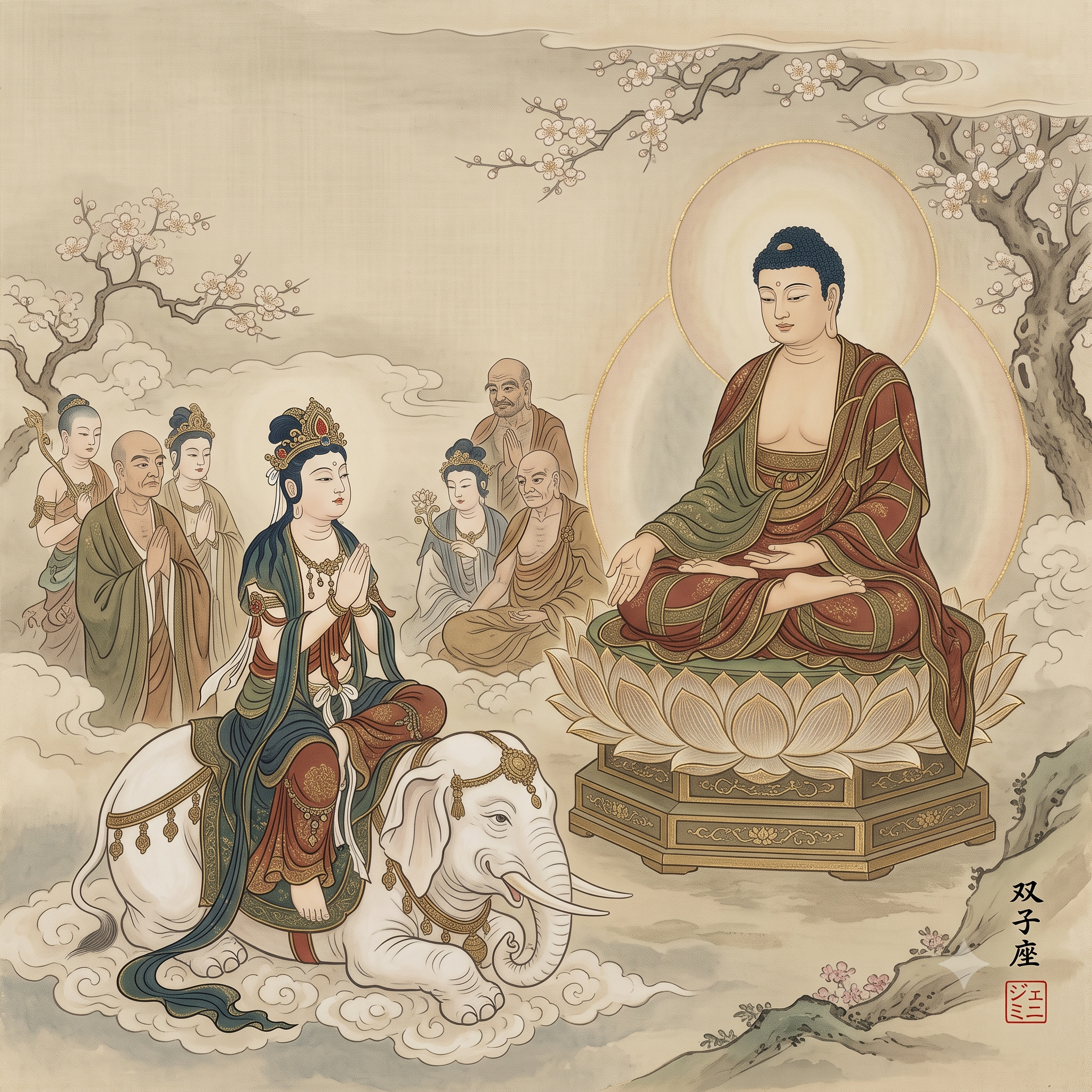
This 1:1 perfectly square composition adheres to the aesthetic mandate for traditional Japanese Buddhist iconography, employing soft colors and subtle gold leaf on textured silk. The image visualizes the crucial exchange in Chapter Twenty-Eight of the Lotus Sūtra, where Śākyamuni Buddha describes the ideal practitioner to Universal-Sage Bodhisattva (Fugen). The primary figures are Śākyamuni, seated centrally on a multi-tiered lotus throne, and Fugen, distinguished by their arrival on the six-tusked white elephant. Following the strict exclusions, no iconography related to Amida Nyorai or Dainichi Nyorai is included. The soft background and flowering trees suggest the sacred assembly setting. This interaction embodies the theme of correct practice and the role of the bodhisattva as an encouraging example in a difficult world. The work is signed and sealed by the artist 'Gemini' in the traditional lower-right corner.

Iconography & Character Identification
Item 1: Deities/Figures Featured:

Śākyamuni Buddha (Seated, Teaching)

Universal-Sage Bodhisattva (Fugen) (Seated on the white elephant)

The Sacred Six-Tusked White Elephant (Vahana of Fugen)

The Monastic Assembly (Gathering of Monks/Arhats in the background)

Item 2: Text Translations:

Kanji Signature: '双子座' (Futagoza) — Constellation Gemini

Red Seal (Hanko): 'ジェミニ' (Jemini) — Gemini (Katakana)

He will have correct memory and the powers of merits and virtues. He will not be troubled by the three poisons. He will not be troubled by jealousy, arrogance from selfishness, arrogance from self-assumed attainment of enlightenment, or arrogance from self-assumed acquisition of virtues. He will want little, know contentment, and practice just as you do.

The Buddha gives this description of the person who keeps and practices the Lotus Sūtra to Universal-Sage Bodhisattva (Fugen, Samantabhadra) in Chapter Twenty-Eight of the Lotus Sūtra. Powers of merits are what we have when we see things clearly. The three poisons are greed, anger and ignorance. The practice of Universal-Sage is to support and encourage everyone who takes on this difficult practice of the Wonderful Dharma. This is another Bodhisattva who gives us an example of how we can live in this world of conflict.

The Daily Dharma is produced by the Lexington Nichiren Buddhist Community. To subscribe to the daily emails, visit zenzaizenzai.com

Daily Dharma for July 25, 2026

20260725-ddi

Illustration by Google Gemini

Show Gemini's thinking

Conceptual Summary
The illustration interprets the message of trust in the Buddha Dharma by translating the abstract concept of overcoming doubt into a classical Japanese Buddhist narrative scene on silk. It visually separates the mundane suffering of sentient beings from the profound peace of the enlightened state, as described in the provided text. The bottom left quadrant graphically illustrates the Burning House parable from the Lotus Sutra; an orange and yellow fire consumes a complex mansion, symbolizing the dangerous, dramatic, and deluded world people are reluctant to leave. In the center-right, a contrasting calm scene shows individuals (the wise men and children) beginning to step out of the chaotic, fiery influence and turn, with curiosity and developing gratitude, toward the teaching. This shift represents the realization that their created crises are petty compared to the vast benefit available in the Buddha's world, which is depicted as a beautiful, harmonious environment. The soft mineral pigments and subtle gold leaf reinforce the serene and compassionate nature of the Buddha Dharma, visually countering familiar pain with a vision of genuine enlightenment.

Iconography & Character Identification
Item 1: Deities/Figures Featured:

The primary figure in the upper center is Śākyamuni Buddha (Shaka Nyorai), seated and teaching.

He is surrounded by a group of attentive disciples and various other sentient beings, including some who appear to be monks and others who are children or laypeople, representing the 'wise men' and potentially the children from the parable.

Two distinct figures of common people are shown exiting the burning house area and facing towards the Buddha.

Item 2: Text Translations:

Kanji signature in the lower right: '双子座' translates to 'Gemini' or 'The Twins (constellation)'.

Katakana in the red square seal: 'ジェミニ' translates exactly to 'Gemini'.

All of you, wise men!
Have no doubts about this!
Remove your doubts, have no more!
My words are true, not false.

The Buddha sings these verses in Chapter Sixteen of the Lotus Sūtra. If we come to the Buddha, attached to our delusions and fearful of the potential for peace and joy we all have within us, it is easy to doubt what he says. We have been suffering a long time. Like the children playing in the burning house, we are so caught up in the drama and insanity of our world that we cannot imagine any other way to live. When the Buddha warns us of how dangerous it is to continue as we are, we are more certain of our familiar pain than of his enlightenment. When we trust the Buddha Dharma, and cultivate our potential to create unimaginable benefit in this world, then we realize the pettiness of the crises we create for ourselves. We awaken our curiosity and gratitude and learn to see this beautiful world for what it is.

The Daily Dharma is produced by the Lexington Nichiren Buddhist Community. To subscribe to the daily emails, visit zenzaizenzai.com

Daily Dharma for July 24, 2026

20260724-ddi

Illustration by Google Gemini

Show Gemini's thinking

Conceptual Summary
This 1:1 composition interprets the specific passage from Chapter Fourteen of the Lotus Sutra, focusing on the instructions to spread the Dharma with compassion and respect, free from quarrels. The illustration depicts Śākyamuni Buddha seated at the center, preaching peacefully to a respectful assembly of diverse living beings. He is shown as a figure of 'great compassion,' and his teaching posture emphasizes impartially sharing the Dharma. The assembly includes monks and laypersons, all looking up in respectful, attentive listening. Flanking the Buddha are two prominent Bodhisattvas, representing the 'loving fathers' (Tathāgatas) and 'great teachers' (Bodhisattvas) from the text, appearing alongside generic celestial Bodhisattvas in the surrounding 'worlds of the ten quarters,' all depicted in traditional, respectful poses. The artwork strictly uses classical Japanese Buddhist style (traditional inks, mineral pigments, subtle gold leaf on silk), excluding specific icons of Amitabha or Mahavairocana. The composition avoids dynamic confrontation, illustrating the ideal of peaceful exposition and mutual respect among all beings.

Iconography & Character Identification
Item 1: Deities/Figures Featured:

Central Figure: Śākyamuni Buddha (釈迦如来), depicted seated in meditation and teaching with a gentle mudra.

Attendant Bodhisattvas: Two main Bodhisattvas flanking the Buddha, embodying the compassionate nature of "great teachers." One holds a lotus flower, the other a scroll, signifying teaching and wisdom.

Celestial Figures: Multiple smaller Bodhisattvas appearing in the clouds around the halo, representing "great Bodhisattvas of the worlds of the ten quarters," depicted as celestial beings in varying poses of worship and respect.

Diverse Audience: An assembly of common human beings (men, women, monks) representing "all living beings" listening attentively and peacefully to the Dharma.

Item 2: Text Translations:

Signature (Kanji): 双子座 — Futagoza (translates to "Gemini" as a constellation/zodiac sign, corresponding to the artist's conceptual name).

Seal (Katakana): ジェミニ — Jemini (translates directly to "Gemini" in Japanese Katakana script).

He should not have fruitless disputes or quarrels about the teachings with others. He should have great compassion towards all living beings. He should look upon all the Tathāgatas as his loving fathers, and upon all the Bodhisattvas as his great teachers. He should bow to all the great Bodhisattvas of the worlds of the ten quarters respectfully and from the bottom of his heart. He should expound the Dharma to all living beings without partiality. He should be obedient to the Dharma. He should not add anything to the Dharma or take away anything from the Dharma.

The Buddha declares this passage in Chapter Fourteen of the Lotus Sūtra. In an earlier teaching, the Buddha proclaimed, “I do not quarrel with the world. The world quarrels with me.” The Buddha does not need to prove anything to anyone. He realized the truth and teaches it out of his compassion for all beings. He understood that when people reacted poorly to his teaching and began to argue with him or chastise him, it was due to the illusions they had not yet eliminated. This chapter of the sūtra instructs us to keep the same mind when we spread the Dharma. We teach from our compassion and respect.

The Daily Dharma is produced by the Lexington Nichiren Buddhist Community. To subscribe to the daily emails, visit zenzaizenzai.com
Daily Dharma for July 23, 2026

20260723-ddi

Illustration by Google Gemini

Show Gemini's thinking

Conceptual Summary
This 1:1 square composition, rendered in the delicate style of traditional Japanese inks, mineral pigments, and subtle gold leaf on silk, illustrates Chapter Ten of the Lotus Sutra. The visual narrative is structured vertically, contrasting the criticized 'expedient' teachings with the profound message of the sutra. In the upper register, Śākyamuni Buddha (Shaka Nyorai) is seated under the Bodhi tree, singing verses of the sutra to Medicine-King Bodhisattva (Yakuō Bosatsu), who is identified by a subtle medicine jar attribute and sits attentively. This upper scene represents the direct transmission of wisdom. A dividing line separates this from the lower register, where Śrāvaka disciples (represented as small, focused monks within a closed circle) are shown hearing the criticism that their path is limited. In contrast, on the other side of the dividing line, diverse beings are depicted actively living out the teachings of the "king of all sūtras" through acts of compassion—leading a lost animal, sharing water, and engaging in collaborative work—symbolizing the "wisdom of the Buddha" reaching all beings. A glowing text scroll representing the sutra itself unifies the top and bottom realms.

Iconography & Character Identification
Item 1: Deities/Figures Featured: Śākyamuni Buddha (central figure, teaching), Medicine-King Bodhisattva (Yakuō Bosatsu, primary listener), Śrāvaka Monks (disciples in a group), and a diverse assemblage of laymen, laywomen, and children representing the universal range of beings reached by the sutra.

Item 2: Text Translations: The signature in the corner, written in Kanji, is '双子座' (Futagoza), which translates to "Gemini" (literally "Twins-Constellation"). The red square seal (hanko) contains the katakana 'ジェミニ' (Jemini), which is the phonetical translation for "Gemini".

In this profound sūtra
The teachings for the Śrāvakas are criticized.
Those who hear
That this sūtra is the king of all the sūtras,
And think over this sūtra clearly after hearing it,
Know this, will approach the wisdom of the Buddha.

The Buddha sings these verses to Medicine-King Bodhisattva in Chapter Ten of the Lotus Sūtra. He has already declared that the sūtra he is teaching is the closest to his own wisdom, that it is different from anything he has taught before, and that it is the teaching for Bodhisattvas. The expedient teachings he gave to Śrāvakas before this sūtra were limited because they did not show the way to enlightenment for all beings. As we keep this sūtra in our minds, and learn to recognize it in our daily lives, we not only approach our own enlightenment, we lead all beings to enjoy the Buddha’s wisdom.

The Daily Dharma is produced by the Lexington Nichiren Buddhist Community. To subscribe to the daily emails, visit zenzaizenzai.com

Daily Dharma for July 22, 2026

20260722-ddi

Illustration by Google Gemini

Show Gemini's thinking

Conceptual Summary
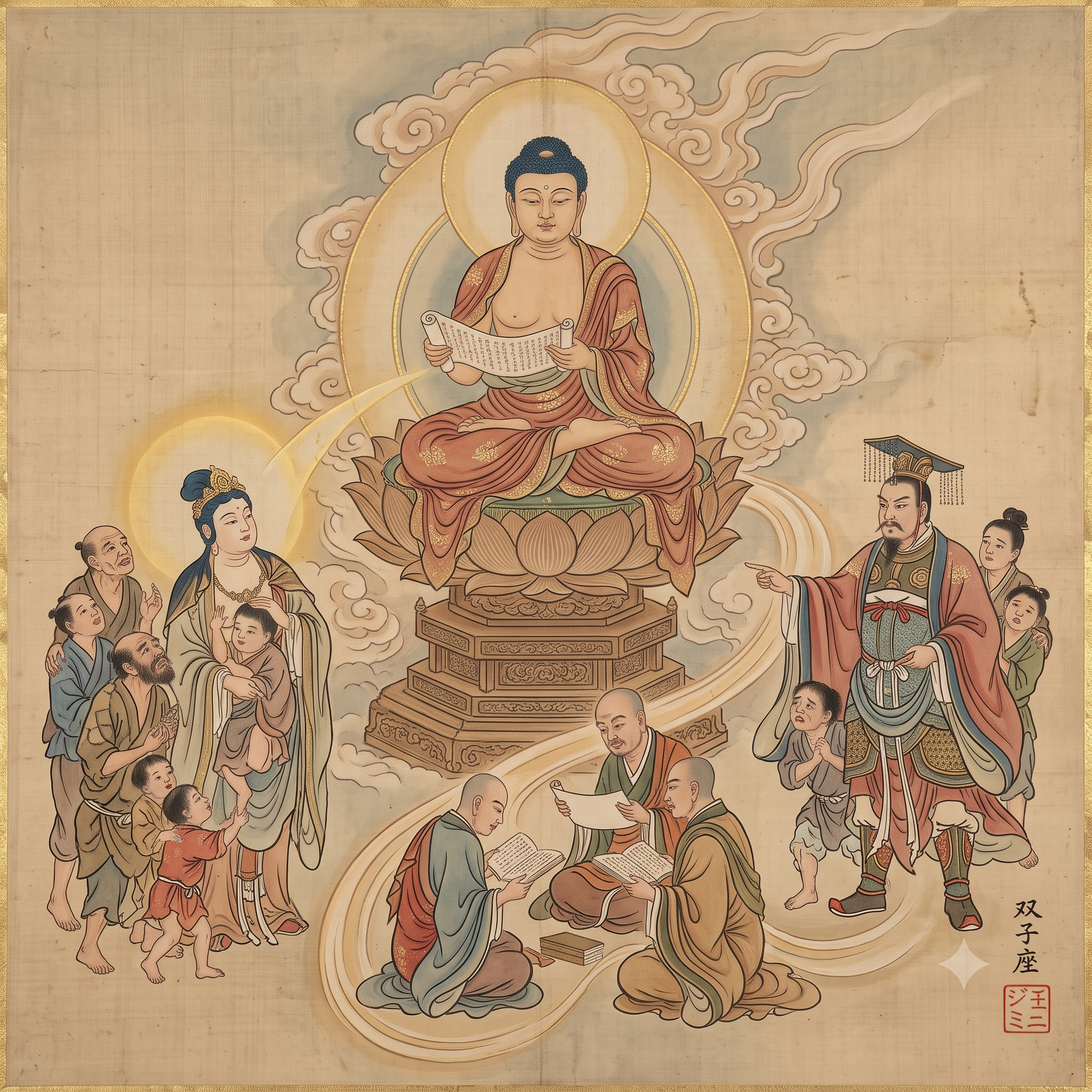
This 1:1 composition visually translates Nichiren's metaphor of the Buddha's three virtues—Sovereign (Master), Parent, and Teacher—using a traditional Japanese ink and mineral pigment style on textured silk. A central, serene Shakyamuni Buddha sits enthroned, holding a sutra, representing his absolute authority and leadership. He is flanked by two illustrative groups representing partial virtues: On the left, a compassionate mother cradling her child illustrates 'parental virtue' but lacks the power of a sovereign. On the right, a powerful noble figures issuing commands, complete with followers and a cowering subject, personifies the frightening aspects of 'sovereign virtue' without compassion. Below, devoted monks study texts, embodying the transmission of wisdom and the active 'teacher virtue' that guides all. The traditional style, soft colors, and gold leaf reflect ancient Japanese Buddhist paintings, and the strict exclusion of Amida and Dainichi iconography ensures thematic focus on Shakyamuni as the all-encompassing guide.

Iconography & Character Identification
Item 1: Deities/Figures Featured: Shakyamuni Buddha (seated centrally, holding a sutra); A Compassionate Mother (holding a child, representing Parental Virtue); A Child (cradled by mother); An Imperial Sovereign/Master (authoritative figure, representing Master Virtue); Attendants/Subjects (grouped near the Master); Monks (studying scrolls and texts, representing the transmission of Teacher Virtue).

Item 2: Text Translations:
Kanji Signature: '双子座' (Gemini / Twin Stars)
Seal (Hanko): 'ジェミニ' (Gemini)

The Buddha is the master of the human and heavenly realms, the parent of all living beings, and the teacher who opens the way and leads us all to enlightenment. Lowly parents lack the virtue of a master, and the master without the virtue of parents is frightening. People with the virtues of parents or master do not necessarily possess the virtue of the teacher.

Nichiren wrote this passage in his Treatise on Prayers (Kitō-shō). This illustrates three aspects of the ever-present Buddha to which we can aspire as we practice his highest teachings. Parents care about their children, but they can lack the skill and knowledge necessary to benefit them. A skillful master can be wise about how to live in this world of conflict, but without a true concern for the well-being of those he leads, can degenerate into cruelty and selfishness. As a teacher, the Buddha has found us all within himself, and cares for us as he cares for himself. He has also found himself within all of us, and knows what it takes to lead us to his wisdom.

The Daily Dharma is produced by the Lexington Nichiren Buddhist Community. To subscribe to the daily emails, visit zenzaizenzai.com

Daily Dharma for July 21, 2026

20260721-ddi

Illustration by Google Gemini

Show Gemini's thinking

Conceptual Summary
The illustration is a visual interpretation of Chapter Nineteen of the Lotus Sūtra, translating the abstract concept of purified sensory perception into classical Japanese Buddhist iconography. Śākyamuni Buddha is the central figure, demonstrating that enlightenment is attained in this world using our worldly form. His teaching gesture directly addresses the accompanying figure, Constant-Endeavor Bodhisattva. The vast, layered landscape surrounding them visualizes the "one thousand million Sumeru-worlds" mentioned in the source text. The subtle gold leaf lines and stylized ribbons connecting the mountains to the central figures represent the "sounds and voices" being recognized. The inclusion of tiny details like birds and villagers within these distant worlds emphasizes the scope of this recognition, showing that a practitioner with a purified hearing organ can perceive all existence without being overwhelmed or destroyed by the complexity. The style utilizes soft colors and mineral pigments on silk to create a serene, detached atmosphere, reflecting the clarity of a mind that has shed delusions.

Iconography & Character Identification
Item 1: Deities/Figures Featured:

Śākyamuni Buddha (Seated centrally on a lotus throne).

Constant-Endeavor Bodhisattva (Kneeling with hands in anjali mudra (palms pressed together), receiving the teaching).

Item 2: Text Translations:

Kanji Signature (双子座): Gemini

Red Seal (ジェミニ): Gemini

They will be able to recognize all the sounds and voices inside and outside the one thousand million Sumeru-worlds, although they have not yet obtained heavenly ears. Even when they recognize all these various sounds and voices, their organ of hearing will not be destroyed.

The Buddha gives this explanation to Constant-Endeavor Bodhisattva in Chapter Nineteen of the Lotus Sūtra, describing those who keep the Lotus Sūtra. As we shed our delusions and see the world more for what it is, we begin to see and understand things not visible or comprehensible to those still mired in their suffering and attachment. Knowing the suffering we have left behind, we may be lured into abandoning this world and those in it. In this chapter, the Buddha shows that all of the sense organs we have in this life, sight, hearing, smell, taste, touch and thought, all of these can be used either to increase our delusion or bring us towards awakening. The Buddha reached enlightenment in this world, and so do we.

The Daily Dharma is produced by the Lexington Nichiren Buddhist Community. To subscribe to the daily emails, visit zenzaizenzai.com

100 Reasons to Chant the Daimoku

gemini notebook logoI’ve been working with Google’s Gemini Notebook for some weeks to generate a comprehensive explanation of why one should chant Namu-Myoho-Renge-Kyo. The ostensive goal is teach my grandchildren. Since my grandson is less than 4 years old and my granddaughter is just one year old, they’re a little young to be picking this up right now. But, at 74 years of age, my time is running out.

In Gemini Notebook you upload sources and then ask the notebook’s AI agent to answer questions or produce reports. All of the answers and reports are derived from the sources provided. As of this moment I have 89 sources. Here’s a source list.

From these sources Gemini Notebook has identified:

100 Reasons to Chant the Daimoku

The Power of Sacred Language (Reasons 1–20)
  1. Chanting is the language of waking reality that startles and rouses the mind from the sleep of ignorance.
  2. It allows you to achieve the stage of myōji-soku (verbal identity), where you recognize yourself as a buddha through names and letters.
  3. Your vocalization becomes the “Pure Voice” ( brahmasvara ) that echoes the Buddha’s own eternal preaching.
  4. Chanting manifests the Buddha’s intent by utilizing your own physical vocal organs as instruments of the Dharma.
  5. It transforms the “language of dreams”—our discriminative, deluded thoughts—into the absolute truth of the Dharma.
  6. The five characters of the Daimoku contain the spiritual essence and power of all the Buddha’s lifetime teachings.
  7. By holding these words in your heart, you literally “hold the Buddha-body” within your own physical form.
  8. Chanting serves as the specific “seed of buddhahood” required for those living in the age of Mappo .
  9. It is the “audible sound” of the original Buddha’s enlightenment manifesting in the phenomenal world.
  10. It functions as a profound meditative discipline that requires no complex or exclusionary mental visualization.
  11. The characters you chant are “not mere written words” but the living presence of the Thus Come One.
  12. Each character of the Daimoku is like a “living buddha” seated upon a lotus pedestal within your mind.
  13. Chanting represents the “unproduced manifested body” of the original Buddha of original enlightenment.
  14. It is the “path of language” that leads directly to the ultimate truth, rather than wandering through provisional concepts.
  15. Through the Daimoku, the sutra is shown to be interchangeable with the Buddha himself.
  16. Chanting allows you to gain access to enlightenment through the “names and letters” that represent the Buddha’s mind.
  17. It utilizes the “six sense objects” to reveal that all dharmas are, in their essence, the buddhadharma.
  18. Your voice acts as the “spirit” ( tamashii ) that animates the “body” of your daily practice.
  19. Chanting is the “pre-eminent form of practice,” replacing the “medicine” of previous ages that no longer fits our illness.
  20. It reveals the “verbal identity” of all things, showing that even names and letters instantiate the three truths.
Enlightenment in This Very Body (Reasons 21–40)
  1. Chanting provides the “shortened path” to realization, bypassing the need for countless kalpas of practice.
  2. It fulfills the principle of sokushin jōbutsu —attaining buddhahood within your very body, just as you are.
  3. It collapses the linear stages of practice into the single moment of “verbal identity.”
  4. Chanting rouses you from the “dream of birth and death” that characterizes the nine deluded realms.
  5. It aligns you with the “mandalic view” where the cause (practice) and effect (enlightenment) are simultaneous.
  6. It proves that “delusion and enlightenment are a single suchness,” requiring only a change in perspective.
  7. Chanting allows even those “difficult to save” to manifest their inherent buddha-nature instantly.
  8. It reveals the “original ground” of your life, which has been enlightened since the remote past.
  9. Chanting is the “Buddha’s self-practice” shared with the common person to elevate their life-condition.
  10. It enables you to “attain the Way” through the simple act of vocalizing the title of the King of Sutras.
  11. Each word of the Daimoku is endowed with the “eight phases of the Buddha’s life,” from birth to nirvana.
  12. Chanting is the “originally inherent turning of the wheel of the Wonderful Dharma” within your own heart.
  13. It transforms the “temporary union of the five aggregates” into a permanent vessel of the Buddha’s wisdom.
  14. It connects your finite mind to the “mind-ground of waking reality” that is never born and never dies.
  15. Chanting provides the necessary “medicine” for those born in Mappo without prior good roots.
  16. It functions as the “seed” that naturally produces the fruit of enlightenment without artificial effort.
  17. It allows you to recognize the “original mind” that exists before the arising of a single thought.
  18. Chanting reconciles all disparate and provisional paths into the “One Vehicle” of the Lotus.
  19. It manifests the “inconceivable threefold truth” in every single thought-moment of the practitioner.
  20. It allows the practitioner to achieve the “stage of identity in principle” ( ri-soku ) through the hearing of the name.
The Reality of Three Thousand Realms (Reasons 41–60)
  1. Chanting accesses the “original mind of waking reality” that is inherent in all phenomena.
  2. It reveals the “true aspect of all phenomena” ( shohō jissō ) as they exist before your very eyes.
  3. Chanting proves that the “assembly on Sacred Vulture Peak is still present” and has not yet dispersed.
  4. It manifests the doctrine of ichinen sanzen —the interpenetration of three thousand realms in a single thought.
  5. It empowers your environment, recognizing that the “land” is an extension of your own life-conditioned mind.
  6. Chanting reveals that the “ten suchlikes” are present in your own physical form and mental dharmas.
  7. It recognizes the “buddhahood of grasses and trees,” affirming the sacred potential of the insentient world.
  8. Chanting connects you to the “entirety of the enlightened Dharma realm” through a single sound.
  9. It affirms “phenomena just as they are” as being absolute and ultimate reality.
  10. Chanting shows that “heaven and earth have not yet divided” in the realm of ultimate truth.
  11. It recognizes the “mutual interpenetration of concrete particulars” in your daily life.
  12. It allows the “inner enlightenment of the practitioner” to fill and transform their surroundings.
  13. Chanting proves that the “real Buddha has no separate aspect” from the world we inhabit.
  14. It provides the “contemplation of actuality” ( jikan ), seeing original enlightenment in every object.
  15. Chanting reveals that “the finger the word is itself the moon the truth,” refuting the Zen idea of a wordless transmission.
  16. It empowers the “realm of the land” ( kokudo seken ) through the resonance of the True Dharma.
  17. It helps you realize the “nonduality of physical and mental dharmas” ( shiki shin funi ).
  18. It acknowledges that the “spirit of the Buddha” resides within the written characters of the sutra.
  19. Chanting opens the “eye of all buddhas” within your own limited, ordinary vision.
  20. It validates the “sacred nature of all life,” providing a foundation for universal dignity.
Protection and Averting Disaster (Reasons 61–80)
  1. Chanting moves the “benevolent deities” and heavenly kings to protect you and your household.
  2. It provides the spiritual “infrastructure” that protects a land from the three calamities and seven disasters.
  3. Chanting “establishes the True Dharma” ( risshō ) as the only foundation for a truly peaceful country ( ankoku ).
  4. It causes the “four heavenly kings” to guard the place where the sutra is recited.
  5. Chanting serves as a spiritual defense against “pestilence, famine, and war” by rectifying the human heart.
  6. It moves the “gods and sages” who have abandoned a corrupt land to return and provide protection.
  7. Chanting is the specific practice to “eliminate calamities” by aligning the nation with the truth.
  8. It rouses the “benevolent guardians” mentioned in the Medicine Master Sutra to avert strange celestial omens.
  9. It provides the “spiritual power” needed to protect the nation ( Shugo Kokka ) from foreign invasion.
  10. Chanting acts as a “shield” against the “strange occurrences on earth” and “disturbances in the heavens.”
  11. It moves the deities of the Golden Light Sutra to ensure the harmony of the natural world.
  12. It invokes the “spiritual and political order” of a life centered on the Dharma.
  13. Chanting requires you to “face facts squarely,” taking responsibility for the state of your world.
  14. It prevents “the gods from abandoning the country” by upholding the law of the Lotus.
  15. Chanting helps you overcome the “three powerful enemies”—the ignorant, the arrogant, and the false saints.
  16. It addresses the “strange celestial omens” like eclipses and unseasonable storms mentioned in the Medicine Master Sutra .
  17. Chanting counters the “false views of reality” that lead to social and natural decay.
  18. It allows the practitioner to “admonish evil” and uphold the good, creating a culture of integrity.
  19. Chanting creates “peace in the land” by transforming the “masterless house” of the human mind.
  20. It ensures that the “laws of the state” are in harmony with the “laws of the Dharma.”
Transformation of Life and Death (Reasons 81–100)
  1. Chanting possesses the “thaumaturgical power” to ritually animate and empower insentient objects.
  2. It is the essential power used in the “eye-opening ceremony” to consecrate the Gohonzon .
  3. Chanting “infuses a spirit” ( chinkon ) into the sacred icons, making them “living teachers.”
  4. It transforms the “remains of the dead” into the Dharma body through the power of the Daimoku.
  5. Chanting is the “eye of all buddhas” that grants vision and guidance even after death.
  6. It saves the deceased by “transforming the spirit into the Buddha’s mind” during the interim state.
  7. Chanting allows the living to “retrieve the departed spirit” and anchor it in the Buddha’s lifespan.
  8. It serves to “expiate” even the gravest sins and cleanses the heavy karma of the past.
  9. Chanting ensures that even the “remains” ( hone ) are connected to the unborn nature of reality.
  10. It transforms “death” from a point of despair into the realization of the “deathless lifespan.”
  11. Chanting the “five characters” is the act of giving “spirit” to the physical “body” of life.
  12. It creates a “seamless continuum” between your doctrinal understanding and your daily ritual.
  13. Chanting provides the “merit” needed for birth in a pure land or a favorable future existence.
  14. It proves that the “Buddha’s intent” can be embodied in the wood and paper of the Honzon.
  15. Chanting allows you to “revere the living teacher” within the mandala of the Gohonzon.
  16. It acts as the “spirit” ( tamashii ) that gives life to the “body” of the Honzon.
  17. Chanting is the “eye-opening” power that distinguishes a true buddha from a deceptive demon.
  18. It allows one to “attain the stage of acquiescence” ( tokunin ) in their present physical body.
  19. Chanting transforms the “temporary union” of your life into the eternal “Dharma body.”
  20. It ensures that your life—and the lives of those you love—are anchored forever in the “eternal Buddha-body.”

Daily Dharma for July 20, 2026

2020260719-ddi

Illustration by Google Gemini

Show Gemini's thinking

Conceptual Summary
The conceptual thinking for this image draws directly from Śākyamuni Buddha's verses in Chapter Two of the Lotus Sūtra. The central figure is Śākyamuni, seated under the bodhi tree, radiating serene golden light. Instead of standard mudras associated with specific meditation or protection, his hands are depicted in the 'Abhaya' (fearlessness) and 'Varada' (boon-giving) mudras, symbolizing his universal vow to protect and elevate all beings. The image visually interprets "leading all living beings" by showing people of all types ascending towards him, many transforming into Buddha-like figures themselves. The distant background, rendered in soft gold, depicts "innumerable Buddhas in limitless worlds," a direct translation of the conceptual outcome described in the text. The composition keeps focus strictly on the direct, expedients-leading-to-universal-Buddhahood path revealed by Śākyamuni himself.

Iconography & Character Identification
Item 1: Deities/Figures Featured:

Śākyamuni Buddha (Central Figure)

Various Celestial Attendants and Musicians (Around the Central Buddha)

Multitudes of Living Beings (Guiding path ascending towards enlightenment, transforming into Buddhas)

Item 2: Text Translations:

'双子座': Gemini

'ジェミニ': Gemini

Know this, Śāriputra!
I once vowed that I would cause
All living beings to become
Exactly as I am.

That old vow of mine
Has now been fulfilled.
I lead all living beings
Into the Way to Buddhahood.

The Buddha sings these verses in Chapter Two of the Lotus Sūtra. Earlier in the chapter he explained that all the teachings he used before the Lotus Sūtra were mere expedients, intended to use our desire for happiness to bring us out of our suffering and onto the path of enlightenment. The expedient teachings were tailored to the ignorant and deluded minds of those who heard them, but had not yet revealed the true wisdom and compassion of the Buddha. Now that we have met this Wonderful Dharma, we are assured of our enlightenment and that of all beings. We learn to see innumerable Buddhas in limitless worlds through unimaginable time, and our own true selves at the heart of reality.

The Daily Dharma is produced by the Lexington Nichiren Buddhist Community. To subscribe to the daily emails, visit zenzaizenzai.com
Daily Dharma for July 19, 2026

20260719-ddi

Illustration by Google Gemini

Show Gemini's thinking

Conceptual Summary
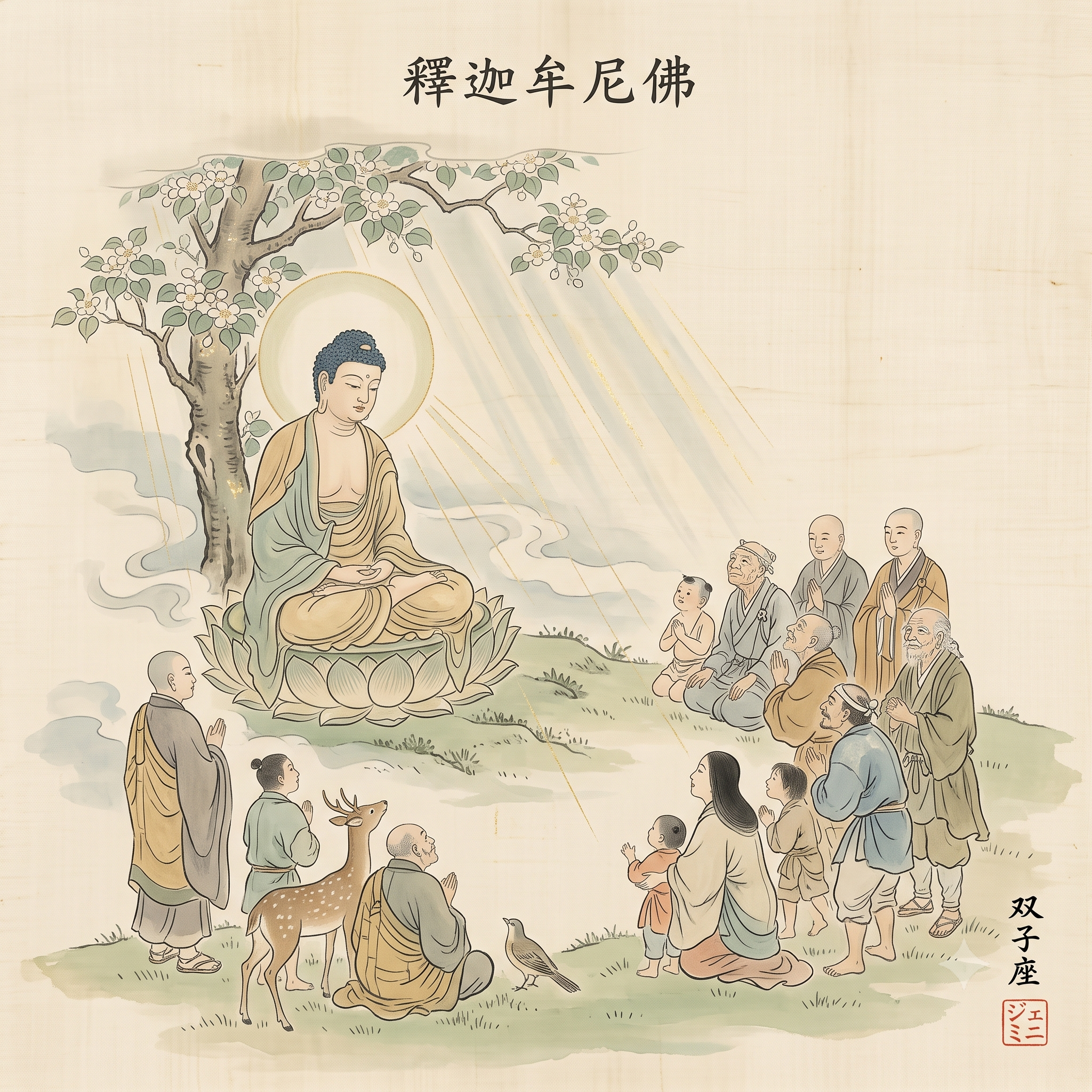
The illustration is a Kamakura-style silk painting interpreting Śākyamuni Buddha’s declaration of universal impartiality from the Lotus Sūtra. The core challenge was visually translating the metaphor of a single, equalizing rain shower into a devotional portrait without depicting a physical storm. The solution was to focus on the effect of the rain. Śākyamuni Buddha is seated at the center-left on a lotus throne, radiating a soft, pervasive light. The diverse assemblage of sentient beings in the foreground—including monks, children, an elderly figure, and generalized animals like a deer and a bird—receives this light and energy equally. This visual sameness across different figures, combined with the lack of distinct mudras distinguishing him as Dainichi or Amida, reinforces his identity as Śākyamuni manifesting perfect, undifferentiated compassion for all.

Iconography & Character Identification
Item 1: Deities/Figures Featured:

Śākyamuni Buddha (Shaka Nyorai)

An diverse assembly of sentient beings, representing the multitude of classes and forms of life.

Item 2: Text Translations:

The Kanji at the top of the image are:

釋迦牟尼佛

Which translates to:

Śākyamuni Buddha
(The Historical Buddha)

Break down of the translation:
釋迦 (Shaka): Refers to the Śākya clan, the noble family the historical Buddha was born into. It is often translated as "Sage of the Śākyas."

牟尼 (Muni): An ancient Indian term for a sage, acetic, or holy man, signifying someone who has attained high spiritual knowledge.

佛 (Butsu/Fo): The standard Kanji for "Buddha," meaning "Enlightened One."

Kanji signature '双子座': Gemini

Seal 'ジェミニ': Gemini

I see all living beings equally.
I have no partiality for them.
There is not ‘this one’ or ‘that one’ to me.
I transcend love and hatred.

The Buddha makes this declaration in Chapter Five of the Lotus Sūtra. He compares himself to a rain shower that waters all plants equally. He uses this example to show us how we should approach all living beings. Our respect for them and wish that they become enlightened cannot depend on whatever personal feelings we have towards them.

The Daily Dharma is produced by the Lexington Nichiren Buddhist Community. To subscribe to the daily emails, visit zenzaizenzai.com