
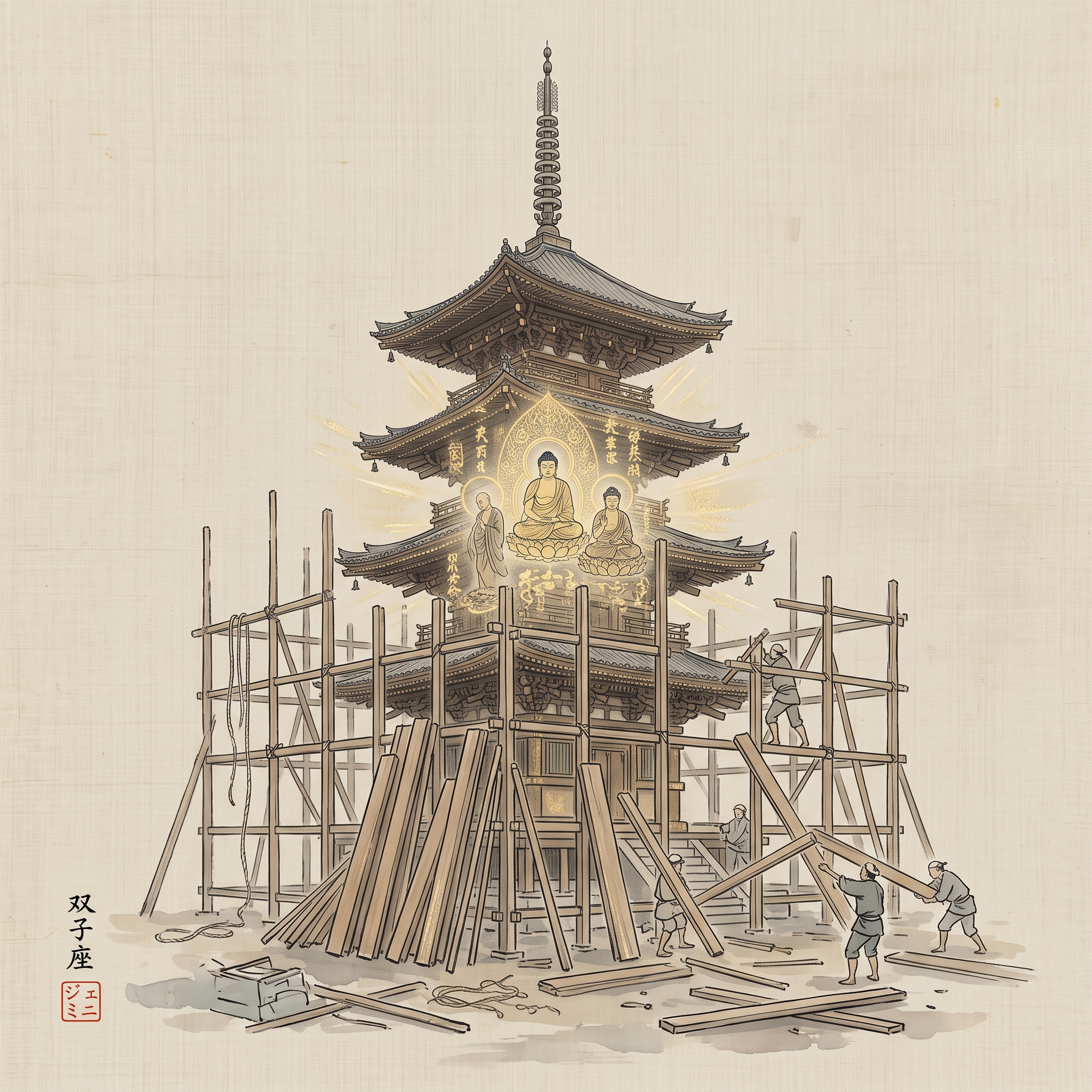
Conceptual Summary
The illustration is a literal and symbolic interpretation of Nichiren’s parable of the "Great Tower." It captures the moment of transition, contrasting utility with ultimate purpose. The completed, luminous pagoda symbolizes the Lotus Sutra (the Great Tower of the Dharma). Radiating with subtle gold leaf, it features figures representing the essential characters of the text—Shakyamuni Buddha, Many Treasures Buddha, and the generic Bodhisattvas—centered within the final structure. Surrounding and partially removed from the finished tower is the complex wooden scaffolding, representing the "expedient teachings" of all previous scriptures. Figures of laborers are shown actively dismantling this utilitarian structure, illustrating the final step of "discarding the expedient" once the ultimate truth has been established. The soft mineral pigments and silk texture reflect a classical aesthetic, emphasizing the reverence for the final, enduring Pagoda over the discarded support.
Iconography & Character Identification
Item 1: Deities/Figures Featured:
Central Figure (Pagoda Interior): Shakyamuni Buddha (seated on a lotus throne, radiating light, representing the living Buddha of the Lotus Sutra).
Seated Figure to the Left (Viewer's Left): Many Treasures Buddha (Prabhutaratna Buddha, seated within the treasure tower to verify Shakyamuni’s teaching).
Standing Figure (Viewer's Right): A representing generic Bodhisattva (one of the Bodhisattvas of the Earth or an attendant).
Generic Figures (Foreground): Seven construction workers/monks (depicted as laborers dismantling the wooden scaffolding).
Item 2: Text Translations:
Kanji Signature (Bottom Left): 双子座 (Gemini-za) — Translates to "Gemini."
Red Hanko Seal (Bottom Left): ジェミニ (Jemini) — Katakana translation for "Gemini."
For example, in building a huge tower, a scaffold is assembled from many small pieces of wood set up ten or twenty feet high. Then, using this scaffold, the huge tower is built with lumber. Once the tower is completed, the scaffold is dismantled. The scaffold here represents all Buddhist scriptures other than the Lotus Sutra, and the Great Tower is the Lotus Sutra. This is what is meant by “discarding the expedient.” A pagoda is built by using a scaffold, but no one worships a scaffold without a pagoda.
Nichiren wrote this passage in his Response to My Lady the Nun, Mother of Lord Ueno (Ueno-dono Haha-ama Gozen Gohenji). In this simile, Nichiren compares the Buddha’s expedient teachings to the Wonderful Dharma he provides in the Lotus Sūtra.
The Daily Dharma is produced by the Lexington Nichiren Buddhist Community. To subscribe to the daily emails, visit zenzaizenzai.com