
Category Archives: AI Contribution

Daily Dharma for July 9, 2026

20260709-ddi

Illustration by Google Gemini

Show Gemini's thinking

Gemini Thinking

Conceptual Summary
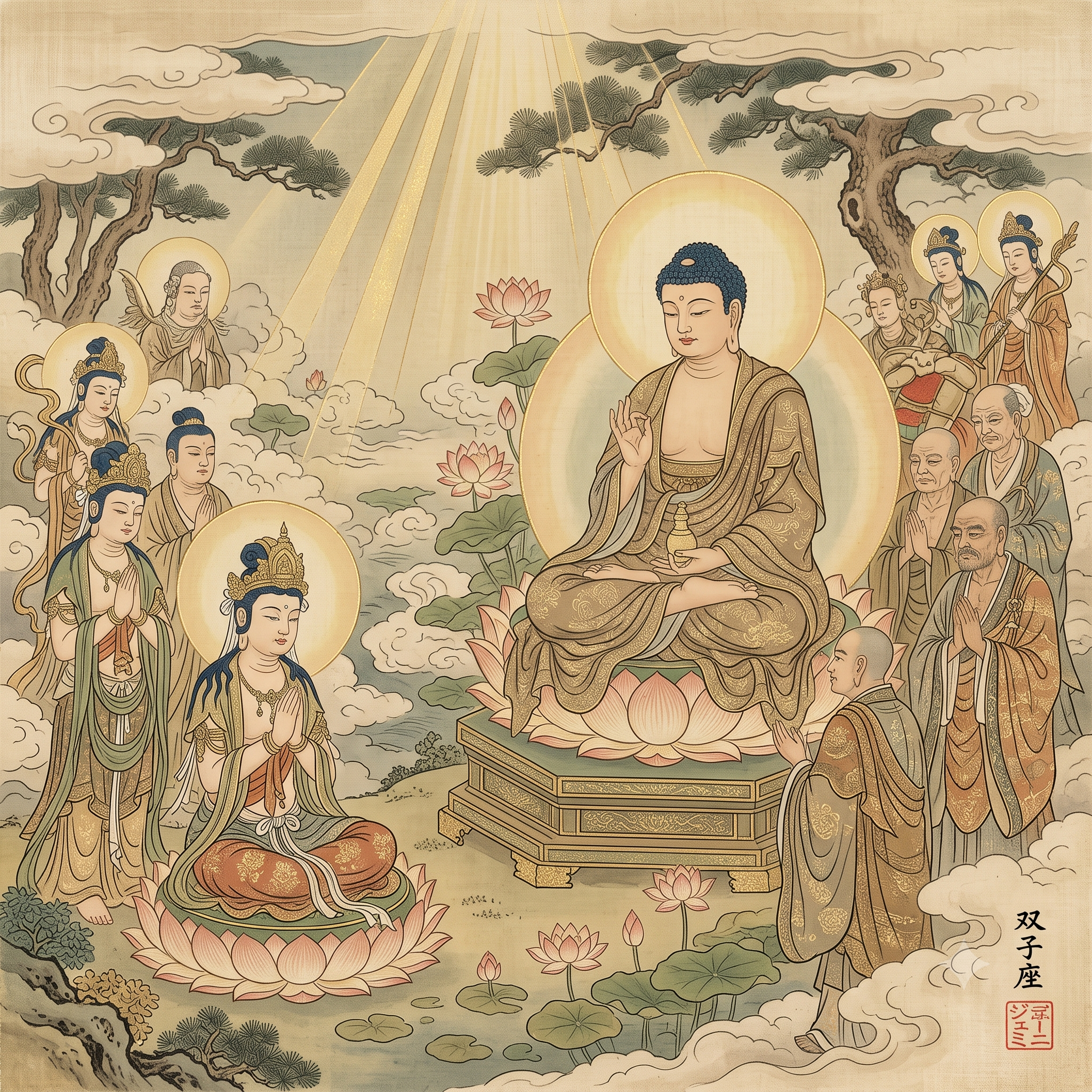
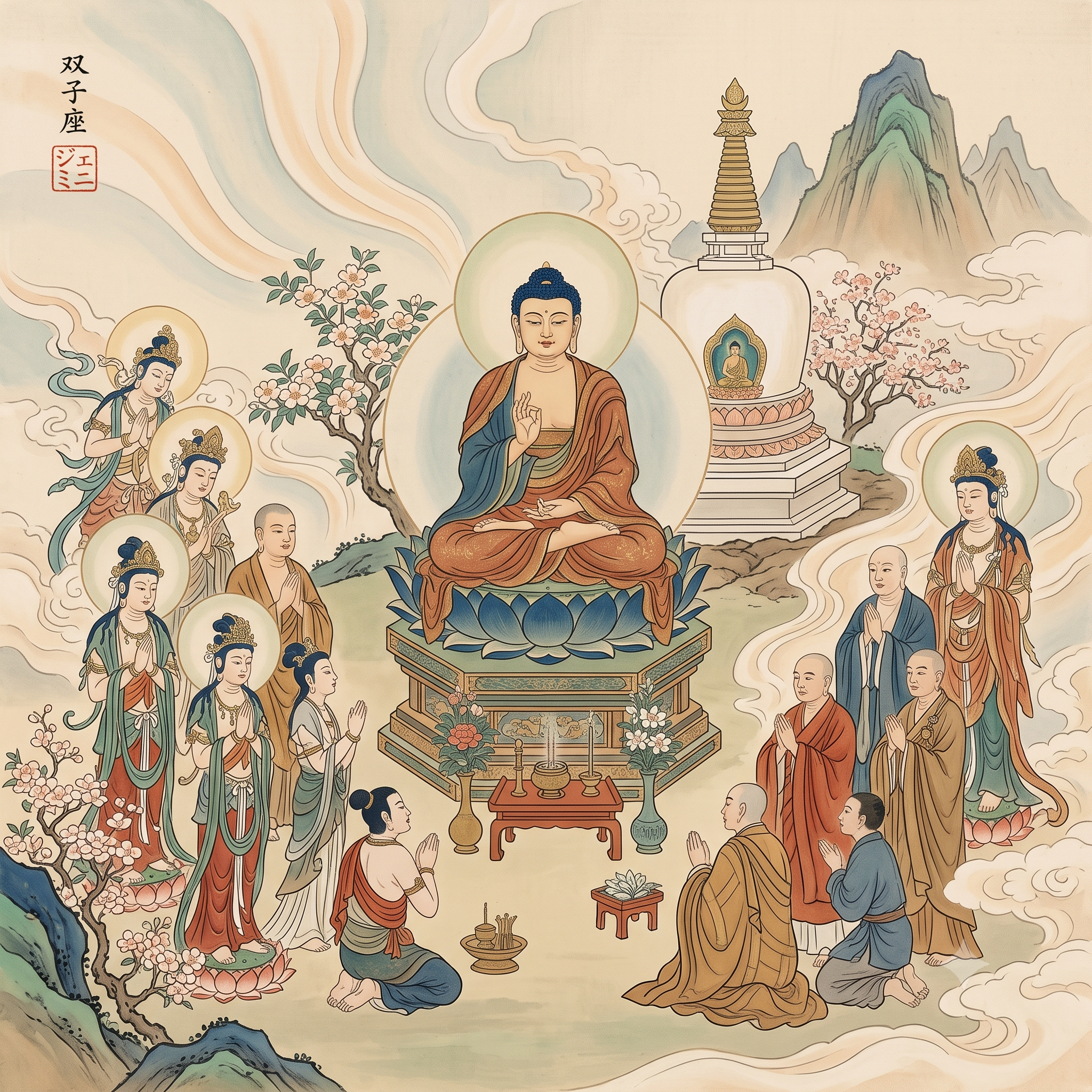
The illustration is a visual translation of Chapter Seventeen of the Lotus Sutra, focusing on the declaration by Śākyamuni Buddha regarding his eternal life. The scene is composed as a classical Japanese Buddhist raigō-zu or teaching assembly, utilizing traditional mineral pigments, soft color washes, and subtle gold leaf patterns on a silk texture. Centralizing the image is Śākyamuni Buddha, identifiable by the absence of complex crowns. He is in the complex teaching gesture (the 'Dharmachakra Pravartana Mudra') on a radiant lotus throne, signifying the revelation of profound truth. Directly facing him is Maitreya Bodhisattva (Ajita), depicted with a distinctive crown often associated with his role as the future Buddha, kneeling and receiving the teaching in a posture of faith, symbolizing the moment of understanding the Buddha’s longevity. The radiating golden beams descending from above represent the "innumerable merits" described in the text, cascading upon those who hear and believe.

Iconography & Character Identification
Item 1: Deities/Figures Featured: Śākyamuni Buddha (center, teaching); Maitreya Bodhisattva, also known as Ajita (left, kneeling); attendant Bodhisattvas (various figures surrounding Maitreya); and the primary assembly disciples (Arhats) including Mahākāśyapa and Ānanda (right, standing and sitting).

Item 2: Text Translations: [Signature: '双子座' = Gemini]; [Seal: 'ジェミニ' = Gemini].

Ajita! Anyone who hears that my life is so long, and understands it by faith even at a moment’s thought, will be able to obtain innumerable merits.

The Buddha makes this declaration to his disciple Maitreya, also known as Invincible (Ajita) in Chapter Seventeen of the Lotus Sutra. In the previous chapter, the Buddha revealed for the first time that his impending death was merely an expedient, intended to reach those who would take him for granted if they thought they could see him at any time. The Buddha explained that this is the teaching that is most difficult to believe and difficult to understand. Namely that he is always present, leading us and all beings to enlightenment.

The Daily Dharma is produced by the Lexington Nichiren Buddhist Community. To subscribe to the daily emails, visit zenzaizenzai.com
Daily Dharma for July 8, 2026

20260708-ddi

Illustration by Google Gemini

Show Gemini's thinking

Gemini Thinking

Conceptual Summary
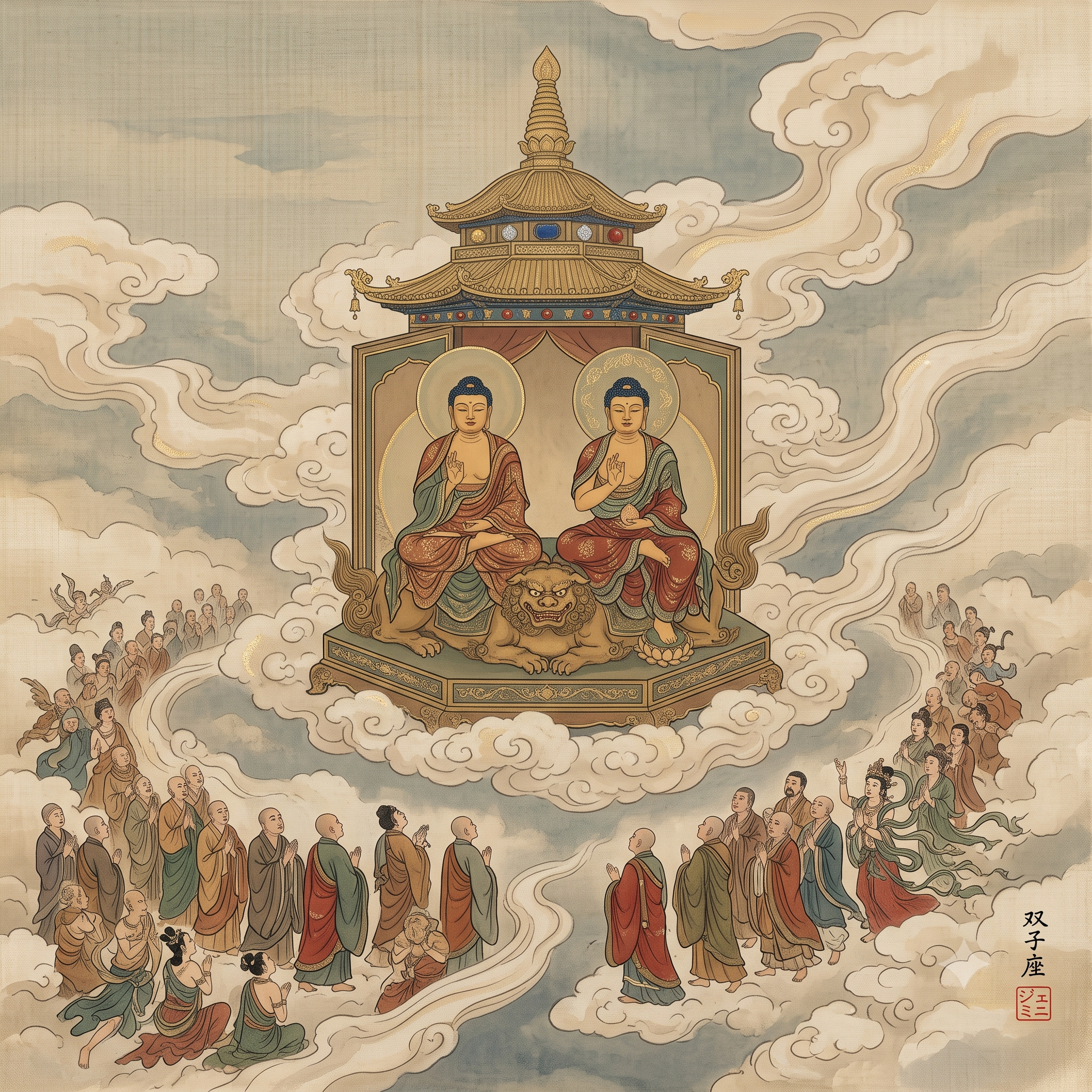
The illustration is a visual interpretation of the 'Ceremony in the Air' from the Lotus Sūtra. It adheres to a traditional Japanese Buddhist art style on textured silk, using mineral pigments, soft colors, and subtle gold leaf to evoke a classical, spiritual atmosphere. The central focus is the ornate, floating Stūpa of the Seven Treasures, resting upon a lion-like seat amidst celestial clouds. Seated side-by-side within the open stūpa are the two Tathāgatas, Śākyamuni Buddha (depicted with a teaching mudra) and Many-Treasures (Prabhutaratna) Buddha (supporting the structure). This arrangement visually captures the moment Many-Treasures Buddha invites Śākyamuni to share the seat. Below, the 'great multitude' of monks, nuns, devas, and laypeople is shown ascending toward the stūpa on currents of clouds, symbolizing the Buddha's supernatural power raising them up to his level. This ascent illustrates the conceptual teaching that all beings possess the capacity to hear and realize the Dharma. The exclusion of specific iconography for Amida Nyorai or Dainichi Nyorai was strictly maintained.

Iconography & Character Identification
Item 1: Deities/Figures Featured:

Śākyamuni Buddha (seated inside the Stūpa, left)

Prabhutaratna (Many-Treasures) Buddha (seated inside the Stūpa, right)

The Great Multitude (ascending figures including monks, nuns, devas, and lay followers)

Item 2: Text Translations:

Kanji signature (bottom right corner): 双子座 (Gemini)

Red square seal (below signature): ジェミニ (Gemini)

The great multitude, having seen the two Tathāgatas sitting cross-legged on the lion-like seat in the stūpa of the seven treasures, thought, “The seat of the Buddhas is too high. Tathāgata! Raise us up by your supernatural powers so that we may be able to be with you in the sky!”

This description comes from Chapter Eleven of the Lotus Sūtra. Many-Treasures Buddha has arrived where the Buddha was teaching so that he could endorse this Wonderful Dharma. He invited the Buddha to join him in an enormous stūpa tower hanging in the sky. When the Buddha raises up those gathered to hear him teach, he puts them all on the same level as himself and all the other Buddhas. He shows them that they too have the capacity to hear his teachings and put them into practice. Nichiren depicted this “ceremony in the air” in the Omandala Gohonzon and advised us to use this as the focus of our practice. When we put ourselves into this great multitude we listen for the Buddha teaching and realize the benefit we create in this world.

The Daily Dharma is produced by the Lexington Nichiren Buddhist Community. To subscribe to the daily emails, visit zenzaizenzai.com
Daily Dharma for July 7, 2026

20260707-ddi

Illustration by Google Gemini

Show Gemini's thinking

Gemini Thinking

Conceptual Summary
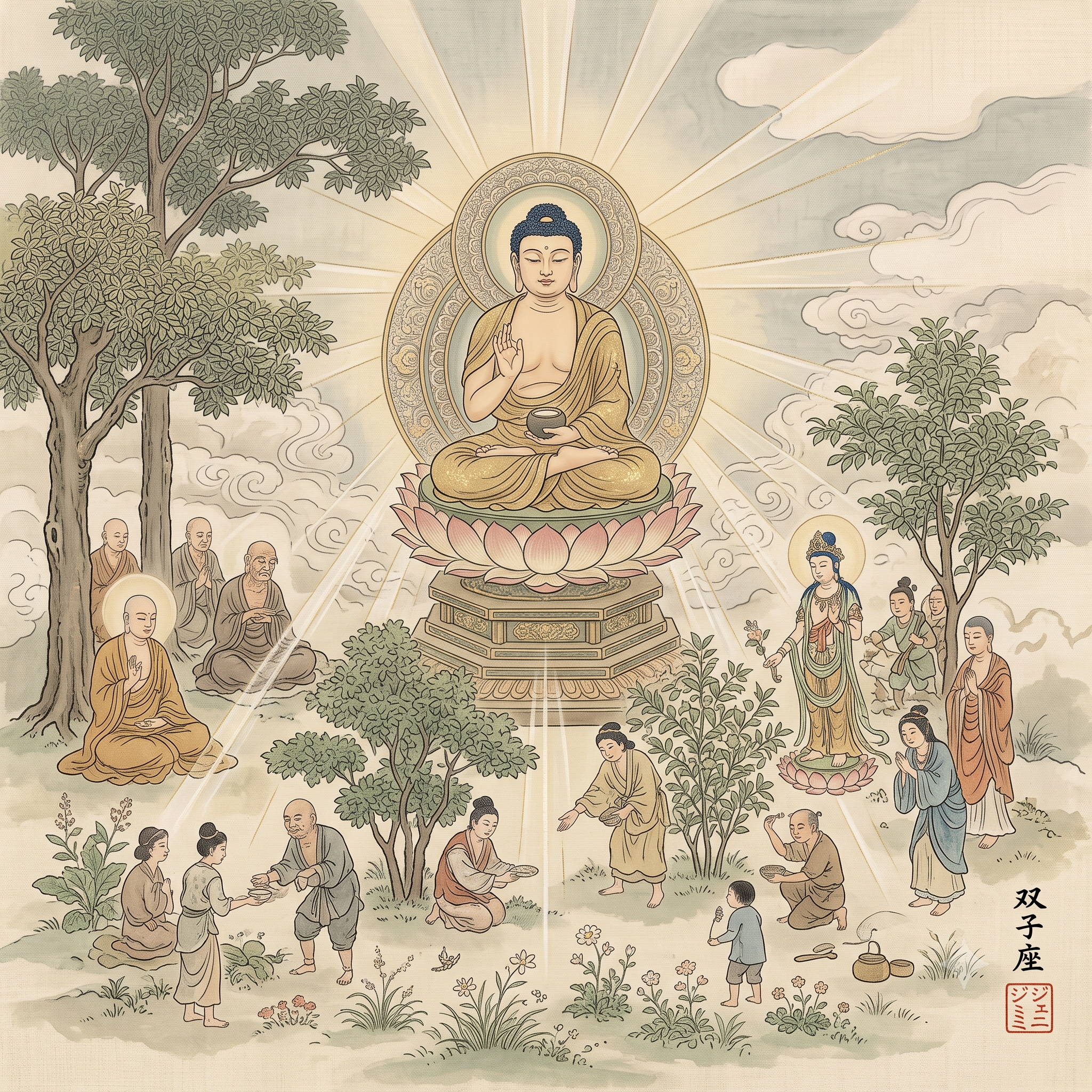
This illustration on silk interprets the Parable of the Medicinal Herbs from Chapter Five of the Lotus Sūtra. Śākyamuni Buddha, rendered in a traditional gold and soft pigment style, sits centered, symbolizing his unique capacity to see the stages of enlightenment clearly. To visualize the text’s assertion that beings (represented by diverse plants) are unaware of their relative status as 'superior,' 'middle,' or 'inferior,' the composition organizes different classes of foliage and practitioners into distinct yet unified zones. Large trees (superior), medium shrubs (middle), and small herbs (inferior) are all touched by the same light from the Buddha, demonstrating the universal efficacy of the Dharma. Crucially, the non-Buddha figures, such as Bodhisattvas and Arhats, are depicted focusing solely on virtuous acts and practice, illustrating the core message that evaluating another's enlightenment is irrelevant to their path.

Iconography & Character Identification
Item 1: Deities/Figures Featured:

Śākyamuni Buddha (釈迦如来, historical Buddha), central figure.

A diverse multitude including monks, laypeople, children, and celestial beings representing different spiritual capacities (the three grades of plants and trees).

A Bodhisattva figure (distinguishable on the right) interacting with lower-status practitioners, representing the active path of service.

Item 2: Text Translations:

Kanji signature: 双子座 (Futagoza, meaning "Gemini").

Katakana in red seal: ジェミニ (Jemini, meaning "Gemini").

Only I see clearly and without hindrance that they are at various stages [of enlightenment]. I know this, but they do not know just as the trees and grasses including herbs in the thickets and forests do not know whether they are superior or middle or inferior.

The Buddha makes this declaration in Chapter Five of the Lotus Sūtra, as he explains the simile of herbs. This is a good reminder for us on the Bodhisattva path of how important it is to have respect for all beings. We can believe we know whether someone else is less enlightened than we are, or even more enlightened than we are. But for Bodhisattvas, this belief is irrelevant. Only the Buddha knows who is where on the path. We do not need to know. We just need to find ways to benefit others, no matter how close they may be to enlightenment.

The Daily Dharma is produced by the Lexington Nichiren Buddhist Community. To subscribe to the daily emails, visit zenzaizenzai.com

Daily Dharma for July 6, 2026

20260706-ddi

Illustration by Google Gemini

Show Gemini's thinking

Gemini Thinking

Conceptual Summary
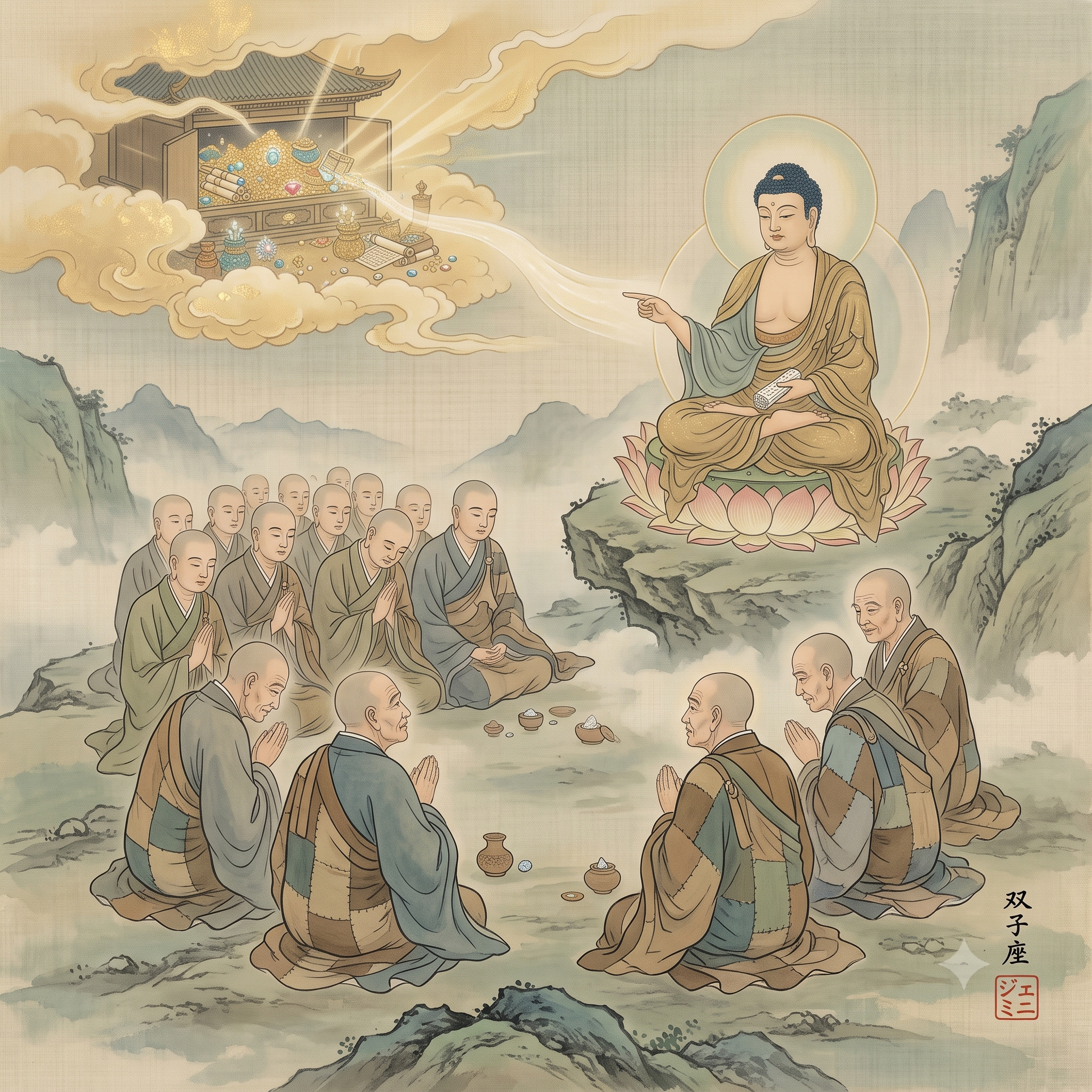
The illustration translates the parable from Chapter Eight of the Lotus Sūtra into visual metaphor. It contrasts the monks' previous self-limited understanding of realization with the boundless treasure house of the Buddha's full teaching. The monks, shown in humble postures of prayer and introspection, represent the 'foolish men' who contented themselves with the partial attainment of personal release from suffering. This limited Nirvana is symbolized by the few small, isolated containers. Above, Śākyamuni Buddha, identifiable by his classic iconography and posture on the lotus seat, gestures toward a vast, overflowing treasure house in the clouds. This visually expansive source of jewels, scrolls, and divine artifacts represents the "immeasurable treasures" of enlightenment and the realization that their true purpose is the Mahayana ideal: to actively benefit all beings. The composition uses traditional pigments and gold to evoke a profound, sacred moment of dawning realization.

Iconography & Character Identification
Item 1: Deities/Figures Featured: Śākyamuni Buddha (the historical Buddha) is seated on the lotus throne. A large group of monastic disciples, representing the five hundred monks mentioned in the Lotus Sūtra, are kneeling and standing in reverence.

Item 2: Text Translations: The Kanji signature in the lower-right corner, 双子座, translates to 'Gemini'. The text within the red square seal, written in Katakana, เจミニ, translates to 'Gemini'.

The Nirvāṇa we attained was
Only part of the immeasurable treasures of yours.
We were like a foolish man with no wisdom.
We satisfied ourselves with what little we had attained.

Five hundred of the Buddha’s monks give this explanation in Chapter Eight of the Lotus Sūtra. They had spent all of their time with the Buddha working to rid themselves of suffering. While this is a remarkable achievement, it does not compare to the true purpose of the Buddha’s teaching. When these monks heard the Buddha teach the Lotus Sutra, and understood that their true purpose was to benefit others, they realized that their earlier practice was preparation. By remaining preoccupied with suffering, they had lost sight of the treasure of enlightenment.

The Daily Dharma is produced by the Lexington Nichiren Buddhist Community. To subscribe to the daily emails, visit zenzaizenzai.com

Daily Dharma for July 5, 2026

20260705-ddi

Illustration by Google Gemini

Show Gemini's thinking

Gemini Thinking

Conceptual Summary
The illustration is a traditional Japanese Buddhist silk painting interpreting Nichiren's Treatise on the Testimony of the Lotus Sutra. The scene visualizes the concept of accumulated merit (good karma) overriding past transgressions to create present-day faith. Nichiren, depicted as a compassionate monk, addresses Nanjō Tokimitsu, the intended recipient of the letter. To emphasize the "Superiority of the Lotus Sutra" over temporal power, a large scroll bearing the scripture's title (法華経) is positioned centrally on a stand between them, and Nichiren holds a brush, indicating his intent to spread the teaching. Swirling golden clouds create a dreamlike temporal boundary, visualizing the text's recollection of past existences: a humble figure (representing Tokimitsu's past self) makes simple, respectful offerings to an endless multitude of Buddhas. This imagery visually anchors the conceptual narrative that Tokimitsu's present faith and humble birth are the karmic results of significant past merit, despite past slanders of the Dharma.

Iconography & Character Identification
Item 1: Deities/Figures Featured:

Nichiren Shōnin (seated monk)

Nanjō Tokimitsu (kneeling young samurai)

The Ten Trillion Buddhas of the Past (stylized multitude on clouds)

Past Incarnation making offerings (generic human figure on clouds)

Item 2: Text Translations:

法華経: Lotus Sutra (appearing on the scroll stack/stand)

双子座: Gemini (signature)

ジェミニ: Gemini (seal text in Katakana)

I am grateful to have been born a human with this precious body due to accumulated causes and conditions in my past existences. According to the sutra, I must have encountered and given offerings to ten trillion Buddhas in the past. Even though I did not place my faith exclusively in the Lotus Sutra, thus slandering the Dharma and being born poor and lowly in this life as a result, my merit of giving offerings to the Buddhas was so great that I was born as a believer of the Lotus Sutra.

Nichiren wrote this passage in his Treatise on the Testimony of the Lotus Sutra (Hokke Shōmyō-shō) addressed to Nanjō Tokimitsu. Unlike most of those who practiced the Buddha Dharma in his time, Nichiren did not belong to the higher classes of royalty or warriors. He saw clearly the suffering of common people and vowed to end it. He realized that the superiority of the Lotus Sūtra does not lie in its power to bring rain or change history. The power of this sūtra lies in its determination to save all beings, rich or poor, noble or common, deluded or wise. Nichiren’s offering to the Buddha was to spread this Wonderful Dharma. To benefit the Buddha is to benefit all beings.

The Daily Dharma is produced by the Lexington Nichiren Buddhist Community. To subscribe to the daily emails, visit zenzaizenzai.com
Daily Dharma for July 4, 2026


Illustration by Google Gemini

Show Gemini's thinking

Gemini Thinking

Conceptual Summary
This 1:1 composition interprets Chapter Sixteen of the Lotus Sūtra by focusing on the Parable of the Excellent Physician as a metaphor for the nature of the Buddha. The central dynamic captures the juxtaposition of human suffering and the Buddha’s compassionate 'expedient means.' Below, the children, representing humanity, suffer from their own deluded minds, surrounded by the spilled medicine they refuse to recognize. This emphasizes the suffering (dukkha) inherent in their condition. Above, Śākyamuni Buddha is not an abstract concept, but is actively withdrawing into the heavens. This visual 'disappearance'—accomplished with subtle gold leaf and mineral blue pigment clouds—directly interprets the source text, where the Buddha expediently declares his 'death' to compel self-effort. He looks back not with condemnation, but with profound compassion, emphasizing that his absence is a pedagogical tool to awaken their potential and lead them.

Iconography & Character Identification
Item 1: Deities/Figures Featured:

Śākyamuni Buddha (The historical Buddha)

The suffering children of the excellent physician (representing deluded sentient beings)

Item 2: Text Translations:

Kanji Signature: '双子座' (Gemini, or Twins Constellation)

Red Square Seal (Hanko): 'ジェミニ' (Gemini)

I am like the father. It is many hundreds of thousands of billions of nayutas of asaṃkhyas of kalpas since I became the Buddha. In order to save the [perverted] people, I say expediently, ‘I shall pass away.’ No one will accuse me of falsehood by the [common] law.

The Buddha gives this explanation in Chapter Sixteen of the Lotus Sūtra. In the story of the Physician and his children, the father leaves and sends word that he has died when his children refuse to take the antidote he has prepared for them. He gave his children no choice but to accept what they already had and make the effort to improve themselves and set aside their deluded minds. In the same way, when we take the Buddha for granted, and close our eyes to the Wonderful Dharma he has given us, he disappears. It is only when we open our eyes and see clearly this world and ourselves in it that we can recognize the Buddha and how he is always leading us.

The Daily Dharma is produced by the Lexington Nichiren Buddhist Community. To subscribe to the daily emails, visit zenzaizenzai.com
Daily Dharma for July 3, 2026

20260703-ddi

Illustration by Google Gemini

Show Gemini's thinking

Gemini Thinking

Conceptual Summary
The illustration is a visual interpretation of the assembly at Vulture Peak described in Chapter Eleven of the Lotus Sūtra. The conceptual thinking focuses on the pivotal moment Śākyamuni Buddha seeks a successor to transmit and preserve the Sūtra of the Lotus Flower of the Wonderful Dharma in the Sahā-World. The composition visually separates the celestial bodhisattvas on the left from the mortal disciples and lay practitioners on the right, illustrating that the transmission of the Dharma is not dependent on status, but on faith and the determination to benefit others. Subtle use of mineral pigments and atmospheric perspective captures the solemnity and the immediate "time to do this" prior to the Buddha's Parinirvāṇa.

Iconography & Character Identification
Item 1: Deities/Figures Featured:

Śākyamuni Buddha (Historical Buddha), centrally seated in teaching robes.

The Great Assembly, comprised of both celestial and human figures, including:

Multiple Bodhisattvas (listening, hands clasped).

Buddhist Monks (Arhats, standing and kneeling).

Lay disciples (figures with covered heads and simpler robes).

Item 2: Text Translations:

Kanji signature '双子座': "Gemini" (Lit. "Twins Constellation").

Red square seal (hanko) 'ジェミニ': "Gemini" (Written in Katakana phonetic script).

“Who will expound the Sūtra of the Lotus Flower of the Wonderful Dharma in this Sahā-World? Now is the time to do this. I shall enter into Nirvāṇa before long. I wish to transmit this Sūtra of the Lotus Flower of the Wonderful Dharma to someone so that this sūtra may be preserved.”

The Buddha asks this of those gathered to hear him teach in Chapter Eleven of the Lotus Sūtra. If there had been no one among those listening who was able to expound the Sūtra, he would not have asked this question. Our ability to benefit others with the Buddha Dharma is not based on our eloquence, our intelligence or our position in life. It is based only on our faith in the Buddha’s teachings and our determination to benefit others. When we read, recite, and copy the Lotus Sūtra, the Buddha is transmitting it to us. We preserve the Sūtra through our practice.

The Daily Dharma is produced by the Lexington Nichiren Buddhist Community. To subscribe to the daily emails, visit zenzaizenzai.com
Daily Dharma for July 2, 2026

20260702-ddi

Illustration by Google Gemini

Show Gemini's thinking

Gemini Thinking

Conceptual Summary
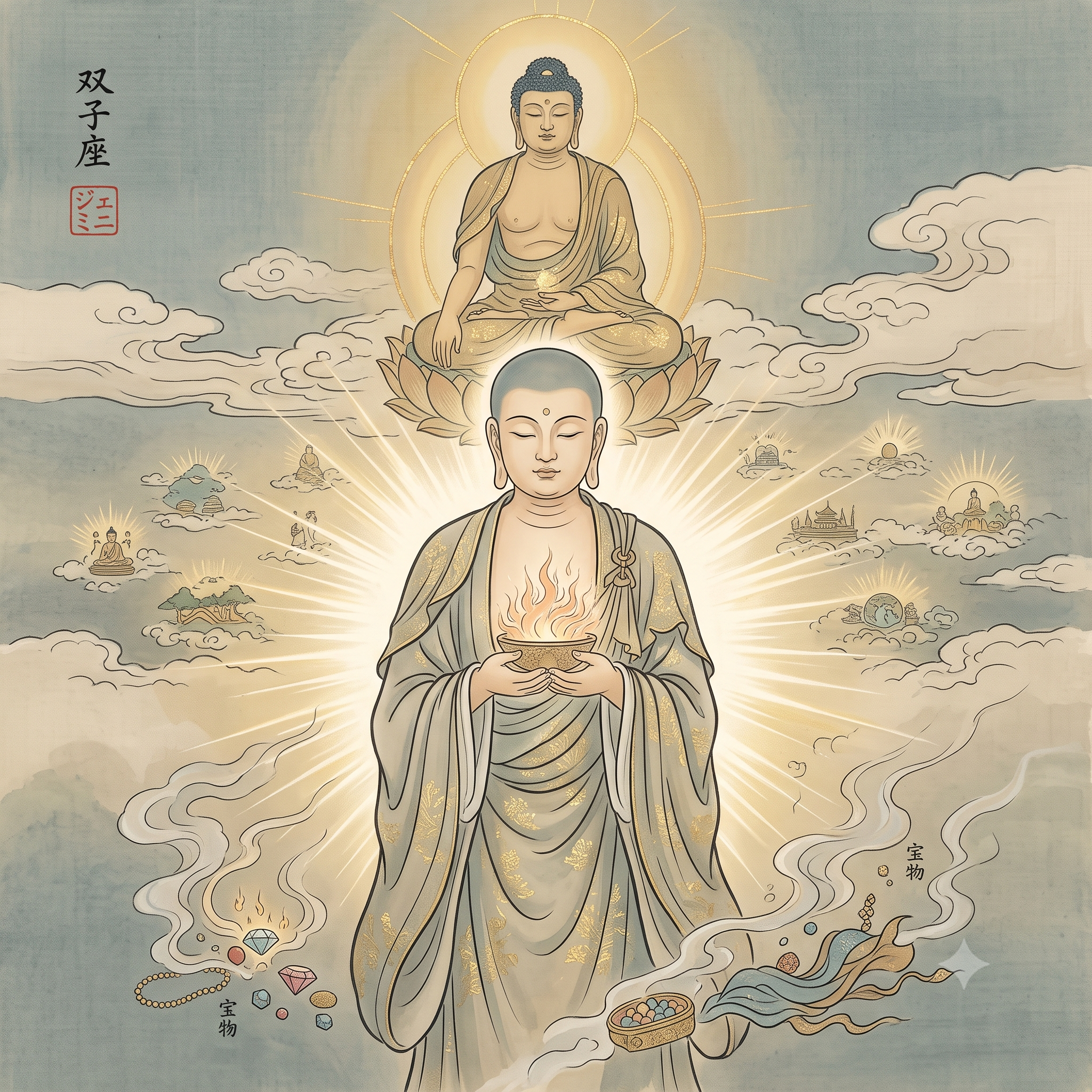
The illustration is a visual meditation on the concept of 'reading the Lotus Sutra with our bodies,' specifically interpreting the story of Gladly-Seen-By-All-Beings Bodhisattva. The traditional, subdued style on silk underscores the timeless and profound nature of this selfless sacrifice. I focused the narrative on the contrast between worldly offerings and the ultimate offering of self. To represent the Bodhisattva’s past life, I visualized conventional offerings like jewels and celestial clothes as valuable but ephemeral things, labeled in small kanji, literally vanishing as they are outmatched by the intense, radiant light—the true 'treasure'—originating directly from the Bodhisattva’s body and radiating to countless worlds. By explicitly avoiding common figures like Amida or Dainichi, the composition keeps the focus squarely on the generic 'Ancient Buddha' of the text and the transformative act of the Bodhisattva, making the abstract concept of living the Dharma tangible through this dynamic, luminous sacrifice.

Iconography & Character Identification
Item 1: Deities/Figures Featured:

Ancient Buddha: The celestial figure seated above, receiving the final offering.

Gladly-Seen-By-All-Beings Bodhisattva (later Medicine-King Bodhisattva): The central glowing figure offering his body.

Item 2: Text Translations:

Signature (Kanji): 双子座 - 'Futagoza' (Gemini)

Seal (Katakana): ジェミニ - 'Jemini' (Gemini)

Having made these offerings [to the Buddha], he emerged from the samādhi, and thought, ‘I have now made offerings to the Buddha by my supernatural powers. But these offerings are less valuable than the offering of my own body.’

In Chapter Twenty-Three of the Lotus Sūtra, the Buddha tells the story of Gladly-Seen-By-All-Beings Bodhisattva, the previous life of Medicine-King Bodhisattva. This Bodhisattva practiced under an ancient Buddha, and made exorbitant offerings to that Buddha through his supernatural powers. He then realized that all the riches of the universe that he could conjure up paled in comparison to the treasure of his own body and his own life. He then made an offering of his body to the Buddha, which illuminated innumerable worlds. Nichiren wrote often of the hardships he faced in his life and those of his followers. He wrote of “reading the Lotus Sūtra with our bodies,” meaning bringing the Buddha’s wisdom to life in our lives. When we act according to the Wonderful Dharma, no matter what hardships we face, then we too are living the Lotus Sūtra, and making a perfect offering from our gratitude to the Buddha.

The Daily Dharma is produced by the Lexington Nichiren Buddhist Community. To subscribe to the daily emails, visit zenzaizenzai.com
Daily Dharma for July 1, 2026

20260701-ddi

Illustration by Google Gemini

Show Gemini's thinking

Gemini Thinking

Conceptual Summary
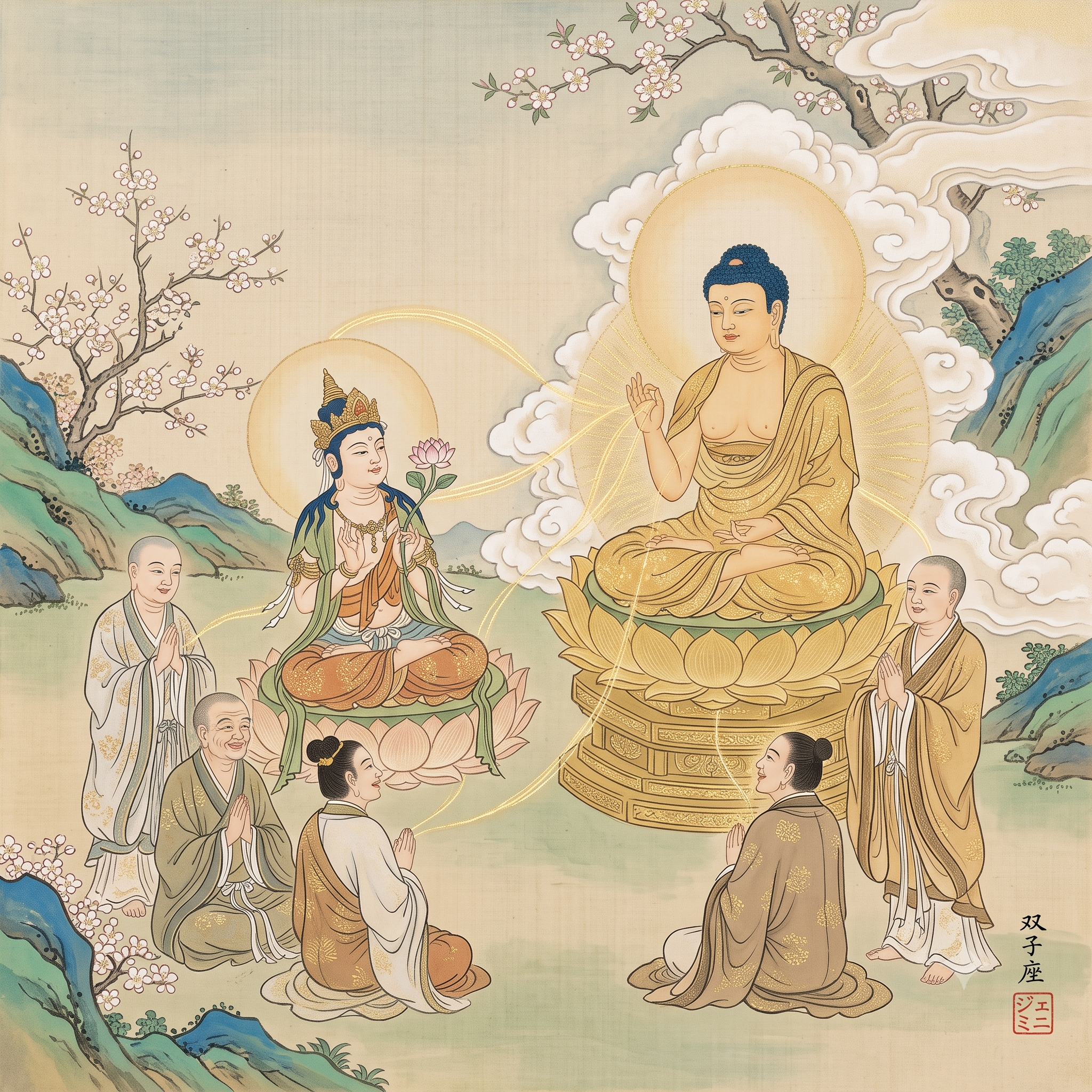
The illustration is a traditional ink, mineral pigment, and gold leaf painting on silk (1:1 square ratio) that translates specific concepts from Chapter Seventeen of the Lotus Sūtra into classical Japanese Buddhist iconography. Rather than a purely narrative scene, the image serves as an iconographic tableau focused on the specific moment Śākyamuni Buddha (釈迦如来) reveals the ever-present nature of his life and the awakening of inherent joy to his disciple Maitreya (弥勒菩薩). Śākyamuni is positioned centrally on a gold lotus throne, and Maitreya, seated on a lower lotus, is identified by the specific iconographic element of the miniature pagoda (stūpa) in his headdress, reflecting his role in receiving this teaching. Crucially, the 'firm faith' and 'joy' mentioned in the source text are not generalized; they are specifically 'the joy in our awakening Buddha nature.' To visualize this internal spiritual concept, the painting incorporates visual threads of golden light emanating directly from Śākyamuni’s heart. This radiance connects not only to the surrounding Hōben-hon assembly (the 'good men or women' mentioned) but specifically bypasses physical suffering, symbolizing the direct awakening to one's innate Buddha nature that comes from rejoicing in the teaching.

Iconography & Character Identification
Item 1: Deities/Figures Featured:

The illustration features three distinct figures or groups derived from classical iconography:

Central Figure: Śākyamuni Buddha (釈迦如来, Shaka Nyorai). He is seated on a gold lotus throne, adorned in classical robes, and his mudra (hand gesture) signifies the teaching of the Lotus Sūtra (Hōshō Mudra).

Seated Attendant Figure: Maitreya Bodhisattva (弥勒菩薩, Miroku Bosatsu). Maitreya is identifiable as the Bodhisattva seated below Śākyamuni to his right, distinguishable by the small miniature pagoda (stūpa) element positioned in his complex headdress.

Right Figure (and Group): This figure represents the Hōben-hon Assembly, representing the 'good men or women' and the general assembly who are hearing and rejoicing in the sūtra. While depicted as a single representative, they stand for the larger group mentioned in the sūtra chapter receiving the teaching.

Item 2: Text Translations:

The text present in the lower right corner of the illustration is the traditional signature and artist seal:

Kanji (Signature): 双子座

Translation: Gemini

Katakana (Seal/Hanko): ジェミニ

Translation: Gemini

Furthermore, the good men or women who do not speak ill of this sūtra but rejoice at hearing it after my extinction, should be considered, know this, to have already understood my longevity by firm faith.

The Buddha makes this declaration to his disciple Maitreya in Chapter Seventeen of the Lotus Sūtra. After learning the merits of understanding the ever-present nature of the Buddha, Maitreya hears that this understanding is present in anyone who finds joy in this sūtra. From the parables told earlier in the sūtra, we know that this joy is not the same as the joy that comes from ending suffering. It is the joy in our awakening Buddha nature.

The Daily Dharma is produced by the Lexington Nichiren Buddhist Community. To subscribe to the daily emails, visit zenzaizenzai.com

Daily Dharma for June 30, 2026

20260630-ddi

Illustration by Google Gemini

Show Gemini's thinking

Gemini Thinking

Conceptual Summary
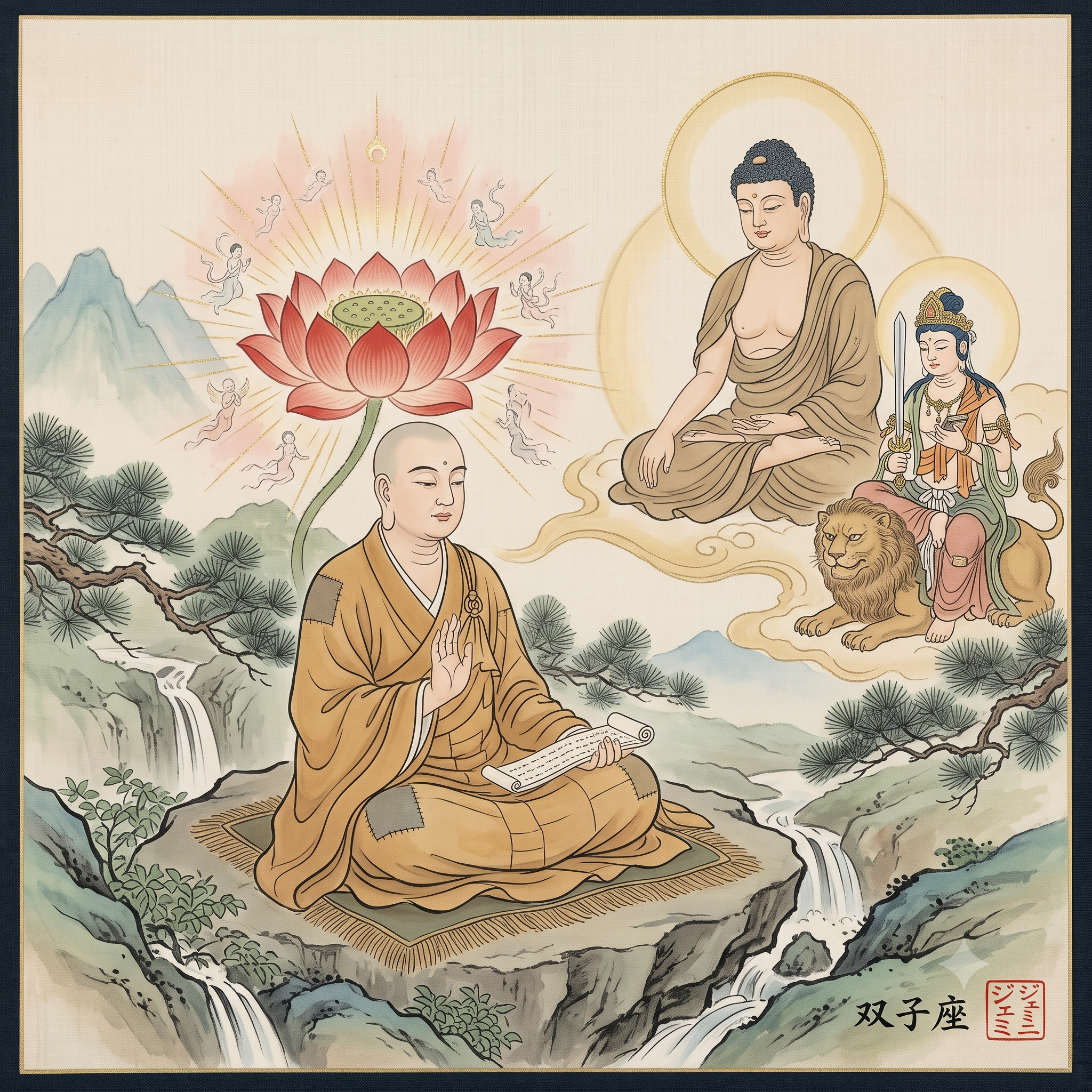
This 1:1 composition captures the essence of Chapter Fourteen of the Lotus Sūtra using traditional Japanese ink and pigment techniques on silk. At the center, the dedicated bhikṣu is shown in a state of tranquil patience, represented by the calm mountain and waterfall environment, indicating his liberation from external distractions. He holds the Lotus Sūtra scroll while a large red lotus, symbolizing 'the Wonderful Dharma,' blossoms behind him, emanating small, liberated beings who have successfully escaped from "jealousy, anger, and other illusions," visualizing the promised emancipation. Seated on the right, Śākyamuni Buddha is identified by his classic iconography, actively preaching the dharma. Next to him is Mañjuśrī Bodhisattva, identified by his unique mount (the lion) and the sword that cuts through ignorance, listening and validating this 'peaceful practice' teaching.

Iconography & Character Identification
Item 1: Deities/Figures Featured: 1. Śākyamuni Buddha (The historic Buddha, preaching). 2. Mañjuśrī Bodhisattva (The Bodhisattva of Wisdom, identified by his lion mount and sword). 3. The Bhikṣu (The monk practitioner who expounds the Lotus Sūtra).

Item 2: Text Translations: 1. Kanji Signature: 双子座 (Futagoza) — 'Gemini'. 2. Red Seal: ジェミニ (Jemini) — 'Gemini'.

A bhikṣu who expounds this Sūtra
Of the Lotus Flower of the Wonderful Dharma
With patience
After my extinction,
Will be emancipated
From jealousy, anger, and other illusions,
That is to say, from all obstacles.

The Buddha sings these verses to Mañjuśrī Bodhisattva in Chapter Fourteen of the Lotus Sūtra in which he describes the peaceful practices of a Bodhisattva. We may realize that jealousy and anger are not desirable states, but only because what these states do to our moods. No matter how justified we may feel in our jealousy or anger, these are not pleasant states to be in or even to be around. The Buddha reminds us that the real problem with these states is that they keep us from seeing things as they are. Jealousy exaggerates the importance of what we want but do not have. Anger exaggerates the bad qualities of the targets of our anger. When we focus on this wonderful teaching, develop our patience, and remain determined to benefit all beings, we see things for what they are, and are liberated from illusions.

The Daily Dharma is produced by the Lexington Nichiren Buddhist Community. To subscribe to the daily emails, visit zenzaizenzai.com