
According to the Lotus Sutra, … even the voice-hearers are on the path of the One Vehicle that leads to buddhahood. The nirvana of the arhats is a temporary goal on the journey to perfect and complete enlightenment, like the “magic city” conjured to provide a temporary respite for weary travelers in one of the parables of the Lotus Sutra. The true “voice-hearer” then, is actually a bodhisattva who has heard the teaching of the One Vehicle of the Lotus Sutra and who enables others to hear it as well.
Lotus World: An Illustrated Guide to the GohonzonAll posts by John Hughes
Daily Dharma – Nov. 5, 2018
Only perverted people say:
“All things exist,” or “Nothing exists,”
Or “All things are real,” or “Nothing is real,”
Or “All things are born,” or “Nothing is born.”
The Buddha declares these verses in Chapter Fourteen of the Lotus Sūtra in which he describes the peaceful practices of a Bodhisattva. Hearing these descriptions can be confusing. We think that we have to choose from among these views, and that these are the only views possible. The Buddha shows us another way. When we think of things as either unchanging or nonexistent, we live in a world of either judgement or despair. The Buddha shows us how to value what exists as it is changing and not attach ourselves to our expectations of stability. It is only because we are changing, and the world is changing around us, that we have the potential to become enlightened.
The Daily Dharma is produced by the Lexington Nichiren Buddhist Community. To subscribe to the daily emails, visit zenzaizenzai.com
The Ultimate Truth That Reflects Objective Reality
To Chih-i, the Relative Truth and the Ultimate Truth constitute the Ultimate Truth that reflects objective reality:
“With this [Dharma of the Relative and Ultimate] as objective reality, what dharma is not incorporated? To bring forth knowledge with this object, what kind of knowledge would not be initiated?”
When the Dharma of Sentient Beings is considered to consist of the Relative and the Ultimate, it also signifies inconceivability. Since the Dharma of Sentient Beings is inconceivable, it is subtle. Chih-i concludes:
“The Dharma of Sentient Beings is inconceivable—though Ultimate, it is yet Relative; even though Relative, it is yet Ultimate. The Ultimate and Relative are identical and of no hindrance to each other. One should not view and look at living beings with the eyes of an ox or a sheep and evaluate and measure them with the mind of an ignorant man. Only when [one] has the knowledge like the Tathāgata, can [one] evaluate and measure [them].”
This is to say that the Dharma of Sentient Beings is related to the Twofold Knowledge concerning the Relative Truth and the Ultimate Truth.
These two truths embrace each other. The Relative contains the Ultimate and vice versa. Speaking of the Relative that contains the Ultimate, the real intention of the Buddha is to utilize the Relative as an expedient means, and to gradually guide sentient beings to attain Buddhahood. Speaking of the Ultimate that contains the Relative, the Relative as an expedient means is an indispensable device in revealing the Ultimate Truth about universal liberation for all sentient beings. The Relative and the Ultimate are two facets of the same reality that constitute the Dharma of Sentient Beings. (Vol. 2, Page 74-75)
The Profound Meaning of the Lotus Sutra: Tien-tai Philosophy of BuddhismThe Influence of Karma
[O]ur bad karma has a big influence on our lives. Once we have created bad karma, we have to reap the undesirable harvest that will inevitably arise as a result until the bad karma runs out. Examples of this harvest may be long periods of illness, accidents, family feuds, trouble with children, health, business, human relationships, etc. Karma influences our whole life and shapes the stream of our lives with good and/or bad fortune.
Summer WritingsDaily Dharma – Nov. 4, 2018
All that I say is true, not false, because I see the triple world as it is. I see that the triple world is the world in which the living beings have neither birth nor death, that is to say, do not appear or disappear, that it is the world in which I do not appear or from which I do not disappear, that it is not real or unreal, and that it is not as it seems or as it does not seem. I do not see the triple world in the same way as [the living beings of] the triple world do. I see all this clearly and infallibly.
The Buddha makes this revelation in Chapter Sixteen of the Lotus Sūtra. In the story, he has just explained that although beings see him as a man who became enlightened after growing up as a crown prince, in reality he has been enlightened since an unimaginable amount of time in the past, and will continue to lead all beings to enlightenment for twice that period of time into the future. As we learn to see the historical Śākyamuni Buddha as the ever-present Śākyamuni Buddha, our vision of the world changes too.
The Daily Dharma is produced by the Lexington Nichiren Buddhist Community. To subscribe to the daily emails, visit zenzaizenzai.com
Three Facets of the Ten Realms
In view of the fact that the Ten Suchnesses represent the Ultimate Truth, and the Ultimate Truth consists of both the Relative and the Ultimate, the Relative and the Ultimate are defined by Chih-i in relation to the Ten Dharma-realms. … [T]he first nine realms are ascribed by Chih-i to the Relative, and the last Buddha-realm to the Ultimate. Among the ten realms, the six realms (hell-dwellers, hungry ghosts, animals, asuras, humans and heavenly beings) are the lower state of existence, and the four realms (śrāvakas, pratyekabuddhas, bodhisattvas, and Buddhas) are the state of sagehood (Liu-tao Ssu-sheng). Since the Ten Dharma-realms are divided into the Relative and the Ultimate, like that of the Ten Suchnesses, the ten realms should also contain the three meanings in terms of the Threefold Truth.
- With regard to the Ten Dharma-realms that contain the meaning of Emptiness, this means that all ten realms belong to the Dharma-realm (Ch., Fa-chieh; Skt., dharmadhātu), the former relies on the latter (Neng-i), and the latter as the foundation is what the former relies upon (So-i). Thus, the ten realms form the Ten Dharma-realms. All of the Ten Dharma-realms are fundamentally empty and enter the realm of Emptiness (K’ung-chieh).
- With regard to the Ten Dharma realms that contain the meaning of the Provisional, this refers to the separation of the ten realms (Shih-chieh Chieh-ko) due to their differences between the lower states of existence and the state of sagehood:
“Because of their different lots, separated causes and effects, and distinctive features of the profane and sacred states, the ten realms are differentiated from each other.”
Their differences are related to the conventional existence, with which the Ten Dharma-realms enter the realm of the Provisional (Chia-chieh).
- With regard to the Ten Dharma-realms that contain the meaning of the Middle Way, this means that the Middle Way can be inferred from the principle or truth that is embodied by the Ten Dharma-realms:
“These Ten [Dharma-realms] are all identical to the dharmadhātu and encompass all dharmas. All dharmas tend toward hell, and do not transcend this destiny. [The dharmadhātu] itself is the principle [of reality], and since it does not depend on anything, it is called the dharmadhātu. The same is also true [for all destinies] all the way up to the Buddha Dharma-realm.”
The principle or truth is what the dharmadhātu denotes, and the principle is referred by Chih-i to the Middle Way. Therefore, the Ten Dharma-realms enter the realm of the Middle Way (Chung-chieh).
The connections between the Ten Dharma-realms and the Ten Suchnesses are displayed in a statement by Chih-i:
“One Dharma-realm embraces the Ten Suchnesses, and the Ten Dharma realms embrace one hundred Suchnesses.”
Meanwhile,
“One Dharma-realm embraces the other nine Dharma-realms, and hence, there come to be one hundred Dharma-realms and one thousand Suchnesses.”
(Vol. 2, Page 73-74)
The Profound Meaning of the Lotus Sutra: Tien-tai Philosophy of BuddhismChild Practice
Of the five practices of a Bodhisattva – saint practice, Brama practice, nature practice, child practice, and sickness practice – Child practice is to practice with the inquisitive excitement of a child exploring and understanding their world. The child when it learns and explores is open to all sorts of possibilities and does not have preconditions for understanding. The child approaches life with unbridled excitement and constant questing for understanding. As we practice Buddhism, especially if we have been doing it a long time, we can loose that childlike wonder and excitement.
Lecture on the Lotus SutraDaily Dharma – Nov. 3, 2018
I see that all living beings are burned by the fires of birth, old age, disease, death, grief, sorrow, suffering and lamentation. They undergo various sufferings because they have the five desires and the desire for gain…Notwithstanding all this, however, they are playing joyfully. They are not conscious of the sufferings. They are not frightened at the sufferings or afraid of them. They do not dislike them or try to get rid of them. They are running about this burning house of the triple world, and do not mind even when they undergo great sufferings.
The Buddha offers this explanation to his disciple Śāriputra in Chapter Three of the Lotus Sūtra. He compares his teaching of suffering and Nirvāṇa to a father luring his children from a dangerous house with a promise of better toys. The children were so preoccupied with their own entertainment that they could not hear their father’s warning. In this triple world of beautiful forms, fascinating ideas and consuming desires, it is easy to stay with our childish games and ignore the Buddha’s teaching. Our maturity as Bodhisattvas comes when we set these aside for the benefit of all beings.
The Daily Dharma is produced by the Lexington Nichiren Buddhist Community. To subscribe to the daily emails, visit zenzaizenzai.com
Home Again
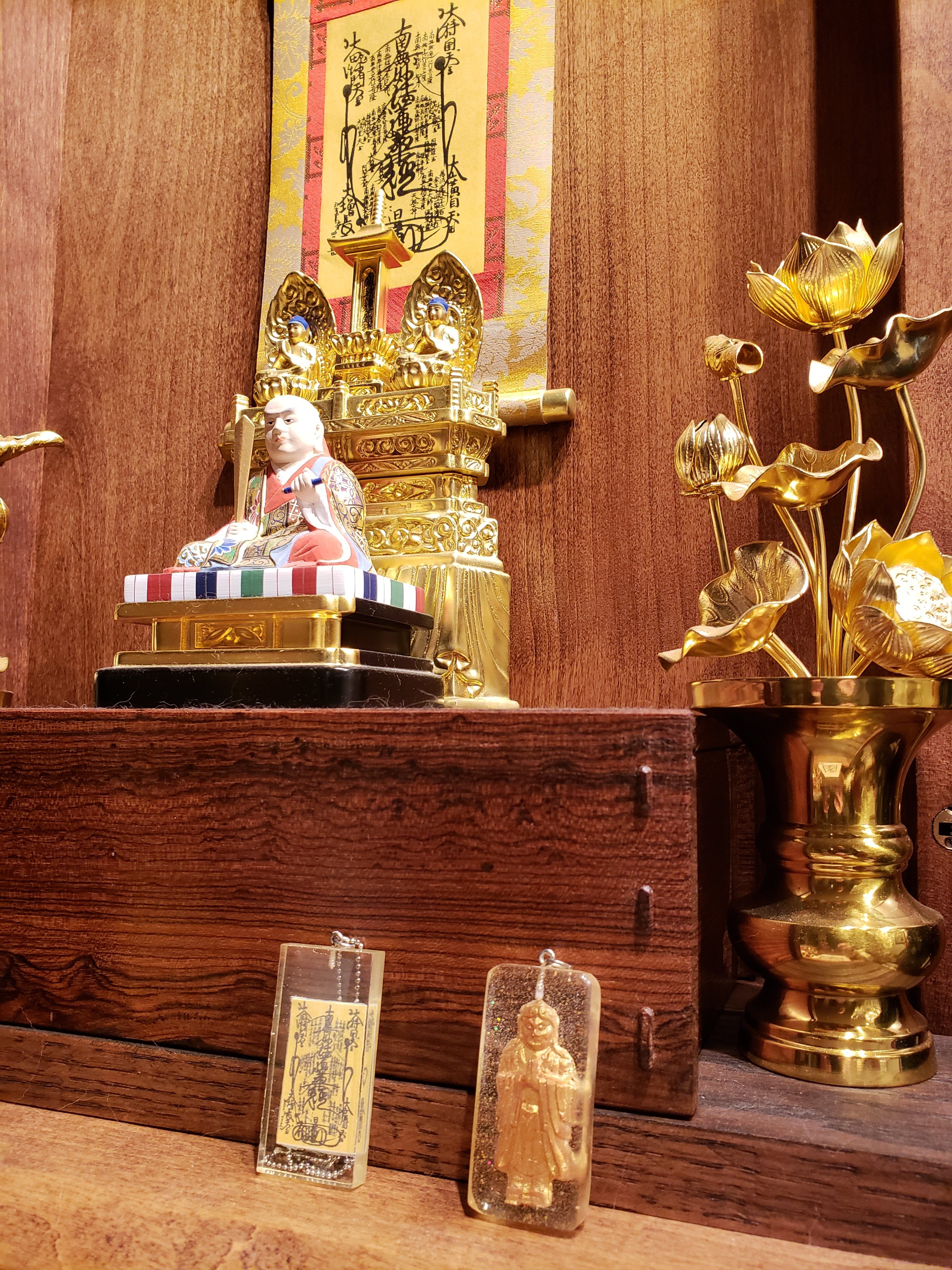
Successfully made it from Churchville, NY, to Sacramento, CA, with stops in:

Three Facets of Ultimate Truth
provisional. The true reality is a single integrated unity, and yet, it contains three facets. The Ultimate Truth is a single integrated unity, and yet, it contains three facets, which is neither vertical nor horizontal. In Chih-i’s terminology, vertical (Shu) and horizontal (Heng) indicate a conceptual understanding of reality (consisting of time and space), in which various dharmas are distinguished as having a length from beginning to end (i.e., time), and as having a range of vastness (i.e., space). Therefore, they exist either horizontally or vertically. Neither vertical nor horizontal indicates a reality that is beyond conceptualization. In this reality, all dharmas that contain the Threefold Truth are simultaneously existent. There is no distinction among them, and therefore, they are considered as neither horizontal nor vertical. Any one of the dharmas represents all dharmas, and all dharmas are included in a single dharma. Chih-states:
“When meanings are expressed through words, Emptiness is identical to the Provisional and the Middle Way. When Emptiness is clarified in terms of ‘suchness’, Emptiness of one thing leads to Emptiness of all things. When “suchness” is specified to explicate the characteristics [of dharmas], the Provisional of one thing comprises the Provisional of all things. To discuss the Middle Way as it is, the Middle Way of one thing embodies the Middle Way of all things. They are not one, two, and three, and yet, they are one, two, and three. They are neither horizontal nor vertical, and are named the Ultimate Truth.”
(Vol. 2, Page 72-73)
The Profound Meaning of the Lotus Sutra: Tien-tai Philosophy of Buddhism