
All posts by John Hughes

Chih-i’s Dharma of Buddha

[T]he subtlety of the Dharma of Buddha is expressed in a passage of the Lotus Sūtra:

“Cease! Cease! No need to explain. My dharma is too subtle to be conceptualized.”

Chih-i concludes:

“The Buddha-dharma is not beyond the Relative and the Ultimate, which is so profound and subtle that it is difficult to be viewed and difficult to be comprehended.”

The meaning of the Subtlety of Knowledge concerning the Ultimate Truth (Shih-chih Miao) is drawn from this sentence:

“Among all sentient beings, none of them can conceive the Buddha.”

The Subtlety of Knowledge concerning the Relative Truth (Ch’üanChih Miao) is drawn from this sentence:

“When it comes to the other categories of the Buddha-dharma, nobody can fathom them either.”

The subtlety of the Dharma of Buddha, composed of the Relative and Ultimate Truth, is evident from the above quotation. Chih-i remarks: “Only Buddhas and Buddhas can ultimately exhaust the Ultimate Truth of all dharmas.”

Basically, the category, Dharma of Buddha, addresses the Ultimate Truth and the Relative Truth that can be the foundation for all the doctrines in the Buddha’s teachings. (Vol. 2, Page 69)

The Profound Meaning of the Lotus Sutra: Tien-tai Philosophy of Buddhism


Hokke-kyō

Besides its characteristic as a source of religious inspiration, the Hokke-kyō was rich in literary qualities. It contained an abundance of materials appealing to the fancy and imagination. The transfiguration of the Vulture Peak and the manifestation of supernal glories set forth in the opening scene; the resplendency of the heavenly worlds in response to the spiritual illumination of a king who, having left his royal dignity, has attained supreme enlightenment; the heavenly shrine (stūpa) appearing in the sky, from which Buddha proclaims and gives assurance of the further propagation of his religion in the Latter Days; the myriads of mysterious beings issuing out of the earth and taking vows before Buddha to work strenuously for religion, these are depicted in a highly imaginative style and with the vividness of apocalyptic vision. The prodigal son who is welcomed home by his noble father and educated to be his worthy heir; the scene of a thunderstorm and heavy rainfall after which plants and flowers grow luxuriantly; the burning house from which a thoughtful father, by means of a special device, takes out his children, these parables are intended to elucidate the all-embracing tact of the educative methods adopted by Buddha. The showers of heavenly flowers scattered upon the spot of Buddha’s sermon; the illumination of all beings by the rays of Buddha’s spiritual illumination; and finally the revelation of the eternal entity of Buddha’s person, these were told and heard in pious devotion. The guarantee given by Buddha to his disciples of their future destiny as Buddhas; the instantaneous enlightenment of a girl Naga (serpent) on hearing Buddha’s sermon, these inspiring stories in assuring salvation for all beings were received with tears of hope and gratitude. In addition to these stimulating stories and good tidings contained in the book, the supreme beauty of the Chinese translation played a great part in deepening and extending its inspiration. It is, then, no wonder that the Hokke-kyō played in Japanese literature a rôle nearly akin to that of the Bible in English literature.

History of Japanese Religion

Daily Dharma – Oct. 28, 2018

I see all living beings equally.
I have no partiality for them.
There is not ‘this one’ or ‘that one’ to me.
I transcend love and hatred.

The Buddha makes this declaration in Chapter Five of the Lotus Sūtra. He compares himself to a rain shower that waters all plants equally. He uses this example to show us how we should approach all living beings. Our respect for them and wish that they become enlightened cannot depend on whatever personal feelings we have towards them.

The Daily Dharma is produced by the Lexington Nichiren Buddhist Community. To subscribe to the daily emails, visit zenzaizenzai.com

Dharma of Sentient Beings

The subtlety of the Dharma of Sentient Beings (Chung-sheng-fa Miao) is also portrayed in the passage of the Lotus Sūtra regarding the material eyes of beings (Ch., Jou-yen; Skt., māṃsacakṣus) which enjoy an equivalent status with either the heavenly eye (Ch., T’ien-yen; Skt., divyacakṣus) or the wisdom-eye (Ch., flui-yen; Skt., prajn͂ācakṣus), or the Dharma-eye (Ch., Fa-yen; Skt., dharmacakṣus), or the Buddha-eye (Ch., Fo-yen; Skt., buddhacakṣus). This proves that Dharma of Sentient Beings is subtle. This is to say that the five eyes are fundamentally one unity, and one inherently possesses them all. From within oneself, one is able to open the Buddha’s knowledge and insight, and perceive the worldly phenomena correctly with one’s own material eyes. Basically, the category Dharma of Sentient Beings concerns the doctrine of the Buddha nature that is possessed by all beings, with which the Buddhahood as the ultimate goal for universal salvation is sustained. (Vol. 2, Page 68-69)

The Profound Meaning of the Lotus Sutra: Tien-tai Philosophy of Buddhism

Daily Dharma – Oct. 27, 2018

Deep in their minds they are thinking of me,
And observing the pure precepts.
Therefore, they will be filled with joy
When they hear they will become Buddhas.
I know their minds.
Therefore, I will expound the Great Vehicle to them.

The Buddha sings these verses in Chapter Two of the Lotus Sūtra. He speaks of those who come to his teachings wanting only to end their own suffering. He understands the part of our existence that is obscured by our delusions, and that the teaching of enlightenment of all beings in the Lotus Sūtra inspires us to purify this world of conflict. The joy we find in the Buddha’s wisdom is incomparable to the happiness we find when our desires are met. When we learn the Buddha’s mind through his teachings, we learn about our own true minds.

The Daily Dharma is produced by the Lexington Nichiren Buddhist Community. To subscribe to the daily emails, visit zenzaizenzai.com

Understanding Buddhism Through the Lotus Sūtra

The … elaboration of the meaning “subtle” paves the way to Chih-i’s own interpretation of the Lotus Sūtra, which is his attempt to establish the Lotus Sūtra as the doctrinal foundation for his system of understanding Buddhism. This is because the most significant feature of the Lotus Sūtra concerns the Ultimate Truth as the Buddha vehicle that embraces all types of the Buddha’s teaching. With the One Buddha-vehicle as the unifying force, Chih-i is able to incorporate different viewpoints, to classify the teaching of the Buddha, to reconcile differences among various divisions of Buddhism, and to give a reasonable explanation of various theories that are held by different schools. By doing so, Chih-i demonstrates that Buddhism can be viewed as a whole, and that various doctrines and theories of practice that are apparently contradictory to each other are in fact coherent, for they are part of the scheme in the Buddha’s teaching. Chih-i’s endeavor of establishing a coherent system of presenting Buddhism as a whole reflects the need of his time that calls for the unification of the Buddhist world in Southern and Northern China (as we have mentioned in the background introduction in Chapter One of Volume I). Chih-i’s effort of establishing a coherent system of understanding Buddhism may be driven by his own religious devotion as well as his own realization of the Lotus teaching. Having fully digested the teaching expressed in different Buddhist scriptures, Chih-i must have felt obligated to use his talent to take upon himself the huge task of systematizing the teaching of the Buddha, in order to reconcile contradictory views among various Buddhist schools, and to assure that Buddhism, as a whole, would further flourish in Chinese soil. (Vol. 2, Page 67-68)

The Profound Meaning of the Lotus Sutra: Tien-tai Philosophy of Buddhism


The Two Vidyarajas

The two Vidyarajas represented on the Great Mandala – Achalanatha [Fudo Myo-o (Japanese) Immovable Lord Knowledge King] and Ragaraja [Aizen Myo-o (Japanese) Desire King Knowledge King], have also been viewed as the representatives of the teachings that “birth and death are themselves nirvana” (Japanese, shoji soku nehan) and “the afflictions are themselves enlightenment” (Japanese, bonno soku bodai) respectively. The first principle means that nirvana does not exist in another realm but is actually the true reality of this realm, the world of birth and death. The second principle means that enlightenment is not the eradication of the afflictions, like greed and anger, but their liberation and trans­formation, via the wholesome energy of the enlightened mind, into positive qualities like devotion and discernment.

Lotus World: An Illustrated Guide to the Gohonzon

A Burial Service

Mary and Robert Buchin laying to rest their partents, Richard and Mary at Churchville Village Cemetery,

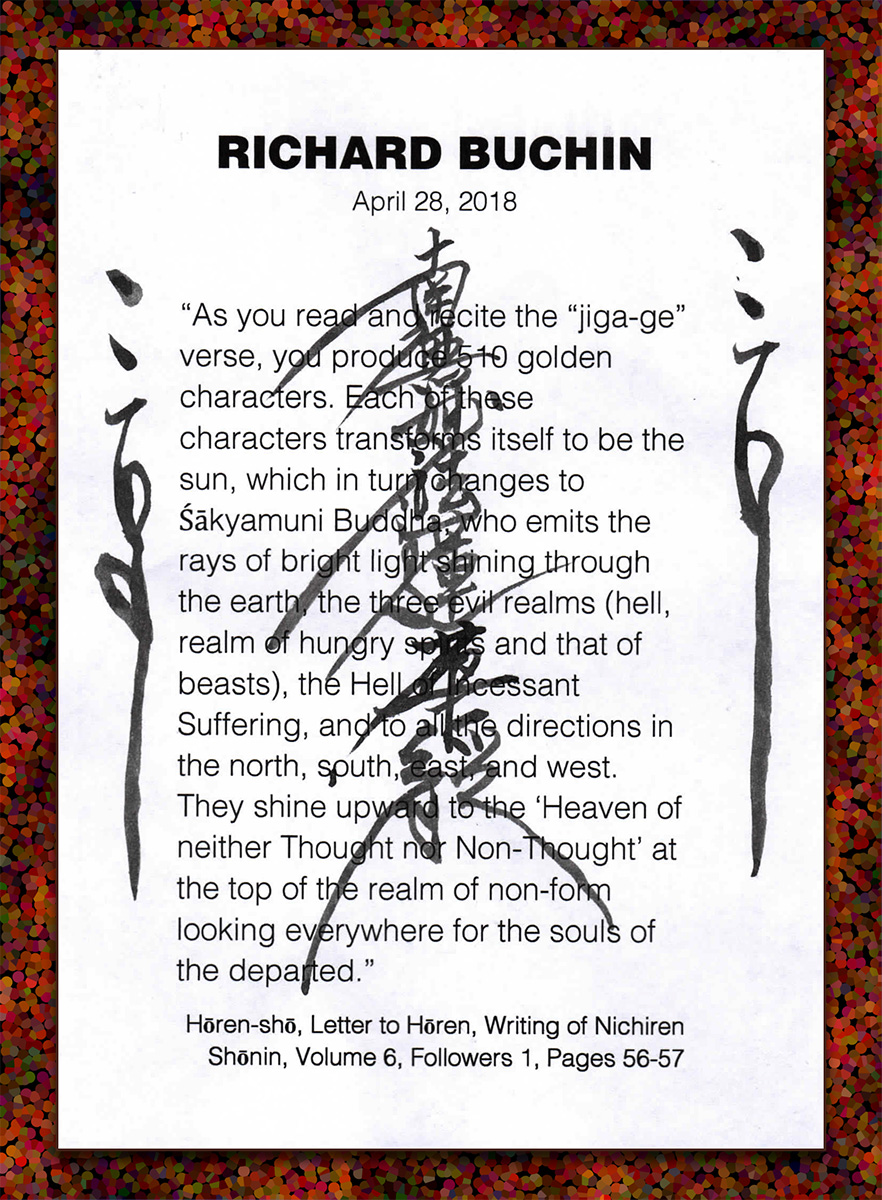
Held a burial service of sorts for my wife’s parents, Richard (April 28 2018) and Mary (April 15, 2016) Buchin. My wife, Mary, and her brother, Robert, each read poems. For my part, I lit two sticks of incense and inserted them in the dirt in front of the cremains. Before reciting the Jiga-Ge verses, I read this excerpt from Nichiren’s Hōren-shō, Letter to Hōren, Writings of Nichiren Shōnin, Volume 6, Followers I,
Pages 56-57:

“As you read and recite the ‘jiga-ge’ verse, you produce 510 golden characters. Each of these characters transforms itself to be the sun, which in turn changes to Śākyamuni Buddha, who emits the rays of bright light shining through the earth, the three evil realms (hell, realm of hungry spirits and that of beasts), the Hell of Incessant Suffering, and to all the directions in the north, south, east, and west. They shine upward to the ‘Heaven of neither Thought nor Non-Thought’ at the top of the realm of non-form looking everywhere for the souls of the departed.”

After completing the Jiga-Ge verses, I chanted Namu-Myoho-Renge Kyo three times.

The poem Mary read as part of the service.

My wife’s mother was Japanese. She meet and married Richard Buchin in Tokyo in 1950. He was in the Army; she worked as a translator. Neither were Buddhists or particularly religious. Still, one of my favorite aspect of my Buddhist practice is the opportunity to transfer merit to the departed.

I have a traditional memorial tablet for my wife’s mother and a somewhat nontraditional memorial for her father.

Daily Dharma – Oct. 26, 2018

The great multitude, having seen the two Tathāgatas sitting cross-legged on the lion-like seat in the stūpa of the seven treasures, thought, “The seat of the Buddhas is too high. Tathāgata! Raise us up by your supernatural powers so that we may be able to be with you in the sky!”

This description comes from Chapter Eleven of the Lotus Sūtra. Many-Treasures Buddha has arrived where the Buddha was teaching so that he could endorse this Wonderful Dharma. He invited the Buddha to join him in an enormous stūpa tower hanging in the sky. When the Buddha raises up those gathered to hear him teach, he puts them all on the same level as himself and all the other Buddhas. He shows them that they too have the capacity to hear his teachings and put them into practice. Nichiren depicted this “ceremony in the air” in the Omandala Gohonzon and advised us to use this as the focus of our practice. When we put ourselves into this great multitude we listen for the Buddha teaching and realize the benefit we create in this world.

The Daily Dharma is produced by the Lexington Nichiren Buddhist Community. To subscribe to the daily emails, visit zenzaizenzai.com

The Ultimate Truth of Oneness

[T]he meaning of the subtlety (Miao-i) is concluded by Chih-i as signifying the single reality of the teaching of the Buddha. This is to say that the teaching of the Buddha concerns the Ultimate Truth of Oneness:

  1. Oneness of principle (Li-i) in terms of the Ten Dharma-realms (that the truth the Buddha intends to convey is one).
  2. Oneness of teaching (Chiao-i) in terms of the five flavors (that all teachings of the Buddha contain the same goal of leading living beings to attain Buddhahood).
  3. Oneness of practice (Hsing-i) in terms of contemplating mind (that all practices aim at attaining truth).
  4. Oneness of person (Jen-i) in terms of the six identities that various transformations of the Buddha (manifested in different levels of attainment) are ultimately one the eternal Buddha, and that all living beings will be able to attain Buddhahood. (Vol. 2, Page 27)
The Profound Meaning of the Lotus Sutra: Tien-tai Philosophy of Buddhism