
It should be noted that the term Shih-hsiang (True Mark) was originally used by Kumārajiva in his translation of the Lotus Sūtra. This term is equivalent to the Dharma-nature, i.e., true nature of entities (Skt., dharmatā; Ch., Fa-hsing) or the Dharma-realm, i.e., the realm of the ultimate or true reality (Skt., dharmadhātu; Ch., Fa-chieh) and so forth. The term specifically stands for the truth of dependent origination (Skt., pratītyasamutpāda; Ch., Yüan-ch’i). What Shih-hsiang represents is the principle, and this principle denotes the true form of all things as they are, the true original nature, true reality, real aspect, and bears the characteristics of being unchanging, indestructible, immanent and permanent. Therefore, in Chih-i’s philosophy, the immanent nature of the Ultimate Truth is taken as the substance the underlying principle of all things, which embraces, diminishes all differences and affirms all existing things, and is the comprehensive and affirmative view of reality in terms of the Middle Way. The implementation of this feature of non-distinction and being all-embracing is the adherence to the One Buddha-vehicle as the single reality of the teaching of the Buddha. The unchanging, indestructible and permanent nature of the Ultimate Truth is viewed by Chih-i as the Buddha-nature inherent in all sentient beings. The Ultimate Truth as the realm of true reality is characterized by Chih-i in terms of the Ten Suchnesses and the Ten Dharma-realms. Due to the richness the term Shih-hsiang (Ultimate Truth) denotes, it features the core of Chih-i’s thought: everything can be concluded as the expression and revelation of the Ultimate Truth, and the Ultimate Truth is the substance and principle of all things.
The Profound Meaning of the Lotus Sutra: Tien-tai Philosophy of BuddhismAll posts by John Hughes
Chih-i’s Five Sections
As for Chih-i’s work Hsüan-i (The Profound Meaning of the Lotus Sūtra), it is composed of ten fascicles, and the interpretation of the Lotus Sūtra follows the five categories of analysis named “Five Sections” (Wu-chang) as a general guideline. These Five Sections are Chih-i’s own system of interpreting Buddhist sūtras. With the means of the “Five Sections” – Name (Ming), Substance (T’i), Gist (Tsung), Function (Yung), and Teaching (Chiao) – the interpretation is no longer passively following the scripture chapter by chapter. Rather, the interpretation is made according to these categories, and the revelation of the themes of the scripture is also revolved around these categories. As a result, Chih-i’s Hsüan-i is no longer limited to the nature of a commentary. It becomes the medium to express Chih-i’s own thought. Moreover, the Five Sections that are applied for the systematic interpretation of the Lotus Sūtra, refer to the structure of the text Hsüan-i itself. Within the domain of the Five Sections, a vast and complex structure of illustrations is laid out, focusing on the themes of the Lotus Sūtra. (Page XXII)
The Profound Meaning of the Lotus Sutra: Tien-tai Philosophy of BuddhismPostscript: Keeping this around for reference when I get to Volume 2.
Until One Tries
Nothing can be known of the life of disembodied spirits or of life after the death of the physical body. Even if such life exists, it is unrelated to man in this world. Whatever ideal realm may exist after this life, it can probably do nothing to ease present sufferings and anxieties.
Seeking earnestly for the attainment of the ideal under the actual conditions of the real world, Shakyamuni, who had already learned that meditation did not lead to his goal, decided to try ascetic austerities. He adopted the standpoint that it is impossible to know whether a thing can or cannot be done until one tries. (Page 25)
The Beginnings of BuddhismPostscript: I want to add this to my stored quotations not because I celebrate the failure of ascetic austerities to ease present sufferings and anxieties. Instead, I celebrate the opportunity each of us has to try – to act – and thus reach for something better.
The Three Virtues of the Eternal Buddha
The Eternal Shakyamuni Buddha also displays the three virtues of parent, teacher, and sovereign of all who live in this Saha world. Which is to say, the Eternal Shakyamuni Buddha nourishes, teaches, and protects humanity through the power of the Wonderful Dharma. This is because faith in the Lotus Sutra enables our wisdom to mature, opens our eyes to the truth, and frees us of suffering.
Lotus World: An Illustrated Guide to the GohonzonDaily Dharma – Aug. 7, 2018
The good men or women who expound even a phrase of the Sūtra of the Lotus Flower of the Wonderful Dharma even to one person even in secret after my extinction, know this, are my messengers. They are dispatched by me.
The Buddha declares these lines to Medicine-King Bodhisattva at the beginning of Chapter Ten of the Lotus Sūtra. When we are caught up in the suffering and unhappiness of this world of conflict, we can yearn for an escape from its troubles. We can believe that living in this world was not our choice, that we are here by chance or due to an obligation we no longer want to meet. When the Buddha reminds us that we are Bodhisattvas, beings whose existence is for the benefit of all beings, we realize that both the joys and the suffering we experience are for the benefit of others.
The Daily Dharma is produced by the Lexington Nichiren Buddhist Community. To subscribe to the daily emails, visit zenzaizenzai.com
Day 2
Day 2 completes Chapter 1, Introductory.
Having last month considered the consequences of Sun-Moon-Light Buddha’s decision to enter Nirvāṇa, we consider Wonderful-Light Bodhisattva’s role.
Wonderful-Light, the Teacher of the Dharma,
Kept the store of the Dharma of the Buddha, and expounded
The Sūtra of the Lotus Flower of the Wonderful Dharma
For eighty small kalpas.Led by Wonderful-Light, those eight princes resolved
To attain unsurpassed enlightenment.
[Wonderful-Light said to them:]
“You will be able to see countless Buddhas.”Having made offerings to [countless] Buddhas,
Those princes followed them, practiced the Great Way,
And became Buddhas in succession.
Each of them assured another of his future Buddhahood.The last God of Gods
Was called Burning-Light Buddha.
As the leader of seers,
He saved innumerable living beings.There was a lazy man
Among the disciples
Of Wonderful-Light, the Teacher of the Dharma.
[The lazy man] was attached to fame and gain.Always seeking fame and gain,
He often visited noble families.
He did not understand what he had recited,
Gave it up, and forgot it.
Because of this,
He was called Fame-Seeking.But he [later] did many good karmas,
And became able to see innumerable Buddhas.
He made offerings to them,
Followed them, practiced the Great Way,
And performed the six paramitas.
Now he sees the Lion-Like One of the Sakyas.He will become a Buddha
In his future life.
He will be called Maitreya.
He will save innumerable living beings.The lazy man who lived after the extinction
Of [Sun-Moon-] Light Buddha was
No one but you.
Wonderful-Light, the Teacher of the Dharma, was I.
The Introduction to the Lotus Sutra offers this explanation of Wonderful-Light Bodhisattva’s role:
Sun-Moon-Light Buddha expounded the Lotus Sutra prior to entering nirvana, and then assured one of his disciples of his future Buddhahood. The same can be said about Sakyamuni. The Lotus Sutra is the written teachings of Sakyamuni that were expounded prior to his death. In them, he too assured disciples of their future Buddhahood.
Sun-Moon-Light Buddha assigned one of his followers, Wonderful-Light Bodhisattva, to preserve and spread his teachings after he was gone. Likewise, Sakyamuni assigned his followers the task of spreading his teachings in this world after he should enter nirvana. This theme will be developed later, beginning in Chapter Ten, “The Teacher of the Law,” and continuing for many chapters after.
Thus this chapter introduces ideas which serve as a prelude to or foreshadowing of the philosophy of the Lotus Sutra, presenting themes which will gradually unfold in the chapters which follow.
Introduction to the Lotus SutraUnderstanding Gratitude Religiously
All Buddhist events are based on the idea of gratitude, including the week of O-Higan held twice a year. There are two meanings: One is to express thanks to our ancestors and to understand how important life is; the other is to obtain a peaceful mind through Buddhist practices. Expressing thanks to one’s ancestors means to understand gratitude religiously. As a result, we hold a service to pray for our ancestors, but sometimes in today’s busy society, we become lazy and forget to pray for them.
Nichiren Shonin said in one of his letters, “Although parents raised ten children with their love, the grownup children would not take care of their mother. Though all wives want to sleep with a warm husband, there is no wife who wants to keep her mother’s cold feet warm. Even if a person takes care of his parents well when they are alive, and after the parents passing he faithfully holds Memorial Services properly for three years, after another ten years no one takes care of his parents anymore.” (Gyobu Saemon-no-jo Nyobo Gohenji)
Summer WritingsDaily Dharma – Aug. 6, 2018
World-Honored One! It is difficult for anyone in the world to believe this. It is as difficult as to believe a handsome, black-haired man twenty-five years old who points to men a hundred years old and says, ‘They are my sons,’ or as to believe men a hundred years old who point to a young man and say, ‘This is our father. He brought us up.’
Maitreya Bodhisattva explains his perplexity to the Buddha in Chapter Fifteen of the Lotus Sūtra. The Buddha has just revealed that all of the Bodhisattvas who have appeared from underground to continue teaching the Wonderful Dharma after the extinction of the Buddha have been taught by the Buddha in the time since he became enlightened. Maitreya realizes that his doubts are no different from the doubts of those gathered to hear the Buddha teach and asks the Buddha to explain. The Buddha says later that he sees the world differently than other living beings. But this does not mean that when our experience does not match what the Buddha teaches, we must keep silence and just accept what he tells us. It is only through sincere questioning that we find the Buddha’s mind and make it our own.
The Daily Dharma is produced by the Lexington Nichiren Buddhist Community. To subscribe to the daily emails, visit zenzaizenzai.com
Day 1
Day 1 covers the first half of Chapter 1, Introductory
Having last month considered Maitreya Bodhisattva’s question in gāthās, we consider what Maitreya is seeing.
I see from this world
The living beings of the six regions
Extending down to the Avici Hell,
And up to the Highest HeavenOf each of those worlds.
I see the region to which each living being is to go,
The good or evil karmas he is doing,
And the rewards or retributions he is going to have.I also see the Buddhas,
The Saintly Masters, the Lion-like Ones,
Who are expounding
The most wonderful sūtra
With their pure and gentle voices,
And teaching
Many billions of Bodhisattvas.
The brahma voices of the Buddhas
Are deep and wonderful,
Causing people to wish to hear them.I also see the Buddha of each of those worlds
Expounding his right teachings to all living beings
In order to cause them to attain enlightenment.He explains his teachings
With stories of previous lives,
And with innumerable parables and similes.To those who are confronted with sufferings,
And tired of old age, disease, and death,
The Buddha expounds the teaching of Nirvana,
And causes them to eliminate these sufferings.To those who have merits,
Who have already made offerings to the past Buddhas,
And who are now seeking a more excellent teaching,
The Buddha expounds [the Way of] cause-knowers.To the Buddha’s sons
Who are performing various practices,
And who are seeking unsurpassed wisdom,
The Buddha expounds the Pure Way.
The unique qualities of this Introductory Chapter are discussed in the Introduction to the Lotus Sutra:
[I]n most sutras, the Introductory and Propagation parts are short and sweet, serving merely structural functions to complete the whole. In contrast, the Lotus Sutra contains a detailed introduction in addition to a general preface. This detailed introduction, unique to the Lotus Sutra, presents teachings that foreshadow what will be expounded in the following chapters.
Introduction to the Lotus SutraThe Perfect Teaching

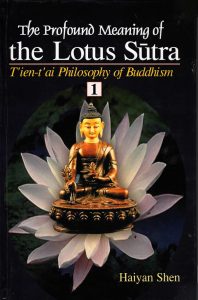 Today I’ve begun publishing quotes from The Beginnings of Buddhism and additional quotes from The Profound Meaning of the Lotus Sutra: Tien-tai Philosophy of Buddhism.
I have 90 quotes that I expect to publish from The Beginnings of Buddhism. In the past when I’ve finished a book, I’ve added all to the quotes to the website and scheduled one to be published per day until they run out. I don’t want to do that this time because of the nature of the topic. These quotes, while valuable in understanding the roots of early Buddhism, need to be kept in perspective of the Ultimate Truth revealed in the Lotus Sūtra.
From The Profound Meaning of the Lotus Sutra: Tien-tai Philosophy of Buddhism:
With regard to the Four Teachings, Chih-i argues that the positions of the Tripiṭaka, the Common, and the Separate Teachings must be abandoned. This is because, once they have fulfilled their roles as tentative positions, i.e., after one has progressed from these three teachings to the Perfect Teaching, and attained the ultimate position of the Perfect Teaching, these tentative positions are no longer needed. Moreover, at the moment when these tentative positions hinder one’s attainment of the ultimate position on the path of religious practice, they must be abolished too.
Moving forward I expect to publish something from The Profound Meaning of the Lotus Sutra: Tien-tai Philosophy of Buddhism each time I publish something from The Beginnings of Buddhism. This will be more haphazard than my rigid daily schedule, but potentially more useful.