
All posts by John Hughes

Some Books On Buddhism Are More Equal Than Others

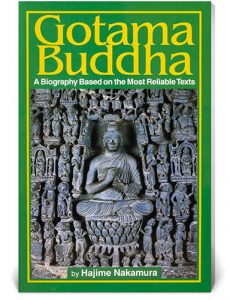
Gotama Buddha: A Biography Based on the Most Reliable Texts
NBIC Book Store

“Gotama Buddha: A Biography Based on the Most Reliable Texts” by Hajime Nakamura is sold by the Nichiren Buddhist International Center under the heading “General Buddhism.”

If the point of the book wasn’t clear in the subhead – A Biography Based on the Most Reliable Texts – the author makes his intent in writing this book explicit when he opens his Preface with:

“My central concern in this volume is to elucidate how Gotama Buddha, or Sakyamuni, the historical figure revered as the teacher of humankind, lived his life and taught his doctrine.”

Having read this book, I’m at a loss to understand why the official Nichiren Shu organization tasked with the promotion of Nichiren Buddhism in the English-speaking world would find this book appropriate.

Keeping in mind that all Nichiren Buddhists view the Lotus Sūtra as Śākyamuni’s great vehicle capable of carrying everyone to the other shore, why does a Nichiren organization promote a book that has this to say of Mahāyāna Buddhists:

“In one sense Buddhism is a ‘founded religion,’ and in another sense it is not. Mahāyāna Buddhists rely on the one who teaches the Dharma, whether it be the bodhisattva Maitreya, Buddha Amitābha, or some other figure. They do not rely on Śākyamuni the individual. It was on this philosophical foundation that Mahāyāna Buddhism was able to declare its orthodoxy as the Buddha’s teaching.”

Page 261

The Lotus Sūtra does not rely on Śākyamuni, the individual?

The NBIC Book Store’s other offering in this category, The Beginnings of Buddhism by Kōgen Mizuno, is a much better exploration of early Buddhist teachings.

There were a few tidbits in “Gotama Buddha: A Biography Based on the Most Reliable Texts” that I felt merited keeping.

The Mahābodhi Society built a large modern temple at Sārnāth, called the Mūlagandha-kutī Vihāra, in 1931. Just coincidentally that’s the same year five families in Sacramento founded their Nichiren Church. In addition, a Japanese artist, Kōsetsu Nousu,  was invited to paint the murals depicting the life of the Buddha. This task required four years.

This is the description of the interior of the temple:

The central part of the temple enshrines relics discovered in Taxila. The innermost altar contains a replica of the fifth-century statue of the seated Buddha delivering his first discourse discovered in Sārnāth. (The original is in the Archaeological Museum in Sārnāth.) It is surrounded by banners and offerings of flowers and candles. There are also relics from Mirpur Khas and Nāgārjunakovda. Placed below the pedestal of the statue to the left is a long, narrow plaque inscribed with the words “Homage to the Lotus Sutra.” 

Page 268

Namu Myoho Renge Kyo, indeed.

Also of interest was this quote:

[The naga king Muchalinda sheltered the Buddha from rain for seven days while he was deep in meditation. When the storm had passed the naga] appeared in the form of a youth, venerating the Blessed One with the palms of his hands together and standing before him. Then the Blessed One, understanding the meaning of it, recited the following verse of uplift: “His solitude is happy, he who is content, who has heard the teachings, who has seen the Truth. Happy is freedom from malice toward others and self-restraint toward all living beings. Happy it is to be rid of all creed toward the world and to transcend all desires. The greatest happiness is control of the pride that comes of the thought ‘I am!’ ”

Page 222

Two points of interest. First is the “verse to uplift” itself. Reading these are what make such books interesting. The second point is the idea of a naga as a deity in the form of a cobra, with a great hood that shielded the Buddha from the rain. The Sanskrit means “serpent” but, as I’ve read before, the Chinese, not knowing what to make of this idea, transformed the naga into dragons. Of course, that gets picked up Japan. Nichiren, in discussing the Dragon King’s Daughter, says, “The Buddha helped a small snake, who was actually a daughter of the dragon king, attain Buddhahood with her present body.” (Sennichi-ama Gozen Gohenji, A Reply to My Lady Nun Sennici, Writings of Nichiren Shōnin, Faith and Practice, Volume 4, Pages 146-147)

Finally is the discussion of Śākyamuni’s visit home and his response when his father, the king, chides him for embarrassing his family by begging:

“Your lineage, O King, is the lineage of kings, but ours is that of the buddhas, extending from Dīpaṃkara and Koṇḍan͂n͂a down to Kassapa. These, and thousands of other buddhas, have begged for alms and lived on their alms alone.” And standing in the middle of the road, he recited this verse:

“Rouse yourself! Be not idle!
Follow the Good Way!
One who acts correctly rests in ease
In this world and the next.”

When Gotama had finished reciting that verse, the king attained the first stage of the sage. He attained the second stage on hearing this verse:

“Follow the Good Way!
Do not that which is evil!
One who acts correctly rests in ease
In this world and the next.”
Practicing

Buddhism requires regular practice; in fact, most students of Buddhism – including those who do not necessarily consider themselves Buddhists – say that Buddhism cannot be understood without at least trying the practice for a period of time.

Awakening to the Lotus

Daily Dharma – Aug. 3, 2018

Universal-Sage! Anyone who keeps, reads and recites this sūtra [in the later five hundred years] after [my extinction], will not be attached to clothing, bedding, food or drink, or any other thing for living. What he wishes will not remain unfulfilled. He will be able to obtain the rewards of his merits in his present life.

The Buddha makes this promise to Universal-Sage Bodhisattva in Chapter Twenty-Eight of the Lotus Sūtra. When we who are living in this latter age of Degeneration keep and practice this Sūtra, we change the focus of our own existence. We lose our dependence on the things we thought we needed to make us happy, and thus learn to appreciate them for what they are. We set aside our fear of losing these things and gain the courage to handle situations we previously thought were impossible. We stop focusing on what we need to live and find gratitude for what sustains our lives.

The Daily Dharma is produced by the Lexington Nichiren Buddhist Community. To subscribe to the daily emails, visit zenzaizenzai.com

Day 30

Day 30 covers all of Chapter 26, Dhāraṇīs

Having last month heard the dhāraṇīs of the rākṣasas and the Mother-Of-Devils, we hear Śākyamuni’s response and conclude the chapter.

The Buddha said to the rākṣasas:

“Excellent, excellent! Your merits will be immeasurable even when you protect the person who keeps only the name of the Sūtra of the Lotus Flower of the Wonderful Dharma. Needless to say, so will be your merits when you protect the person who keeps the sūtra itself, and makes to a copy of this sūtra hundreds of thousands of offerings such as flowers, incense, necklaces, powdered incense, incense applicable to the skin, incense to burn, streamers, canopies, music, and various lamps like lamps of butter oil, oil lamps, lamps of perfumed oil, lamps of sumanas-flower oil, lamps of campaka flower oil, lamps of vārṣika-flower oil, and lamps of utpala-flower oil. Kunti! You [rākṣasas] and your attendants should protect this teacher of the Dharma.”

When the Buddha expounded this chapter of Dhārānis, sixty-eight thousand people obtained the truth of birthlessness.

The Daily Dharma from April 22, 2018, offers this:

The Buddha said to the rākṣasīs: “Excellent, excellent! Your merits will be immeasurable even when you protect the person who keeps only the name of the Sūtra of the Lotus Flower of the Wonderful Dharma.”

The Buddha declares these lines in Chapter Twenty-Six of the Lotus Sūtra. The rākṣasīs are violent, bloodthirsty demons whose nature is to satisfy their own cravings at the expense of beings weaker than themselves. In the Lotus Sūtra, they learn of their capacity to use their strength to protect others and vow to the Buddha to defend anyone who keeps this sūtra. They understand that when they dedicate their strength to caring for other beings rather than destroying them, they gain the merit which will bring them closer to enlightenment. We learn from this example about our own natures, and that of the beings we share this world with.

The Daily Dharma is produced by the Lexington Nichiren Buddhist Community. To subscribe to the daily emails, visit zenzaizenzai.com

A Life of Study

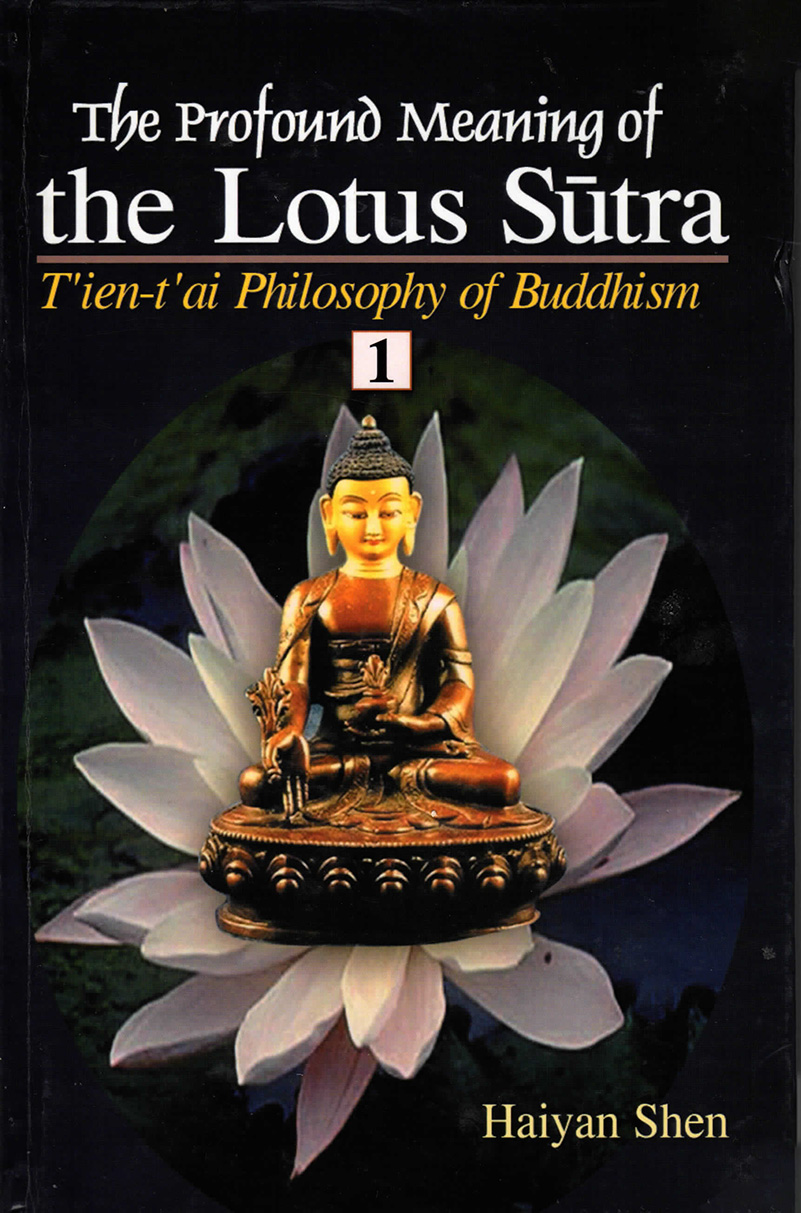
ProfoundMeaningBookCover
Available on Amazon

As I work my way through books on Buddhism, I’m constantly weighing them against Nichiren’s writings and the Lotus Sūtra. In introductory books such as Basic Buddhist Concepts and The Beginnings of Buddhism,  I find pieces of Buddhist concepts implied in the Lotus Sūtra but glossed over.  I wonder how this all fits together.

I find one compelling explanation in The Profound Meaning of the Lotus Sūtra. T’ien-t’ai Philosophy of Buddhism by Haiyan Shen. I’ve only just begun the first volume, but in there is this enlightening passage:

Chih-i has stressed the unique feature of the Lotus Sūtra by comparing the Lotus Sūtra with other sūtras:

“All these various sūtras aim at catering to the will of others [i.e., living beings], causing others to gain benefits. They do not discuss the intention of the Buddha, and to where his intention tends. The present [Lotus] Sūtra is not so. Regarding the doctrines [which make up the Buddhist] system [of thought], the Mahāyāna and Hinayāna methods of contemplation, the ten powers and [four forms of] fearlessness [of the Buddha], and various rules and customs [of the Buddhist religion], [the Lotus Sūtra] does not discuss them at all, for they have already been stated in the previous sūtras. [The Lotus Sūtra] only discusses the original career of the Tathāgata’s preaching, how he resorted to the sudden and gradual [methods of the teaching] in [his] middle career, and how he finally approached [his] end career [by revealing] the great cause [of universal salvation]. [The Lotus Sūtra exhibits] the framework of [the Buddha’s] teaching, and [makes known] the expedient means [the Buddha employs] to universally transform [sentient beings].

Mou Tsung-san also reiterates the superiority of the Lotus Sūtra, in a way which is akin to Chih-i’s viewpoint. Its superiority is demonstrated by the fact that it is not concerned with expressing certain doctrines, but it only establishes the merging and ultimate teaching in order to reveal the real intention of the Buddha for universal salvation of sentient beings underlying his various teachings. Mou Tsung-san considers this nature of the sūtra as belonging to the level of the transcendent. This is to say that the Lotus Sūtra is concerned with wisdom and insight into the Ultimate Truth. In order for one to understand this Truth, one first has to acquire the basic knowledge stated in other Buddhist scriptures.

Hurvitz has also indicated a similar view when he comments on the nature of the Lotus Sūtra. He states that the Lotus Sūtra takes the existence of a formulated Hinayāna philosophy (Four Noble Truths, dependent origination, substantiality of the dharmas, insubstantiality of the ego, personal release, etc) and of an equally formulated Mahāyāna philosophy (insubstantiality of the dharmas, bodhisattvahood, the Six Perfections, etc) for granted.

The Profound Meaning of the Lotus Sutra: Tien-tai Philosophy of Buddhism


And as I read I discover the threads of Buddhism taken for granted and acquire some of the basic knowledge merged in the Ultimate Truth contained in the Lotus Sūtra.

Noble Truth of Suffering

All of these obstructions cloud the truth, lead to mistaken thoughts and actions, and prevent the realization of the ideal and thus are causes of suffering. To recognize suffering as suffering and see obstructions as obstructions calls for an understanding of the Buddhist religious ideal. The truths of suffering and its cause are based on the truth of the elimination of suffering. When the possibility of an end to suffering is glimpsed, the true nature of suffering and its causes become clear. Though they should be eliminated, suffering and its causes must be seen as aspects of reality, and the ideal of the elimination of suffering must be realized. Viewed in this way, suffering becomes the noble truth of suffering, and its cause the noble truth of the cause of suffering.Basic Buddhist Concepts

Daily Dharma – Aug. 2, 2018

Anyone who expounds this sūtra to the four kinds of devotees,
Or reads or recites this sūtra in a retired place,
After doing these [three] virtuous things,
Will be able to see me.

The Buddha sings these verses to Medicine-King Bodhisattva in Chapter Ten of the Lotus Sūtra. While the Buddha was alive 2500 years ago, people traveled great distances and endure great hardships just to see him. Today, even though the man named Siddhartha Gautama is no longer in our world, we are assured that the ever-present Śākyamuni is always with us and leading us to his enlightenment. When we make the effort to keep, read, recite, copy and expound this Sūtra, it is as if we are traveling great distances and enduring great hardships.

The Daily Dharma is produced by the Lexington Nichiren Buddhist Community. To subscribe to the daily emails, visit zenzaizenzai.com

Day 29

Day 29 covers all of Chapter 25, The Universal Gate of World-Voice-Perceiver Bodhisattva.

Having last month heard how World-Voice-Perceiver Bodhisattva eliminates suffering in gāthās, we conclude Chapter 25.

World-Voice-Perceiver will save
All living beings from misfortunes
And from innumerable sufferings of the world
By the wonderful power of his wisdom.

He has these supernatural powers.
He employs various expedients with his wisdom.
In the ten quarters there is no ksetra
In which he does not appear at all.

Hell, the region of hungry spirits, and the region of animals,
That is the [three) evil regions will be eliminated.
The sufferings of birth, old age, disease and death
Will gradually be eliminated.

He sees the truth of all things and their purity.
He sees all things with his great wisdom.
He sees all things with loving-kindness and compassion.
Think of him constantly! Look up at him constantly!

All darkness is dispelled by the light of his wisdom
As spotless and as pure as the light of the sun.
The light destroys the dangers of wind and fire,
And illumines the whole world brightly.

His precepts out of his loving-kindness brace us up as thunderbolts.
His wishes out of his compassion are as wonderful as large clouds.
He pours the rain of the Dharma as sweet as nectar,
And extinguishes the fire of illusions.

Suppose you are in a law-court for a suit,
Or on a battlefield, and are seized with fear.
If you think of the power of World-Voice-Perceiver,
All your enemies will flee away.

His wonderful voice [comes from] his perceiving the voice of the world.
It is like the voice of Brahman, like the sound of a tidal wave.
It excels all the other voices of the world.
Therefore, think of him constantly!

Do not doubt him even at a moment’s thought!
The Pure Saint World-Voice-Perceiver is reliable
When you suffer, and when you are confronted
With the calamity of death.

By all these merits, he sees
All living beings with his compassionate eyes.
The ocean of his accumulated merits is boundless.
Therefore, bow before him!

Thereupon Earth-Holding Bodhisattva rose from his seat, proceeded to the Buddha, and said to him:

“World-Honored One! Those who hear of his supernatural powers by which he opened the universal gate without hindrance, and which are expounded in this chapter of World-Voice-Perceiver Bodhisattva, know this, will be able to obtain not a few merits.”

When the Buddha expounded this chapter of the Universal Gate, the eighty-four thousand living beings in the congregation began to aspire for the unparalleled Anuttara-samyak-saṃbodhi.

Nichiren offers this perspective on Chapter 25:

The chapter “Bodhisattva Voice Perceiver” is also known as the chapter “Universal Gate.” Since the first half of this chapter tells of the merits of a person who pays homage to the Bodhisattva World Voice Perceiver (Avalokiteśvara), this chapter is named “Voice Perceiver.” It is also named “Universal Gate” since the latter half tells of the merits of a person who takes refuge with the Lotus Sutra which the Bodhisattva Voice Perceiver maintains.

Nichinyo Gozen Gohenji, A Response to My Lady Nichinyo, Writings of Nichiren Shōnin, Volume 4, Faith and Practice, Pages 133-134

Walking Our Path With The Buddha

We learn that we live with the Buddha and walk on the path of our life with the Buddha. By doing so, we are involved in the eternal life of the Buddha. Now, we as cause and the Buddha as effect no longer theoretically but realistically become one. It is perfectly attaining Buddhahood with cause and effect existing simultaneously; with true cause and effect; with Ichinen Sanzen of Ji; with one’s present body; and with receiving and upholding the teaching of the Lotus Sutra. Therefore, it is not necessary for Odaimoku practitioners to achieve a certain stage (rank) or to practice for a long period of time, because one is directly involved in the Buddha’s life with one’s present body.

Buddha Seed: Understanding the Odaimoku

Daily Dharma – Aug. 1, 2018

Having thought this, he said to his children as he had thought, ‘Come out quickly!’ He warned them with these good words out of his compassion towards them, but they were too much engrossed in playing to hear the words of their father. They were not frightened or afraid. They did not wish to come out. They did not know what a fire was, what a house was, and what they would lose. They ran about happily. They only glanced at their father occasionally.

This passage is part of the Parable of the Burning House, told by the Buddha in Chapter Three of the Lotus Sūtra. In this story, he compares us living in this world of conflict to children playing in a dangerous house. As the children in the story were too distracted by their games to hear their father’s warnings, we are often too distracted by the attachments of our world to hear the voice of the Buddha.

The Daily Dharma is produced by the Lexington Nichiren Buddhist Community. To subscribe to the daily emails, visit zenzaizenzai.com