
Arising and abandoning are the two aspects of evaluating various levels of religious attainment as positions that belong to the Four Teachings respectively. According to Chih-i, the positions that belong to the three teachings (Tripiṭaka, Common, and Separate) are coarse, seeing that the doors of these teachings are expedient means or contain expediency. This proposes that truth expounded by the Buddha in these teachings is relative, which functions to guide beings to eventually reach the Ultimate Truth. The positions of the Perfect Teaching are considered to be subtle, for the door of the Perfect Teaching directly reveals the Ultimate Truth without having to employ expedient means as the Relative Truth. Therefore, “arising of positions” (Wei-hsing) is to confirm the legitimacy of various positions regardless of whether they are coarse or subtle, from the viewpoint that all of them are beneficial in terms of suiting different abilities of sentient beings. On the other hand, the abandonment of these tentative positions (Wei-fei) is necessary for the arising of new positions. Attainment arises according to conditions. Along with the arising of new conditions, new positions are produced, with which old positions must be abandoned. With regard to the Four Teachings, Chih-i argues that the positions of the Tripiṭaka, the Common, and the Separate Teachings must be abandoned. This is because, once they have fulfilled their roles as tentative positions, i.e., after one has progressed from these three teachings to the Perfect Teaching, and attained the ultimate position of the Perfect Teaching, these tentative positions are no longer needed. Moreover, at the moment when these tentative positions hinder one’s attainment of the ultimate position on the path of religious practice, they must be abolished too. (Volume 1, Page 60)
The Profound Meaning of the Lotus Sutra: Tien-tai Philosophy of Buddhism
All posts by John Hughes
The Profound Meaning of the Lotus Sutra: Tien-tai Philosophy of Buddhism
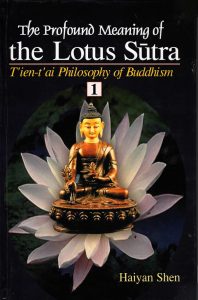
This book makes an initial investigation into T’ien-t’ai Chih-i’s masterpiece The Profound Meaning of the Lotus Sutra (Hsuan-i) in an endeavor to unravel his systematic approach to elaborating Buddhism and his Buddhist philosophy in religious salvation. This book is divided into two volumes. Volume one concentrates on the uniqueness of the Hsuan-i and Chih-i’s achievements in the Hsuan-i. As the embodiment of Chin-i’s own philosophy, the coherent and integrated nature of his text fully displays his perfect and harmonizing philosophy. Closely related to the first volume is the second volume of this book. In order to make the assessment of Chih-i’s system, thoughts and achievements comprehensible in the context of the Hsuan-i, volume two launches an unprecedented exploration of this gigantic text Hsuan-i, giving a delineation of the whole work by outlining, explaining and analyzing its complicated structure, its rich content, and its sophisticated theories. The textual study of this book brings into light a new perspective of understanding the depth of Chih-i’s philosophy, and contributes to the field of study of T’ien-t’ai Buddhism.
The Beginnings of Buddhism

In the eighteen chapters of this book, I give an account of basic Buddhism, centered on the life of Śākyamuni, the historical Buddha, and the primitive teachings of his time. The book is not an ordered, doctrinal presentation but a blend of what I have to say about the teachings and of material concerning the life of Śākyamuni taken from the oldest and most reliable sources. Though I did not intend to write a detailed biography, I have made use of the historical evidence considered most correct.
The oldest extant Buddhist classics – the Agama sutras and the Vinaya-pitaka – were not written as biographies of Śākyamuni and contain only a fragmentary exposition of his words, actions, teachings, and discussion. These works, which cover a period of more than forty years, deal less with the life of Śākyamuni than with correct revelations of his teachings and, although not compiled with the intention of producing scholarly, historically factual records, contain fairly detailed accounts of the first two or three years of activity after Śākyamuni attained enlightenment and of the events of the period of about a year surrounding his entrance into nirvana.
The writing of biographies of Śākyamuni did not begin until several centuries after his death. There are about ten kinds of such biographies, all of which show him as a superhuman being for whom nothing was impossible. They reveal his greatness but fail to give a picture of his true humanity and go too far in the effort to create a powerful impression.
Attempts on the part of later writers to make Śākyamuni seem supernatural led Western scholars to assume that he had never existed as an actual human being but was a fiction invented on the basis of ancient Indian sun myths. In order to obtain an impression of Śākyamuni as a living human being and to understand his true greatness, it is essential to rely on the unembellished accounts found in the oldest historical sources. Though fragmentary and incomplete, this material gives a clearer, more vital picture than accounts compiled in later periods.
A true picture of Śākyamuni and the religion he founded is of maximum importance today for the following reasons. Śākyamuni is ranked as one of the four great sages of the world, together with Socrates, Jesus Christ, and Confucius. Buddhism itself ranks with Islam and Christianity as one of the world’s three great religions. People of learning and culture in both the East and the West who attempt to interpret the issue impartially agree that, of the four great sages, Śākyamuni had the most harmonious and outstanding personality. Furthermore, cultural leaders throughout the world insist that, in terms of rationality and of inspiring peace and a spirit of generosity, either Buddhism or something similar to it is the ideal kind of religion for the future of all mankind.
The Starting Point of Buddhism
Because he had proved that neither meditation nor ascetic austerities enabled one to attain the ideal, Śākyamuni saw that no other method that existed at the time could lead to his goal. In reflecting on this, the prince developed three comparisons: transferring light ignited with a fire stick to waterlogged fresh wood, transferring light ignited with a fire stick to ordinary fresh wood, and igniting fire with a fire stick on dry wood. Waterlogged and fresh wood symbolize the heart saturated with desires and worldly attachments. Dry wood symbolizes a heart in which there is no longer desire or attachment to worldly things. The act of igniting fire by means of a fire stick represents diligent effort. The most assiduous effort in ascetic austerities cannot bring enlightenment to a heart saturated with desires and attachments, just as fire struck by means of the fire stick at the cost of great effort cannot be transferred to waterlogged or fresh wood. But since fire can be struck readily by diligent effort with the fire stick on dry wood, so a heart that has already been drained of desires and attachments by equally diligent spiritual effort can attain the ideal goal.
When he understood this, Śākyamuni saw that both meditation practice and ascetic austerities were mistaken. After recovering his physical strength, he prepared a seat with soft grass under an assattha, or bo, tree not far from the town of Gaya and, making a vow not to rise until he attained enlightenment, even if it meant death, sat in meditation.
In the first hours of the night of his enlightenment (the hours from six till ten), he attained wisdom about all past things. In the middle hours (from ten until two in the morning), he attained wisdom about all future things. Then in the final hours (from two until six in the morning), he was freed of all bondage and attained wisdom without illusion. He became a Buddha. And this was the starting point of Buddhism. (Page 26-27)
The Beginnings of BuddhismThe Cycle of Judgment and Intolerance
We can easily be trapped in a cycle of judgment and intolerance and even prejudice. One of the easiest symptoms that surfaces which we can use to check in with ourselves is how easy do we justify our own correctness, and our own goodness and even use that as a measure of comparison. It’s just a thought.
Lecture on the Lotus SutraDaily Dharma – Aug. 5, 2018
It is difficult to keep this sūtra.
I shall be glad to see
Anyone keeping it even for a moment.
So will all the other Buddhas.
The Buddha sings these verses in Chapter Eleven of the Lotus Sūtra. He is well aware of how hard it is to move from expedient teachings to the Wonderful Dharma. We have habits and attachments built up over many lifetimes, and live in a world that does not always support our practice. Still, one cannot underestimate the importance of trying, even for the briefest amount of time, to hold on to this teaching and bring it to life in this world.
The Daily Dharma is produced by the Lexington Nichiren Buddhist Community. To subscribe to the daily emails, visit zenzaizenzai.com
Day 32
Day 32 covers Chapter 28, The Encouragement of Universal-Sage Bodhisattva, closing the Eighth Volume of the Sutra of the Lotus Flower of the Wonderful Dharma.
Having last month learned how the good men or women who live after the extinction of the Buddha will be able to obtain this Sūtra of the Lotus Flower of the Wonderful Dharma, we hear the vow of Universal-Sage Bodhisattva.
Thereupon Universal-Sage Bodhisattva said to the Buddha:
“World-Honored One! If anyone keeps this sūtra in the defiled world in the later five hundred years after [your extinction], I will protect him so that he may be free from any trouble, that he may be peaceful, and that no one may take advantage [of his weak points]. Mara, his sons, his daughters, his subjects, his attendants, yakṣas, rākṣasas, kumbhāṇḍas, piśācakas, kṛtyas, pūtanas, vetādas or other living beings who trouble men shall not take advantage [of his weak points]. If anyone keeps, reads and recites this sūtra while he walks or stands, I will mount a kingly white elephant with six tusks, go to him together with great Bodhisattvas, show myself to rum, make offerings to him, protect him, and comfort him, because I wish to make offerings to the Sūtra of the Lotus Flower of the Wonderful Dharma. If he sits and thinks over this sūtra, I also will mount a kingly white elephant and appear before him. If he forgets a phrase or a gāthā of the Sūtra of the Lotus Flower of the Wonderful Dharma, I will remind him of it, and read and recite it with him so that he may be able to understand it. Anyone who keeps, reads and recites the Sūtra of the Lotus Flower of the Wonderful Dharma [after your extinction], will be able to see me with such joy that he will make more efforts. Because he sees me, he will be able to obtain samadhis and a set of dhārāṇis. The set of dhārāṇis will be the dhārāṇis by which he can memorize repetitions of teachings, the dhārāṇis by which he can memorize hundreds of thousands of billions of repetitions of teachings, and the dhārāṇis by which he can understand the expediency of the voice of the Dharma.
The Daily Dharma from May 21, 2018, offers this:
Thereupon Universal-Sage Bodhisattva said to the Buddha:
“World-Honored One! If anyone keeps this sūtra in the defiled world in the later five hundred years after [your extinction], I will protect him so that he may be free from any trouble, that he may be peaceful, and that no one may take advantage [of his weak points].”
Universal-Sage Bodhisattva (Fugen, Samantabhadra) makes this vow to the Buddha in Chapter Twenty-Eight of the Lotus Sutra. In this world of conflict, it can seem like very few people are practicing the Buddha Dharma with us. Nichiren compared those beings alive in this world of conflict to the amount of soil in the whole earth, while those who keep and practice the Lotus Sūtra are like the dirt under a fingernail. The vow of Universal-Sage reminds us that innumerable beings support our practice and that in turn, we support them with our practice.
The Daily Dharma is produced by the Lexington Nichiren Buddhist Community. To subscribe to the daily emails, visit zenzaizenzai.com
Unborn and Deathless True Nature
Once the Eternal Buddha reveals his unborn and deathless true nature, Buddhahood is no longer just a theory, or the achievement of a special person who lived in the distant past, or a remote future possibility. Buddhahood is the essential truth of the present moment that the other teachings point toward. This is why the One Vehicle teaching of the historical Shakyamuni Buddha is considered to be the reflection of the Eternal Buddha in this world of impermanence, while the Eternal Buddha is the ever-present actuality that is the source of all such reflections. It is important that we receive this teaching with faith and rejoicing, and spread it to others.
Lotus SeedsDaily Dharma – Aug. 4, 2018
All this while Śākyamuni Buddha sat in silence. The four kinds of devotees also kept silence for the fifty small kalpas. By his supernatural powers, however, the Buddha caused the great multitude to think that they kept silence for only half a day.
We find this description of the Buddha and his congregation in Chapter Fifteen of the Lotus Sūtra. Innumerable Bodhisattvas have sprung up from underground and come to pay their respects to the Buddha. This passage shows that in our suffering and attachment, we have a different concept of time than the Buddha. The kalpas the Lotus Sūtra uses to measure time are unimaginably long periods. When a stone a mile on each side is worn down to a pebble by a celestial being flying past it every thousand years and brushing it with her veil, a kalpa expires. When we see the world on this scale of time, rather than the limited years we have in our lives, it opens us up to the Buddha’s wisdom.
The Daily Dharma is produced by the Lexington Nichiren Buddhist Community. To subscribe to the daily emails, visit zenzaizenzai.com
Day 31
Day 31 covers Chapter 27, King Wonderful-Adornment as the Previous Life of a Bodhisattva.
Having last month witnessed the efforts of Pure-Store and Pure-Eyes to influence their father, we see the two sons tell their mother that their father now understands the Dharma by faith.
“Thereupon the two sons descended from the sky, came to their mother, joined their hands together, and said to her, ‘Our father, the king, has now understood the Dharma by faith. He is now able to aspire for Anuttara-samyak-saṃbodhi. We did the work of the Buddha for the sake of our father. Mother! Allow us to renounce the world and practice the Way under that Buddha!’
“Thereupon the two sons, wishing to repeat what they had said, said to their mother in gāthās:
Mother! Allow us to renounce the world
And become śramaṇas!
It is difficult to see a Buddha.
We will follow that Buddha and study.
To see a Buddha is as difficult
As to see an udumbara[-flower ]
To avert a misfortune is also difficult.
Allow us to renounce the world!“The mother said, ‘I allow you to renounce the world because it is difficult to see a Buddha.’
“Thereupon the [father came to them. The] two sons said to their parents, ‘Excellent, Father and Mother! Go to Cloud-Thunderpeal-Star-King-Flower-Wisdom Buddha, see him, and make offerings to him because to see a Buddha is as difficult as to see an udumbara flower or as for a one-eyed tortoise to find a hole in a floating piece of wood! We accumulated so many merits in our previous existence that we are now able to meet the teachings of the Buddha in this life of ours. Allow us to renounce the world because it is difficult to see a Buddha, and also because it is difficult to have such a good opportunity as this to see him.’
This tale of the children helping their father to understand the dharma by faith always inspires. This letter from “A Phrase A Day” puts faith in perspective:
Faith is nothing special. A wife loves her husband, the husband devotes his life to her, parents do not give away their children, and children do not desert their mother. Likewise, believe in the Lotus Sutra, the Buddha Sakyamuni, the Buddha Taho, all Buddhas, Bodhisattvas, and deities. Then chant “Namu Myoho Renge Kyo.” This is faith.
(Background : May 18, 1280, 58 years old, at Minobu, Showa Teihon, p.] 749)