
All posts by John Hughes

Day 22

Day 22 covers all of Chapter 17, The Variety of Merits.


Having last month considered the merits of those who copy, read, recite, keep or expounds the sutra, we repeat in gāthās the merits of those who copy, read, recite, keep or expounds the sutra.

Thereupon the World-Honored One, wishing to repeat what he had said, sang in gāthās:

Anyone who keeps this sūtra
After my extinction
Will be able to obtain
Innumerable merits a previously stated.

He should be considered
To have already made various offerings.
He should be considered
To have already built a stupa
With a yasti soaring up to the Heaven of Brahman,
The upper part of it being the smaller,
A stupa which was adorned with the seven treasures,
And with thousands of billions of jeweled bells
Sounding wonderful when fanned by the wind.
He should be considered to have already enshrined
My śarīras in this stupa,
And offered flowers, incense, necklaces, heavenly garments,
And various kinds of music to it,
And lit lamps of perfumed oil around it for innumerable kalpas.

Anyone who keeps this sūtra in the evil world
In the age of the decline of my teachings
Should be considered
To have already made these offerings.

Anyone who keeps this sūtra should be considered
To have already built a monastery
Made of the cow-head candana,
installed with thirty-two beautiful hall ,
Eight times as tall as the tala-tree,
Provided with delicious food and drink,
With wonderful garments and bedding,
With accommodations for one hundred thousand people,
With gardens, forests, and pools for bathing,
And with promenades and caves for the practice of dhyāna.
He should be considered lo have already offered
That monastery to me in my presence.

Anyone who not only understands
This sūtra by faith
But also keeps, reads and recites it,
And copies it, or causes others to copy it,
And strews flowers, incense,
And incense powder to a copy of it,
And lights lamps of the perfumed oil
Of sumanas, campaka, and atimuktaka
Around the copy of this sūtra
And offers the light thus produced to it,
Will be able to obtain innumerable merits.
His merits will be as limitless as the sky.

Needless to say, so will be the merits of the person
Who keeps this sūtra, gives alms, observes the precepts,
Practices patience, prefers dhyāna-concentrations,
And does not get angry or speak ill of others.

The Daily Dharma from April 4, 2022, offers this:

Anyone who not only understands
This sūtra by faith
But also keeps, reads and recites it,
And copies it, or causes others to copy it,
And strews flowers, incense,
And incense powder to a copy of it,
And lights lamps of the perfumed oil
Of sumanas, campaka, and atimuktaka
Around the copy of this sūtra
And offers the light thus produced to it,
Will be able to obtain innumerable merits.
His merits will be as limitless as the sky.

The Buddha sings these verses in Chapter Seventeen of the Lotus Sūtra. This teaching contains the Buddha’s highest wisdom, leads all beings to enlightenment, and calls us to transform our personal suffering into an aspiration to benefit all beings. The joy and clarity we gain by practicing and respecting this sūtra is beyond what we can imagine in our state of attachment and delusion.

The Daily Dharma is produced by the Lexington Nichiren Buddhist Community. To subscribe to the daily emails, visit zenzaizenzai.com
An Unexpected Treat

20220703_shodaigyo-web
Shoshogyo – chanting Daimoku

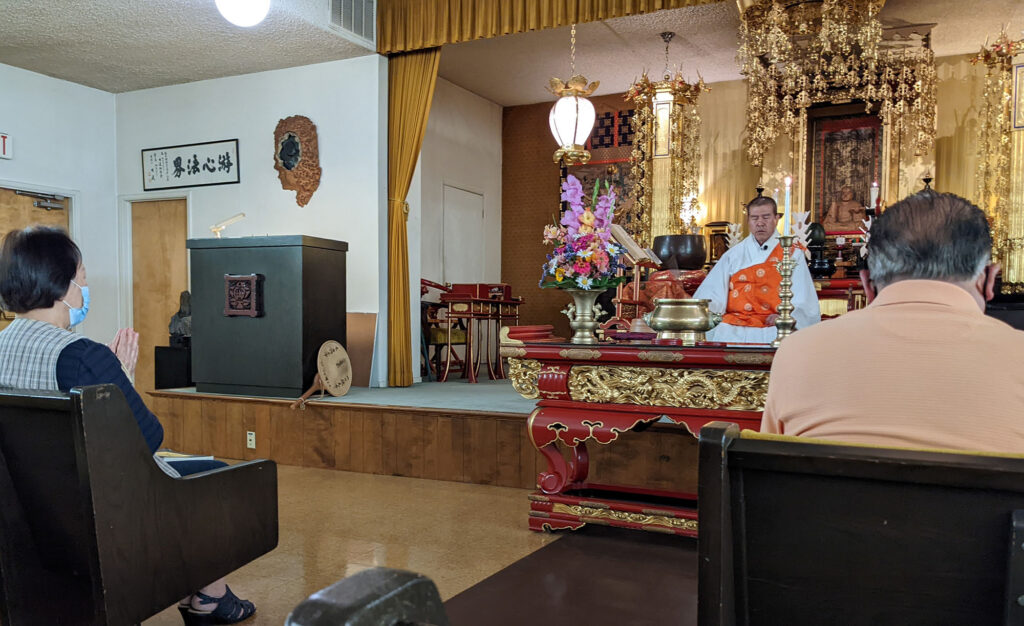
The Sacramento Nichiren Buddhist Church was founded by five Japanese families in 1931. If you exclude the years when all of Sacramento’s Japanese immigrant and Japanese American residents were locked away in distant camps during World War II, the church has been in existence continuously since then. Eleven priests served the congregation before Rev. Kenjo Igarashi took over the position in 1989. In all that time, no one has ever held a Shodaigyo service at the church. That is until yesterday.

Rev. Igarashi didn’t offer an explanation of why he chose the July 3 service to introduce Shodaigyo to the congregation. A woman behind me at the service said, “I’ve been attending services here since I was a child and I’ve never heard of this service.” I believe I was the only one in the audience, other than perhaps Rev. Igarashi’s wife, who actually knew what to expect.

The service did not follow the program developed by Enkyoji Buddhist Network or the Shodai Gyo guide included in the Liturgy of Nichiren Shu offered by the Nichiren Buddhist International Center.

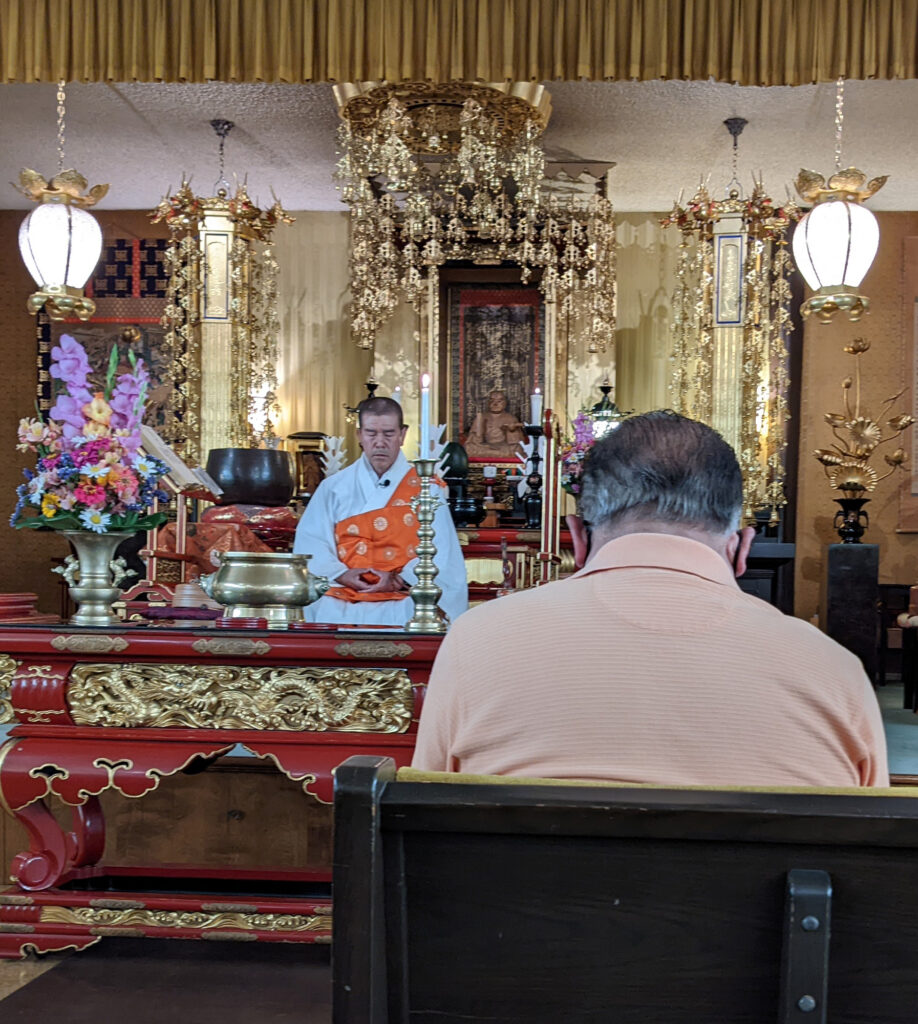
One could describe Rev. Igarashi’s Shodaigyo service as a simplified introduction. First the congregation was invited to give incense offerings. After everyone was seated, Rev. Igarashi stood before the altar and said a prayer. He then took a seat facing the congregation and explained the proper hand position for Joshingyo, the first of two periods of silent meditation.

At the conclusion of Joshingyo, Rev. Igarashi had everyone put their hands in gassho and lightly close their eyes. He then began to slowly chant Daimoku, increasing the speed and eventually slowing down.

After chanting, Rev. Igarashi explained that the purpose of the second silent meditation period, Jinshingyo, was to explore our past lives.

When Jinshingyo was concluded, Rev. Igarashi returned to stand before the altar and offered a closing prayer.

After the prayer, Rev. Igarashi offered a sermon in which he explained that chanting Namu Myoho Renge Kyo is the equivalent of chanting the entire Lotus Sutra. He also pointed out that there was a time when Shodaigyo was not an approved Nichiren Shu practice. He had participated in Shodaigyo in this unofficial period. He recalled chanting for an hour or two hours during which the pace of chanting would start slow and speed up and slow and then speed up again, creating waves of Daimoku.

I have no idea whether we’ll ever have another Shodaigyo service at the Sacramento Nichiren Buddhist Church. Rev. Igarashi is in Chicago next Sunday and in Long Beach the following Sunday. The fourth Sunday in July is the annual Obon service and the fifth Sunday will be a Kaji Kito Service.

Shodaigyo was an unexpected treat.

20220703_meditation-web
Silent meditation

800 Years: Becoming Naturally Virtuous

The Lotus Sūtra is called “Zui-jii,” namely it expounds the true mind of the Buddha. Since the Buddha’s mind is so great, even if one does not understand the profound meaning of the sūtra, one can gain innumerable merits by just reading it. Just as a mugwort among hemp plants grows straight and a snake in a tube straightens itself, if one becomes friendly with good people, one’s mind, behavior, and words become naturally gentle. Likewise, the Buddha thinks that those who believe in the Lotus Sūtra become naturally virtuous.

Zui-jii Gosho, The Sūtra Preached in Accordance to [the Buddha’s] Own Mind, Writings of Nichiren Shōnin, Faith and Practice, Volume 4, Page 155

Daily Dharma – July 4, 2022

Their tongues will be purified.
Their tongues will not receive anything bad.
Anything they eat will become
As delicious as nectar.

The Buddha sings these verses to Constant-Endeavor Bodhisattva in Chapter Nineteen of the Lotus Sūtra, describing those who keep the Lotus Sūtra. With food and drink it is easy to see how different people will find the same food either delicious or disgusting. Our experience and beliefs shape what we are comfortable putting into our bodies, and whether we do so for the sake of our health or the pleasure that comes from experiencing their flavor. But when we find that something with good flavor is bad for our health, or vice versa, we can change our tastes. This is another example of how the Lotus Sūtra teaches us how to live in the world. We learn to embrace situations we once found frightening or intolerable. We increase our capacity with our focus on benefiting others. As a wise teacher once said, we learn to enjoy problems the way we enjoy ice cream.

The Daily Dharma is produced by the Lexington Nichiren Buddhist Community. To subscribe to the daily emails, visit zenzaizenzai.com

Day 21

Day 21 covers all of Chapter 16, The Duration of the Life of the Tathāgata.


Having last month considered the purpose of the various sutras, we consider why the Buddha pretends to enter into Nirvāṇa.

“Good men! The duration of my life, which I obtained by the practice of the way of Bodhisattvas, has not yet expired. It is twice as long as the length of time as previously stated. Although I shall never enter into Nirvāṇa, I say to men of little virtue, ‘I shall pass away.’ I teach them with this expedient. Why is that? It is because, if they see me for a long time, they will not plant the roots of good, but become poor and base, and cling to the five desires so much that they will be caught in the nets of wrong views. If they think that I am always here, and do not think that I will pass away, they will become too arrogant and lazy to realize the difficulty of seeing me, and they will not respect me. Therefore I say [to them] expediently, ‘Bhikṣus, know this! It is difficult to see a Buddha who appears in [this] world.’ Why is that? It is because some men of little virtue cannot see me even during many hundreds of thousands of billions of kalpas while the others can. Therefore, I say [to them], ‘Bhikṣus! It is difficult to see a Tathāgata.’ Those who hear this and know that it is difficult to see me, will adore me, admire me, and plant the roots of good. Therefore l say [to them], ‘I shall pass away,’ although I shall not.

“Good men! All the Buddhas, all the Tathāgatas, do the same as I do. [They expound their teachings] for the purpose of saving all living beings. Therefore, [their teachings] are true, not false.

The Daily Dharma from March 27, 2021, offers this:

Although I shall never enter into Nirvāṇa, I say to men of little virtue, ‘I shall pass away.’ I teach them with this expedient. Why is that? It is because, if they see me for a long time, they will not plant the roots of good, but become poor and base, and cling to the five desires so much that they will be caught in the nets of wrong views.

The Buddha gives this explanation in Chapter Sixteen of the Lotus Sutra. This Chapter is the first time he reveals himself as the Ever-Present Buddha who became enlightened in the far distant past and will continue to lead all beings to enlightenment into the far distant future. The Buddha uses the death of his physical body as an expedient so that those who take him for granted will make efforts to practice his teachings. When we practice the Wonderful Dharma of the Lotus Sūtra, then we learn to see the Buddha in ourselves and all beings.

The Daily Dharma is produced by the Lexington Nichiren Buddhist Community. To subscribe to the daily emails, visit zenzaizenzai.com

800 Years: See the Buddha in Everyone

In continuing my yearlong discussion of faith and the Lotus Sutra, I think it is important to look at Chapter 12 as two halves rather than as the completion of the sutra’s lesson on universal salvation, which it clearly represents. I will consider Devadatta here and follow with a look at the dragon girl’s impact on faith.

In his Stories of the Lotus Sutra, Gene Reeves says:

“Basic to the teachings of this Sutra is a kind of promise, an assurance, that each and every living being has the potential to become a buddha. This tells us something about ourselves, of course, but here the light is shining in the other direction, encouraging us to see the buddha in others—regardless of their moral or other qualities.

“In an important sense, this story [about Devadatta] is not so much about Devadatta as it is about Shakyamuni Buddha. It does not teach us that Devadatta was able to become a buddha because his inner intentions were really good, or because he changed his ways and became a good man, or because of anything else he did or did not do. What this story teaches is that the Buddha is one who can see the buddha in others. And that is what we are encouraged by this story to do – to look for and see the buddha in all those we encounter.”

The Stories of the Lotus Sutra, p151

Of course, we repeat in Chapter 20 and the lessons of Never-Despising Bodhisattva that our practice should see the Buddha in everyone, but here we are being asked to set aside our preconceived ideas about people.

In part this reflects a lesson in non-duality. As Introduction to the Lotus Sutra explains:

“Buddhism believes that good and evil are not two separate things; there is no absolute distinction between the two. An evil deed cannot be considered an absolute. The Devadatta Chapter is known as the teaching that explains the attainment of enlightenment by evil people, and its philosophical background comes from the ‘non-duality of good and evil,’ as understood in Buddhism.”

So, while everyone knew of Devadatta’s past wrongs, only the Buddha knew of his past good works. This is an important lesson on our faith and our practice of Lotus Sutra Buddhism. As Nikkyō Niwano explains in Buddhism for Today:

“This is a most important declaration. When we receive scorn, abuse, and obstruction from others, we are apt to become angry with them, feel sad, and begin to doubt the Law. We must instead endure such hardships and divert them to a positive force because the teaching of the Lotus Sutra is the supreme Law in this world. Many ancient teachers and leaders, including both Sakyamuni Buddha and Nichiren, have proved by their example that man can thus transform drawbacks into advantages. … Sakyamuni Buddha not only did not feel resentment toward Devadatta, who inflicted so many injuries on him, but even thanked him for his ‘good friendship.’ ”

Buddhism for Today, p156

Table of Contents Next Essay

Daily Dharma – July 3, 2022

The Buddhas seldom appear in the worlds.
It is difficult to meet them.
Even when they do appear in the worlds,
They seldom expound the Dharma.

The Buddha proclaims these verses in Chapter Two of the Lotus Sūtra. Later in the Sūtra he explains that in reality he became enlightened far in the past and will continue to lead all beings to enlightenment far into the future. The reason the Buddhas appear so rarely is not because they conceal themselves. It is because we do not recognize them for what they are. We cannot see the air we breathe, but it is crucial for our lives. Because of this we often take it for granted, unless we are so afflicted, or the air is so poisoned that we cannot breathe. Then we are aware of it. Likewise, the Buddha Dharma is available to us all the time.

The Daily Dharma is produced by the Lexington Nichiren Buddhist Community. To subscribe to the daily emails, visit zenzaizenzai.com

Day 20

Day 20 completes Chapter 15, The Appearance of Bodhisattvas from Underground, and concludes the Fifth Volume of the Sutra of the Lotus Flower of the Wonderful Dharma.


Having last month considered Maitreya’s reaction and the congregation’s doubt, we consider in gāthās Maitreya’s doubts and conclude today’s portion of Chapter 15, The Appearance of Bodhisattvas from Underground.

Thereupon Maitreya Bodhisattva, wishing to repeat what he had said, sang in gāthās:

It is not long
Since you renounced the family of the Śākyas
And sat under the Bodhi-tree
Near Gaya.

These sons of yours are innumerable.
They have practiced
The way to Buddhahood for a long time.
They have supernatural powers and the power of wisdom.

They have studied the Way of Bodhisattvas well.
They are not defiled by worldliness
Just as the lotus-flower
Is not defiled by water.

They sprang up from underground,
And are now standing before you respectfully.
This is difficult to understand.
How can we believe this?

You attained enlightenment quite recently.
But you have done so many things.
Remove our doubts!
Explain all this as it is!

Suppose a man twenty-five years old
Points to grey-haired and wrinkle-faced men
A hundred years old,
And says, “They are my sons.”
Suppose old men point to a young man
And say, “He is our father.”
No one in the world will believe
That a father is younger than his sons.

You are like the father.
You attained enlightenment quite recently.
These Bodhisattvas are resolute in mind.
They are not timid.
They have practiced the Way of Bodhisattva
For the past innumerable kalpas.

They are good at answering difficult questions.
They are fearless and patient.
They are handsome, powerful and virtuous.
They are praised by the Buddhas
Of the worlds of the ten quarter .
They expound [the Dharma] clearly.

They did not wish to live among men.
They preferred dwelling in dhyana-concentration.
They lived in the sky below
In order to attain the enlightenment of the Buddha.

We do not doubt your words
Because we heard them direct from you.
Explain all this so that the living beings in the future
May be able to understand your words, Buddha!

Those who doubt this sūtra
And do not believe it
Will fall into the evil regions.
Explain all this to us now!

How did you teach these innumerable Bodhisattvas
In such a short time,
And cause them to aspire for enlightenment
And not falter in seeking enlightenment?

[Here ends] the Fifth Volume of the Sūtra of the Lotus Flower of the Wonderful Dharma.

The Daily Dharma from Sept. 22, 2021, offers this:

How did you teach these innumerable Bodhisattvas
In such a short time,
And cause them to aspire for enlightenment
And not falter in seeking enlightenment?

Maitreya Bodhisattva sings these verses to the Buddha in Chapter Fifteen of the Lotus Sūtra. Despite the Buddha’s explanation that he personally taught all of the Bodhisattvas who appear in Chapter Fifteen, Maitreya and others are still confused by what the Buddha has told them. Since they have faith that whatever the Buddha teaches is for their benefit, they persist with their sincere questioning, assured that the Buddha is leading them to enlightenment. While faith is an important part of our practice, recognizing our own confusion, and using questions to resolve that confusion are equally important. The Buddha does not ask for blind obedience. He knows we cannot find peace until we bring our whole being to his practice.

The Daily Dharma is produced by the Lexington Nichiren Buddhist Community. To subscribe to the daily emails, visit zenzaizenzai.com

800 Years: With Nichiren Encouraging Us

Since this 800 Years of Faith project is dedicated to Nichiren and his work, it’s only right to emphasize how his faith encourages us so many centuries later. After all, as he says in Hyōesakan-dono Gohenji, Answer to Lord Ikegami Munenaga, we have not chosen an easy task:

“To become a Buddha is more difficult than trying to thread a needle by casting a thread from the top of one Mt. Sumeru to the needle on the top of another Mt. Sumeru. How much more difficult it will be if a strong headwind is blowing the other way!

Writings of Nichiren Shōnin, Volume 6, Followers I, Page 93

But how much easier is the task when we have a leader to follow, one who has trod the path. In Shohō Jisso-shō, Treatise on All Phenomena as Ultimate Reality, Nichiren writes:

“Born in the Latter Age of Degeneration, I, Nichiren, was the first to spread the outline of the Wonderful Dharma reserved for Bodhisattva Superior Practice. I was also the first to inscribe the Great Mandala with Śākyamuni Buddha appearing in the ‘Life Span of the Buddha’ chapter of the essential section of the Lotus Sūtra, the Buddha of Many Treasures who emerged in the ‘Stupa of Treasures’ chapter of the theoretical section, and bodhisattvas from the earth in the ‘Emerging from the Earth’ chapter. These are very meaningful to me. And those who hate me cannot affect my enlightenment no matter what power they hold.”

Writings of Nichiren Shōnin, Faith and Practice, Volume 4, Page 77

Nichiren took the example of Śākyamuni Buddha and the Buddha of Many Treasures together in the Stupa of Treasures and devoted his life solely to the cause of spreading the Lotus Sūtra in the Latter Age of Degeneration. As he says in Shohō Jisso-shō:

“When Śākyamuni Buddha, the Buddha of Many Treasures, and many other Buddhas and bodhisattvas from all over the Universe gathered at the assembly up in the sky above Mt. Sacred Eagle, what Śākyamuni Buddha and the Buddha of Many Treasures agreed upon was solely for the sake of perpetually spreading the Lotus Sūtra in the Latter Age of Degeneration. When the Buddha of Many Treasures who had already been inside the Stupa shared his seat with Śākyamuni Buddha, what was decided by the two Buddhas as generals standing under the flag of Myōhō Renge Kyō was nothing but the truth. It was a meeting to help us living beings achieve Buddhahood.”

Writings of Nichiren Shōnin, Faith and Practice, Volume 4,
Page 78-79

Nichiren goes on to say that he wasn’t there at the time, but speculates he might have been and just doesn’t recall since he’s an ordinary man. With this speculation he emphasizes that “past, present, and future are not separated from one another.” This is just as true today for those of us who have taken faith in the Lotus Sutra – the past on Mt. Gṛdhrakūṭa is not separate from where we practice today.


Table of Contents Next Essay

Daily Dharma – July 2, 2022

Our palaces are beautifully adorned
Because we accumulated merits in our previous existence.
We offer [these palaces] to you.
Receive them out of your compassion towards us!

The Brahma-Heavenly-Kings of the East sing these verses in Chapter Seven of the Lotus Sutra. In the story, they came to the world of Great-Universal-Wisdom-Excellence-Buddha from their worlds of beauty and pleasure when that Buddha became enlightened. Their offering shows their understanding that while they can enjoy the results of the merits they have created, these results are meant to be shared with all beings. No matter how much or how little we have, being grateful for what we have, rather than being resentful for what we lack, is an expression of the Buddha’s wisdom.

The Daily Dharma is produced by the Lexington Nichiren Buddhist Community. To subscribe to the daily emails, visit zenzaizenzai.com