All posts by John Hughes

Ten Suchlike Characteristics of the Four Evil Destinies

[B]y arranging together those [dharma realms] of like characteristics, we have four categories. The four [evil] destinies [of hell, preta, beasts, and asura]; men and gods; śrāvakas and pratyekabuddhas; and bodhisattvas and Buddhas.

First I will clarify the ten suchlike characteristics of the four evil destinies.

  1. “Suchlike appearance” refers to their evil appearances which are made manifest by their falling into a state which is not desirable [such as falling into a hellish state]. It is analogous to a man who has not yet met disaster but he already shows maladious signs. A soothsayer, upon examination, can predict his ill fortune. If these evil appearances arise, it is clear that he will fall into hell in the future. Common men cannot recognize [these signs], but those of the two vehicles can recognize them slightly, bodhisattvas recognize them but not profoundly, and Buddhas recognize them exhaustively. It is like a skillful fortuneteller who has penetrating insight into the beginning and end [of all things]. Therefore it is called “such-like appearances.”
  2. “Suchlike nature“: [these beings in the four evil destinies] have an intrinsic nature which is “black.” They are so accustomed to “black evil” [deeds] that it is difficult for them to change. It is like wood: when it comes into contact with fire, in the right conditions it will burn [and turn black]. The Mahāparinirvāṇa Sūtra says, “Since the dharmas of passions have the nature of arising, therefore it is possible for them to arise.”171 These evil beings have the propensity [“nature”] to be born in these four destinies. Therefore if the conditions are such, they are born [in these four evil destinies]. Even if a clay or wooden image has the outer appearance [of something], it lacks the inner nature [of that which it represents] so it is not able to arouse birth. The nature of evil beings is not like this.172 Therefore it is called “suchlike nature.”
  3. “Suchlike essence“: [these beings in the four evil destinies] are attached to evil forms and mentalities173 which have been pounded and hacked to dust. This is their essential quality. Also, first in this life they abuse their minds, and in the next life their material body is abused. Also, the results and retributions from this world in which the mind and body is abused is such that in the next world the results and retributions will consist of the abuse of mind and body. Therefore the abuse of body and mind is the essence [of those in the four evil destinies].
  4. “Suchlike power” refers to evil potentialities. It is like a broken object which, though it is not useful [for what it what meant to do], first becomes useful when it fulfills another purpose.174 The Mahāparinirvāṇa Sūtra says, “In building a house one utilizes wood, not silk threads. In making cloth one utilizes silk threads, not clay and wood.”175 Hellish beings have the potential to tread the edge of a blade,176 preta have the potential to swallow copper and to chew steel [in their attempt to satisfy their unlimited hunger], beasts [have the potential of] the strong overcoming the weak – fish eat other fish, and [other animals] pull carts or other heavy objects. These are all evil [or unpleasant] powers and potentialities.
  5. “Suchlike activity“: to make conceptual constructions, perform daily routines, and in general perform verbal, physical, and mental actions is to establish all sorts of evil [deeds, causes, and results]. This is called “activity.” The eighth section of the Mahāparinirvāṇa Sūtra says, “It is like one who indulges in evil deeds in the world is called only half a person.”177 Thus to indulge in evil deeds is called the activity of hellish beings.
  6. “Suchlike causes“: these are the repetitive causes of evil. These give rise to [evil results] of an identical type [as the cause], which habitually continue and are not severed. Since they arise habitually it is easy to [continue to] do evil. Therefore these are called “suchlike causes.”
  7. “Suchlike conditions” are auxiliary causes, such as [the erroneous belief in] the self and possessions, which contributes to the maturation of repetitive karma. It is like water which can moisten the seed [and cause a plant to grow]. Therefore that which functions as the cause of a retribution is called “conditions.”
  8. “Suchlike results” refer to repetitive results. It is like a man who is full of desires and experiences a hellish body. He sees instruments of suffering but [mis]takes them to be desirable objects, and thus passionate attachments are increased further. This is called “repetitive results.”
  9. “Suchlike retributions” are the retributive results. It is like a man who is full of desire is in a hellish state, and when he approaches the objects of his desires he experiences the sufferings of the copper pillars and steel beds. Therefore this is called “suchlike retributions.”
  10. “The beginning and end both the same” has three meanings.178 First, since both the beginning and end are empty [of substantial Being], they are called “the same.” Second, the evil results and retributions already exist within the initial appearances and nature [and so forth of sentient beings]. Therefore the beginning [appearances and natures] and end [results and retributions] are “the same.” If the later states are not [contained in] the initial [appearances and causes], then the soothsayer would not be able to predict [the future]. If the later [results and activities occur] apart from the initial state, the soothsayer would not be able to continue his predictions. One should know that the beginning and end exist as mutually interdependent, and that these conventional states are thus called “the same.” Third, the mind [which understands] the true aspects of reality179 is not different from Buddhahood; there is not one visible form nor one scent which is not a part of the middle way. From this point of view of the principle of reality, [beginning and end] are called “the same.” Due to these [three] meanings it is said that “the beginning and the end are the same.” These three meanings are also contained in each other. Therefore they are “the same.”
Foundations of T'ien T'ai Philosophy, p 184-187
171
See Yamamoto II, 514. This passage follows a long section which discusses the meaning of arising and non-arising which Chih-i examines in more detail in his section of the Four Noble Truths. The immediate context reads: “O good man! The dharmas of outflow (of passions, sāsrava-dharma), at the time when they have not yet arisen, already have the nature of arising. Therefore they are able to arise. The dharmas of no outflow (of passions, anāsrava-dharma) fundamentally have no nature of arising. Therefore they are not able to arise.” In other words, it is in the inherent nature of passions to arise and perish, but the lack of any passions has no “existence” and thus it makes no sense to talk of it as “arising” or “perishing.” return
172
That is, unlike a clay or wooden image, they do have the nature which leads to birth in an evil destiny. return
173
Body and mind, rūpa-citta. return
174
This phrase is very vague in the original. It refers to the various unpleasant and undesirable “abilities” of those in the four destinies, which are a deviant and abusive utilization of abilities which should be used to help others and gain enlightenment. return
175
This is a paraphrase of the original which reads: “It is like when Devadatta wishes to make a wall he takes up mud and not colors; when he wishes to make a painting he gathers colors and does not take up grass and wood; in making a robe he takes up threads and does not take up mud and wood; in making a house he takes up mud and not threads. One can know the result of what one is able to make from what one takes up.” return
176
This refers to the pursuit of satisfying one’s desires whatever the cost. For example, people abuse their bodies and minds in a futile attempt to satisfy their appetites. return
177
Yamamoto I, 206-207. This passage is in the chapter “On Letters” in which each of the Sanskrit letters is given a doctrinal interpretation. At the beginning of the chapter it is explained that the letters of the alphabet themselves are “half-words” and though these form the basic foundation for all verbal communication, it is only when they are put together to form words, called “complete words,” that meaning and communication is possible. The passage in the Mahāparinirvāṇa Sūtra says, “The meaning of ‘halfwords’ is the foundation for verbalizing all good dharmas. Therefore they are called ‘half-words.’ ‘Complete words’ refers to the foundation of verbalizing all good dharmas. It is like one who does evil deeds in the world is called half a person, and one who cultivated good practice is called a complete person.” In T’ien-t’ai doctrine, the Hinayāna teachings are called “the teachings of half-words.” return
178
Corresponding to the threefold truth. return
179
Lit., “middle-real-principle of reality-mind.” This refers either to reality itself or to the mind which understands the true aspects of reality as the middle, i.e., simultaneously empty of substantial Being yet conventionally existent. return

The Life of Kumarajiva

Daniel Montgomery’s Fire in the Lotus offers many details of the characters who played a role in Nichiren Buddhism. Take the story of Kumarajiva, whose skillful translation of the Lotus Sutra into Chinese led to the sutra’s popularity in Asia.

Kumarajiva was born in Kucha, a Central Asian city on the northern trade route between India and China. His father Kumarayana was an Indian Brahmin of high rank, who had abandoned court life for that of an itinerant preacher. His mother Jiva was a sister of the King of Kucha. When Kumarayana’s travels took him to Kucha, he caused such a sensation that the princess demanded to have him for a husband. Their child was named after both his distinguished parents, Kumara for his father and Jiva for his mother.

Princess Jiva was a most remarkable woman. Under her husband’s influence, she became more and more interested in Buddhism and eventually surpassed him in wisdom and practice. She wanted to become a nun, but her husband objected, at least until a second child was born. When Kumarajiva was seven, his father finally relented. The mother took her son, and both of them entered the Buddhist Order.

When Kumarajiva was nine or ten, he travelled with his mother to India, where they studied under a famous Hinayana teacher. When he was 12, they returned to Central Asia, this time to Kushan, where they continued their studies. Already the boy was known as a precocious scholar and debater. The two spent a year in Kashgar studying Abhidharma (Hinayana philosophy) and other sutras, and then returned to Kucha to study the Hindu Vedas. Finally they were introduced to Mahayana, and Kumarajiva began his career of copying, translating, and lecturing on Mahayana sutras. He became a fully ordained monk, at the age of 20. His mother, who had attained the level of enlightenment called anagamin (one who will never be reborn in this world), retired to India.

Kumarajiva’s star was still rising. He became the most celebrated teacher in Central Asia, and his fame spread abroad as far as China. King Fu Chien (Fu Jian) of the former Ch’in kingdom resolved to bring him to his capital of Ch’ang-an. Around 382 he sent his general Lu Kuang (Lu Guang) with an army of 70,000 men to capture Kucha and bring back Kumarajiva. It was to be nearly 20 years, however, before Kumarajiva reached China.

General Lu Kuang stormed Kucha, killed the king, and captured the Buddhist sage. However, when he heard bad news from China, that the king had been overthrown and replaced by an inimical monarch, the general decided not to return home. Instead, he returned only part of the way, carved out a petty kingdom of his own, and took his prize captive with him.

The general took perverse delight in humiliating his prisoner. He was not a Buddhist, and was not impressed by Kumarajiva, who was then about 40 years old. He insisted that the monk marry a princess of Kucha. When Kumarajiva refused, the general got him drunk and locked him up in the same room with the princess. By dawn Kumarajiva was no longer either a teetotaler or a virgin.

Kumarajiva, always a scholar at heart, did not waste his time during his long sojourn in western China. He became fluent in the Chinese language, attracted many disciples, and even won the grudging admiration of the general. When the new king of Ch’in (called Later Ch’in), who was a Buddhist, begged the general to send Kumarajiva to China the general refused.

It took a second military invasion to get Kumarajiva into China at last. In 401 an army from China overthrew the general and brought his hostage safely to the capital of Ch’ang-an.

Here the famous teacher was treated with great respect. He was given the title of National Preceptor and put in charge of translating the sutras into Chinese. He was given every facility, including a team of linguists to assist him, and splendid quarters in the royal palace. Under such favorable circumstances he was able to turn out one translation after another, all of them unexcelled in their accuracy and elegant style. The Sutra of the Lotus Flower of the Wonderful Dharma (Myoho Renge-kyo in Sino-Japanese) was his masterpiece.

As Kumarajiva grew older, the king began to fear that his incomparable talent would be lost to the world after his death. The solution seemed to be for him to have an heir, who would carry on his work. He ordered that the sage be waited upon by ten comely maidens, hoping that at least one of them would become the mother of his child. Kumarajiva relented, but he was not proud of his luxurious lifestyle. He is said to have told his pupils, ‘You must take only the lotus flower that grows out of the mire, and not touch the mire itself.’

Many Buddhist monks resented Kumarajiva’s way of life, and a fellow Central Asian, Buddhabhadra, translator of the Flower Garland Sutra, criticized him openly. So popular was Kumarajiva, however, that it was the critic Buddhabhadra who was forced to leave the capital. Kumarajiva continued to live there in splendor until the day he died.

The story is taken from Kogen Mizuno’s “Buddhist Sutras: Origin, Development, Transmission,” which was published by Kosei Publishing in 1989.

Next The Dharani that Contains All Dharanis

The Buddha’s Time in the Trāyastriṃsá Heaven

In the past, the Buddha, wishing to repay his debt to his mother, Māyā, ascended to the Trāyastriṃsá Heaven on the fifteenth day of the fourth month. While he was there, everyone in the five regions of India from the rulers and their great vassals down to the ordinary men and women, sobbed with grief and lamented that they had lost the Buddha, like parents who had lost a child or a child who had lost his parents. For a man to be separated from a beloved wife or a woman from her beloved husband is unbearable. How much more unbearable a separation from the World Honored One of Great Enlightenment with the thirty-two marks and eighty signs, whose color is a beautiful purple-gold, and whose voice is that of the kalaviṅka bird, and who teaches that all sentient beings will attain Buddhahood. Because of the Buddha’s deep loving-kindness and compassion, their longing and grief for Him is indescribable. It exceeded the grief of the beautiful lady imprisoned in the Shang-yang Palace; it exceeded the grief of the two daughters of Emperor Yao, O-huang and Nu-ying, when they were parted from Emperor Shun; and it exceeded the longing of Su Wu, banished for nineteen years to live amidst the snow in a foreign land.

A man who longed to see the Buddha took wood to make an image of Him, but he was unable to carve the likeness of even one of the thirty-two marks of the Buddha. At that time the great King Udayāna summoned Viśvakarman, the Carpenter, down from the Trāyastriṃsá Heaven and had a statue carved from red sandalwood. That statue went to meet the original Buddha in the Trāyastriṃsá Heaven, because of King Udayāna’s deep faith. This was the first statue of the Buddha carved in Jambudvīpa.

Again, there was a wealthy man called Sudatta. When the Buddha was to descend to India from the Trāyastriṃsá Heaven on the fifteenth of the seventh month, Sudatta wished to build a monastery, but he had no land on which to build. Prince Jeta, a son of King Prasenajit, owned a park called Jetavana, which was about 40 li wide. This park was such a sacred and peaceful place that if one were to bring in swords or knives, the weapons would suddenly break apart. When the wealthy man Sudatta asked for the park in which to build his monastery, the prince told him he would only sell it for the amount of gold it would take to cover the park 4 inches thick. Sudatta agreed to the terms, but the prince then said, “I was only joking. The park is not for sale.” Sudatta insisted, “The Son of Heaven can never be double-tongued. How could you lie, even for a moment?” and he told King Prasenajit what had happened. “Prince Jeta is the heir to the throne. How could he lie even in jest,” wondered the king. Prince Jeta had no choice but to sell the park. Then, when the wealthy man Sudatta paid for the park with gold piled four inches thick as promised and joyfully prepared to build the monastery, Śāriputra appeared with a rope to demarcate the grounds of the park. Then he looked up into the sky and laughed. Sudatta remarked, “A great sage always has a dignified bearing and maintains self-control. What strange thing have you seen to cause you to laugh?” Śāriputra replied, “Because of this monastery you are building the six heavens of the realm of desire are each raising armies to contend for you. Each of the gods wants the person who is cultivating such a tremendously good deed in his own heaven. I am laughing at them for fighting. When your life-span is over, you will be born in the Tuṣita Heaven.” Thus the monastery was built and named the Jeta Grove Monastery.

On the night of the fifteenth of the seventh month when the Buddha was about to enter the temple, Indra and the King of the Brahma Heaven built three bridges made of gold, silver, and crystal from the Trāyastriṃsá Heaven. The Buddha entered by the middle bridge, while Indra on his left and the King of the Brahma Heaven on his right held a canopy over the Buddha. Behind the Buddha came the four categories of Buddhists (monks, nuns, laymen, and laywomen); the eight kinds of supernatural beings (gods, asura, dragons, gandharva, kiṃnara, garuda, mahoraga, and yakṣa); twelve hundred arhats led by Kāśyapa, Kātyāyana, Maudgalyāyana, and Subhūti; twelve thousand hearers; and eighty thousand bodhisattvas.

All the people of the five regions of India gathered together to collect oil to offer lamps. Some lit ten thousand lamps, some lit one thousand lamps, some lit one hundred lamps, and some could only light one lamp. Among them was an impoverished woman, incomparably poor. She had no clothes except a mat woven of wisteria vines even coarser than a rush mat. She ran about in all four directions but was not able to get enough money to buy enough oil for even a single lamp. She looked up to the sky and cried, thinking that if her tears had been oil they could have fueled one hundred or one thousand or ten thousand lamps or more. After much thought, she cut off her own hair, and braided it into a wig that she sold to buy oil for a single lamp. Perhaps because her devotion was accepted by the Buddha and gods, the three treasures, the heavenly deities, and the terrestrial deities, her lamp alone was not extinguished by the fierce winds that blow at the destruction of the world and the beginning of a new world cycle, and it lit the way as the Buddha entered the Jeta Grove Monastery.

As you see, even if people are rich and give great treasures as alms, if their faith is weak they cannot attain Buddhahood. Even though people are poor, if they have strong faith and deep determination they will attain Buddhahood without fail.

Minobu-san Gosho, Mt. Minobu Letter, Writings of Nichiren Shōnin, Volume 5, Page 129-131

Daily Dharma – May 17, 2021

Great-Eloquence! Now I will collect the Buddhas of my replicas who are now expounding the Dharma in the worlds of the ten quarters.

The Buddha makes this declaration to Great-Eloquence Bodhisattva in Chapter Eleven of the Lotus Sūtra. In the story, a large tower has sprung up from underground. From inside, the voice of Many-Treasures Buddha proclaims the truth of the Lotus Sutra that Śākyamuni Buddha is teaching. Before the Buddha can open the door to this tower and allow the congregation to see this Buddha, Śākyamuni must summon all the other Buddhas in the other worlds throughout the universe. We often say of others, “They live in their own world.” We are surrounded by as many worlds as there are people in our lives. When we summon their Buddha-Nature using our Buddha-Nature, we open doors to treasures we can barely imagine.

The Daily Dharma is produced by the Lexington Nichiren Buddhist Community. To subscribe to the daily emails, visit zenzaizenzai.com

Day 16

Day 16 concludes Chapter 11, Beholding the Stūpa of Treasures, and completes the Fourth Volume of the Sūtra of the Lotus Flower of the Wonderful Dharma.

Having last month witnessed Many Treasures Buddha offer half of his see to Śākyamuni, we repeat in gāthās the story Many Treasures Buddha’s vow.

Thereupon the World-Honored One, wishing to repeat what he had said, sang in gāthās:

The Saintly Master, the World-Honored One,
Who had passed away a long time ago,
Came riding in the stūpa of treasures
To hear the Dharma [directly from me].
Could anyone who sees him
Not make efforts to hear the Dharma?

It is innumerable kalpas
Since he passed away.
He wished to hear the Dharma at any place
Because the Dharma is difficult to meet.

His original vow was this:
“After I pass away,
I will go to any place
To hear the Dharma.”

The Buddhas of my replicas
As innumerable
As there are sands in the River Ganges
Also came here
From their wonderful worlds,
Parting from their disciples,
And giving up the offerings made to them
By gods, men and dragons,
ln order to hear the Dharma,
See Many-Treasures Tathāgata,
Who passed away [a long time ago],
And have the Dharma preserved forever.

I removed innumerable living beings from many worlds,
And purified those worlds
By my supernatural powers
In order to seat those Buddhas.

Those Buddhas came under the jeweled trees.
The trees are adorned with those Buddhas
Just as a pond of pure water is adorned
With lotus flowers.

There are lion-like seats
Under the jeweled trees.
Those Buddhas sat on the seats.
The worlds are adorned
With the light of those Buddhas as bright
As a great torch in the darkness of night.

Wonderful fragrance is sent forth
From the bodies of those Buddhas
To the worlds of the ten quarters.
The living beings of those worlds
Smell the fragrance joyfully,
Just as the branches of a tree bend before a strong wind.
Those Buddhas employ these expedients
In order to have the Dharma preserved forever.

See A Vow to Manifest Our Buddhahood

Three Truths of Ten Suchlikes

General explanation [of the ten suchlike characteristics]: Appearance has its point of reference externally. What can be distinguished by being seen is called “appearance.” Nature has its point of reference internally. That which intrinsically belongs to one’s self and does not change is called “nature.” That which is the central quality [of something] is called “essence.” The ability to influence is called “power.” That which constructs is called “activity.” “Repetitive causes”166 are called “causes.” “Auxiliary causes”167 are called “conditions.” “Repetitive results”168 are called “results.” Retributive effects are called “retribution.” The initial “appearance” is called the “beginning,” the ninth “retribution” is called the “end,” and the place to which they belong169 is ultimately the same.”

If one were to emphasize the suchness [of these ten characteristics], then “sameness” refers to the fact that they, from beginning to end, are all empty [of substantial Being]. If one were to emphasize their appearance and nature and so forth, “sameness” means that from beginning to end they do exist interdependently. If one emphasizes the meaning of the middle [their simultaneous emptiness and conventional existence], then “sameness” means that from beginning to end they are all the true aspects of reality.

Here we do not rely on these [distinct meanings of] sameness. Here “ultimately the same” means that all three dharmas170 are integrated with each other. The term “ultimately” refers to middle; that is, to the “sameness” of all true aspects of reality.

Foundations of T'ien T'ai Philosophy, p 184
166
A cause which brings about a result similar to the cause, such as thoughts causing more good thoughts. return
167
Indirect or conditional causes. return
168
A result which is the same as its cause, such as an evil thought resulting in more evil thoughts. return
169
Lit. the place to which they return and the place to which they tend, that is, the integration of all in the reality of the ten dharma realms. return
170
It is not clear whether this refers to the three dharmas of sentient beings, Buddha, and the mind, or to the three truths of emptiness, conventional existence, and the middle. The thrust of Chih-i’s explanation is the same in either case. return

Objection

On Sunday, May 9, 2021, I attended the Izu Persecution Service at the Sacramento Nichiren Buddhist Church. As a result, I was unable to attend the Nichiren Buddhist Sangha of the Bay Area lecture on Chapter 7 of the Lotus Sutra, The Parable of a Magic City. Fortunately, the monthly lectures are recorded and posted on YouTube.

If I have an affinity with one chapter of the Lotus Sutra more than any other, I suppose it would be Chapter 7. After all, this is 500yojanas.org, On the Journey to the Place of Treasures.

So it is little wonder that I bristled at this slide:

Long, highly repetitive chapter? Miles and miles of unending monotony, the scenery never changing?

For more than five years I’ve made it my daily practice to read a portion of the Lotus Sutra in shindoku in the morning and then in English in the evening.  Even after more than 63 times through the Lotus Sutra, none of the Lotus Sutra is monotonous.  It was really very hard to focus on the lecture after this. In reviewing the slide deck afterward, I felt better. The summary points I would have emphasized were mostly mentioned.

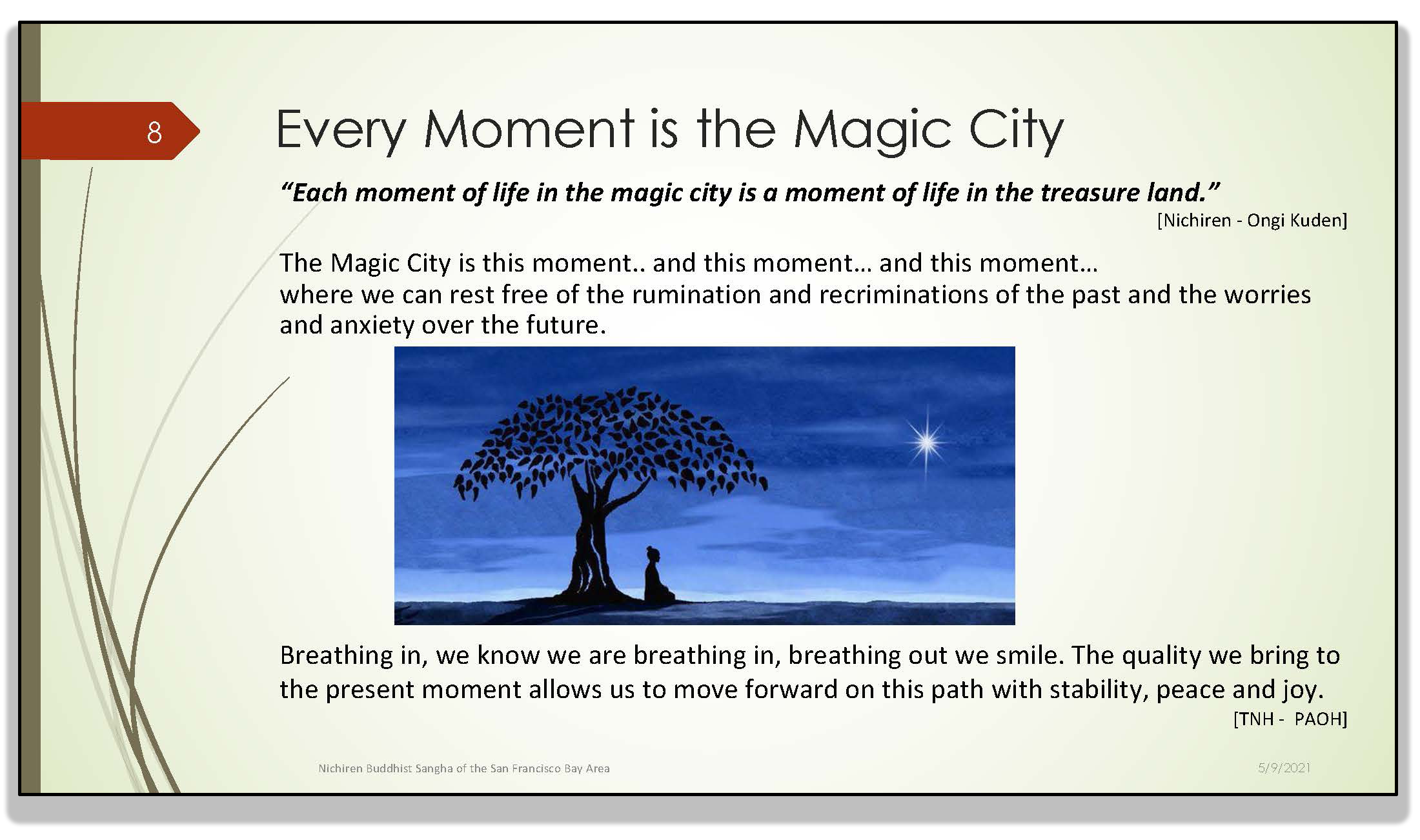
But then we got to this:

20210509_LotusSutraStudy_ChapterSeven_v4_Page_08First the chapter is declared boring and now the plain words of the sutra are said to have no meaning. Chapter 7 explains why the Buddha taught the lesser teachings. It was an expedient to allow those followers who could not make the full journey to the treasure of enlightenment to rest and gain strength. Those in the crowd hearing the Lotus Sutra had been hearing him for life after life since he was a śramaṇera teaching the Lotus Sutra.

Using the Ongi Kuden to explain the Lotus Sutra is like relying on a commentary for understanding instead of reading the sutra itself.

As Nichiren said repeatedly, “True practicers of Buddhism should not rely on what people say, but solely on the golden words of the Buddha.”

The Ongi Kuden is not the oral teachings of Nichiren.  Modern scholars suggest the book was actually written by Nikko’s followers  at the height of the popularity of the Tendai teaching of Original Enlightenment between 110 and 185 years after Nichiren’s death.

Yesterday I published Original Enlightenment and Nichiren as the Original Buddha, an excerpt from Daniel Mongomery’s Fire in the Lotus, explaining why the Ongi Kuden is an unreliable source of Nichiren’s teachings. The most troubling implication to me, is the extent to which Nichiren Shoshu and, by extension, Soka Gakkai have used the Ongi Kuden to reject the Eternal Śākyamuni of Chapter 16 while elevating  Nichiren to the status of Original Buddha.

In Jacqueline Stone’s prize winning book Original Enlightenment and the Transformation of Medieval Japanese Buddhism, she explains that such games with words were “characteristic of medieval Tendai kanjin-style interpretations: The seed surpasses the harvest; the stage of practice surpasses that of attainment; Superior Conduct, a bodhisattva, is superior to Śākyamuni, a Buddha; and Nichiren, who lived after Śākyamuni in historical time, becomes his teacher in beginningless time.”

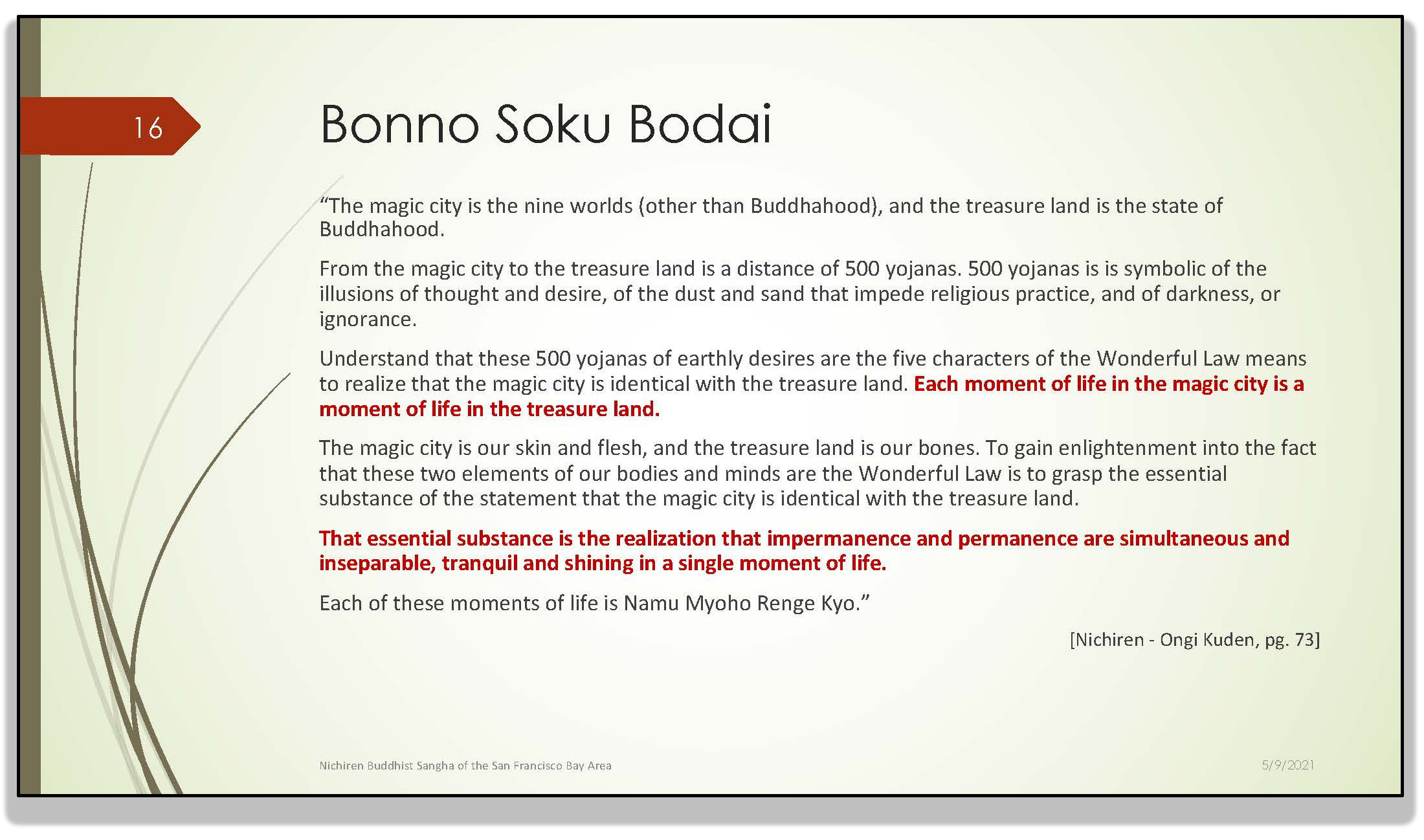
The slide deck for the lecture included several supporting slides, one of which was this one:

20210509_LotusSutraStudy_ChapterSeven_v4_Page_16

This is the full text from the Ongi Kuden used earlier to say every moment is the Magic City.

To say “From the magic city to the treasure land is a distance of 500 yojanas” is nonsensical. The magic city was created 300 yojanas from the start to give a rest to those who wanted to turn back. What’s the point of changing that plain fact?

In Senji-shō, Selecting the Right Time, Nichiren admonishes his questioner: “You may ask for scriptural proofs to back up statements in later commentaries, but you may not look for proofs in later commentaries when statements in sūtras are clear.”

In a letter that discusses distinguishing the true sūtra from the provisional, Nichiren quotes Grand Master Dengyō: “Rely upon the words of the Buddha in sūtras; do not believe in what has been transmitted orally.”


‘I, Nichiren, Was the First’

Born in the Latter Age of Degeneration, I, Nichiren, was the first to spread the outline of the Wonderful Dharma reserved for Bodhisattva Superior Practice. I was also the first to inscribe the Great Mandala with Śākyamuni Buddha appearing in the “Life Span of the Buddha” chapter of the essential section of the Lotus Sūtra, the Buddha of Many Treasures who emerged in the “Stupa of Treasures” chapter of the theoretical section, and bodhisattvas from the earth in the “Emerging from the Earth” chapter. These are very meaningful to me. And those who hate me cannot affect my enlightenment no matter what power they hold. Therefore, the transgression of exiling me to this remote island will never disappear for incalculable kalpa (aeons).

Referring to this the Buddha preaches in “A Parable” chapter, “If I were to describe its sin, I would exhaust a kalpa without fully explaining its magnitude.” The merit of your offerings to me and becoming my follower, on the other hand, cannot be fully comprehended even with the Buddha’s wisdom. Therefore, it is preached in the “Medicine King Bodhisattva” chapter, “Even the wisdom of the Buddha cannot measure the extent of such merit.”

Shohō Jisso-shō, Treatise on All Phenomena as Ultimate Reality, Writings of Nichiren Shōnin, Faith and Practice, Volume 4, Page 77

Daily Dharma – May 16, 2021

You should promptly discard your false faith and take up the true and sole teaching of the Lotus Sutra at once. Then this triple world of the unenlightened will all become Buddha Lands. Will Buddha lands ever decay? All the worlds in the universe will become pure lands. Will Pure Lands ever be destroyed? When our country does not decay and the world is not destroyed, our bodies will be safe and our hearts tranquil. Believe these words and revere them!

Nichiren wrote this passage in his Treatise on Spreading Peace through Right Practice (Risshō Ankoku-ron). We may believe that we can practice correctly only when the world becomes peaceful. As if so long as we are in this world of conflict, we would need to use force and aggression to create peace. Nichiren turns this idea upside down. He shows that only by our practicing respect towards all beings, and working for their benefit, can we create peace in this world.

The Daily Dharma is produced by the Lexington Nichiren Buddhist Community. To subscribe to the daily emails, visit zenzaizenzai.com

Day 15

Day 15 concludes Chapter 10, The Teacher of the Dharma, and opens Chapter 11, Beholding the Stūpa of Treasures.

Having last month repeated in gāthās the three things needed to be done before expounding this sutra, we conclude today’s portion of Chapter 10.

If anyone speaks ill of you, or threatens you
With swords, sticks, tile-pieces or stones
While you are expounding this sūtra,
Think of me, and be patient!

My body is pure and indestructible.
I will appear in any of many thousands of billions of worlds
During many hundreds of millions of kalpas,
And expound the Dharma to the living beings.

If a teacher of the Dharma expounds this sūtra
After my extinction,
I will manifest the four kinds of devotees:
Bhikṣus, bhikṣunīs, and men and women of pure faith,
And dispatch them to him
So that they may make offerings to him,
And that they may lead many living beings,
Collecting them to hear the Dharma [from him].

If he is hated and threatened
With swords, sticks, tile-pieces or stones,
I will manifest men and dispatch them to him
In order to protect him.

If an expounder of the Dharma
Reads and recites this sūtra
In a retired and quiet place,
Where no human voice is heard,
I will show my pure and radiant body to him.
If he forgets a sentence or a phrase of this sūtra,
I will tell it to him
For his complete understanding.

Anyone who expounds this sūtra to the four kinds of devotees,
Or reads or recites this sūtra in a retired place,
After doing these [three] virtuous things,
Will be able to see me.

If he lives in a retired place,
I will dispatch gods, dragon-kings, yakṣas,
Demigods, and others to him,
And have them hear the Dharma [from him].

He will expound the Dharma with joy.
He will expound it without hindrance.
He will cause a great multitude to rejoice
Because he is protected by all the Buddhas.

Those who come to this teacher of the Dharma
Will be able to complete the Way of Bodhisattvas quickly.
Those who follow him and study will be able to see
As many Buddhas as there are sands in the River Ganges.

See The True Meaning of Worship