
Buddhism for Today, p142“Medicine-King! Erect a stupa of the seven treasures in any place where this sūtra is expounded, read, recited or copied, or in any place where a copy of this sūtra exists! The stupa should be tall, spacious and adorned. You need not enshrine my śarīras in the stupa. Why not? It is because it will contain my perfect body.” Chapter 10, The Teacher of the Dharma
Through these words the Buddha teaches us that it is much more important to revere the Law itself than to worship idols. What he is saying is: However much a person may blaspheme the Buddha, his sin is still light. There is no need to deposit the Buddha’s relics in pagodas. The greatest veneration of the Buddha is to practice the Lotus Sutra, and the heaviest sin is to defame the lay devotees or monks who practice the sutra.
However, we must be careful in our understanding of this teaching. It would be a great mistake to think that it does not matter if we blaspheme the Buddha, or that we should ignore the Buddha’s relics. Sakyamuni Buddha was a great man who left us his precious teachings, and for this reason we cannot revere him too much. We worship the image of the Buddha in order to show our boundless gratitude to the Buddha, who left us his precious teachings. As mentioned repeatedly in this book, it is also done for the sake of deepening our reverence for the Buddha as our ideal, which we wish to approach little by little.
Moreover, through the image of Sakyamuni as the historical Buddha, we worship the Tathāgata Sakyamuni and the Eternal Original Buddha, namely, the Law preached by him. Worshiping the image of the Buddha is not idol worship. Idol worship indicates the idea of regarding the thing itself as the object of worship, believing, for example, that if one worships some object one’s disease will be cured, one will be spared from suffering, or one’s desires will be fulfilled. There is all the difference in the world between true worship and idol worship.
All posts by John Hughes
Real Yet Tentative; Tentative Yet Real
Foundations of T'ien T'ai Philosophy, p 183-184It should be known that the dharmas of sentient beings are beyond conceptual understanding. They are real yet tentative; tentative yet real. Their real and tentative aspects are mutually non-obstructing. It is not possible to perceive [the true reality of] sentient beings with the eyes of a bull or sheep. It is not possible to measure [the true reality of] sentient beings with the mind of an ignorant man. Wisdom like that of the Buddha is able to measure it. Why is this so? Because the dharma of sentient beings is subtle.
Original Enlightenment and Nichiren as the Original Buddha
In describing Daniel Montogemery’s Fire in the Lotus, I mentioned that it appeared to adhere to a Nichiren Shu doctrinal line that Senchu Murano drew. This is most evident in Montgomery’s discussion of Original Enlightenment thought and the Ongi-kuden.
Senchu Murano’s 1998 booklet entitled Questions and Answers on Nichiren Buddhism contains a series of questions he was asked by his friends overseas.
Feb. 6, 1986, Daniel B. Montgomery asked:
“Are the Ongi-kuden and the Onko-kikigaki of any value or not?”
Murano responded on Feb. 24, 1986:
“Recent investigations have reached the conclusion that the Ongikuden was written by a priest of the Nikko Monryu during the Muromachi Period (1392-1467). It stresses the importance of the Hongaku-shiso (the philosophy of original enlightenment). The Hongaku-shiso was naturalistic optimism, which flourished in those days of national disintegration. The logic favored by the philosophers was, roughly speaking, we have the Buddha-nature; we are Buddhas in essence; we are already Buddhas; we do not have to practice anything. Thus, secularism was justified. The purpose of Buddhism became just to enjoy speculation by arbitrary self-will, ignoring the study of texts. Bold equations were endlessly created, such as “we are Buddhas,” “illusions are enlightenment,” “this world is the Buddha-land,” “one is three,” “three are one” etc., etc. These equations are fascinating, but produce no value. The Hongaku-shiso was advocated by the Medieval Age Tendai (Chuko Tendai), and many Nichiren Buddhists were also attracted to this philosophy. Even today, the impact of this philosophy is still found in the terminology of the liturgy of Nichiren Buddhism. The Onko-kikigaki was written probably by someone connected with the Itchi-ha, who attempted to cope with the Ongi-kuden, also during the Muromachi Period.”
In Fire in the Lotus, Montgomery examines the idea of Original Enlightenment thought as it evolved in Japan and shows how the distortion of Original Enlightenment theory led to Nichiren Shoshu’s idea that Nichiren, not Śākyamuni, is the original Buddha.
There is a difference between Original Enlightenment as taught in India and China, and as it developed in Japan, where it encountered ‘the basically optimistic Shinto mentality of the Japanese.’ In its pure form Original Enlightenment may be the highest reaches of Buddhist thought. The idea is that all the contradictions and conflicts of the world as we know it are transcended by Emptiness. Subject and object, male and female, mind and body, life and death, good and evil, and other polarities are not opposed to each other, but mutually dependent. Take away one, and you lose the other. In the Vimalakirti Sutra this idea of interdependence is expressed as non-duality (Japanese, funo.) Nonduality refers to the absolute, not to the everyday world, which is clearly full of dualities and contradictions.
In Japan, however, Tendai thinkers pushed the idea further. They affirmed the absolute nature of the contradictions. The everyday world is the absolute; it is not-two.
Yoshiro Tamura, in his study entitled ‘Interaction between Japanese Culture and Buddhism: The Thought of Original Enlightenment,’ points out that a very thin dividing line has been crossed here. From maintaining the tension between the absolute and the relative as not two, we have crossed over to the affirmation of the relative itself as the not-two (Osaki Gakuho, No. 138 (1985) 2).
This is the Japanese version of Original Enlightenment. It spread gradually, almost as if its proponents were not fully aware of what they were implying. The idea of Original Enlightenment was already developing at the time of the Kamakura reformers, and it became pervasive after them. It is found everywhere, especially in Tendai, Shingon, Nichiren, Kegon and Zen. It is forcefully repudiated only by the Pure Land schools, who reject this world entirely, putting all their hope in the world to come. But even there, it sometimes sneaked in by the back door, for we are saved naturally by Amida without any contrivance on our part.
The logic of Original Enlightenment is that since we are already enlightened, we do not have to do anything about it. We are already Buddhas just as we are. It follows that any religious practice — any morality, for that matter — will only confuse the matter. We must ‘do our own thing’ because ‘our own thing’ is the Buddha nature operating within us.
The vocabulary of Original Enlightenment produced grandiose slogans: ‘I am Buddha’; ‘illusions are enlightenment’; ‘this world is the Buddha-land’; ‘the three bodies of Buddha are one’; ‘one is three’; ‘earthly desires are enlightenment’; ‘body and mind are one’; ‘the sufferings of life and death are nirvana’. In his authenticated writings Nichiren rarely used such terms, and when he did, he carefully explained their meaning.
‘Earthly desires are enlightenment and … the sufferings of life and death are nirvana. When one chants Namu Myoho Renge Kyo even during sexual union of man and woman, then earthly desires are enlightenment and the sufferings of life and death are nirvana. Sufferings are nirvana only when one realizes that the entity of human life throughout its cycle of birth and death is neither born nor destroyed.’ (MW 2:229)
Nichiren’s explanation is orthodox Mahayana. Reality viewed from wisdom is nirvana and enlightenment (bodai); reality viewed from illusion is passion and suffering. In either case, reality is reality. Many Tendai, Shingon, and Pure Land teachers of the times crossed a subtle line here with their careless use of dramatic slogans, but Nichiren held to that line. A highly moral man, he objected to the amorality latent in Original Enlightenment. He saw it clearly in the iconoclasm of Zen, which he described as ‘inspired by devils.’
After his death, however, there appeared collections of his unauthenticated ‘oral teachings,’ which were loaded with the vocabulary of Original Enlightenment. A well-meaning author compiled a book to bring Nichiren up-to-date by recasting his teachings in the then-popular slogans of Original Enlightenment. He called it Ongi Kuden (‘Record of the Orally Transmitted Teachings [attributed to Nichiren]’). Appearing at the height of the Original Enlightenment craze, it is saturated with its phraseology. Here is its exegesis of a line from Chapter 16 of the Lotus Sutra:
‘Since I truly became Buddha (there have passed) infinite, boundless . . .’ (Ga jitsu jobutsu irai muryo muhen): Gajitsu (‘I truly’) means Buddha’s attaining enlightenment in kuon, the infinite past. However, the true meaning is that Ga (‘I’) is indicative of all living things in the universe or each of the Ten Worlds, and that Jitsu (‘truly’) is defined as Buddha of Musa Sanjin (natural Three Bodies) . . . The person who realizes this is named Buddha. I (literally, ‘already’) means the past and rai (literally, ‘to come’) the future. Irai includes the present in it. Buddha has attained the enlightenment of Ga jitsu, and His past and future are of uncountable and unfathomable length . . . Kuon means having neither beginning nor end, being just as man is, and being natural. It has neither beginning nor end because Musa Sanjin is not created in its original form. It is just as man is because it is not adorned by the 32 wonderful physical features and 80 favorable characters [of a Buddha]. It is natural because the Buddha of Honnu Joju (‘unchanging inherently existing’) is natural. Kuon is Namu Myoho Renge Kyu Kuon Jitsujo — really enlightened, enlightened as Musa (‘not being produced by conditions’).
(Ongi Kuden, quoted by Ikeda, Science and Religion 200)All the main ideas of Original Enlightenment are here: ‘just as man is’; ‘not produced by conditions’; ‘not adorned with any special characteristics’; ‘inherently existing’; ‘all living things are originally enlightened’. The only important idea which is missing is ‘earthly desires are enlightenment’, but that appears elsewhere in the same text: ‘Burn the firewood of earthly desires and reveal the fire of enlightened wisdom’ (Ongi Kuden, quoted by Kirimura, Outline of Buddhism 172).
Ongi Kuden, which may have been written at Taiseki-ji in the first place, became prominent in the theology of Nichiren Shoshu. It was widely believed to contain the authentic verbal teachings of Nichiren as recorded by Nikko. Ironically, one forgery provoked another one. The rival ‘Unity’ branch produced its own ‘oral transmission’ called Onko-kikigaki, and claimed that it had been put into writing by Niko of Mount Minobu. Its real purpose seems to have been to counteract the influence of Ongi Kuden. Only in recent times have both works come to be regarded as pious forgeries (Murano 1982).
The Nichiren Shoshu doctrine that Nichiren himself is the Original Buddha follows logically from Original Enlightenment. Nichiren is originally enlightened to the true Dharma. ‘Original’ here does not mean first at a point in time, but eternal — timeless. We are all originally enlightened, and Nichiren reveals what this means. When we practice what he practiced (as when Shakyamuni practices what he practiced) we uncover our originally enlightened nature.
Nichiren is said to have realized his own Original Enlightenment at the moment the executioner raised the sword above his head on the beach at Tatsunokuchi. From that moment on Nichiren’s teachings are the infallible words of the Originally Enlightened Buddha.”
Fire in the Lotus, p177-180
To underscore this focus on the Ongi-kuden in Nichiren Shoshu at the expense of Nichiren Shu foundational teachings, Montgomery points out that in 1950, Jōsei Toda, a founder of Soka Gakkai, promised to rebuild Taiseki-ji, which had been largely abandoned during the war years. To do this, he vowed to emphasize the Ongi Kuden and to shun Chih-i’s philosophy. Montgomery points out that he gets this information from Daisaku Ikeda’s Human Revolution, Volume IV, pages 249-56.
Next: The Life of Kumārajīva
Revealing the Enlightenment of Śākyamuni Buddha
It is clearly stated in the Lotus Sūtra that the true intent of the Buddha has completely been preached in it. The second chapter on “Expedients” declares, “Now is the time to expound the wisdom of the Buddha.” The sixteenth chapter on “The Life Span of the Buddha” states, “I have always been contemplating how I should lead all people into the Supreme Way, enabling them to become Buddhas promptly.” The twenty-first chapter on “Divine Powers of the Buddha” states, “In sum, the teachings of the Buddha are all revealed and clearly expounded in this sūtra.”
These statements of the Buddha clearly show that the enlightenment of Śākyamuni Buddha is revealed in this sūtra without reservation. Moreover, the Buddha of Many Treasures and Buddhas in manifestation in the worlds all over the universe gathered together in the courtyard on Mt. Sacred Eagle to validate the words of Śākyamuni Buddha: “Of all the Buddhist scriptures, which have already been preached, now being preached and will be preached in the future…” deciding that no sūtras are as difficult to understand and put faith in as the Lotus Sūtra, supreme of all scriptures.
Shugo Kokka-ron, Treatise on Protecting the Nation, Writings of Nichiren Shōnin, Doctrine 1, Page 70
Daily Dharma – May 15, 2021
The [perverted] people think:
“This world is in a great fire.
The end of the kalpa [of destruction] is coming.”
In reality this world of mine is peaceful.
The Buddha sings these verses in Chapter Sixteen of the Lotus Sūtra. Here he draws a stark contrast between how those caught in the web of delusion see the world and how things really are. The world is constantly changing. When we expect the world to be as we want it, rather than as it is, any change is frightening. We assume that the world is falling apart and will sweep us along in its demise. When we practice the Wonderful Dharma of the Lotus Sūtra, we know that we and all beings will become enlightened. The change in the world is part of our practice. We know how it will turn out and there is no fear. Only peace.
The Daily Dharma is produced by the Lexington Nichiren Buddhist Community. To subscribe to the daily emails, visit zenzaizenzai.com
Day 14
Day 14 covers all of Chapter 9, The Assurance of Future Buddhahood of the Śrāvakas Who Have Something More to Learn and the Śrāvakas Who Have Nothing More to Learn, and opens Chapter 10, The Teacher of the Dharma.

Thereupon Ānanda and Rāhula thought, ‘We are always thinking: How glad we shall be if we are assured of our future Buddhahood!’ They rose from their seats, came to the Buddha, worshipped his feet with their heads, and said to him:
“World-Honored One! We think that we also are qualified to be assured [of our future Buddhahood]. Only you, the Tathāgata, are our refuge. We are known to all gods, men and asuras of the world. Ānanda always protects the store of the Dharma as your attendant. Rāhula is your son. If you assure us of our future attainment of Anuttara-samyak-saṃbodhi, the wishes not only of us but also of others will be fulfilled.”Thereupon the two thousand disciples [composed of the two kinds of Śrāvakas]: the Śrāvakas who had something more to learn and the Śrāvakas who had nothing more to learn, also rose from their seats, bared their right shoulders, came to the Buddha, joined their hands together with all their hearts, looked up at the WorldHonored One, begged him just as Ānanda and Rāhula did, and stood to one side of the place.
Fire in the Lotus
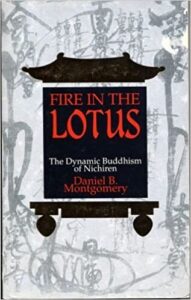
Fire in the Lotus was published in 1991. As a result it does not address the excommunication of Soka Gakkai members by Nichiren Shoshu on Nov. 28, 1991. It also discusses groups such as Nichijo Shaka’s Buddhist School of America that have since disappeared. But on a whole, it stands up well today.
That’s not to say that I don’t have any complaints. Montgomery erroneously conflates the Parable of the Priceless Gem of Chapter 8, The Assurance of Future Buddhahood of the Five Hundred Disciples, with the Parable of the Priceless Gem in the Top-Knot of Chapter 14, Peaceful Practices.
Another parable in the Sutra treats the matter from a different angle. A young man became drunk after an evening of carousing and passed out. A wealthy friend had to leave him there, but decided first to do him a favour. He took a valuable jewel and placed it in the drunken man’s topknot. Surely, he reasoned, when his friend woke up, he would notice the jewel, use it to pay any expenses, and still have plenty left over for whatever he wanted.
But this did not happen. When the drunken man got up the next day, it never occurred to him that he was now wealthy. First he was thrown out of the inn for not paying his bill. Then things went from bad to worse. He wandered from place to place, doing odd jobs when he could and living from hand to mouth.
Years later, his wealthy friend ran into him and was shocked by his appearance. ‘What happened to you?’ he asked. ‘How did you lose all your money?’
‘What money? I never had any. You know that.’
The money from the jewel I left in your topknot. I left it for you so that you could pay your expenses, invest the rest, and go into business for yourself.’
The poor man dug into his topknot and, sure enough, there was the priceless jewel! It had been there all along. He had been a rich man, carrying a fortune with him wherever he went, but he had never known it.
So it is, says the Buddha, with everyone. The priceless jewel, the Buddha nature, lies within us untapped. The only difference between the Buddha and us is that he knows this, has unraveled his topknot, and exposed the jewel of the Buddhahood. (Page 50)
Then there’s the question of how one writes the Daimoku in English. For most of the book, Montgomery uses Namu Myoho Renge Kyo. But occasionally Soka Gakkai’s spelling with Nam sneaks in. It is understandable when Montgomery is quoting a Nichiren Shoshu or a Soka Gakkai source, but then it pops up unexpectedly:
Even more extraordinary is the story of Nisshin Nabekamuri, the ‘pot-wearer’ (1407-88). A representative of Toki Jonin’s Nakayama School, he arrived in Kyoto at the age of 22, and promptly set to work writing a thesis in imitation of Nichiren’s, which he called, ‘Establish the Right Law and Rule the Country’. When he finished it he presented it to Shogun Ashikaga Yoshinori, which was a mistake. The Shogun had once been an ordained monk on Mount Hiei, and had inherited a bitter hatred for Nichiren Buddhism. He decided to break Nisshin for his impertinence. The young priest was arrested and tortured. Nisshin was not tortured only once, but daily for two years. The Shogun took a perverse delight in watching the sufferings of the priest; he supervised the daily tortures by fire, rack, sword, and whatever else he could think of. Nothing would make Nisshin stop chanting, Nam-myoho-renge-kyo. Finally the Shogun ordered that a metal pot be jammed over his head to keep him quiet, but from underneath the pot could still be heard, Nam-myoho-renge-kyo! Nam-myoho-renge-kyo!
Nisshin’s ordeal might have continued indefinitely had not the cruel Shogun been assassinated one day while watching a theatrical performance. Nisshin was released, and the pot was removed from his head. He rebuilt his temple, which had been destroyed, took up his drum, and went back to the street corners to chant, Nam-myoho-renge-kyo! Nam-myoho-renge-kyo! Never one to avoid a challenge, he is said to have triumphed in 60 religious debates in the course of his 65-year career. (Page 161-162)
One assumes Montgomery got this version of the tale from Nichiren Shoshu/Soka Gakkai materials, but the inconsistency grates.
Montgomery has something of pattern of picking up material whole. For example, in discussing Shariputra’s dislike for women he quotes from Buddha-Dharma: New English Edition, published by the Numata Center for Buddhist Translation in 1984.
However, there is a delightful Sanskrit story that even Shariputra met his match when he encountered a woman saint in heaven and asked her, ‘Now that you have the ability, why don’t you change yourself into a man?’ Instead of answering him, she turned him into a woman and asked him if he felt any different.
That “delightful Sanskrit story” is actually the Vimalakīrti Sūtra and the “saint in heaven” is actually a goddess who has been living in Vimalakīrti’s room for 12 years. Here’s Burton Watson’s translation of the exchange:
Shariputra said, “Why don’t you change out of this female body?
The goddess replied, “For the past twelve years I have been trying to take on female form, but in the end with no success. What is there to change? If a sorcerer were to conjure up a phantom woman and then someone asked her why she didn’t change out of her female body, would that be any kind of reasonable question?”
“No,” said Shariputra. “Phantoms have no fixed form, so what would there be to change?”
The goddess said, “All things are just the same—they have no fixed form. So why ask why I don’t change out of my female form?”
At that time the goddess employed her supernatural powers to change Shariputra into a goddess like herself, while she took on Shariputra’s form. Then she asked, “Why don’t you change out of this female body?”
Shariputra, now in the form of a goddess, replied, “I don’t know why I have suddenly changed and taken on a female body!”
The goddess said, “Shariputra, if you can change out of this female body, then all women can change likewise. Shariputra, who is not a woman, appears in a woman’s body. And the same is true of all women—though they appear in women’s bodies, they are not women. Therefore the Buddha teaches that all phenomena are neither male nor female.”
Then the goddess withdrew her supernatural powers, and Shariputra returned to his original form. The goddess said to Shariputra, “Where now is the form and shape of your female body?”
Shariputra said, “The form and shape of my female body does not exist, yet does not not exist.”
The goddess said, “All things are just like that—they do not exist, yet do not not exist. And that they do not exist, yet do not not exist, is exactly what the Buddha teaches.”(Page 90-91)
All things considered, Fire in the Lotus is an excellent addition to any library devoted to Nichiren and the Lotus Sutra.
Next: Original Enlightenment and Nichiren as the Original Buddha
The Concept of No-Truth in Both Hinayāna and Mahāyāna
Foundations of T'ien T'ai Philosophy, p 255-256Question: Why do you discuss [the concept of] no-truth in both Hinayāna and Mahāyāna?
Answer: The Ta chih tu lun [Treatise on the Great Perfection of Wisdom] says, “I am not criticizing the nirvāṇa attained in the mind of the sage, but the attachment to nirvāṇa among those who have not yet attained [enlightenment] which gives rise to vain speculation [prapañca].”622 It is like arousing attachments when coming in contact with [the concept of] non-Being [and mistaking it for nothingness]. Therefore one destroys [the notion of one truth] by saying “no-truth.”
Question: If this is so, then one should criticize both the attainment and non-attainment of the Hinayānist, and one should criticize both the attainment and non-attainment of the Mahāyānist.
Answer: This is not the case. Those of the Hinayāna have distinct delusions which should be removed and a distinct reality which they should manifest. Therefore though it is said that they have attainment, this should be criticized. The Middle Path is not like this. Why then should its attainment be criticized?
Question: If so, then the Middle Path alone should be the one real truth, and should not be called “no-truth.”
Answer: It is necessary to say “no-truth” for the sake of those who have not fulfilled attainment, and in their attachments give rise to delusion. For those who have real attainment, there is [a positive truth]; for those [lost] in vain speculation, there is none.623
- 622
- The Shakusen kōgi refers to the Ta chih tu lun, fascicle 1.12, but the closest passage I could find in this section were the verses on prapañca, which read in part, “If one relies on one’s own mistaken views, one will give rise to all sorts of vain speculations.” These are verses which illustrate the fourth siddhānta. return
- 623
- The section on the subtlety of objects continues for a couple of pages in a section titled “Exposing the Harmony of All Objects.” Here Chih-i discusses the relationship between all of the above subjects, such as which parts of twelvefold conditioned co-arising correspond to which parts of the ten such-likes, and so forth. This illustrates the integrated nature, or interrelatedness, of all these aspects of objective reality, thus manifesting Chih-i’s basic theme of variety within a single reality. This is the last part of the section on subtle objects, but it is not included in my translation because of its length and repetitiveness. Chih-i’s point is already clear. return
Insight of the Buddha in the Theoretical Section
Grand Master T’ien-t’ai interprets the two letters of Chih and kuan (concentration and insight) in the Great Concentration and Insight: “I call kuan the wisdom of the Buddha and Chih the insight of the Buddha.” This (interpretation), however, refers to the wisdom and insight of the Buddha in the theoretical section, not the ultimate wisdom and insight of the Buddha at the highest stage of Supreme Enlightenment. For the Great Concentration and Insight is based on the ten realms, the ten aspects, the 3,000 realms of existence, the triple truth and the threefold contemplation, which Grand Master T’ien-t’ai attained, and these thoughts are the real intention of the theoretical section in the first half of the Lotus Sūtra. Therefore, we should remember that the Great Concentration and Insight is the wisdom and insight of the Buddha in the theoretical section.
Risshō Kanjō, A Treatise on Establishing the Right Way of Meditation, Writings of Nichiren Shōnin, Doctrine 2, Page 228
Daily Dharma – May 14, 2021
Today we are not what we were then.
We have obtained
What we did not expect
To obtain
Just as the poor son obtained
The innumerable treasures.
Subhūti, Mahā-Kātyāyana, Mahā-Kāśyapa, and Mahā-Maudgalyāyana, all disciples of the Buddha, speak these lines in Chapter Four of the Lotus Sūtra as they explain their story of the wayward son. They compare the father’s treasure house in the story to the Buddha’s enlightenment. Until they had been led by the Buddha’s expedient teachings, they could not even imagine themselves as enlightened, any more than the wayward son in the story could imagine the contents of his father’s treasure house.
The Daily Dharma is produced by the Lexington Nichiren Buddhist Community. To subscribe to the daily emails, visit zenzaizenzai.com