All posts by John Hughes

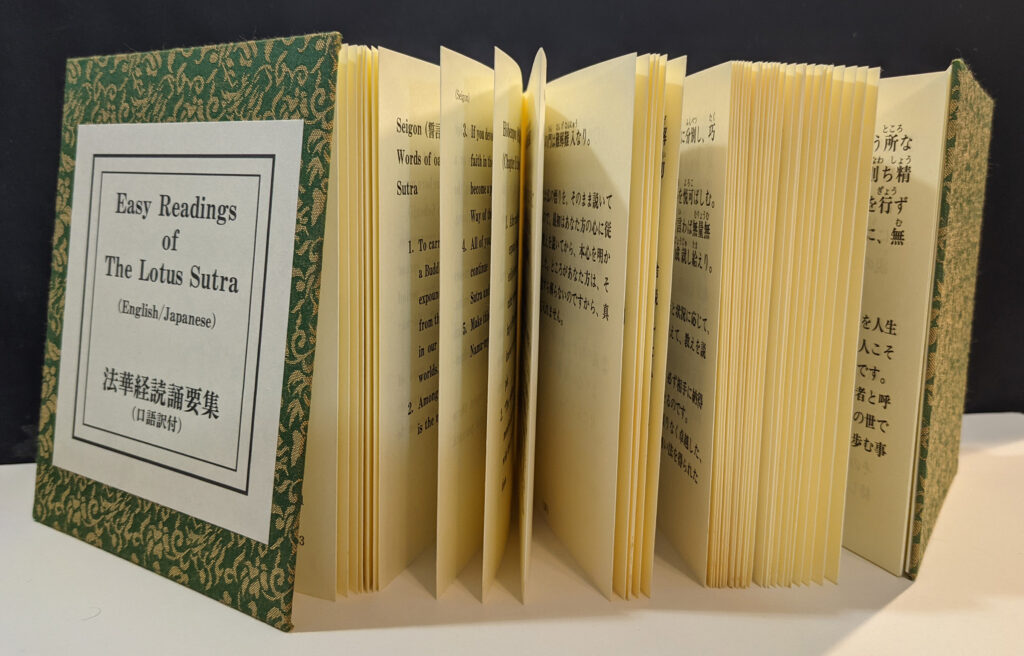
Easy Readings of the Lotus Sutra

easy-readings-coverFrom the NBIC Online Store
This prayer book is a handy new edition by Rev. Jodo Kiyose of Nichihonji Temple, published by Rev. Shukai Oikawa of Joenji Temple, designed to serve as an introduction to the liturgy of the Nichiren Order. Although it is impossible to replace a teacher who could explain the liturgy, this book will be helpful for those who may have been chanting the Japanese without a clear notion of its meaning as many of the important quotations of the liturgy have been extracted and broken down into simple components to acquaint the practitioner with its basic meaning.

Contents:

  1. Dojokan – Establishing the Place of Prayer
  2. Sanmon – Adoration of Gohonzon
  3. Seigon – Words of oath before reciting the Lotus Sutra
  4. Hobempon – Chapter 2: Expedients
  5. Juryohon – Chapter 16: The Duration of the Life of the Tathāgata
  6. Shodaigyo – The Practice of Odaimoku Chanting
  7. Shikyonanji – Chapter 11: Beholding the Stūpa of Treasures (Hōtōge)
  8. Iyogonshi – Chapter 21: The Supernatural Powers of the Tathāgatas
  9. Eko – Offering of Merits
  10. Hosshin – Resolve
  11. Sange – Repentence
  12. Kie – Prayer to declare faith
  13. Japanese Readings ‐ Shindoku for Hobenpon and Juryohon
  14. Phrases of Nichiren Daishonin ‐ Short snippets from Nichiren’s writings

Published: April 28th, 2014

Editor: Rev. KIYOSE Jōdō
Nichihon-ji Temple, 1820-1, Tako-machi, Katori-gun, Chiba-ken 289-2257

Publisher: Rev. OIKAWA Shokai
Jōen-ji Temple, 7-12-5, Nishi-shinjuku, Shinjuku-ku, Tōkyō 160-0023

174 pages, bound in traditional Japanese expandable accordion style

Book Quotes

 
Book List

Easy Does It

Easy Readings of The Lotus Sutra is 174 pages, bound in traditional Japanese expandable accordion style

For the next 12 days, I’ll be publishing excerpts from Easy Readings of The Lotus Sutra, a fascinating little book that is both “easy” to read and informative. It certainly meets its stated objective: “Although it is impossible to replace a teacher who could explain the liturgy, this book will be helpful for those who may have been chanting the Japanese without a clear notion of its meaning.”

An excellent example of this is the English translation of the Ten Suchnesses from Chapter 2

This true state of all things must be viewed from the following 10 kinds of perspectives: “sō” is the outside appearance; “shō” is the nature hidden inside; “tai” is the combination of the two. These three factors are the fundamentals of existence. “Riki” is the inner power; “sa” is the outside effect; “in” is the direct cause; “en” is the indirect cause; “ka” is the result; “hō” is a new interrelationship with the surroundings suitable to its effect. The factors of “hon”, which encompasses “sō” , “shō” and “tai”, and “matsu”, which encompasses the rest, are the factors existing in all things and always complement one another. This is “tō” or equality.

After I add this material I will incorporate it into my “Where to Begin” content.

Three Kinds of Messengers

The Lotus Sūtra can be viewed differently, depending on the recipient’s ability, on the era and country in which it is preached, and on the people who spread it. However, even bodhisattvas at the highest rank almost equal to the Buddha do not seem to understand this, much less ordinary people in the Latter Age of Degeneration. When I think about it, there are three kinds of messengers. One is extremely wise, another is neither simple-minded nor wise, and the last is very simple-minded but honest and dependable.

Of these three, the first one has wisdom so that mistakes are not made. Although the second one is not as wise as the first, wisdom is present. This messenger might add arbitrary words to the master’s; making this messenger the most dangerous of all. The third one lacks any wisdom and thus does not think about adding words. Also, since this messenger is extremely honest, the words of the master are transmitted accurately; therefore, this messenger may be a superior to the second type. In fact, in some cases the third one is better than the first messenger. The first messenger is compared to the four ranks of bodhisattva leaders after the death of the Buddha in India, the second messenger is compared to Buddhist masters in China, and the third messenger is compared to ordinary people in the Latter Age of Degeneration who are simple-minded but honest.

Zui-jii Gosho, The Sūtra Preached in Accordance to [the Buddha’s] Own Mind, Writings of Nichiren Shōnin, Faith and Practice, Volume 4, Page 155

Daily Dharma – April 1, 2021

Muddy water has no mind but it still catches the moon’s reflection and naturally becomes lucid. Plants and trees catch the rain in order to blossom, but can we say they do this deliberately? The five characters of Myo Ho Ren Ge Kyo are not the text of the sutra nor a mere explanation; rather they are the sole intent of the whole sutra. Beginners may practice this without knowing the heart (of the Lotus Sutra), but their practice will naturally harmonize with its intention.

Nichiren wrote this passage in his Treatise on The Four Depths of Faith and Five Stages of Practice (Shishin Gohon-Shō). This is another way of saying that we do not need to rely on our own skills or wisdom to practice the Buddha Dharma. Whether we are brilliant or slow, focused or distracted, calm or agitated, when we rely on the Ever-Present Buddha, we are in harmony with the world.

The Daily Dharma is produced by the Lexington Nichiren Buddhist Community. To subscribe to the daily emails, visit zenzaizenzai.com

Day 4

Day 4 concludes Chapter 2, Expedients, and completes the first volume of the Sūtra of the Lotus flower of the Wonderful Dharma.

Having last month considered how all of the Buddhas use expedients, we consider the dilemma faced by the Buddha upon attaining enlightenment.

Śāriputra, know this!
Seeing with the eyes of the Buddha
The living beings of the six regions, I thought:
“They are poor, and devoid of merits and wisdom.
They incessantly suffer because they are taken
To the rough road of birth and death.
They cling to the five desires
Just as a yak loves its tail.
They are occupied with greed and cravings,
And blinded by them.
They do not seek the Buddha who has great power.
They do not seek the Way to eliminate sufferings.
They are deeply attached to wrong views.
They are trying to stop suffering by suffering.”

My great compassion was aroused towards them.
I for the first time sat at the place of enlightenment[,]
[And attained enlightenment].
For three weeks afterwards,
I gazed on the tree,
Or walked about, thinking:
“The wisdom I obtained is
The most wonderful and excellent.
The living beings [of the six regions]
Are dull, attached to pleasures,
And blinded by stupidity.
How shall I save them?”

On that occasion King Brahman,
Heavenly-King Śakra,
The four heavenly world-guardian kings,
Great-Freedom God, and other gods [of each world],
And thousands of millions of their attendants
Joined their hands together [towards me] respectfully,
Bowed to me,
And asked me to turn the wheel of the Dharma.

I thought:
“If I extol only the Buddha-Vehicle,
The living beings [of the six regions] will not believe it
Because they are too much enmeshed in sufferings to think of it.
If they do not believe but violate the Dharma,
They will fall into the three evil regions.
I would rather enter into Nirvana quickly
Than expound the Dharma to them.”

See The Meaning of the Buddha’s Reluctance to Teach

Practice and the Six Perfections

The Six Perfections – generosity, discipline, patience, energy, meditation, and wisdom – are an important element of Buddhist practice. From one perspective, they lead us to Buddhahood. From another perspective, they describe the way of life of one who has achieved Buddhahood. Nichiren Buddhism emphasizes the latter interpretation and views our ability to embody the Six Perfections as the fruit of our practice of Namu Myoho Rcnge Kyo. The more we actualize our capacity for Buddhahood through the practice of Namu Myoho Renge Kyo, the more we will bring forth the qualities of generosity, discipline, patience, energy, meditation, and wisdom.

Lotus Seeds

Generosity: Empty Giving

How should we understand the higher form of generosity – “perfect giving”? The answer can be found throughout the Perfection of Wisdom Sutras, because wisdom is precisely what is needed to perfect generosity. Wisdom is the sixth perfection, the most perfect of the perfections, and the essential ingredient in all the others. Therefore it will need to be considered here in order to complete our understanding of the ideal of perfect generosity.

Perfect wisdom, whether related to generosity or any other dimension of life, consists in the realization of “emptiness,” and it is this teaching that the sutras promulgate from beginning to end. Although emptiness Śūnyatā) was an infrequently used word in the earliest layers of Buddhist literature, when it did make its appearance as the central concept in Mahayana sutras, it was defined in terms that were already familiar in the Pali sutras. To say that something is “empty” is to say that it is subject to continual change, that its existence is wholly dependent on factors outside of itself, and that it has no unchanging core or permanent essence. Making that claim, Mahayana Buddhists invoked the basic Buddhist teachings of impermanence, dependent arising, and no-self. All things are “empty” of their own self-established permanent essence because they are always subject to alteration and revision and because they are composed and defined in terms of what lies outside of them.

The “perfection” of giving incorporates the wisdom of “emptiness” to transform the perspective from which acts of giving occur. When the impermanence, dependence, and insubstantiality of all things are absorbed into one’s worldview down to the level of daily comportment, everything changes. A new, non-self-centered identity gradually emerges, one that entails reciprocity with everything that previously seemed to be other than oneself. This identity dissolves previous habits of self-protection and self-aggrandizement, opening the “self” to others in a connection of compassionate identification. To see how the vision of “emptiness” transforms thinking about generosity or giving, we look closely at passages in the sutras.

Instructing his disciple, Subhūti, in the perfection of generosity, the Large Sutra has the Buddha say: “Do not imagine that the gift is one thing, its fruit another, the donor another, and the recipient another. . . . And why? Because this gift is empty of a gift, its fruit empty of a fruit, and also the donor is empty of a donor and the recipient empty of a recipient. For in emptiness no gift can be apprehended nor its fruit, no donor, and no recipient. And why? Because absolutely those dharmas are empty in their own-being.”

The Buddha says, “Do not imagine.” Imagine what? Do not imagine that the world is divided up into separate self-subsistent entities, the way we ordinarily assume it to be. Do not imagine yourself as one of these isolated entities. Why not? Because all of these seemingly separate “things” are what they are only in connection to other things that make them what they are. Nothing stands on its own, and that is what it means to be “empty” of “own-being.” Applied to the act of giving, we see that the gift is not a gift without a donor and a recipient. Likewise, without the gift, there is no donor, no recipient. Each depends on the others, and when one changes, so do the others.

Six Perfections: Buddhism & the Cultivation of Character, p 23-24

Counting Practicers of the Lotus Sūtra

In China, Grand Master T’ien-t’ai defeated the Northern and Southern ten masters and was revered as a great master during the reign of the Ch’ên dynasty. As stated in the Effects of T’ien-t’ai on the Buddhist Schools, he was superior to various masters and was outstanding in T’ang China.

In Japan, Grand Master Dengyō defeated the six schools of Nara in debate and was appointed the first Grand Master in Japan. Throughout India, China, and Japan these three were the only persons who deserved to be called “the first among all the people.” Therefore, it is said in the Outstanding Principles of the Lotus Sūtra:

“The Buddha Śākyamuni has stated that it is easy to keep provisional sūtras preached before the Lotus Sūtra and hard to uphold the Lotus Sūtra. It is the way of a brave man to challenge the hard and leave the easy. Grand Master T’ien-t’ai, therefore, spread the teaching of the Lotus Sūtra in China, believing in and practicing the teaching of Śākyamuni Buddha. Our men of Mt. Hiei follow Grand Master T’ien-t’ai and propagate the Lotus Sūtra throughout Japan.”

During the 1,800 years after the extinction of the Buddha Śākyamuni there has been only one practicer of the Lotus Sūtra in China, and one in Japan, two in all. Adding the Buddha Śākyamuni to them, there have been three in all.

A non-Buddhist scripture says: “A sage appears once in one thousand years. A man of wisdom appears once in five hundred years. The Yellow River, with its tributaries of Wei and Ching, will be half clear in five hundred years. It will take one thousand years to be all clear.” This is true indeed.

Hōon-jō, Essay on Gratitude, Writings of Nichiren Shōnin, Doctrine 3, Pages 28.

Daily Dharma – Mar. 31, 2021

Thereupon the Buddha said to the great multitude including Bodhisattvas and others, “Good men! Understand my sincere and infallible words by faith!”

With these words, the Buddha prepares those gathered to hear him teach in Chapter Sixteen of the Lotus Sūtra. “Understanding by faith” can be a difficult idea for those of us who believe faith is opposed to understanding; that it means believing something even though we do not understand it. The Buddha does not ask us to set aside our curiosity or our comprehension to practice his highest teaching. But he does say that it takes more than understanding to reach the wisdom he attained. As we apprehend more of what the Buddha teaches us, our confidence in him grows. As we set aside our doubts about the benefits of the Buddha Dharma, we increase our ability to see the world for what it is.

The Daily Dharma is produced by the Lexington Nichiren Buddhist Community. To subscribe to the daily emails, visit zenzaizenzai.com

Day 3

Day 3 covers the first half of Chapter 2, Expedients.

Having last month considered the Buddha’s various teachings, we consider how the Buddhas craft their message to our desires.

“Śāriputra! The present Buddhas, the present World-Honored Ones, of many hundreds of thousands of billions of Buddha-worlds of the ten quarters benefit all living beings, and give them peace. These Buddhas also expound various teachings with innumerable expedients, that is to say, with stories of previous lives, parables, similes and discourses, only for the purpose of revealing the One Buddha-Vehicle. The living beings who hear the teachings from these Buddhas will also finally obtain the knowledge of the equality and differences of all things.

“Śāriputra! These [present] Buddhas teach only Bodhisattvas because they wish to show the insight of the Buddha to all living beings, to cause them to obtain the insight of the Buddha, and to cause them to enter the Way to the insight of the Buddha.

“Śāriputra! So do I. I know that all living beings have various desires. I also know that they have attachments deep in their minds. Therefore, I expound various teachings to them with stories of previous lives, parables, similes and discourses, that is to say, with various expedients according to their natures.

“Śāriputra! I do all this for the purpose of causing them to realize the teaching of the One Buddha-Vehicle, that is, to obtain the knowledge of the equality and differences of all things. Śāriputra! There is not a second vehicle in the worlds of the ten quarters. How can there be a third?

See One Vehicle for All Beings