
Six Perfections: Buddhism & the Cultivation of Character, p 232-233Several realizations make wisdom more difficult to imagine than the other five ideals we have examined. Wisdom differs from the others in the extent to which it is readily identifiable and noticeable. When we look for acts of generosity, morality, tolerance, energy, and meditation, we know roughly where to look. Acts of generosity, for example, are located in a certain sphere of our lives; they are easily identified wherever something beneficial is intentionally and freely transferred from one person or group to another. But where do we look to find examples of wisdom? Nowhere in particular, or anywhere. There is no specific domain of wisdom. You can be wise or unwise in any dimension of life. Wisdom can be found at work in all of the other perfections and in everything we do, rather than in its own domain. There is wise giving, wise tolerance, wise eating, wise shopping, and so on. Wisdom appears at a more comprehensive level than the other perfections, and this is how it can guide, encompass, and perfect the other perfections.
All posts by John Hughes
Giving Benefit to People After the Buddha’s Extinction
However, (if I may quote passages from the Lotus Sūtra as proof), it is stated in the “Appearance of Bodhisattvas from Underground” chapter that Maitreya Bodhisattva having wondered what the Buddha stated, said to Him, “If beginning bodhisattvas hear these words of Yours after Your extinction they may not believe in them and commit the sin of slandering the dharma.” It means that if the Buddha had not expounded the chapter on “The Life Span of the Buddha” to reveal His eternity, ordinary people in the Latter Age would fall into evil realms such as hell by having doubts and slandering the dharma. In the same chapter, the Buddha says, “I’m leaving this excellent medicine here.” Although this chapter seems to have been intended to benefit people in the past when the Buddha was alive, it is clear from this statement that the Buddha’s true intention is to give benefit to people after His extinction. Benefiting those in the past is intended to show an example of the past for the people after His extinction.
Hokke Shuyō Shō, Treatise on the Essence of the Lotus Sūtra, Writings of Nichiren Shōnin, Doctrine 2, Page 212
Daily Dharma – Mar. 30, 2021
The king and queen took off their necklaces of pearls worth hundreds of thousands, and strewed the necklaces to the Buddha. The necklaces flew up to the sky [seven times as high as the tāla-tree], and changed into a jeweled platform equipped with four pillars. On the platform was a couch of great treasures, and thousands of millions of heavenly garments were spread [on the couch]. The Buddha [went up,] sat cross-legged [on the couch], and emitted great rays of light. King Wonderful-Adornment thought, ‘The Buddha is exceptional. He is exceedingly handsome. He has the most wonderful form.’
The Buddha uses this description as part of the story of King Wonderful-Adornment in Chapter Twenty-Seven of the Lotus Sūtra. This King was led by the supernatural powers of his children to meet Cloud-Thunderpeal-Star- King Flower-Wisdom Buddha who was teaching the Wonderful Dharma in that world. The King and his wife the Queen were both so inspired by that Buddha that they allowed the symbols of their wealth and power to be transformed into a sacred platform from which the Buddha could lead all beings to enlightenment. When they found that Buddha, the beauty of his wisdom far outshone the beauty of their jewels.
The Daily Dharma is produced by the Lexington Nichiren Buddhist Community. To subscribe to the daily emails, visit zenzaizenzai.com
Day 2
Chapter 1, Introductory (Conclusion).

The son who became a Buddha last was called Burning-Light. One of the eight hundred disciples [of Wonderful-Light] was called FameSeeking. He was attached to gain. He read and recited many sūtras, but did not understand them. He forgot many parts of those sūtras. Therefore, he was called Fame-Seeking. But he [later] planted the roots of good, and became able to see many hundreds of thousands of billions of Buddhas. He made offerings to them, respected them, honored them, and praised them.
“Maitreya, know this! Wonderful-Light Bodhisattva at that time was no one but myself; and Fame-Seeking Bodhisattva, no one but you. This good omen we see now is not different from what I saw at that time. Therefore, l think that the Tathagata of today also will expound the sūtra of the Great Vehicle called the ‘Lotus Flower of the Wonderful Dharma, the Dharma for Bodhisattvas, the Dharma Upheld by the Buddhas.’
Meditation: The Ideal
Six Perfections: Buddhism & the Cultivation of Character, p 214The ideal of this fifth perfection is to live in a meditative frame of mind regardless of whether we happen to be meditating. The goal, therefore, is not always to be meditating, always to be practicing a preparatory activity, but rather to live in the spirit of composure and insight that the practice has produced.
Serving a Teacher Without Fail
Truly, in order to attain Buddhahood we must serve a teacher without fail. In fascicle four of the Annotations on the Great Concentration and Insight, Grand Master Miao-lê points out: “If there is a disciple who finds fault with his teachers, whether it is true or not, his mind will be ruined and he will lose the merit of the Dharma.”
Minobu-san Gosho, Mt. Minobu Letter, Writings of Nichiren Shōnin, Volume 5, Page 126-127
Daily Dharma – Mar. 29, 2021
For example, in building a huge tower, a scaffold is assembled from many small pieces of wood set up ten or twenty feet high. Then, using this scaffold, the huge tower is built with lumber. Once the tower is completed, the scaffold is dismantled. The scaffold here represents all Buddhist scriptures other than the Lotus Sutra, and the Great Tower is the Lotus Sutra. This is what is meant by “discarding the expedient.” A pagoda is built by using a scaffold, but no one worships a scaffold without a pagoda.
Nichiren wrote this passage in his Response to My Lady the Nun, Mother of Lord Ueno (Ueno-dono Haha-ama Gozen Gohenji). In this simile, Nichiren compares the Buddha’s expedient teachings to the Wonderful Dharma he provides in the Lotus Sūtra.
The Daily Dharma is produced by the Lexington Nichiren Buddhist Community. To subscribe to the daily emails, visit zenzaizenzai.com
Day 1
Day 1 covers the first half of Chapter 1, Introductory
Mañjuśrī!
Some Bodhisattvas make offerings
To the śarīras of a Buddha
After his extinction.I also see some sons of the Buddha
Adorning the world of the Buddha
With as many stupa-mausoleums
As there are sands in the River Ganges.Those stupas of treasures are
Lofty and wonderful.
They are five thousand yojanas high,
And two thousand yojanas wide and deep.Each of the stupa-mausoleums has
One thousand pairs of banners and streamers.
It also has curtains adorned with gems.
It also has jeweled bells ringing.Gods, dragons, men, and nonhuman beings
Constantly offer incense, flowers, and music
[To the stupa-mausoleums].Mañjuśrī!
Those sons of the Buddha
Adorn the stupa-mausoleums
And offer the adornments
To the śarīras [of the Buddha].The worlds [of the Buddha] naturally become
As wonderful and as beautiful
As the [flowers] of the kingly tree
In full bloom on the top of Mt. Sumeru.
The multitude of this congregation and I
Can see the various wonderful things
Of those worlds
By the ray of light of the Buddha [of this world].
Spring: The Time to Sow the Seed of Buddhahood
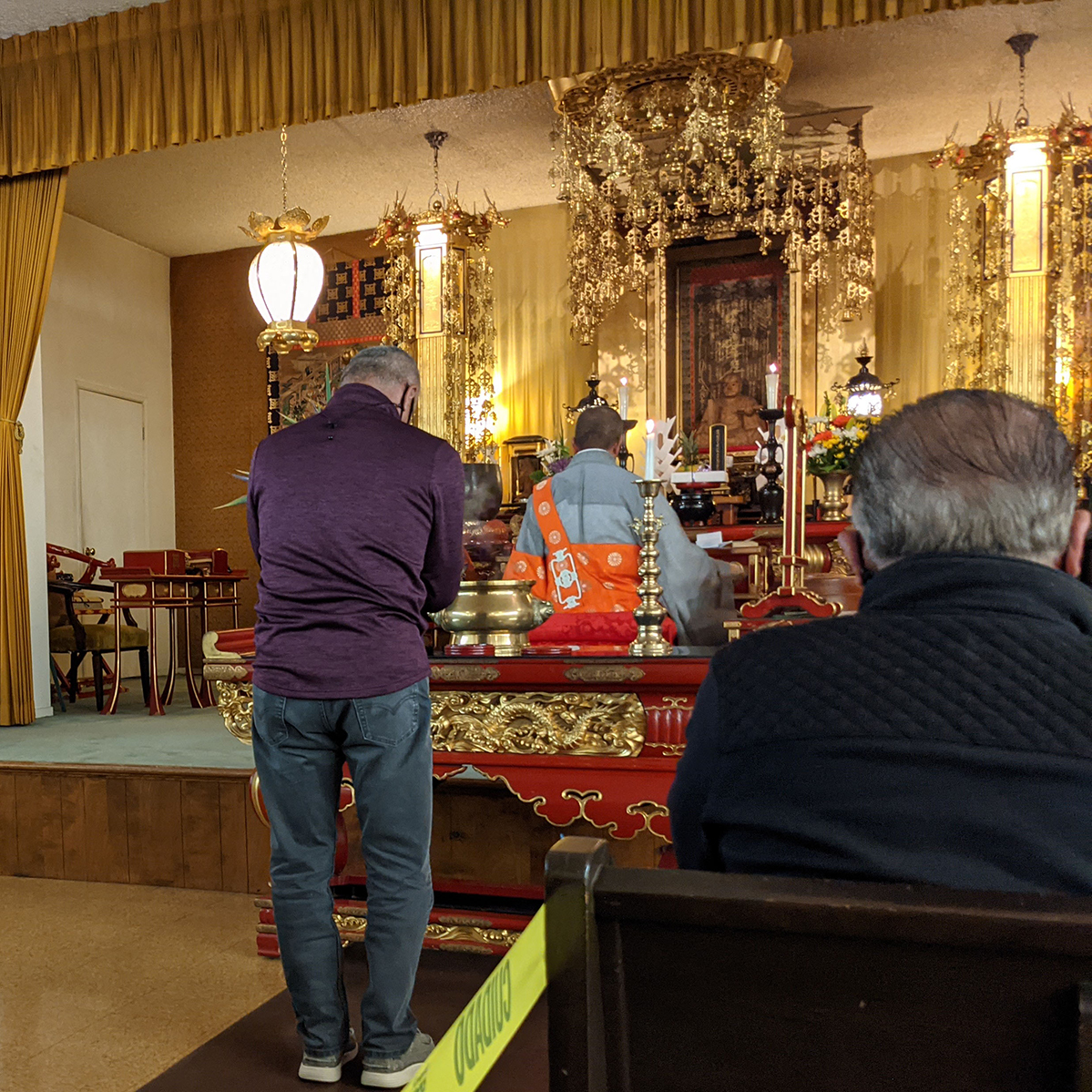
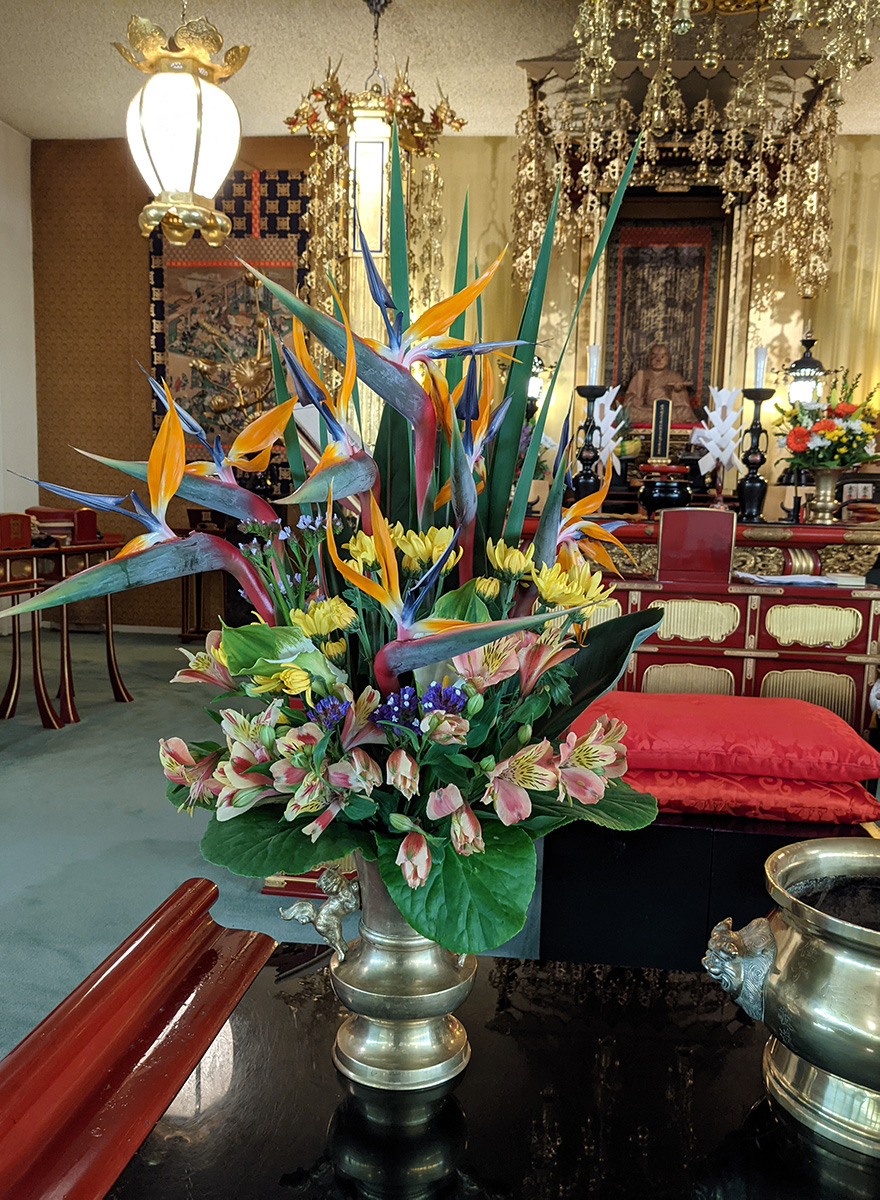
Note: This is an edited transcription of a recording from Ven. Kenjo Igarashi’s sermon following the Ohigan ceremony March 28, 2021. For some reason I can’t explain I didn’t publish this then and now I can’t see any reason not to post it late. While I’m posting this April 3, 2021, it will appear in my timeline March 28, 2021.
Spring Paramita service
Time to sew the seed of Buddhahood in our minds. All the time we need practicing during Higan week.
Everyone wonders why we are born into this world, this suffering world. This world is not a happy world, not paradise. If you ask someone why, they will most likely say they do not know. But Nichiren Shonin said the answer is to become a Buddha. That’s why we are born into this world.
Everybody’s life is different because of their previous life. Maybe we’ve come back from hell, hungry spirits or animals or asura. Now we are living in this world. Maybe sometime someone comes back from heaven. That’s why everyone’s life is different. Everybody’s cause and condition is different.
We are born into this world because we need practicing. Then we become a Buddha and help other people. We are not born into this world to become rich people or famous people. We are just born into this world to become a Buddha.
While we are practicing the six paramitas during paramita week we also have to think about our ancestors, our deceased parents. This is a matter of filial piety.
American’s think filial piety is satisfied if we just buy something for our parents on their birthday or some anniversary. In Buddhism we teach three kinds of filial piety. Just giving presents to parents is the lowest grade of filial piety. Intermediate filial piety is to obey your parents’ wishes. The higher grade filial piety is our memorial prayers. When parents pass away we cannot perform the lessor forms of filial piety. That’s why Nichiren Shonin said, If parents pass away we have to consider the question: Where did they go? If they are in the suffering world we try to save their spirit to a more good realm. That’s why we practice for ourselves and our parents.
I’ve been thinking, Was I dutiful to my parents. When I was 20 years old I became a minister and left home. After studying and practicing I moved to the United States when I was 27 years old. I didn’t call my parents when I arrived in the United States. It was too expensive. Was I a dutiful to my parents? Now my parents have passed away and I pray for them every day, seeking to send them to a better realm. That is my filial piety.
Everybody should pray for their parents. That’s why we have Higan and Obon to pray for deceased parents. They are waiting for your chanting and accept it and go to better realm and become a Buddha and never come back to the suffering world.
This is the teaching of Buddhism and Nichiren Shonin. That’s why we are born into this world — to become a Buddha.
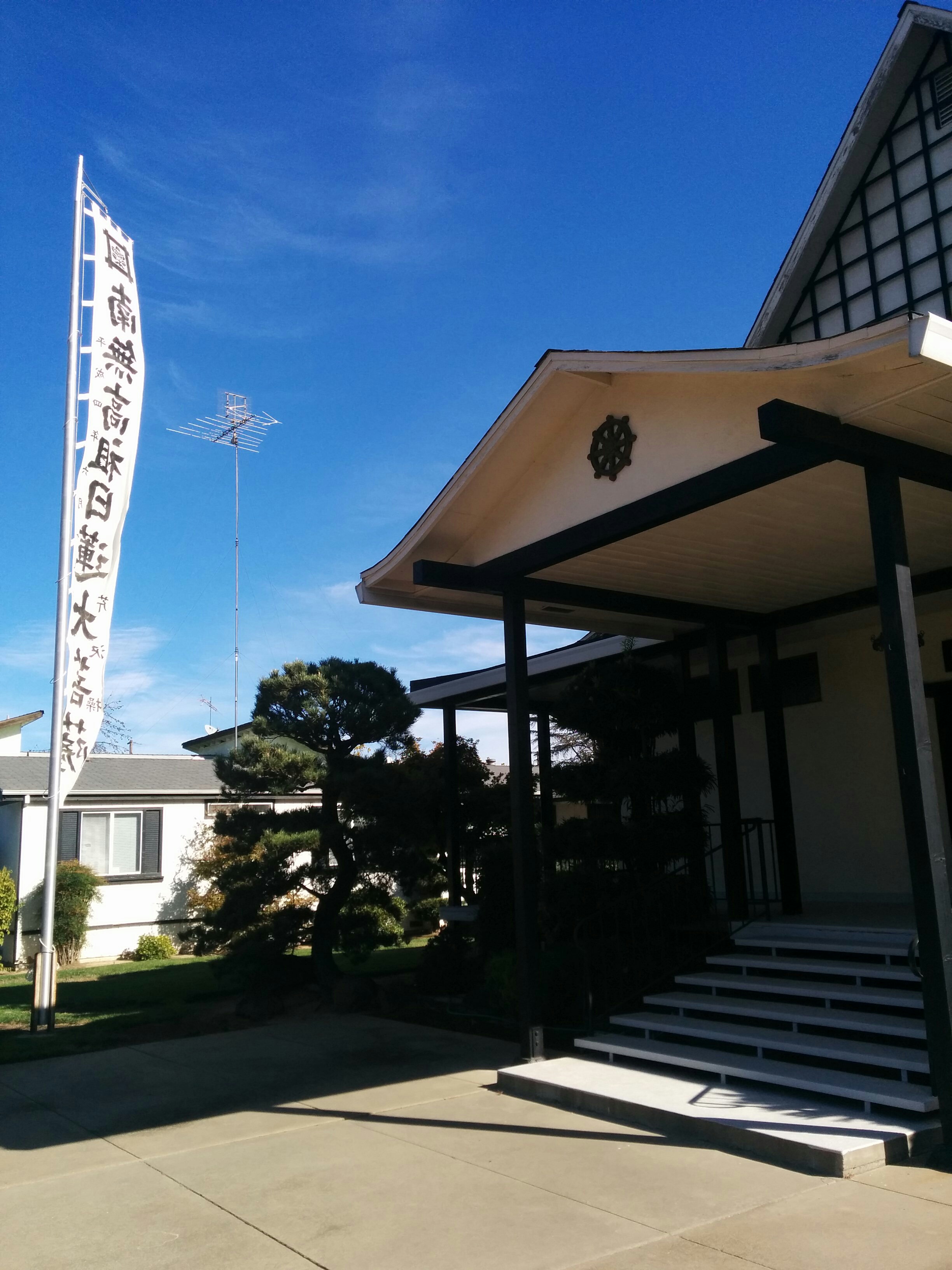
Missing from the Spring Higan service was the banner that always flies for special services. Rev. Igarashi said he did not fly the banner for Spring Higan for fear that the Chinese calligraphy might provoke anti-Asian problems. “I don’t want anybody to fool around with the banner so that is why he did not put up the banner this time,” he said.
Energy: Powered by Desire
Six Perfections: Buddhism & the Cultivation of Character, p 156-157Desire is the basis of motivation. It is the source of our energy. Without wanting something enough to motivate our will and energize our action, we are unlikely to pursue or get it. Imagine what it would be to eliminate all desire while still living a human life. Without desires we would be inactive and impotent. Lacking ambition, we would be without purposes and plans. Existing in so dispassionate a way that we desire nothing, we would be indifferent to any outcome; we would not care—about anything. Apathetic, that is, lacking pathos and passion, we would be devoid of feelings of any kind as well as the activities and spiritedness that follow from them. Although it is no doubt true that there have been a few aspirants who have understood the Buddha’s enlightenment to be a state of complete desirelessness, this is not the image of the compassionate and energized bodhisattva that we are likely to imagine and admire. A richer and more complete conception of Buddhist enlightenment encompasses and elevates desire rather than rejecting it. …
Those skilled in practices of mindfulness and in the discipline of character know how to assess desires. They consciously evaluate and rank desires, and when some of them are out of accord with chosen purposes—a “thought of enlightenment”—they also know how to extinguish them. Keeping these points in mind, we can still say, in the spirit of traditional forms of Buddhism, that the bodhisattva’s wisdom arises from having eliminated desires, as long as what we mean by that is that enlightenment is incompatible with many of our immature, uncultivated desires. Immature desires—based on a narrow self-understanding—are eliminated in the process of enlarging the sense we have of ourselves to encompass aspects of the world or ourselves previously beyond incorporation. Our very best desires, however—those honed by compassionate elevation of vision—need to be cultivated and maintained. Desire of this kind fuels our energy; it propels our most capacious vision.