All posts by John Hughes

The Manifestation of the Lotus Sūtra

QUESTION: In the second chapter of the Lotus Sūtra, fascicle 1, “Expedients, it is preached, “All phenomena as ultimate reality” means the principle into which all existing things: their appearances, natures, entities, powers, activities, primary causes, environmental causes, effects, rewards and retributions all from the beginning to end are united in one.” What does this mean?

ANSWER: It means that the whole world is divided into ten realms from the bottom of hell to the top of Buddhas and everything in the ten realms without exception is the manifestation of the Lotus Sūtra.

Shohō Jisso-shō, Treatise on All Phenomena as Ultimate Reality, Writings of Nichiren Shōnin, Faith and Practice, Volume 4, Page 74-75

Daily Dharma – Mar. 28, 2021

All living beings are suffering.
Being blind, they have no leader.
They do not know how to stop suffering,
Or that they should seek emancipation.
In the long night fewer people go to heaven,
And more people go to the evil regions.
They go from darkness to darkness, and do not hear
Of the names of the Buddhas.

The children of Great-Universal-Wisdom-Excellence Buddha proclaim this to their father in a story told by Śākyamuni Buddha in Chapter Seven of the Lotus Sūtra. They understand that when beings are so preoccupied with their own happiness, and so convinced that this happiness comes from what they can acquire, that they need an enlightened being to lead them to see the world as it is. With the Lotus Sūtra as the embodiment of the Buddha’s highest teaching, we have the same wisdom present to us as those children’s father was to them.

The Daily Dharma is produced by the Lexington Nichiren Buddhist Community. To subscribe to the daily emails, visit zenzaizenzai.com

Another Innumerable Day Before Day 1

Having last month considered the fifth of the 10 Beneficial Effects of the Sutra of Innumerable Meaning, we consider the sixth beneficial effect:

“Sixth, this sutra’s unimaginable power for beneficial effect is this: Whether during or after the lifetime of a buddha, if men and women of good intent accept, keep faith with, and internalize and recite this sutra, although they themselves may have delusive worldly passions they nevertheless will expound the teachings for living beings, enabling them to overcome delusive worldly passions and the cycle of births and deaths and put an end to all suffering. Living beings that practice after hearing them will grasp the Dharma, attain its fruits, and realize the Way no differently than if they were with the buddha tathāgatas. Suppose there is a youthful and inexperienced prince. When the king, while traveling or due to ill health, entrusts this prince to manage the affairs of state, the prince, following the great king’s instructions, then leads the government officials and the various ministries, governing justly and properly according to the laws of the land. And all of the country’s citizens are at ease, following along in a manner no different than if it were the rule of the king. So it is also with the women and men of good intent who keep faith with this sutra, whether during or after the lifetime of a buddha. Even though unable to initially become steadfast in the stage of equanimity, these men and women of good intent, following the discourses given by the Buddha, expound the teachings and spread them far and wide. Living beings that practice wholeheartedly after hearing them will cast delusive worldly passions away, grasp the Dharma, attain its fruits, and realize the Way. O you of good intent! This is known as the inconceivable power of the sixth beneficial effect of this sutra.

Underscore although they themselves may have delusive worldly passions they nevertheless will expound the teachings for living beings.

Receiving the Same Merit Gained by Practicing the Six Pāramitā

During the month of March, I am publishing articles related to Higan, which occurs on the Spring and Fall Equinox and extends three days before and three days after to involve the six pāramitās.


The character Myō in the Myōhō Renge Kyō (Sūtra of the Lotus Flower of the Wonderful Dharma) was verified by the tongues of the two Buddhas (Śākyamuni and Many Treasures). The tongues of these two Buddhas are an eightfold double-blooming lotus flower. A wish-fulfilling gem, on top of this double-blooming lotus flower, is the character Myō. This wish-fulfilling gem, the character Myō, contains all the merits of Śākyamuni Buddha’s Six Paramita (the six kinds of practice by which He attained Buddhahood). In a previous life, Śākyamuni offered His own body to a hungry tiger and sacrificed His life to a hawk to save a dove (charity). When He was King Śrutasoma, he did not violate the Buddhist precepts even at the cost of his life (precepts). When he was Hermit Forbearance, he willingly endured the tortures of King Kālika cutting off his four limbs (forbearance). When he was Prince Dāna, he devoted his life to finding a wishfulfilling gem to save people (effort). When he was the Hermit Shōjari, he did not move until the eggs that a heron placed on his head hatched (meditation). And so on. Therefore, we in the Latter Age of Degeneration who simply believe in the Lotus Sūtra are able to receive the same merit gained by practicing the Six Pāramitā in full even if we haven’t performed any good deeds.

Nichimyō Shōnin Gosho, A Letter to Nichimyō Shōnin, Writings of Nichiren Shōnin, Followers II, Volume 7, Page 138-139

Teaching According to a Person’s Capacity

Venerable Śāripūtra tried to teach a smith the practice of meditating on a skeleton to realize the impurity of the body, and a laundryman the practice to obtain a stable mind by counting the number of breaths. His disciples, however, learned little about the Buddha’s teaching in 90 days. Instead, they cultivated wrong views and became icchantika, ones who have no goodness in their nature and, therefore, no possibility of becoming Buddhas. Then the Buddha taught the smith the practice of counting the number of breaths and the laundryman that of meditating on a skeleton, and they understood the teaching immediately. Even Śāriputra, who was reputed as the wisest man, made a mistake in teaching according to a person’s capacity. Needless to say, it is not easy for ignorant, ordinary, and unenlightened masters in the Latter Age of Degeneration to decipher a person’s capacity.

However, such an ordinary master, who cannot discern an individual’s capacity, should solely teach the Lotus Sūtra to his disciples.

Kyō Ki Ji Koku Shō, Treatise on the Teaching, Capacity, Time and Country, Writings of Nichiren Shōnin, Doctrine 3, Page 250

Daily Dharma – Mar. 27, 2021

Although I shall never enter into Nirvāṇa, I say to men of little virtue, ‘I shall pass away.’ I teach them with this expedient. Why is that? It is because, if they see me for a long time, they will not plant the roots of good, but become poor and base, and cling to the five desires so much that they will be caught in the nets of wrong views.

The Buddha gives this explanation in Chapter Sixteen of the Lotus Sutra. This Chapter is the first time he reveals himself as the Ever-Present Buddha who became enlightened in the far distant past and will continue to lead all beings to enlightenment into the far distant future. The Buddha uses the death of his physical body as an expedient so that those who take him for granted will make efforts to practice his teachings. When we practice the Wonderful Dharma of the Lotus Sūtra, then we learn to see the Buddha in ourselves and all beings.

The Daily Dharma is produced by the Lexington Nichiren Buddhist Community. To subscribe to the daily emails, visit zenzaizenzai.com
Between Day 32 and Day 1: Fattery, Deprecating Words, Duplicity, Defamation and Slander

Going through each of the senses and their karmic consequences – the sense faculty of sight, the sense faculty of hearing, the sense faculty of smell, the sense faculty of speech and the sense faculty of the body and mind – we continue with sense faculty of speech.

When the self-amendment process is completed, the practitioner must again internalize and recite the Great Vehicle sutras without laziness of body or mind. Through the power of the Great Vehicle, an ethereal voice will declare to the Dharma successor:

“You must now face the buddhas of the ten directions and praise and give voice to the Great Vehicle! Before the buddhas, relate your faults yourself! The buddha tathāgatas are your compassionate fathers. You must yourself declare the unwholesome and harmful karmic acts produced by your sense faculty of speech: ‘This sense faculty of speech musters characteristics of undesirable karma: lies, flattery, deprecating words, duplicity, defamation and slander, praise of wrong views, and use of useless words. In the manner of such many and multiple varieties and kinds of harmful karmic acts, it instigates conflicts and confusion and asserts that Dharma is not Dharma. I now amend myself of all impurities such as these!’ ”

After saying these words before the Heroes of the World, the practitioner must cast him- or herself upon the ground and universally pay homage to the buddhas of the ten directions. The practitioner must then kneel erectly on both knees, place palms together, and say:

“The troubles and faults of this tongue are innumerable and limitless! The thorns of harmful karmic causes grow from the sense faculty of speech. Estrangement from correct discourse on the Dharma begins with this tongue, and thus does this unwholesome tongue destroy seeds of beneficial effects. It forcefully discourses on many matters that have no meaning. Its praise of wrong views is like stoking their fires, thereby intensifying the flames that harm living beings. It is like something that poisons and brings death with no outward signs. The detrimental, adverse, dire consequence of all of this is to fall into bitter conditions for a hundred or a thousand kalpas. I sink into a great hell because of deceitful speech. I now take refuge in the buddhas of the southern direction and avow my very grave faults!”

When the practitioner effects this mindfulness, a voice will fill the air:

“There is a buddha in the southern direction whose name is Sandalwood Virtue. This buddha also has innumerable buddhas emanated from him, all of whom expound the Great Vehicle that destroys and eliminates impurities and faults. As for your impurities: you should now face the innumerable buddhas of the ten directions, the greatly compassionate World-honored Ones! Avow your very grave faults and sincerely amend yourself!”

In considering our speech, it is helpful to consider the promise of the Lotus Sutra as explained in the Oct. 29, 2020, Daily Dharma:

When they expound the Dharma to the great multitude with their tongues, they will be able to raise deep and wonderful voices, to cause their voices to reach the hearts of the great multitude so that the great multitude may be joyful and cheerful. Hearing their speeches given in good order by their deep and wonderful voices, Śakra, Brahman, and the other gods and goddesses will come and listen to them.

The Buddha declares these lines to Constant-Endeavor Bodhisattva in Chapter Nineteen of the Lotus Sūtra, describing those who keep the Lotus Sūtra. When we share the Buddha Dharma with others, it is as if the Buddha’s mind is finding voice in our words. It should then come as no surprise to us that beings of all dispositions will want to hear more of what the Buddha has taught us. When we “practice the sūtra with our bodies,” as Nichiren described, when we make this teaching a part of our lives, then we find the words we need to reach all beings and lead them to the Buddha’s enlightenment.

The Daily Dharma is produced by the Lexington Nichiren Buddhist Community. To subscribe to the daily emails, visit zenzaizenzai.com

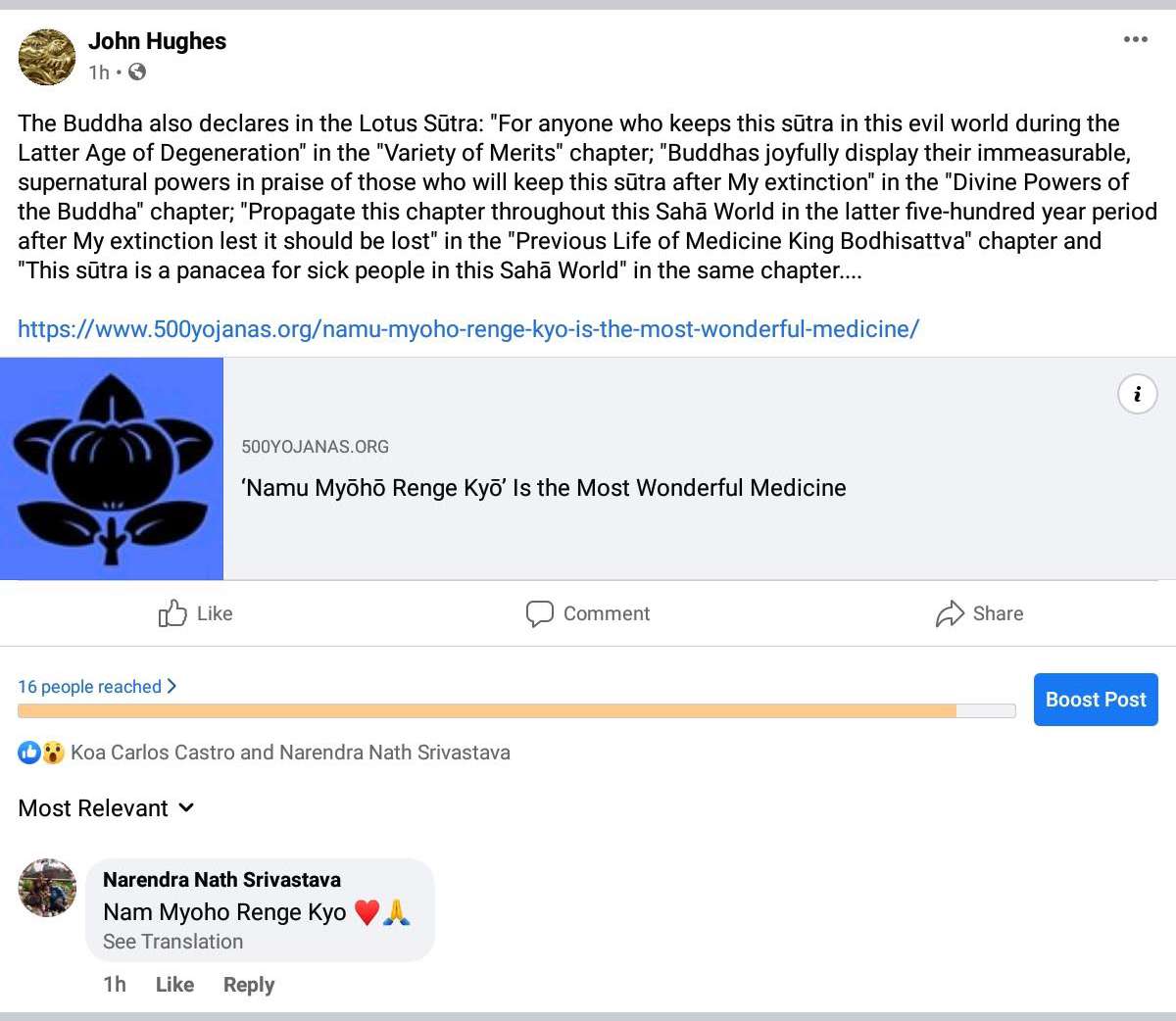
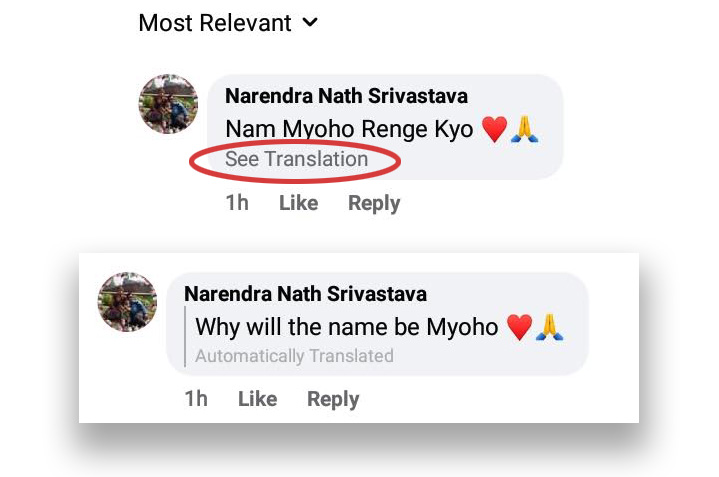
‘Why will the name be Myoho’

Facebook post and comment
Facebook translation
When I chant the Daimoku, I sometimes chant “Namu” and sometimes the “u” is unvoiced and it sounds like “Nam.” Doesn’t change the significance of my devotion to the Lotus Sutra with or without the “u.”

But when I write the Daimoku I always write “Namu,” because that’s how it’s spelled when you romanize the two Chinese characters Na and Mu.

In “The Journey on the Path to Righteousness,” the manual for the Shodaigyo practice, Namu is explained:

Namu, as is written, is the character expressing the direction south, but, in this case, it does not mean south, or residing in the south. Characters used in this manner are commonly referred to as non-characters because the meaning of the characters is considered inconsequential. Rather, in this case, this is the transliteration of the Sanskrit word “Namah,” and can be defined as devotion (Kimyo or Kie). Two common definitions for these are: “I ask of” and “I offer up my life to”.

Journey of the Path to Righteousness, p 24-25

I’m not criticizing Narendra. In fact, I sincerely thank him for reading my posts on Facebook and taking the time to comment.

If anyone deserves criticism it’s the publishing arm of Soka Gakkai, which insists on “Nam Myoho Renge Kyo.” “Nam” is a phonetic contraction of “Namu,” they explain. But this phonetic contraction only applies for the Daimoku.

For example, the Soka Gakkai translation of On Repaying Debts of Gratitude (page 733) has this sentence:

Because I, Nichiren, chant and spread Nam-myoho-renge-kyo, the power of Namu-Amida-butsu will be like a moon waning, a tide running out, grass withering in autumn and winter, or ice melting in the sun. Watch and see!

Why the inconsistency? Would chanting Nam-Amida-butsu be more effective?

For me, the question of writing “Namu” vs “Nam” gets to the meaning of the Daimoku.

Namu-myoho-renge-kyo means “Devotion to the Wonderful (myo) Dharma (ho) of the Lotus (ren) Flower (ge) Sutra (kyo).”

Nam-myoho-renge-kyo means “Why will the name be Myoho.” (See Google’s translation of Nichiren’s Nativity.)

Tolerance: Accepting Reality

Accepting the reality in which we stand, tolerant people do not indulge in moods of resentment; they do not waste energy resenting that things are as they are. In the grip of resentment, we falsify the world, refusing to face the reality that has come to be. Wise patience does not struggle in this way; it does not exhaust resources of mind and body wishing that things were other than they are. Resentment of the real undermines our best efforts to see what we face and to deal with it constructively. Ideally, the practices of tolerance and patience would release us from the grip of these agitations, freeing the mind to deal with the situation calmly and directly. Letting go of unhelpful distractions, we are in a much better position to participate thoughtfully and effectively in the world.

Six Perfections: Buddhism & the Cultivation of Character, p 121

‘Namu Myōhō Renge Kyō’ Is the Most Wonderful Medicine

The Buddha also declares in the Lotus Sūtra: “For anyone who keeps this sūtra in this evil world during the Latter Age of Degeneration” in the “Variety of Merits” chapter; “Buddhas joyfully display their immeasurable, supernatural powers in praise of those who will keep this sūtra after My extinction” in the “Divine Powers of the Buddha” chapter; “Propagate this chapter throughout this Sahā World in the latter five-hundred year period after My extinction lest it should be lost” in the “Previous Life of Medicine King Bodhisattva” chapter and “This sūtra is a panacea for sick people in this Sahā World” in the same chapter. The Buddha also states in the Nirvana Sūtra: “Suppose there are seven children, their parents love them all equally but care most for a sick child.” Icchantika and slanderers of the True Dharma are like the first and second children of the seven whom parents care most about. Of many illnesses, slandering the Lotus Sūtra is the most serious. Of many medicines, “Namu Myōhō Renge Kyō” is the most wonderful medicine.

Hokke Shuyō Shō, Treatise on the Essence of the Lotus Sūtra, Writings of Nichiren Shōnin, Doctrine 2, Page 212-213