All posts by John Hughes

Daily Dharma – Jan. 17, 2021

When they expound the scriptures of non-Buddhist schools, or give advice to the government, or teach the way to earn a livelihood, they will be able to be in accord with the right teachings of the Buddha.

The Buddha gives this explanation to Constant-Endeavor Bodhisattva in Chapter Nineteen of the Lotus Sūtra, describing those who keep the Lotus Sūtra. In this chapter, the Buddha shows that our practice of this Wonderful Dharma is not separate from our existence in this world. The purpose of the Buddha’s wisdom is not to escape to a better life, but to see our lives for what they are, and to use that clarity for the benefit of all beings.

The Daily Dharma is produced by the Lexington Nichiren Buddhist Community. To subscribe to the daily emails, visit zenzaizenzai.com

Day 32

Day 32 covers Chapter 28, The Encouragement of Universal-Sage Bodhisattva, closing the Eighth Volume of the Sutra of the Lotus Flower of the Wonderful Dharma.

Having last month greeted the arrival of Universal-Sage Bodhisattva, we consider the protection promised by Universal-Sage Bodhisattva.

Thereupon Universal-Sage Bodhisattva said to the Buddha:
“World-Honored One! If anyone keeps this sūtra in the defiled world in the later five hundred years after [your extinction], I will protect him so that he may be free from any trouble, that he may be peaceful, and that no one may take advantage [of his weak points]. Mara, his sons, his daughters, his subjects, his attendants, yakṣas, rākṣasas, kumbhāṇḍas, piśācakas, kṛtyas, pūtanas, vetādas or other living beings who trouble men shall not take advantage [of his weak points]. If anyone keeps, reads and recites this sūtra while he walks or stands, I will mount a kingly white elephant with six tusks, go to him together with great Bodhisattvas, show myself to rum, make offerings to him, protect him, and comfort him, because I wish to make offerings to the Sūtra of the Lotus Flower of the Wonderful Dharma. If he sits and thinks over this sūtra, I also will mount a kingly white elephant and appear before him. If he forgets a phrase or a gāthā of the Sūtra of the Lotus Flower of the Wonderful Dharma, I will remind him of it, and read and recite it with him so that he may be able to understand it. Anyone who keeps, reads and recites the Sūtra of the Lotus Flower of the Wonderful Dharma [after your extinction], will be able to see me with such joy that he will make more efforts. Because he sees me, he will be able to obtain samadhis and a set of dhārāṇis. The set of dhārāṇis will be the dhārāṇis by which he can memorize repetitions of teachings, the dhārāṇis by which he can memorize hundreds of thousands of billions of repetitions of teachings, and the dhārāṇis by which he can understand the expediency of the voice of the Dharma.

See The Work Ahead

The Work Ahead

[F]or the Dharma Flower Sutra one of the worst failings of human beings is an arrogance that leads to supposing that one has arrived at the truth and has no more to do. Anyone who truly wants to fulfill the Lotus Sutra and become a bodhisattva or buddha for others always has more to do. Followers of the Sutra refer to Shakyamuni Buddha as “Eternal Buddha Shakyamuni.” Some might misunderstand this appellation as meaning that the Buddha has arrived at his goal, is finished or perfect, and has no more to do. But in Chapter 16, which is entitled “Lifetime of the Tathagata” and is about the extremely long life of the Buddha, the Buddha says that he has been practicing the bodhisattva way, that is, helping others, for a fantastically long time – and that he is not yet finished. In other words, the long life of the Buddha, rather than being an indication that he has arrived at some static nirvana, indicates nearly the opposite – that he still has a lot of work to do. It follows, of course, that if the Buddha still has a lot of work to do, so do we. And, for that, we have to remain determined to be awakened.

The Stories of the Lotus Sutra, p302

Bowing as Meditation

When I bow and touch the Earth, I feel deep respect and deep love. I feel very grateful for all those bodhisattvas surrounding me who follow the example of Mañjuśrī, Avalokiteśvara, Samantabhadra, and all the other great bodhisattvas. Looking at the practice of bowing from the outside, we might get the impression that it is a simple devotional ritual or that it is like praying to a god. This is not true. While it is an expression of our respect and admiration for the Buddhas and bodhisattvas, bowing is not merely a practice of devotion. Breathing mindfully and bowing down to touch the Earth, we are in deep connection with the bodhisattvas and with the qualities they represent. Done in this spirit, bowing is actually a practice of meditation. We get in touch with understanding, compassion, and great action, and see all living beings as the object of our awareness and love. So in showing respect to these great bodhisattvas, we are also demonstrating our commitment to practice the bodhisattva path and cultivate the energy of understanding, love, and compassion within ourselves.

Peaceful Action, Open Heart, p229-230

What About Myself Do I Need to Change?

We do not know all of our past causes. We can only be certain of the life we live today. If we think of someone as only evil and of someone as being only a hindrance to our practice then we may very well miss an opportunity to grow and to repay our debts to others. If we set up a dynamic of the other person needing to be fixed, then we place ourselves above them and from that point we fail to see what in our own lives could be changed.

Instead of practicing Buddhism so that we can change everyone else to be the way we want them, we would be better served in saying, “What about myself do I need to change so that I can appreciate the other person as both a Buddha and someone who can teach me how to be a better person?” Viewing others as deficient only serves to foster disharmony and will not help to change our life.

Lecture on the Lotus Sutra

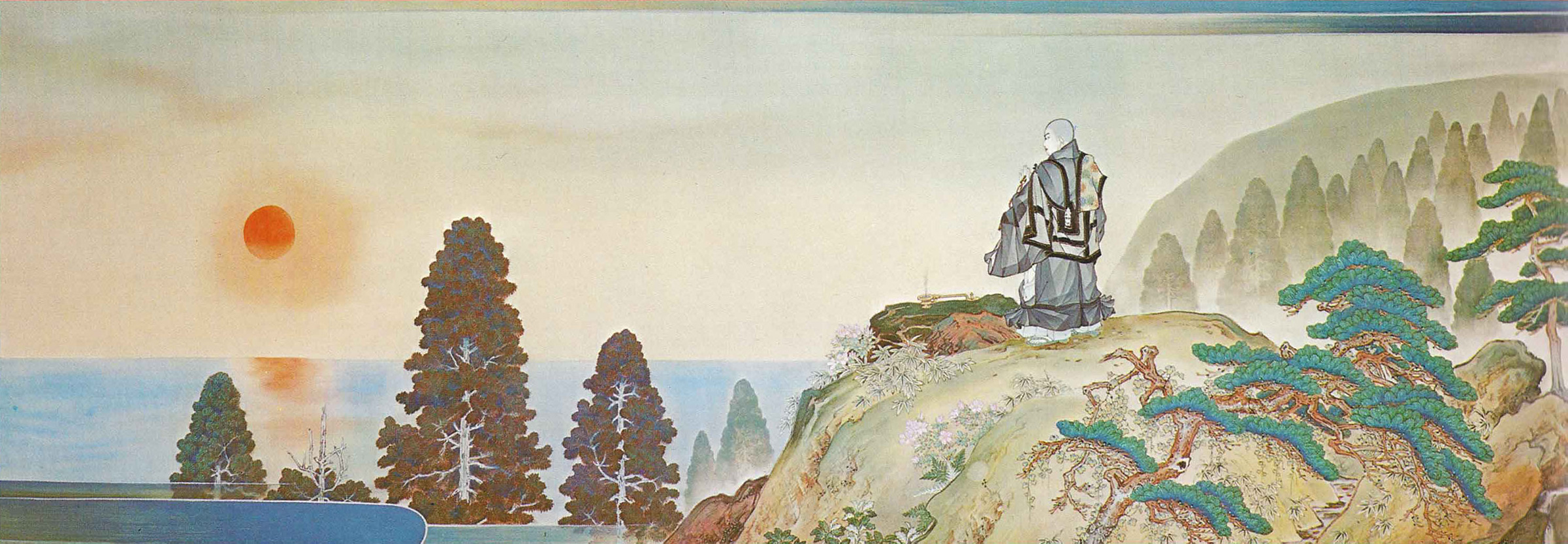
Life of Nichiren in Paintings

The photos used in the header for this website come from a booklet Pictorial life of Nichiren Shonin. You can view this booklet online here. Another copy of this booklet, which includes an explanation of the artwork technique, is available online here including a downloadable PDF copy of the booklet.

Daily Dharma – Jan. 16, 2021

You, the World-Honored One, are our leader.
You give peace to gods and men.
Hearing that you assured us of our future Buddhahood,
We are relieved and satisfied.

These verses are sung by Maha-Prajāpatī Bhikṣuṇī, Yaśodharā Bhikṣuṇī, and their attendants in Chapter Thirteen of the Lotus Sūtra. In our lives we have many desires, some of which we may not recognize. We believe that when these desires are met, only then can we be happy and peaceful. At the foundation of these desires is the desire for liberation. These women recognize that with this desire, just knowing that it will be fulfilled is enough to bring joy.

The Daily Dharma is produced by the Lexington Nichiren Buddhist Community. To subscribe to the daily emails, visit zenzaizenzai.com

The Basic Nichiren Shu Service v.2.0

service-guideIt occurred to be recently that my basic Nichiren Shu service guide that I created in August 2019 was missing several components and when I went to update it today I discovered that it was missing half of the prayer. (face palm emoji)

I have fixed the prayer and I’ve also added the Memorial Prayer that is included in the back of the Liturgy of Nichiren Shu booklet.

What I originally remembered missing was the readings from the Lotus Sutra. These short excerpts follow the recitation of Chapter 2 and Chapter 16, Hoben Pon and Ji Ga Ge. When I do this service, this is where I read that day’s portion of the Lotus Sutra. I completely forgot about the excerpts in the booklet. Those have now been added.

I have also included additional excerpts from Nichiren Shōnin’s writings. I should point out that the version of Shōho Jissō Shō I have been using is not the one in the booklet, but the version that’s in the Nichiren Buddhist Sangha of Greater New England’s Myoho Renge Kyo Romanized, which I use in the morning. All but one of the excerpts also appear in the A Phrase A Day booklet, where they include commentary by the priest who translated the excerpt.

Day 31

Day 31 covers Chapter 27, King Wonderful-Adornment as the Previous Life of a Bodhisattva.

Having last month considered what happened when the two sons asks their mother to go hear Cloud-Thunderpeal-Star-King-Flower-Wisdom Buddha, we consider what the two sons did to inspire their father to understand the Dharma by faith.

“Thereupon the two sons went up to the sky seven times as high as the tala-tree, and displayed various wonders because they were thinking of their father. They walked, stood, sat, and reclined in the sky. Then they issued water from the upper parts of their bodies, and fire from the lower parts. Then they issued water from the lower parts of their bodies, and fire from the upper parts. Then they became giants large enough to fill the sky, became dwarfs, and became giant again. Then they disappeared from the sky and suddenly appeared on the earth. Then they dived into the earth just as into water, and stepped on the surface of water just as on the earth. [Then they went up to the sky and stayed there.] By displaying these various wonders, they purified the mind of their father, that is, of the king, and caused him to understand the Dharma by faith.

“Seeing [these wonders displayed by] the supernatural powers of his sons, the father had the greatest joy that he had ever had. He joined his hands together towards his sons [staying in the sky], and said, ‘Who is your teacher? Whose disciples are you?’

“The two sons said, ‘Great King! Cloud-Thunderpeal-Star-King-Flower-Wisdom Buddha, who is now sitting on the seat of the Dharma under the Bodhi-tree of the seven treasures, is expounding the Sūtra of the Lotus Flower of the Wonderful Dharma to all the gods and men of the world. He is our teacher. We are his disciples.

“The father said to them, ‘I also wish to see your teacher. I will go with you.’

See The King and His Two Sons

The King and His Two Sons

So the King’s beliefs are different, perhaps even more “orthodox” than those of the sons, who have decided to follow the Buddha of that time. What should the sons do in such a case? Here they are urged by their mother to continue to respect and honor their father.

Buddhism does not reject family life as such. And yet, by setting up an alternative, celibate, monastic institution, traditional Buddhism did have and continues to have a problematic relation to families. But the Lotus Sutra says little about monastic rules and life as such, emphasizing the importance of life in the world being dedicated to the work, especially to the teaching work, of the Buddha. Thus, we can understand this story as saying that it is good if a whole family can devote itself to the Buddha Way.

The Stories of the Lotus Sutra, p286-287