
Peaceful Action, Open Heart, p227-228We often show our respect to the Buddha and bodhisattvas by bowing, but it is important to understand that this action is not a kind of propitiation, in which a devotee pays respect to a powerful divine being in order to gain favor. The Buddha does not need us to pay respect to him; it is we who benefit from this practice. When you pay respect to the Buddha, you begin to see the path. You start to walk in the direction of goodness. You know that you are a Buddha-to-be – you have the capacity to become enlightened, awakened. You recognize that you have the capacity to love, to accept, to feel joy and to bring joy to others.
When you bow to the Buddha you are really acknowledging your own capacity for Buddhahood. In acknowledging the Buddha, you acknowledge the Buddha nature inherent within you. This practice can help release you from a negative self-image that keeps you from realizing your true nature. If you don’t have this kind of confidence, you will not be able to progress very far on the path. When understood and practiced in this way, paying respect to the Buddha is not merely a devotional ritual but is also a wisdom practice.
All posts by John Hughes
Devadatta
Devadatta was a grandson of King Siṃhahanu, a son of King Dropodana who was an uncle of Śākyamuni Buddha, and an elder brother of Venerable Ānanda. His mother was a daughter of Suprabuddha. As a member of the Wheel-turning Noble King’s clan, Devadatta was a man of distinguished background in the continent of Jambudvīpa. Prior to entering the Buddhist Order, he lost to Prince Siddhārtha for the hand of Princess Yaśodharā and was possessed with the idea that Siddhārtha was his sworn enemy. After entering the priesthood, moreover, he was rebuked by the Buddha before a crowd of human and heavenly beings, “You are a fool who eats the saliva of other people.” Moreover, he greatly valued fame and satisfying desires and felt envious of the Buddha being regarded with such respect by people. Thus Devadatta practiced the five ways, pretending to be more venerable than the Buddha; branded the wheel of 1,000 spokes (one of the Buddha’s 32 physical characteristics) on the sole of his foot; collected fireflies to pretend that he, like the Buddha, had a white curl between the eyebrows; preached all the Buddhist teachings, said to be 60,000 or 80,000 in number, as if they all are his own; established a precept dais on Mt. Gayāśīrṣa to induce many disciples of the Buddha; and attempted to inject poison into the Buddha’s foot through his own toenail. Moreover, he beat Nun Utpalavarṇā to death, and threw a large stone causing the Buddha’s foot to bleed.
Thus, he committed the three rebellious sins (causing the Buddha’s body to bleed, causing disunity in the Buddhist order, and killing an arhat), and in the end gathered all the evils in all of India and caused harm to the Buddha and His disciples and donors. King Bimbisāra, the primary supporter of the Buddha, sent 500 vehicles filled with donations daily to the Buddha. Envious of this, Devadatta seduced Crown Prince Ajātaśatru to imprison the father king and finally crucified him with seven-foot-long nails. Because of such grave sins as these, Devadatta finally fell into the Hell of Incessant Suffering through the hole in the ground of the northern gate of the town of Rājagṛha. All the people in the whole world without exception witnessed this event, believing that Devadatta would never be able to come out of this hell even after having spent incalculable number of aeons (kalpa as many as the number of dust-particles of the great earth) there. Nevertheless, he was made to become the Heavenly King Buddha in the Lotus Sūtra. This is indeed inexplicable yet precious. If Devadatta does not become a Buddha, the numerous evil people who were induced by him to enter into the evil comradeship would never be able to escape the torment of the Hell of Incessant Suffering. It is solely due to the great favor of the Lotus Sūtra that all of Devadatta’s evil comrades too, are allowed to be Buddhas. Devadatta and his numerous followers, accordingly, will stay in the residences of those who practice the Lotus Sūtra. Thus, I feel we can count on them.
Kitō Shō, Treatise on Prayers, Writings of Nichiren Shōnin, Faith and Practice, Volume 4, Page 64-65
Daily Dharma – Jan. 15, 2021
Only I know his secret practices.
He shows himself
To all living beings
In the form of my eldest son.
The Buddha sings these verses in Chapter Nine of the Lotus Sūtra, speaking of Rāhula, the son born to him and his wife Yaśodharā before he left his life as a crown prince to seek enlightenment. In his highest teaching, the Buddha reminds us of our vows as Bodhisattvas to come into this world of conflict to benefit all beings. In the preoccupations that come with this life, we can forget these vows; they become a secret even to us. When we hear this Sūtra, we are reminded that we are the dear children of the Dharma, and that enlightenment is our rightful inheritance.
The Daily Dharma is produced by the Lexington Nichiren Buddhist Community. To subscribe to the daily emails, visit zenzaizenzai.com
Day 30
Day 30 covers all of Chapter 26, Dhāraṇīs
Having last month considered the dhārāni spells offered by Vaiśravaṇa Heavenly-King, we consider the dhārāni spells offered by World-Holding Heavenly-King.
Thereupon World-Holding Heavenly-King, accompanied by thousands of billions of nayutas of gandharvas who were surrounding him respectfully, came to the Buddha, joined his hands together, and said to him, “World-Honored One! I also will protect the keeper of the Sūtra of the Lotus Flower of the Wonderful Dharma with dhārānis, with divine spells.”
Then he uttered spells,” Akyanei (1), kyanei (2), kuri (3), kendari (4), sendari (5), matōgi (6), jōguri (7), furoshani (8), atchi (9).”
[He said to the Buddha:]
“World-Honored One! These dhārānis, these divine spells, have already been uttered by four thousand and two hundred million Buddhas. Those who attack and abuse this teacher of the Dharma should be considered to have attacked and abused those Buddhas.”
World-Holding Heavenly-King is represented on the Gohonzon in the upper right corner. He is also known as Dai Jikoku Tenno, or Dhrtarastra, or The Heavenly King of the East according to Senchu Murano’s The Gohonzon.
The Lotus World by Rev. Ryuei McCormick says:
The Flammarion Iconographic Guide: Buddhism describes Dhritarashtra as follows: “This guardian king governs in the east and presides over the spring. He is ‘He who maintains the kingdom (of the Law)’, ‘the maintainer of the state’ … He commands an army of celestial musicians (Gandharvas) and vampire demons (Pishacha).” The gandharvas are one of the eight kinds of supernatural beings who are said to revere and protect the Dharma; the pishachas are a type of hungry ghost.
According to the Kumarajiva translation of the Lotus Sutra, it is Dhritarashtra who offers dharanis in Chapter 26 for the benefit of those who keep the Lotus Sutra.
Practicing Filial Piety
Peaceful Action, Open Heart, p225In order to better understand [Chapter 27, King Wonderful-Adornment as the Previous Life of a Bodhisattva], we have to understand how Mahayana Buddhism became established as a viable religion in China. Chinese society was strongly influenced by the teachings of Confucianism, which especially upheld the importance of filial duty – the duty and reverence of children toward their parents and ancestors. This ideal has been one of the underpinnings of Chinese society and culture from the time of Confucius in the fifth century B.C.E. to the present day Given this cultural context, we can see that the Buddhist ideal of renunciation – leaving one’s home and family to become a monk or nun, a seeker of truth – would have been difficult to accept.
Someone who is practicing always has the capacity to return home in order to liberate their family from suffering. No one practices just for himself or herself alone. When followers of Confucianism condemned Buddhism as failing to practice filial piety, the practitioners had to prove the opposite, that in following the path of the Buddha they were also following the path of humanity and filial piety. In the story of bodhisattva Quan Am of the Southern Seas (written in Vietnamese Nom script), we have the following verse:
The suchness of the Buddha’s path is very wonderful, our heart is loyal with filial piety and the first thought we have is to look after humanity.
Filial piety is our aim to be able to liberate from suffering those who are close to us. Our humanity is our aim, to be able to rescue all living beings from drifting and sinking in the ocean of suffering.
Those Who Believe in the Lotus Sūtra
QUESTION: If anyone associates with a false teacher, despite his faith in the Lotus Sūtra, he will fall into the three evil realms, won’t he?
ANSWER: If anyone without comprehension of the Lotus Sūtra, meets with “evil friends” of expedient teachings and retreats from the true teaching, he will without fail fall into the three evil realms because of his sin of putting faith in the wicked teacher. Those who despised and persecuted Bodhisattva Never-Despising, for instance, fell into the Hell of Incessant Suffering, though faithful to expedient teachings. Those who had associated with the Lotus Sūtra at the time of the Great Universal Wisdom Buddha have been unenlightened for as long as 3,000 dust-particle kalpa because they had retreated from the Lotus Sūtra, believing in expedient teachings.
Those who believe in the Lotus Sūtra, however, except for abandoning their faith in the Lotus Sūtra and following the teacher of expedient teachings, will never fall into the three evil realms for committing sins in worldly matters. It is because such sins are not grave enough to upset the merits of the Lotus Sūtra.
Shugo Kokka-ron, Treatise on Protecting the Nation, Writings of Nichiren Shōnin, Doctrine 1, Page 66
Daily Dharma – Jan. 14, 2021
To sum up, all the teachings of the Tathāgata, all the unhindered, supernatural powers of the Tathāgata, all the treasury of the hidden core of the Tathāgata, and all the profound achievements of the Tathāgata are revealed and expounded explicitly in this sūtra. Therefore, keep, read, recite, expound and copy this sūtra, and act according to the teachings of it with all your hearts after my extinction!
The Buddha makes this declaration to Superior-Practice Bodhisattva (Jōgyo, Viśiṣṭacārītra) in Chapter Twenty-One of the Lotus Sūtra. In Chapter Two, the Buddha told those gathered to hear him teach that his highest teaching could not be attained by reasoning alone. These two passages show us faith to look beyond the words in this book to find the Buddha Dharma in every aspect of our lives, and the ever-present Buddha leading us all to enlightenment.
The Daily Dharma is produced by the Lexington Nichiren Buddhist Community. To subscribe to the daily emails, visit zenzaizenzai.com
Impeachment
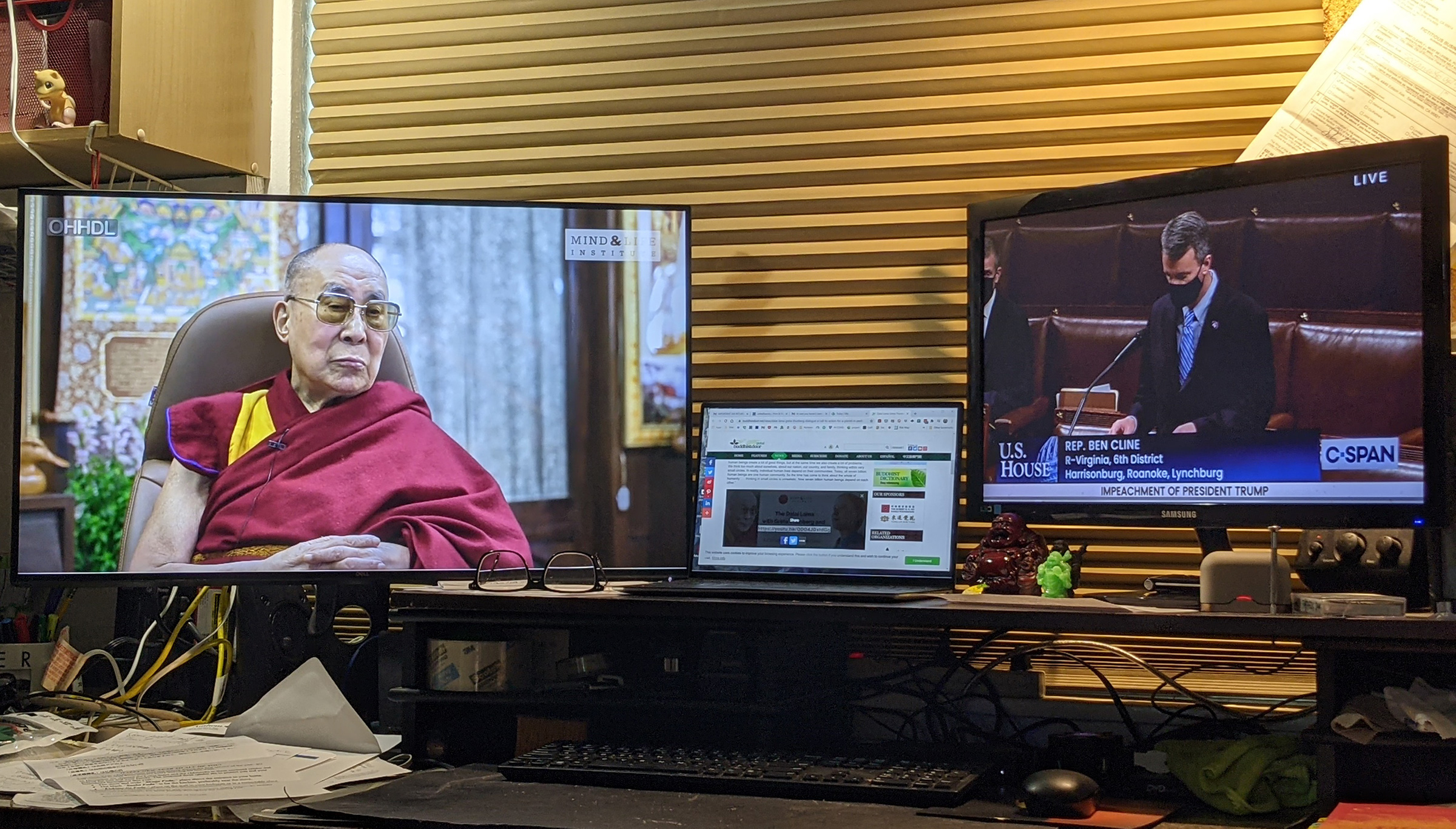
I think this picture of my home office desk today offers a suitable commentary on the day’s events.
While listening to the Impeachment debate in the U.S. House of Representatives I was browsing my newsfeed and came across an article in the online magazine Buddhistdoor entitled, Dalai Lama-Greta Thunberg Dialogue a Call to Action for a Planet in Peril. With the debate muted on one monitor, I called up the video from the January 9 online conference entitled, The Dalai Lama with Greta Thunberg and Leading Scientists: A Conversation on the Crisis of Climate Feedback Loops.
The crisis of a lawless president egging on his followers to storm the Capitol and disrupt the peaceful transfer of power is real. It is important, both here in the United States and around the world if unchecked. But what have we saved if we preserve democracy and fail to act to save the planet?
During last Sunday’s service broadcast from the Nichiren Buddhist Kannon Temple of Nevada, Rev. Shoda Kanai devoted his sermon to the topic of reaction to the invasion of the Capitol and the requirement that Buddhists, especially followers of the Lotus Sutra, never lose sight of the fact that everyone – Trumpers included – has the potential to become a Buddha. We should all be Never Despising Bodhisattva.
Impeaching and removing the president won’t save democracy if the causes and conditions that brought 74,222,593 men and women to support him are not addressed.
No, I don’t have an answer, but I do chant Namu Myōhō Renge Kyō as I try to be Never Despising Bodhisattva.
Day 29
Day 29 covers all of Chapter 25, The Universal Gate of World-Voice-Perceiver Bodhisattva.
Having last month considered in gāthās the many misfortunes for which World-Voice-Perceiver responds, we conclude Chapter 25, The Universal Gate of World-Voice-Perceiver Bodhisattva.World-Voice-Perceiver will save
All living beings from misfortunes
And from innumerable sufferings of the world
By the wonderful power of his wisdom.He has these supernatural powers.
He employs various expedients with his wisdom.
In the ten quarters there is no ksetra
In which he does not appear at all.Hell, the region of hungry spirits, and the region of animals,
That is the [three) evil regions will be eliminated.
The sufferings of birth, old age, disease and death
Will gradually be eliminated.He sees the truth of all things and their purity.
He sees all things with his great wisdom.
He sees all things with loving-kindness and compassion.
Think of him constantly! Look up at him constantly!All darkness is dispelled by the light of his wisdom
As spotless and as pure as the light of the sun.
The light destroys the dangers of wind and fire,
And illumines the whole world brightly.His precepts out of his loving-kindness brace us up as thunderbolts.
His wishes out of his compassion are as wonderful as large clouds.
He pours the rain of the Dharma as sweet as nectar,
And extinguishes the fire of illusions.Suppose you are in a law-court for a suit,
Or on a battlefield, and are seized with fear.
If you think of the power of World-Voice-Perceiver,
All your enemies will flee away.His wonderful voice [comes from] his perceiving the voice of the world.
It is like the voice of Brahman, like the sound of a tidal wave.
It excels all the other voices of the world.
Therefore, think of him constantly!Do not doubt him even at a moment’s thought!
The Pure Saint World-Voice-Perceiver is reliable
When you suffer, and when you are confronted
With the calamity of death.By all these merits, he sees
All living beings with his compassionate eyes.
The ocean of his accumulated merits is boundless.
Therefore, bow before him!Thereupon Earth-Holding Bodhisattva rose from his seat, proceeded to the Buddha, and said to him:
“World-Honored One! Those who hear of his supernatural powers by which he opened the universal gate without hindrance, and which are expounded in this chapter of World-Voice-Perceiver Bodhisattva, know this, will be able to obtain not a few merits.”
When the Buddha expounded this chapter of the Universal Gate, the eighty-four thousand living beings in the congregation began to aspire for the unparalleled Anuttara-samyak-saṃbodhi.
‘Lowland Buddhism’
The Stories of the Lotus Sutra, p281-282Another Chinese development in which Kwan-yin plays a unifying role is the common portrayal of her as being accompanied by, or served by, Sudhana and the dragon princess, a boy and a girl – one from the Avatamsaka Sutra, the other from the Lotus Sutra, two sutras which are closely associated with two different and rival schools of Buddhism.
All human beings, I believe, have both male and female qualities, but strict adherence to the ideas that all buddhas are male, and that nuns should always be subservient to monks, restricts access in both women and men to their female selves. By being a buddha who is both male and female, Kwan-yin provides a kind of balance to the overwhelmingly male-oriented weight of Buddhist tradition, enabling women to appreciate their value and men to appreciate the woman often hidden in themselves.
Kwan-yin, I have said on many occasions, represents a kind of “lowland Buddhism.” By this I mean that in contrast to those who would see religions as a matter of climbing to a mountaintop to enjoy some kind of “peak experience,” the Dharma Flower Sutra, especially as it is embodied in Kwan-yin, is a way that emphasizes the importance of being earthly, of being this-worldly, of being involved in relieving suffering. …
I believe that we should also be lowland Buddhists like Kwan-yin, seeking the low places, the valleys, even the earthy and dirty places, where people are suffering and in need. That is how we will meet the bodhisattva Kwan-shih-yin, at least if we are lucky or perceptive. That is where we will find those who hear and respond with compassion to the cries and sorrows of this world. They too are bodhisattvas of compassion, Kwan-shih-yin embodied.