
Peaceful Action, Open Heart, p216The title of Chapter 26 of the Lotus Sutra, “Dharani” means “holding fast to.” Dharanis are words or phrases that hold great powers of insight and transformation. Just by reciting a dharani mindfully, often repeated three times, we invoke the power of the syllables, the sacred sounds that are produced when our body, speech, and mind are in harmony, unified, in a state of samadhi. With the energy of concentration, the sound of a dharani can in and of itself bring about transformation.
The practice of reciting dharanis aims at reestablishing communication and understanding with the great beings, the Buddhas and bodhisattvas, in order to receive their spiritual energy. We do not walk the spiritual path alone; we walk in the footsteps of our teachers, friends, fellow practitioners, and all those who have practiced before us, our spiritual ancestors. So the practice of the dharanis is a Dharma door that opens up and allows us to receive the energy of those who support us in our practice.
All posts by John Hughes
Causing Joy
When we begin to think we have to be the cleverest person speaking, I think we have begun to shift from being heart-centered to being mind- and ego-centered. Our conversations about Buddhism are not about twisting someone’s mind or thinking to be in line with our own. That is not fully being respectful of the person to whom you are speaking. When it becomes your desire to outwit someone then it is creating a dynamic of powerover and not power-with. The Lotus Sutra replaces the powerover dynamic of a teacher who has all the answers but does not reveal them. The Lotus Sutra presents us with a power-with where the Buddha says here is everything you need to know to attain enlightenment equal to all Buddhas.
Our most effective strategy should be to determine how do we benefit and cause the person the most joy.
Lecture on the Lotus SutraInspiring a Soul into Portraits and Wooden Statues
[T]he “3,000 existences contained in one thought” doctrine is based on the three realms of existence: the realm of living beings, the realm of five components, and the realm of environment. Putting aside the first two realms for now, the third realm of environment includes trees and plants. The five colors of paint are made of trees and plants and therefore a portrait painted with colors of paint is made of trees and plants. Also, a wooden statue is made of wood. It is the power of the Lotus Sūtra that inspires a soul into these portraits and wooden statues. This is based on the “3,000 existences contained in one thought” doctrine perceived by Grand Master T’ien-t’ai. Applied to living beings, this doctrine means the “attainment of Buddhahood with one’s present body. ” Applied to the portraits and wooden statues, it means the “attainment of Buddhahood by trees and plants.”
Applauding the doctrine of T’ien-t’ai expounded in his Great Concentration and Insight, Grand Master Chang-an states, “The doctrine of ‘tranquility and contemplation’ has never been made as clear as this,” while Grand Master Miao-lê states in his Annotations on the Great Concentration and Insight, “Preaching that insentient beings such as trees and plants possess the Buddha-nature, T’ien-t’ai startled the people.” This doctrine of “3,000 existences contained in one thought” had never appeared before T’ien-t’ai nor was it to appear again. If it did appear later, it must have been plagiarized from his doctrine.
Shijō Kingo Shakabutsu Kuyō-ji, Opening the Eyes Service of Shijō Kingo’s Statue of Śākyamuni, Writings of Nichiren Shōnin, Volume 6, Followers I, Page 132
Daily Dharma – Jan. 11, 2021
But the merits to be given to the person who fills the one thousand million Sumeru-worlds with the seven treasures and offers that amount of the seven treasures to the Buddhas, to the Great Bodhisattvas, to the Pratyekabuddhas, and to the Arhats, are less than the merits to be given to the person who keeps even a single gāthā of four lines of this Sūtra of the Lotus Flower of the Wonderful Dharma.
The Buddha gives this explanation to Star-King-Flower Bodhisattva in Chapter Twenty-Three of the Lotus Sūtra. Generosity is the first of the perfections of a Bodhisattva, a being who vows to delay their own enlightenment so that they can benefit others. The offering of material goods helps remove the suffering caused by our sense of self-importance, and prepares us for the Buddha’s highest teaching. By offering the Buddha’s wisdom, embodied in this Lotus Sūtra, we benefit all beings.
The Daily Dharma is produced by the Lexington Nichiren Buddhist Community. To subscribe to the daily emails, visit zenzaizenzai.com
Day 26
Day 26 concludes Chapter 21, The Supernatural Powers of the Tathāgatas, includes Chapter 22, Transmission, and introduces Chapter 23, The Previous Life of Medicine-King Bodhisattva.
Having last month witnessed Śākyamuni Buddha’s transmission of the Dharma to the Bodhisattvas, we consider the reaction of the Bodhisattvas and conclude Chapter 22, Transmission.
Having heard these words of the Buddha, the Bodhisattva-mahāsattvas were filled with great joy. With more respect than ever, they bent forward, bowed, joined their hands together towards him, and said simultaneously. “We will do as you command. Certainly, World-Honored One! Do not worry!”
The Bodhisattva-mahāsattvas said simultaneously twice more, “We will do as you command. Certainly, World-Honored One! Do not worry!”
Thereupon Śākyamuni Buddha, wishing to send back to their home worlds [Many-Treasures Buddha and] the Buddhas of his replicas, who had come from the worlds of the ten quarters, said, “May the Buddhas be where they wish to be! May the stupa of Many-Treasures Buddha be where it was!”
Having heard these words of the Buddha, not only the innumerable Buddhas of his replicas, who had come from the worlds of the ten quarters and were sitting on the lion-like seats under the jeweled trees, Many-Treasures Buddha, and the great multitude of the innumerable, asaṃkhya Bodhisattvas, including Superior-Practice, but also the four kinds of devotees including Śāriputra and other Śrāvakas, and the gods, men and asuras of the world, had great joy.
Exemplars of the Dharma
The Stories of the Lotus Sutra, p235[W]hat is the job that needs to be done? The more general answer is that the Dharma needs to be widely shared – so, especially with the Buddha no longer able to do so directly, bodhisattvas are responsible for teaching, and thus perpetuating, Buddha Dharma. The Sutra is concerned not only with teaching the Dharma in the ordinary sense; it is concerned with having the Dharma be embodied, having it be a central part of the lives of people. Early in [Chapter 23], Shakyamuni Buddha says, “For incalculable hundreds of thousands of billions of eons, I have studied and practiced this rare Dharma of supreme awakening.” Notice that he says both “studied” and “practiced.” Practicing the Dharma goes beyond studying it to embody it in one’s life. Thus bodhisattvas have a responsibility not only of teaching the Dharma by words, but also by demonstrating and exemplifying it in their actions.
It is because of this role as exemplars of the Dharma that bodhisattvas, both mythical and human, can be models for us. Because they are said to have many marvelous powers, people may pray to a bodhisattva for relief from some kind of danger or suffering, but that is not the most useful way to understand our relationship to such bodhisattvas. They have been entrusted by the Buddha to be exemplars of the Dharma who in their very being can inspire us to follow our own bodhisattva ways. If various bodhisattvas have found skills and powers with which to help others, we too can develop skill in ways of helping others.
Reciting the Lotus Sutra in English
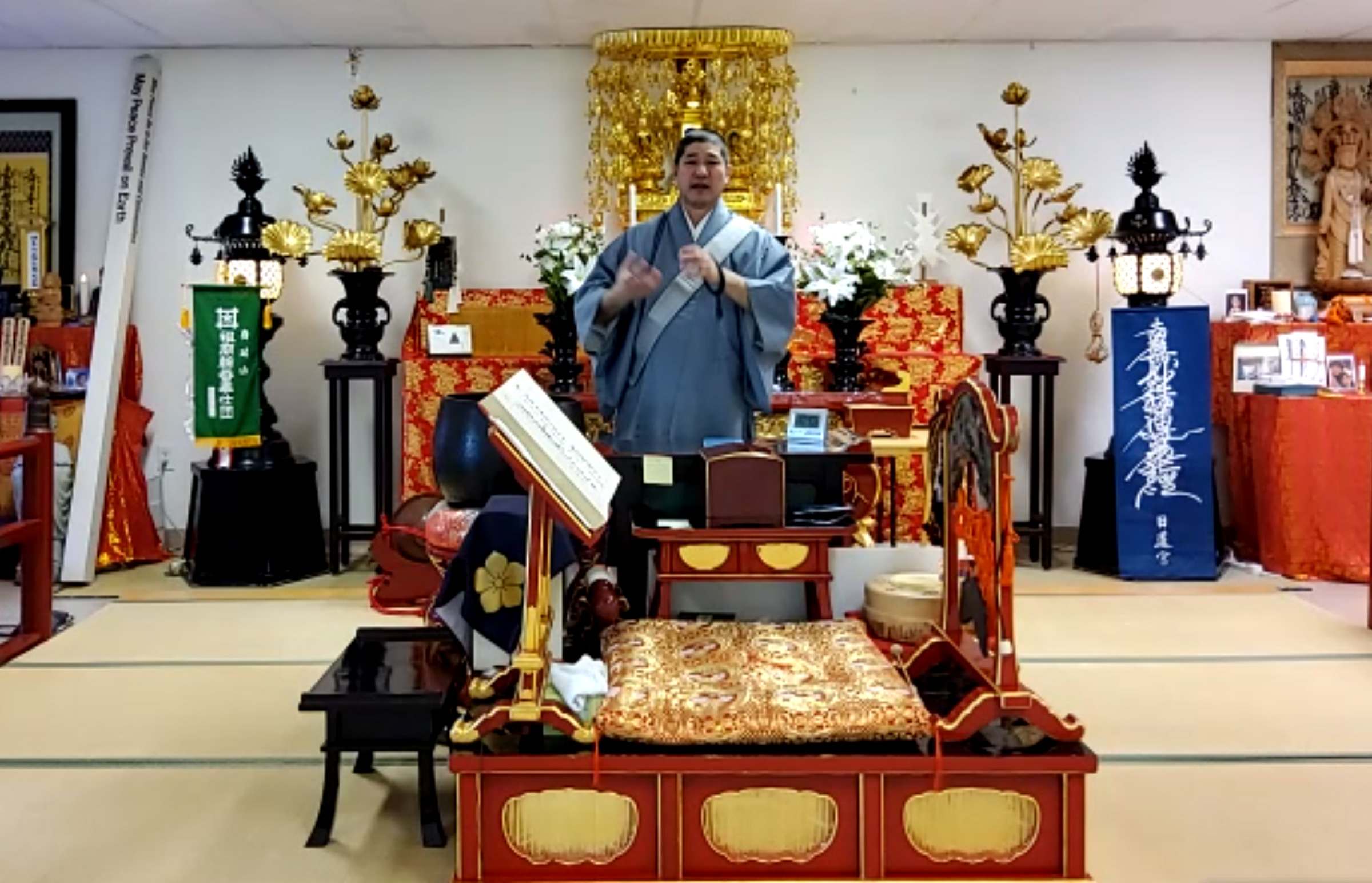
Today I attended the English language service at the Nichiren Buddhist Kannon Temple of Nevada. Prior to the start of the service Rev. Shoda Kanai explained that he doesn’t chant the sutra in English and instead reads the sutra, which he feels makes it more understandable.
I heartily endorse the idea of reading aloud the Lotus Sutra, which I have been doing daily since 2015.
When I explain my daily practice I point to the years when my son was an infant and I would read to him every night as he fell asleep. This is how I read the sutra aloud, imagining myself reading to my son.
English simply does not lend itself to the shindoku style of recitation. And besides, you have some great opportunities to embellish when reading to your child.
This month the Nichiren Buddhist Sangha of the Bay Area is discussing Chapter 3, which includes the Parable of the Burning House. This is my favorite chapter to embellish.
Consider the father’s warning to this children in the gāthās:
Or the children’s pestering of their father to get the promised toys:
And then there is my personal favorite, the Used Car Salesman and The Buddha Vehicle:
A Vast, Incalculable Ocean of Happiness
Peaceful Action, Open Heart, p199-200Fully endowed with all the merits,
His benevolent eye beholding the beings,
He is happiness accumulated, a sea incalculable.
For this reason one must bow one’s head to him.This is the concluding verse of [Chapter 25, The Universal Gate of World-Voice-Perceiver Bodhisattva]. The bodhisattva of compassion is equipped with all kinds of merits (sattva punya), acquired during countless lifetimes of manifesting understanding and compassion. He is able to regard all beings with love and compassion. I think this is the most beautiful sentence in the entire sutra: “The bodhisattva regards all beings with the eyes of love.” You too have the eyes of compassion and love. The Buddha eye has been transmitted to you. The question is whether you will choose to make use of those eyes to look deeply.
Looking deeply, listening carefully, you understand the suffering of the other person, you accept him or her, and naturally your love and compassion flow freely. This is the most beautiful practice, the most powerful method of bringing about transformation and healing. Happiness is not described here in terms of weights or measures, but as a vast, incalculable ocean.
The Actualization of Ichinen Sanzen.
Ichinen Sanzen, the theoretical expression of the interdependent nature of all reality, teaches that all states of life are constantly present in all phenomena and are subject to the law of cause and effect. Therefore, the state of Buddhahood is an ever-present possibility that requires the right cause and conditions in order to make itself fully known. The Three Great Secret Dharmas produce those causes and conditions, in that they are the signs of the Buddha-nature within our life and the means for attaining Buddhahood. For this reason, Nichiren Shonin regarded the Three Great Secret Dharmas as the actualization of Ichinen Sanzen.
Lotus SeedsGods Attesting to the Truth of the Lotus Sūtra
The ancient gods of India, China, and Japan also attended the assembly. Goddess Amaterasu, Great Bodhisattva Hachiman, and the gods of Kumano and Suzuka cannot dispute with the words that attest to the truth of the Lotus Sūtra. The Lotus Sūtra is supreme among all the scriptures of Buddhism. It is like a lion, the king of animals that run on the earth, and the eagle, the king of birds that fly in the sky.
Sennichi-ama Gozen Gohenji, A Reply to My Lady Nun Sennichi, Writings of Nichiren Shōnin, Faith and Practice, Volume 4, Page 146